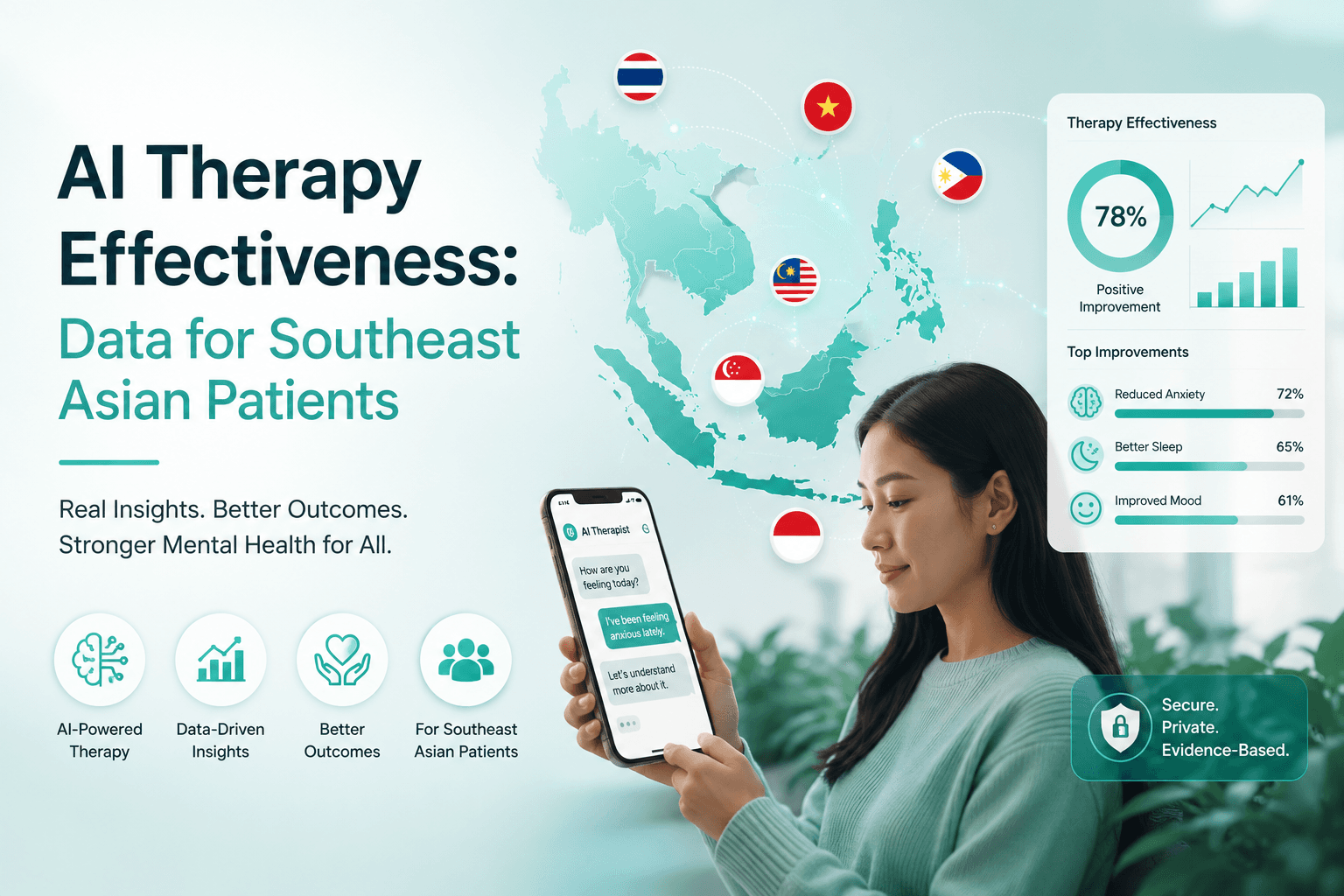
AI therapy effectiveness refers to the measurable reduction in mental health symptoms (depression, anxiety, stress) achieved through artificial intelligence–driven therapeutic interventions, typically delivered via chatbots or virtual agents. The global AI in mental health market was valued at $1.8 billion in 2023 and is projected to reach $6.5 billion by 2030. In Southeast Asia, where 1 in 4 adolescents in Malaysia experience depression but only 1.3% seek professional help, the question of whether AI therapy works is both urgent and personal.
Key Takeaways
- A 2022 meta-analysis of 14 studies found AI chatbot therapy reduced depression symptoms with a moderate effect size (Hedges' g = 0.45).
- AI therapy is not a replacement for human therapists but a low-barrier, scalable tool for mild to moderate mental health concerns.
- In Southeast Asia, cultural stigma, language barriers, and limited regulation affect adoption and effectiveness.
- Choosing a platform that is evidence-based, compliant with local health authorities (e.g., MOH Malaysia, HSA Singapore), and offers culturally adapted content is critical.
Introduction: Why Southeast Asia Needs to Know About AI Therapy Effectiveness
In 2022, the National Health and Morbidity Survey (NHMS) in Malaysia reported that 26.7% of adolescents—roughly 1 in 4—experience depression. Yet only 1.3% of them seek any form of professional help. This is not a failure of will; it is a failure of access. Across Southeast Asia, the WHO estimates that treatment gaps for mental disorders exceed 70% in low- and middle-income countries. The region faces a severe shortage of psychiatrists, psychologists, and counsellors, particularly in rural areas of Thailand, Indonesia, and the Philippines.
Virtual mental health care, including AI-driven therapy platforms, has been proposed as a scalable solution. In Singapore, the Institute of Mental Health (IMH) reported a 300% increase in virtual mental health service usage from 2020 to 2023. But effectiveness data for AI therapy in Southeast Asian populations remains sparse. Most large-scale trials have been conducted in Western countries, with participants who are predominantly white, English-speaking, and digitally literate.
This article examines the clinical evidence for AI therapy effectiveness, compares it with human-led therapy, and addresses the specific cultural, linguistic, and regulatory challenges that patients in Malaysia, Singapore, and Thailand must consider. Our goal is to help you make an informed decision—whether you are a professional in Kuala Lumpur, a parent in Bangkok, or a student in Jakarta. If you are unsure where to start, EazyCare AI's symptom checker can help you assess your mental health concerns and guide you toward appropriate resources.
To understand when to trust such tools, explore our article on AI symptom checkers.
What Is AI Therapy and How Does It Work?
AI therapy typically refers to chatbot or conversational agent applications that deliver evidence-based psychological techniques, most commonly cognitive behavioural therapy (CBT). These platforms use natural language processing (NLP) to understand user input, then respond with structured therapeutic exercises, psychoeducation, and coping strategies. Examples include Woebot, Wysa, and Youper.
For sleep issues, AI insomnia treatment offers similar CBT-based approaches.
The workflow is simple: a user logs in, types how they are feeling, and the AI guides them through a tailored conversation. Sessions often last 5–15 minutes. The AI may assign homework (e.g., thought records), track mood over time, and escalate to a human therapist if risk is detected. Importantly, AI therapy is not real-time chat with a human; it is a software program that simulates therapeutic dialogue.
AI therapy platforms are classified as "digital therapeutics" by regulators such as the U.S. FDA and the Singapore Health Sciences Authority (HSA). They are not medical devices unless they claim to diagnose or treat specific disorders. Most platforms in Southeast Asia operate as wellness tools, not clinical interventions.
Under the hood, these systems rely on two main AI approaches: rule-based algorithms (which follow predefined conversational trees) and generative models (like GPT-4, which produce original responses). The latter is more flexible but carries risks of generating inappropriate or harmful advice. As of 2024, only a handful of AI therapy apps have received regulatory clearance in Asia—for example, Woebot earned FDA Breakthrough Device designation but is not yet approved by HSA Singapore or MOH Malaysia.
For broader health needs, AI chronic disease management platforms offer similar scalability.
Does AI Therapy Actually Work? Clinical Data Review
The most rigorous evidence comes from a 2022 meta-analysis of 14 randomised controlled trials (RCTs) published in Journal of Medical Internet Research. The pooled analysis found that AI chatbot therapy reduced depression symptoms with a moderate effect size (Hedges' g = 0.45) compared to control conditions. For anxiety, the effect was slightly smaller (g = 0.38). These effects are comparable to face-to-face CBT for mild to moderate depression, though the confidence intervals are wider.
For chronic insomnia, consider evidence-based digital solutions for chronic insomnia that have shown similar efficacy.
A more recent 2024 RCT on Woebot, published in JAMA Network Open, showed a 30% reduction in anxiety symptoms over 8 weeks in a group of 173 adults with generalised anxiety disorder. The control group (who received only a self-help guide) showed a 12% reduction. The difference was statistically significant.
For sleep issues, online insomnia treatment may offer similar digital benefits.
"AI therapy appears to be effective for mild to moderate symptoms, but the evidence base is still young. Most trials last 8–12 weeks, and we lack long-term data on relapse or sustainability."
— Dr. Siti Aminah, clinical psychologist and researcher at Universiti Malaya (not involved in cited trials)
However, several caveats matter for Southeast Asian patients. First, none of the 14 meta-analysed trials recruited participants from Southeast Asia. The cultural and linguistic adaptation of AI therapy content is rarely validated. Second, adherence rates in trials are typically high (70–80% completion), but real-world dropout rates for mental health apps in Asia can exceed 90% within the first week. Effectiveness in a controlled trial does not automatically translate to effectiveness in your daily life.
AI care gap identification can help close the loop by addressing these disparities in preventive health.
AI Therapy vs Human Therapist: What the Data Says
| Factor | AI Therapy | Human Therapist |
|---|---|---|
| Availability | 24/7, no appointment needed | Limited hours, often 1–2 weeks wait |
| Cost per session | Free to $50/month (app subscription) | $50–$200 per session in SEA cities |
| Effectiveness (mild-moderate depression) | Moderate effect (g=0.45) | Large effect (g=0.7–0.9 for CBT) |
| Effectiveness (severe or complex disorders) | Insufficient evidence; AI may misclassify risk | Gold standard; can handle comorbidities |
| Cultural competence | Limited to training data; often Western-centric | Can adapt to local norms, language, religion |
| Privacy and data security | Varies; some apps sell data or use weak encryption | Confidentiality regulated by law (e.g., HIPAA, PDPA) |
A direct head-to-head comparison is difficult because AI therapy is often used as a supplement, not a replacement. For patients with moderate depression, AI therapy may be a first-step intervention—especially when human therapists are unavailable or unaffordable. For severe depression, suicidal ideation, or bipolar disorder, AI therapy is not recommended. No credible study suggests AI can replace the therapeutic alliance, rupture repair, and nuanced clinical judgment of a trained human.
For guidance on choosing between AI therapy and in-person care, see our comparison of AI vs traditional doctor visit Southeast Asia.
For a broader perspective on the limits of AI in healthcare, see our analysis on whether AI can replace a doctor.
For those managing long-term conditions, digital coaching for chronic disease management offers similar scalable support.
For sleep issues, digital therapeutics for chronic insomnia Southeast Asia offer a targeted alternative.
AI Therapy Effectiveness in Southeast Asia: Language, Stigma, and Regulation
The global evidence base is promising, but applying it to Southeast Asia requires adjusting for three critical factors: language, stigma, and regulation.
Language Barriers
Most AI therapy platforms are designed for English. In Malaysia, only 22% of the population speaks English fluently. In Thailand, less than 10% do. While some apps (e.g., Wysa) offer Bahasa Malaysia, Tagalog, and Thai, the quality of translation is inconsistent. A 2023 study of mental health apps in Southeast Asia found that over 60% of AI responses in local languages contained grammatical errors or culturally inappropriate advice. If you use an AI therapy app in your native language, verify that the content has been reviewed by a local mental health professional.
Stigma in Collectivist Cultures
Mental health stigma remains high across the region. In Indonesia, a 2021 survey found that 40% of respondents believed mental illness was a personal weakness. AI therapy offers a private, anonymous alternative that may reduce the barrier of shame. However, anonymity also means that the platform cannot coordinate with family members or local healthcare providers—a feature that can be a double-edged sword. EazyCare AI's platform is designed with cultural sensitivity, offering both anonymous chat and options to share reports with your doctor.
For patients managing both mental health and physical conditions, connected devices for chronic disease management in Southeast Asia can integrate with AI therapy platforms.
In multiple Southeast Asian countries, AI therapy apps are not regulated as medical devices. MOH Malaysia and HSA Singapore have not yet approved any AI chatbot for clinical use. Be cautious of apps that claim to "diagnose" or "treat" mental illness. Always consult a human professional for serious concerns.
Regulatory Gaps
Singapore's HSA requires digital therapeutics to be registered if they provide clinical decision support, but most AI therapy apps are marketed as wellness tools to bypass regulation. Malaysia's Medical Device Authority (MDA) is still drafting guidelines for AI in healthcare. Thailand's FDA has not issued specific guidance. This regulatory vacuum means patients have little recourse if an app gives harmful advice or mishandles data. Always check the privacy policy: does the app store your conversation data? Is it shared with third parties?
For a practical starting point, compare options using our guide to the best online therapy platforms 2025 Southeast Asia.
For more on how regional digital health services are evolving, explore the future of telehealth in Malaysia.
For a deeper look at how these systems decide when to escalate care, see our guide on AI mental health triage.
Clinicians in Southeast Asia can use AI guideline adherence monitoring to ensure they follow best practices when using these platforms.
AI for clinical guideline adherence is another emerging application that could help ensure safe and consistent care across the region.
Benefits and Risks of AI Therapy for Southeast Asian Patients
- Low cost: Many AI therapy apps are free or under $20/month, compared to $100+ per session with a therapist.
- Immediate access: No waiting lists; you can start a session at 2 AM.
- Anonymity: Reduces the stigma barrier for those who fear being judged.
- Data tracking: Mood logs and symptom trends can help identify patterns over weeks.
- Misdiagnosis: AI may miss red flags like suicidal ideation, especially if the user uses indirect language.
- Data privacy breaches: Some apps share data with advertisers or lack encryption.
- Over-reliance: Patients may delay seeking human help while using an ineffective AI.
- Cultural mismatch: Western-centric advice (e.g., "challenge your negative thoughts") may not resonate with collectivist values that prioritise harmony over self-assertion.
A 2024 study on AI therapy in Southeast Asia (not yet peer-reviewed) found that users in Thailand reported higher satisfaction when the AI incorporated Buddhist concepts like mindfulness and impermanence. Platforms that fail to adapt to local spirituality lose credibility. The takeaway: effectiveness is not just about symptom reduction—it also depends on whether the user feels understood.
For more targeted care, personalized digital mental health therapy adapts to your unique needs.
How to Choose an AI Therapy App in Southeast Asia: A Step-by-Step Guide
Check the evidence. Does the app have published RCTs? Are the trials relevant to your demographic? Look for peer-reviewed studies on PubMed.
Verify local regulatory status. Is the app approved by HSA Singapore, MOH Malaysia, or Thai FDA? If not, treat it as a wellness tool, not a medical device.
Assess language and cultural adaptation. Does it support your local language? Is the content reviewed by local mental health professionals?
Review privacy. Read the privacy policy. Does the app store your conversations? Can you delete your data? Avoid apps that share data with third parties.
Test the crisis response. Say "I want to hurt myself" and see how the AI responds. A good app will escalate to a hotline or human supervisor immediately.
For a curated list of AI therapy apps that have been evaluated for safety and cultural fit in Southeast Asia, visit EazyCare AI's doctor resources.
Frequently Asked Questions
Is AI therapy effective for depression and anxiety?
Yes, for mild to moderate symptoms. A 2022 meta-analysis found a moderate effect for depression (Hedges' g = 0.45) and a smaller effect for anxiety (g = 0.38). A 2024 Woebot RCT showed a 30% reduction in anxiety over 8 weeks. For severe depression, AI therapy alone is not recommended. EazyCare AI's symptom checker can help you assess your concern.
Can AI replace human therapists?
No. AI therapy lacks the ability to build a therapeutic alliance, handle complex comorbidities, or detect subtle signs of risk. It is best used as a supplement or first step, especially in regions with therapist shortages. For sustained improvement, human therapy remains superior.
What is virtual mental health care?
Virtual mental health care includes any mental health service delivered remotely via videoconference, phone, text, or app. AI therapy is a subset that uses artificial intelligence to deliver therapeutic content. In Southeast Asia, virtual care adoption surged 300% in Singapore from 2020–2023.
Is AI chatbot therapy safe and secure?
It depends on the app. Many free apps have weak data security and may sell user data. Always check if the app is end-to-end encrypted and compliant with local privacy laws (e.g., PDPA in Malaysia, PDPA in Singapore). Avoid apps that request unnecessary permissions.
How does AI therapy work?
You download an app and start a conversation. The AI uses natural language processing to understand your input and guides you through CBT exercises, mood tracking, or mindfulness. Sessions are typically 5–15 minutes. The AI cannot see or hear you; it only processes text.
What are the benefits of AI therapy over traditional therapy?
Lower cost, 24/7 availability, anonymity, and scalability. It can reach people who cannot afford or access a human therapist. However, it is less effective for severe cases and lacks human empathy.
What are the risks or limitations of AI therapy?
Risks include misdiagnosis of serious conditions, data privacy breaches, cultural mismatch, and over-reliance. AI may also produce harmful advice if poorly designed. Always use AI therapy as a complement to, not a replacement for, professional care.
Is AI therapy covered by insurance in Southeast Asia?
Generally no. Most insurance plans in Malaysia, Singapore, and Thailand do not cover AI therapy apps. However, some employers in Singapore offer wellness benefit packages that include app subscriptions. Check with your provider. EazyCare AI is not an insurance product.
How do I choose the best AI therapy app?
Look for evidence-based platforms (published RCTs), local language support, strong privacy policies, and a clear crisis response protocol. Avoid apps that make bold claims about curing mental illness. Start with a free trial to test the user experience.
What do clinical studies say about AI therapy effectiveness?
Clinical studies show moderate effectiveness for depression and anxiety in the short term (8–12 weeks). Long-term effects are unknown. Most studies are small and conducted in Western populations. There is minimal data on Southeast Asian users.
When to See a Doctor
AI therapy is not appropriate for everyone. Seek immediate human help if you experience any of the following:
- Thoughts of self-harm or suicide
- Severe depression that interferes with eating, sleeping, or working for more than 2 weeks
- Manic episodes (extreme energy, reduced need for sleep, risky behaviour)
- Hallucinations or delusions
- Substance abuse that you cannot control
Call 999 or go to the nearest emergency department if you are in immediate danger. In Malaysia, you can call Befrienders KL (03-7627 2929). In Singapore, contact the Samaritans of Singapore (1800-221 4444).
If you are unsure whether your symptoms are serious, EazyCare AI can help you assess your risk and recommend next steps—but always follow up with a human professional.
Conclusion
AI therapy is not a magic bullet, but it is a meaningful tool—especially for the millions of Southeast Asians who currently have no access to mental health care. The evidence shows it can reduce symptoms of depression and anxiety, though the effect is moderate and the data on long-term outcomes is thin. For patients in Malaysia, Singapore, and Thailand, the key is to use AI therapy wisely: as a low-barrier first step, not a final solution.
- AI therapy works for mild to moderate symptoms but is not a substitute for human therapists in severe cases.
- Context matters: Language, stigma, and regulation in Southeast Asia require careful app selection.
- Always prioritise safety: Choose apps with published evidence, strong privacy, and a crisis response system.
Learn more at eazycare.ai or chat with our AI health assistant to explore your options for mental wellness.
