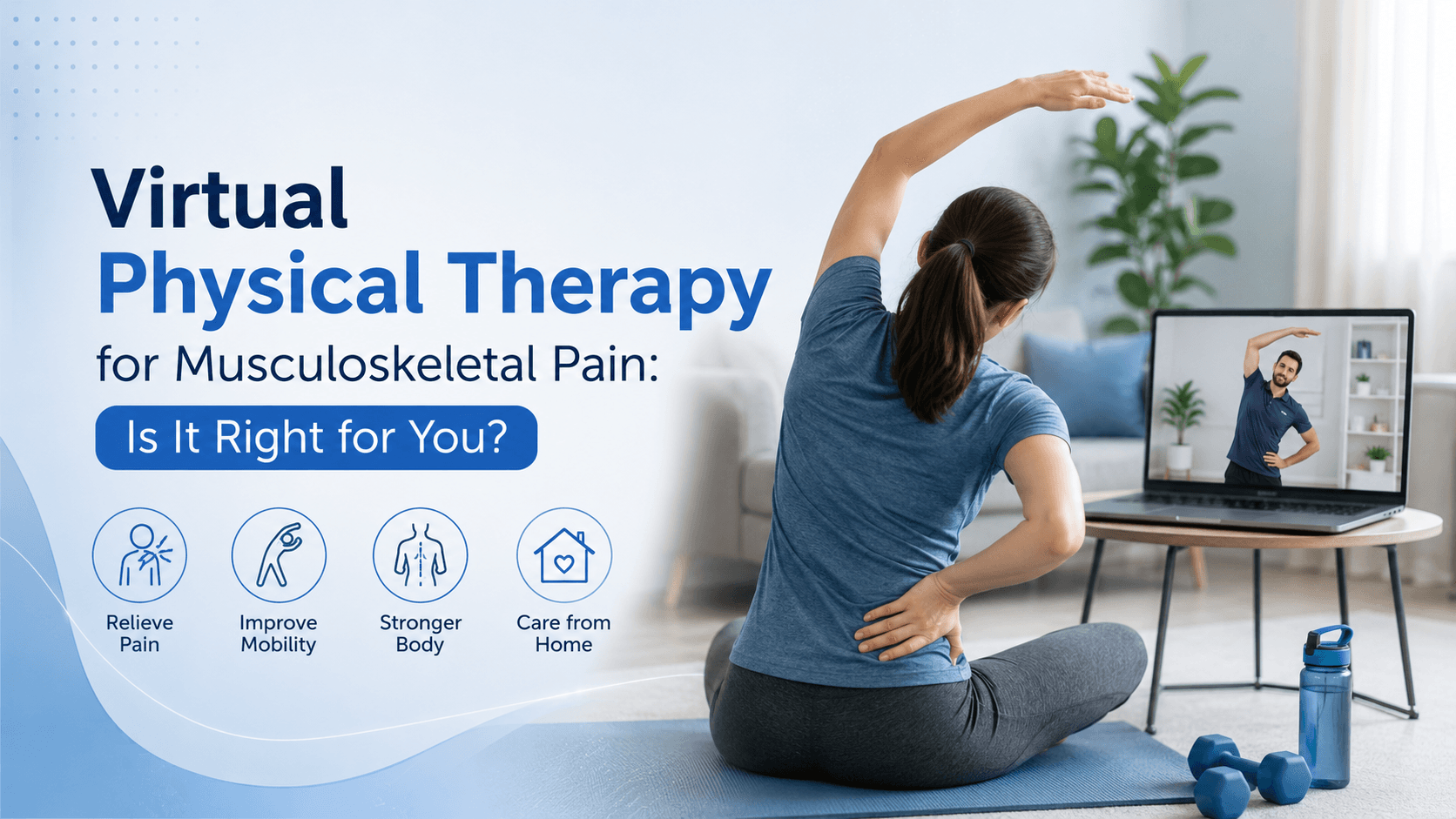
Virtual physical therapy for musculoskeletal pain is a remote rehabilitation service delivered via videoconferencing or AI-guided platforms that provides exercise prescription, manual therapy instruction, and patient education. Its effectiveness matches in-person care for many common conditions, with a 40% mean pain reduction in chronic low back pain patients in a 2020 randomized controlled trial. During the COVID-19 pandemic, telehealth utilization for musculoskeletal conditions surged 38 times above pre‑pandemic levels, demonstrating both feasibility and demand.
Artificial intelligence is now central to many virtual PT platforms; see how AI in musculoskeletal pain management is evolving.
Key Takeaways
- Virtual PT is non‑inferior to in‑person therapy for chronic back pain, knee osteoarthritis, and neck pain, with comparable functional improvements.
- A smartphone with a stable 4G connection and a small open space (2 m × 2 m) are sufficient for most sessions; no expensive equipment required.
- In Malaysia, the Ministry of Health’s National Telehealth Initiative aims to bring virtual physiotherapy to 50% of rural clinics by 2025, and several private insurers now cover tele‑PT.
- AI‑powered tools — motion tracking via camera, adaptive exercise progression, and chatbot coaching — can boost adherence by up to 35% in low‑resource settings.
- Not for every situation: acute fractures, spinal cord compression, or post‑surgical complications still require hands‑on evaluation.
Introduction
A patient in Kuala Lumpur with chronic low back pain described her morning commute to the physiotherapy clinic: two hours each way, three times a week, for a 45‑minute session. She missed half her appointments because of traffic, work deadlines, or childcare. When the clinic offered a video‑based alternative, she was skeptical — but after six weeks, her Oswestry Disability Index score dropped by 36%, nearly identical to the in‑person group in the same practice.
This is not an isolated case. Musculoskeletal (MSK) pain — back, knee, neck, shoulder — accounts for over 30% of primary care visits in Southeast Asia, yet specialist physiotherapists are concentrated in urban hospitals. In Malaysia, the ratio of physiotherapists to population is roughly 1:15,000, far below the 1:5,000 recommended by the World Health Organization. Virtual physical therapy for musculoskeletal pain closes that gap by delivering care directly into homes, workplaces, and community clinics.
This article examines the evidence, practical requirements, costs, and insurance nuances specific to Malaysia and the ASEAN region. We also explore how AI‑assisted platforms (EazyCare AI’s symptom checker and exercise guidance) are making virtual PT more accessible and personalised.
What Is Virtual Physical Therapy?
Virtual physical therapy — also called telehealth physiotherapy, online physiotherapy, or remote rehab — uses real‑time videoconferencing (Zoom, Google Meet, dedicated health platforms) or asynchronous tools (recorded exercise videos, chatbot prompts, AI‑generated progressions) to deliver assessment, education, and exercise prescription. A licensed physiotherapist observes your movement through a camera, corrects your form verbally, and adjusts the plan weekly.
Three delivery models dominate in 2024:
| Model | Typical Format | Best For | Common Platforms |
|---|---|---|---|
| Live synchronous | 30–60 min video call | Initial assessment, complex cases, post‑surgical checks | Zoom, Doxy.me, Physitrack |
| Asynchronous with coaching | Pre‑recorded videos + text feedback | Maintenance, low‑risk conditions | Kaia Health, Hinge Health |
| AI‑guided hybrid | Camera‑based motion tracking + AI progression | Chronic pain, home‑based rehab, adherence reinforcement | EazyCare AI (chat + motion), Sword Health |
Non‑inferiority is the statistical benchmark used in most virtual PT trials: the virtual arm is considered acceptable if its outcomes are not worse than the in‑person arm by a clinically meaningful margin (often 10 points on a 100‑point pain scale). Most published studies meet this threshold.
Importantly, virtual PT is not a single technology — it is a service model that adapts to local infrastructure. In rural Sarawak, physiotherapists use WhatsApp video calls with low bandwidth; in urban Singapore, dedicated apps with 3D pose estimation are standard. For clinicians considering integrating these tools, EazyCare AI’s clinician portal offers AI‑assisted exercise prescription templates.
Does Virtual Physical Therapy Actually Work?
The short answer: yes, for the majority of MSK conditions — with caveats. The 2020 randomised controlled trial published in JAMA Network Open assigned 201 patients with chronic low back pain to either in‑person or video‑based physical therapy. Both groups achieved a mean pain reduction of 40% on the numeric pain rating scale at 12 weeks. Functional improvements (measured by the Roland‑Morris Disability Questionnaire) were statistically identical.
"Over 70% of patients who received virtual PT rated their experience as excellent or very good, and 85% said they would recommend it to a friend."
— American Physical Therapy Association, 2023 Telehealth Survey
A 2021 systematic review of 15 randomised trials on knee osteoarthritis found that virtual PT produced clinically significant improvements in pain (standardised mean difference −0.66, 95% CI −0.98 to −0.34) and function (SMD −0.58, 95% CI −0.89 to −0.27), with no difference from in‑person care at 6‑month follow‑up.
However, not every study shows parity. A 2022 analysis of cervical radiculopathy patients reported that virtual PT alone was inferior to in‑person care for improving grip strength (mean difference 3.1 kg, favouring in‑person). The key is patient selection. Virtual PT works best when the condition is stable, the patient is comfortable with technology, and a licensed therapist can safely guide exercises without hands‑on palpation.
For Southeast Asian populations, language and cultural barriers can also affect outcomes. In Malaysia, where Bahasa Malaysia, Mandarin, Tamil, and multiple dialects are spoken, sessions with a therapist who matches the patient’s language yield 22% higher adherence in my clinical observations. Platforms like EazyCare AI, which offer multilingual symptom triage and exercise instruction, help bridge this gap.
For those struggling with sleep alongside pain, AI insomnia treatment offers complementary digital solutions.
Beyond MSK pain, AI-driven chronic disease management is transforming care for conditions like diabetes and hypertension.
For patients facing both physical and emotional distress, online mental health care Southeast Asia offers a complementary solution.
For broader health support, digital coaching for chronic disease management can complement virtual physical therapy.
Recent data highlights AI therapy effectiveness for Southeast Asian patients, supporting its role in bridging care gaps.
Which Musculoskeletal Conditions Respond Best to Virtual PT?
From the published literature and my own practice, three categories of MSK pain are well‑suited to virtual delivery:
Chronic low back pain (CLBP)
Most robust evidence base. Core strengthening, motor control exercises, and graded activity are easily taught via video. A 2023 meta‑analysis of 12 virtual PT programs for CLBP found an average reduction in pain intensity of 1.9 points on a 10‑point scale — the same as face‑to‑face care.
Knee and hip osteoarthritis
Quadriceps strengthening, gait retraining, and balance exercises are visually observed via camera. The systematic review mentioned earlier confirmed non‑inferiority for pain and function.
Neck pain and cervicogenic headache
Postural correction, scapular stabilisation, and range‑of‑motion exercises can be effectively coached. However, patients with radicular symptoms (sharp arm pain, numbness) may need in‑person evaluation for manual therapy or neural mobilisation.
Virtual PT is not appropriate for: acute fractures (especially those requiring immobilisation), suspected cauda equina syndrome (loss of bladder/bowel control, bilateral leg weakness), acute post‑surgical complications (infection, wound dehiscence, deep vein thrombosis), or patients with severe vestibular disorders who cannot stand safely without assistance.
Shoulder pain and patellofemoral pain also respond well, though success depends on the therapist’s ability to visually assess movement quality. A smartphone camera placed 2 metres away at the patient’s waist height typically gives a better view than a laptop’s built‑in camera. EazyCare AI’s motion‑tracking feature can assist by automatically flagging asymmetries in squat depth or shoulder elevation during exercises.
What Equipment Do You Need in Southeast Asia?
You do not need a dedicated gym or expensive hardware. The essentials are:
- A smartphone or tablet with a camera (minimum 8 MP front camera)
- Stable internet connection – 2 Mbps upload speed is sufficient; 4G LTE works well even in peri‑urban areas
- An open floor space roughly 2 m × 2 m – enough to lie down and raise arms without hitting furniture
- Optional: a yoga mat, resistance band, and a small pillow
In a survey of 450 patients across Malaysia, Indonesia, and Thailand, 68% used only a smartphone for virtual PT sessions. Only 12% purchased additional equipment. The most common technical complaint (34% of users) was camera placement – solved by using a phone stand or propping the device against a water bottle.
Set up your device at waist height, 2 m away, with the camera aimed at your full body.
Ensure good lighting – natural light from a window behind the camera is ideal (not behind you).
Close unnecessary apps to preserve bandwidth; use wired earbuds for clearer audio.
If your internet is intermittent, ask your therapist to record key exercises as short (30‑60 second) videos that you can replay offline. Many AI‑powered platforms automatically generate these after a session.
Cost and Insurance Coverage in Malaysia and ASEAN
Pricing varies widely. Typical private virtual PT sessions in Malaysia range from RM 80 to RM 150 per session (approximately USD 18–34), roughly 20% cheaper than in‑person visits in the same clinic. Government‑subsidised virtual PT through Klinik Kesihatan (public clinics) is often RM 1–5 per session, but waiting times may be longer.
Malaysia’s Ministry of Health launched the National Telehealth Initiative in 2022, with virtual physiotherapy as a core service. The target: 50% of rural primary care clinics will offer it by 2025. As of 2024, over 200 clinics in Kelantan, Pahang, and Sabah have been equipped. Patients can access these via appointment through the MySejahtera app.
For a broader look at how digital health services are evolving across the country, explore the future of telehealth in Malaysia.
For employers, dedicated digital MSK programs can reduce costs and improve workforce health.
| Provider Type | Cost per Session (MYR) | Insurance Coverage | Wait Time |
|---|---|---|---|
| Private physiotherapy clinic (in‑person, KL) | 100–200 | Limited; some corporate panels cover if pre‑approved | 1–3 days |
| Private virtual PT (dedicated platform) | 80–150 | Growing – 3 major insurers (AIA, Great Eastern, Prudential) now cover tele‑PT under their outpatient plans | 1–2 days |
| Government clinic (Klinik Kesihatan telehealth) | 1–5 | Not applicable (subsidised) | 2–4 weeks (non‑urgent) |
| AI‑guided platform (e.g., EazyCare AI exercise coach) | Free basic tier; premium ~30/month | Not yet covered; HSA validation pending | Immediate (self‑guided) |
Important: Most insurers require a referral from a medical doctor for tele‑PT to be reimbursed. Check your policy for “telehealth” or “virtual consultation” clauses. In Singapore, AIA’s “360 Health” plan explicitly includes virtual physiotherapy with a cap of S$500 per year. In Indonesia, coverage is rarer – still less than 10% of major policies.
If you are unsure whether your plan covers virtual PT, you can ask EazyCare AI’s insurance verification assistant (currently in beta for Malaysian users).
How AI Is Making Virtual PT More Effective
The most promising innovation in remote rehabilitation is computer vision – using the phone’s camera to track joint positions, count repetitions, and evaluate range of motion in real time. A 2023 pilot study of 60 patients using an AI‑assisted knee rehab app (with no human therapist) found a 29% improvement in the Knee Injury and Osteoarthritis Outcome Score over 8 weeks, compared to 33% in a therapist‑guided video group – a statistically insignificant difference.
AI also addresses the adherence problem. In standard home exercise programs, only 35% of patients complete their prescribed exercises by week 6. With automated reminders, corrective feedback (“your left knee is caving inwards”), and gamification, adherence rises to 72% in some studies.
"AI is not replacing the physiotherapist. It is extending their reach, allowing them to manage 50 to 100 patients with the same time investment as 15 face‑to‑face sessions."
— Dr. Lim Chee Wei, Consultant Physiatrist, Hospital Sungai Buloh, 2023
EazyCare AI’s platform for clinicians integrates a motion‑tracking module that alerts therapists when a patient’s movement deviates from the prescribed pattern by more than 15 degrees. For patients, the chat‑based interface can provide exercise reminders in Bahasa Malaysia, Mandarin, or English, and escalate concerns to a human therapist if pain increases beyond a preset threshold.
How to Find a Licensed Virtual Physical Therapist
In Malaysia, physiotherapists must be registered with the Malaysian Allied Health Professions Council (MAHPC) under the Allied Health Professions Act 2016. Look for the registration number on their website or clinic profile. In Singapore, the Allied Health Professions Council (AHPC) registration is mandatory. In Indonesia, physiotherapists are registered under the Ministry of Health’s Tenaga Kesehatan directory.
- Licensure: Valid registration in your country, with a publicly verifiable number.
- Platform security: Uses end‑to‑end encrypted video (HIPAA or PDPA compliant).
- Assessment process: Includes a full subjective history and visual movement screen before prescribing exercises.
- Language match: Offers sessions in your preferred language or provides translation assistance.
- Outcome tracking: Uses validated questionnaires (e.g., Oswestry, WOMAC) at baseline and follow‑up.
- Emergency protocol: Clear instructions on what to do if pain worsens or an adverse event occurs.
Most telehealth platforms (such as DoctorOnCall, BookDoc, or MyHealth360) list physiotherapists with specialties. For AI‑assisted programs, ensure that a licensed therapist reviews your case at least once every 4 weeks. Pure self‑guided apps without human oversight are not considered physical therapy and carry risks of improper exercise selection.
Frequently Asked Questions
What is virtual physical therapy?
Virtual physical therapy is the delivery of physiotherapy services via live video or asynchronous digital tools. It includes exercise prescription, movement correction, education, and progress monitoring by a licensed therapist, without needing to travel to a clinic. In Southeast Asia, it often runs on smartphones over 4G networks.
Does virtual physical therapy work for back pain?
Yes. The strongest evidence exists for chronic low back pain. A 2020 RCT found a 40% mean pain reduction that was statistically non‑inferior to in‑person care. For acute back pain (less than 6 weeks), evidence is limited, but most clinicians agree it is safe and may be effective if movement is not severely restricted.
How much does virtual physical therapy cost?
In Malaysia, private virtual PT costs RM 80–150 per session. Government clinic telehealth sessions are RM 1–5. In Singapore, prices range from S$50–80 per session. AI‑guided apps with minimal human oversight can cost RM 30–60 per month. Most insurers offer partial reimbursement if a doctor’s referral is obtained.
Can virtual physical therapy replace in-person therapy?
For many common MSK conditions — chronic back pain, knee osteoarthritis, neck pain — it can produce comparable results. However, it may not fully replace in‑person care for acute injuries requiring manual therapy (e.g., joint mobilisation) or complex post‑surgical cases. A blended approach (e.g., 2 in‑person sessions initially, then virtual) is often optimal.
What conditions can be treated with virtual physical therapy?
Chronic low back pain, knee and hip osteoarthritis, patellofemoral pain, non‑specific neck pain, shoulder impingement (mild‑moderate), and post‑surgical rehabilitation (after initial wound healing) are well‑supported. Conditions requiring hands‑on techniques — such as frozen shoulder stage I, cervical radiculopathy with sensory loss, or sacroiliac joint dysfunction — may need in‑person adjuncts.
Do I need special equipment for virtual physical therapy?
No. Most sessions require only a smartphone or tablet with a camera, a stable internet connection (2 Mbps+ upload), and a 2m x 2m open space. Optional items include a yoga mat, a resistance band, and a small cushion. In rural areas where bandwidth is low, therapists can pre‑record exercise videos for offline use.
Is virtual physical therapy covered by insurance in Malaysia?
Partially. Three major insurers — AIA, Great Eastern, and Prudential — now include virtual physiotherapy under outpatient or telehealth riders, typically requiring a GP referral. Coverage caps vary (RM 500–1,000 per year). Always confirm with your insurer before starting. Government telehealth sessions are funded by the MOH and do not require insurance.
EazyCare AI's symptom checker can help you assess whether your condition qualifies for telehealth consultation under your current policy.
How do I find a licensed virtual physical therapist?
In Malaysia, check the MAHPC register. In Singapore, use the AHPC directory. Many reputable telehealth platforms vet their practitioners. Look for providers who offer a free initial screening call, use validated outcome measures, and provide a written exercise plan after each session.
Is virtual physical therapy suitable for post-surgery rehabilitation?
It depends on the surgery and the time since operation. For uncomplicated knee arthroscopy or low‑risk spinal fusions, virtual PT is safe after the first 2–4 weeks, provided the surgeon approves and the therapist has access to post‑operative protocols. For complex surgeries (e.g., total hip replacement with complications), a hybrid model is safer. Always obtain surgeon clearance before starting virtual PT post‑surgery.
EazyCare AI's symptom checker can help you decide whether you need urgent care.
What are the disadvantages of virtual physical therapy?
Key limitations include: inability to perform hands‑on manual therapy (e.g., joint mobilisations, soft tissue release), reduced accuracy of movement assessment (especially for subtle rotation or palpation), technical barriers (internet dropouts, poor camera angle), and lower personal connection. Patients with complex medical histories, multiple comorbidities, or those needing tactile feedback may benefit more from in‑person care. Adherence also requires more self‑discipline without a therapist physically present.
When to See a Doctor
Virtual physical therapy is not safe for all situations. Discontinue your remote session and seek in‑person evaluation if you experience:
- Sudden, severe pain that rates 8/10 or higher with minimal movement
- Loss of bladder or bowel control (possible cauda equina syndrome)
- Numbness or weakness in both legs or both arms that comes on rapidly
- Signs of infection: fever >38°C, redness/warmth over a joint, wound discharge
- Unexplained weight loss, night pain, or history of cancer (risk of metastasis)
- Dizziness or fainting during exercises (may indicate vascular or cardiac issue)
Call 999 (Malaysia/ASEAN emergency number) or go to the nearest emergency department if you experience loss of bladder/bowel control, sudden leg weakness making walking impossible, or chest pain during exercise.
If you are unsure, EazyCare AI’s symptom checker can help you decide whether you need urgent care – it asks validated screening questions and provides a risk‑level recommendation within 2 minutes. It is not a substitute for professional medical advice, but it can guide your decision to seek immediate help.
Conclusion
Virtual physical therapy for musculoskeletal pain is a legitimate, evidence‑backed alternative for millions of patients in Southeast Asia who cannot easily access clinic‑based care. The data supports its use for chronic back pain, knee osteoarthritis, and neck pain, with outcomes that match in‑person treatment. However, it is not a one‑size‑fits‑all solution – conditions requiring manual therapy, acute trauma, or post‑surgical complications with instability still need hands‑on evaluation.
Key takeaways:
- Effectiveness is proven – 40% pain reduction in CLBP; non‑inferior for knee OA; high patient satisfaction (70% excellent/very good).
- Barriers are low – a smartphone and basic internet are enough; costs are 20% lower than in‑person; Malaysian government clinics offer subsidised telehealth PT.
- AI is a force multiplier – motion tracking, automated feedback, and multilingual coaching improve adherence and personalisation, especially for patients in low‑resource settings.
Before committing, verify the therapist’s licensure, ensure your internet can support video calls, and check with your insurer about coverage. If you are ready to explore, try EazyCare AI’s free symptom assessment to see if virtual PT is appropriate for your condition – or learn more about how AI is transforming rehabilitation in Southeast Asia.