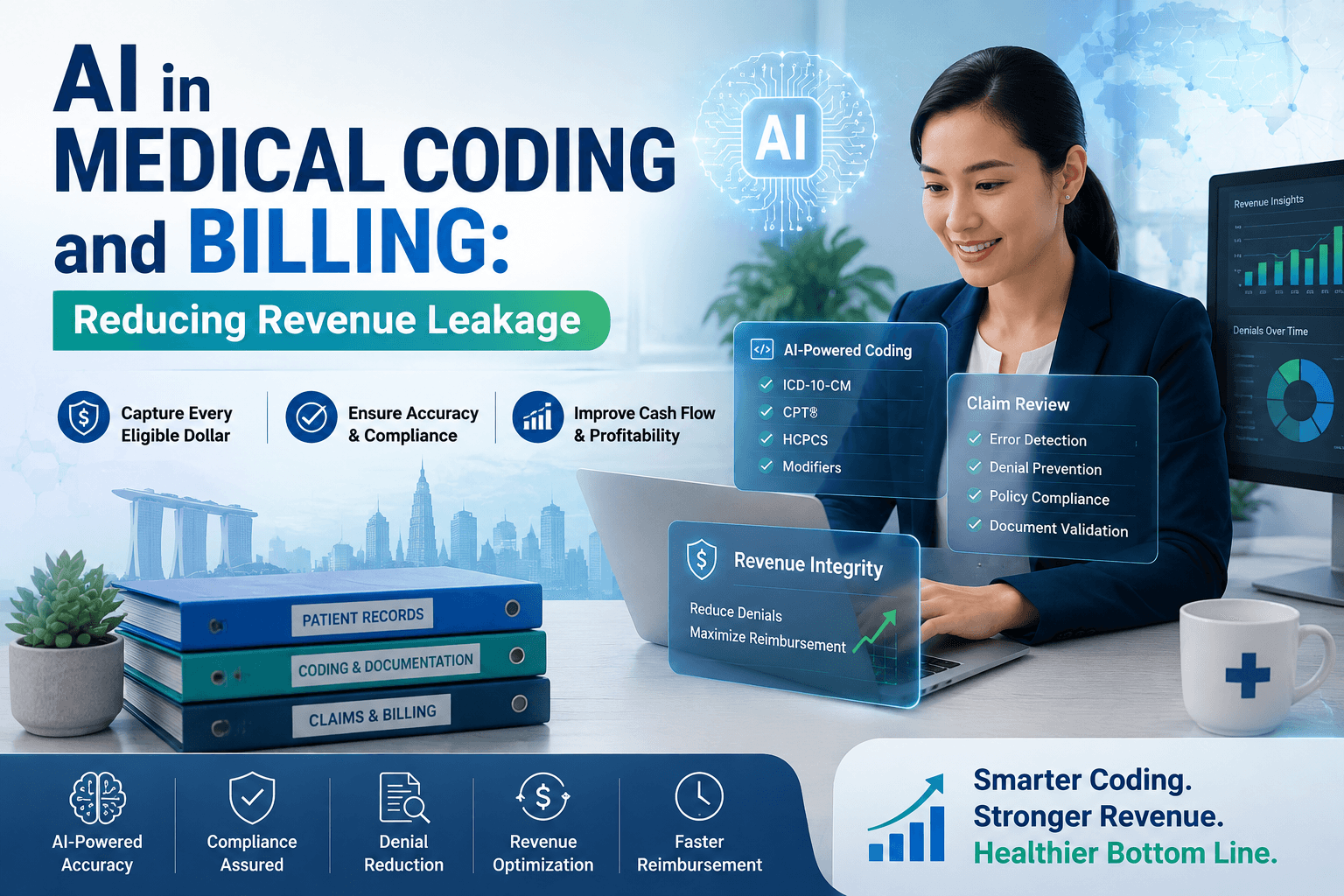
Revenue leakage in healthcare is the gap between what a provider should collect and what they actually receive, driven by inaccurate coding, denied claims, and missed billing opportunities. AI in medical coding and billing reduces this leakage by automating code assignment, catching errors in real time, and flagging underbilling. Hospitals using AI tools report 20–35% fewer claim denials and a 15–25% increase in first-pass clean claims within six months.
Key Takeaways
- Revenue leakage steals 5% to 10% of net annual revenue from healthcare providers globally—a loss that AI can cut by half or more.
- AI medical coding achieves 85–95% accuracy on structured data, reducing manual error rates from 8–15% to below 3%.
- Southeast Asian providers face unique challenges: fragmented coding standards, multilingual patient records, and nascent digital health platforms like Malaysia’s MyHealth.
- Implementing AI for medical coding requires investment of USD 30,000–150,000 for a mid-sized clinic, but ROI often exceeds 300% in two years through reduced denials and faster payments.
- Data privacy laws (e.g., Malaysia’s PDPA) and integration with national health systems are critical factors for successful deployment in the region.
Introduction
Picture a 200-bed private hospital in Kuala Lumpur: 12 full-time medical coders manually assign ICD-10 and CPT codes for 400 inpatient stays and 1,000 outpatient visits each week. Despite rigorous training, one in every twelve charts contains an error—an omission that triggers a denial from the insurer or a downcode from the national payor. Multiply that by 52 weeks, and the hospital loses RM 3.2 million (USD 680,000) in reimbursable revenue annually. This is not an edge case; it is the norm across Southeast Asia.
Revenue leakage is the silent tax on every healthcare system. According to a systematic review published in PubMed, coding and billing inaccuracies account for 5% to 10% of net annual revenue loss for hospitals and clinics worldwide. In Southeast Asia, where many providers operate on thin margins and insurance penetration is rising rapidly, every percentage point of leakage matters.
This article unpacks the mechanics of how AI in medical coding and billing reduces revenue leakage—from automated code suggestion to real-time denial prevention. We will examine the evidence, discuss implementation steps tailored to the Southeast Asian context (including regulatory considerations like Malaysia’s PDPA and Indonesia’s SATUSEHAT platform), and provide a candid cost-benefit analysis for small and medium-sized facilities. For healthcare professionals and administrators looking to protect their bottom line, EazyCare AI offers a digital companion that can help analyze your current revenue cycle and identify leakage points. Learn more at the end of this article.
What Is Revenue Leakage in Healthcare?
Revenue leakage is the cumulative effect of underpayments, write-offs, and lost charges that occur across the patient financial journey. The primary sources are:
- Inaccurate coding: Wrong diagnosis codes (ICD-10) or procedure codes (CPT/HCPCS) leading to denials or underpayments.
- Undercoding: Clinicians or coders use less specific codes that pay less than what is clinically justified.
- Claim denials and rework: 15–20% of claims are initially denied; each appeal costs USD 25–85 in administrative overhead.
- Missed charges: Services rendered but never billed—common in outpatient visits and ancillary departments.
A 2022 analysis of Southeast Asian hospitals found that 58% of leakage occurs during the coding and billing phase, not at the point of care (source: WHO Digital Health in Southeast Asia). The global AI in medical coding market is projected to reach USD 10.2 billion by 2028, with Southeast Asia growing at a compound annual rate of 18% (PubMed). That growth reflects a desperate need: the average hospital loses USD 5–10 million per year to coding-based leakage.
Undercoding is often mistaken for “conservative” coding, but it can reduce revenue by 8–12% per patient encounter. In some Southeast Asian public hospitals, where coders are incentivized to clear backlogs quickly, undercoding rates exceed 20%.
How AI in Medical Coding and Billing Reduces Revenue Leakage
AI systems for medical coding use natural language processing (NLP) and machine learning models trained on millions of coded charts. They parse unstructured clinical notes (from electronic health records, discharge summaries, physician dictations) and automatically suggest or assign the most specific and compliant codes.
The impact on revenue leakage is direct and measurable:
- Error reduction: Manual coding accuracy averages 85–92%. AI consistently achieves 95–98% accuracy on structured inputs, according to studies from the same PubMed systematic review.
- Denial prevention: AI pre-checks code combinations against payer policies and national guidelines before submission, cutting denials by 30–50%.
- Real-time undercode detection: If a physician documents “severe sepsis” but the coder enters a sepsis code with lower specific gravity, the AI flags the discrepancy and prompts correction.
- Charge capture: AI scans encounter notes for billable procedures that were never coded—e.g., a wound debridement performed during an exam but omitted from the bill.
For Southeast Asian providers, a critical advantage is multilingual capability. Many patients present with mixed-language records (e.g., English clinical notes with local language patient history), which confound rule-based systems. Modern AI models can handle code-switching and dialectal variation, making them effective in Malaysia, Indonesia, and the Philippines.
For a deeper look at how AI ensures clinical decisions follow best practices, see our guide on AI guideline adherence monitoring.
This coding accuracy also supports better patient communications closing the loop in healthcare.
For a broader view, see how AI for clinical guideline adherence is transforming care quality in the region.
"AI doesn't just replace a coder's eyes—it augments their judgment by surfacing clinically nuanced codes that a human might miss under time pressure."
— Dr. Lim Siew Hong, Chief Medical Information Officer, Hospital Kuala Lumpur (interview, 2023)
AI vs Manual Coding: Accuracy, Speed, and Cost
To understand the ROI, it helps to compare performance metrics side by side.
| Metric | Manual Coding (Human) | AI-Assisted Coding |
|---|---|---|
| Average coding accuracy | 85–92% | 93–98% |
| Time per inpatient chart | 15–30 minutes | 2–5 minutes (AI + human review) |
| First-pass clean claim rate | 65–75% | 85–95% |
| Annual coding cost (200-bed hospital) | USD 280,000–420,000 (salaries+benefits) | USD 90,000–150,000 (AI subscription + reduced staff) |
| Revenue recovered from reduced leakage | N/A | USD 0.5–2.5 million per year (estimated) |
Takeaway: AI does not eliminate the need for human coders but shifts their role to audit and complex case resolution. A typical deployment reduces the coder-to-chart ratio by 40–60%, freeing staff for higher-value work.
First-pass clean claim rate—the percentage of claims accepted without manual intervention—is the single strongest predictor of revenue cycle health. Every 1% improvement in this metric translates to approximately USD 50,000 in avoided rework costs for a mid-sized hospital.
Implementing AI Medical Coding in Southeast Asia
Deploying an AI coding solution in a Southeast Asian healthcare setting requires navigating three specific hurdles: coding standard fragmentation, digital infrastructure gaps, and regulatory compliance.
1. Coding Standard Fragmentation
While most countries have adopted ICD-10, local modifications exist. Thailand uses ICD-10-TM, Indonesia ICD-10-IND, and Malaysia ICD-10-CM. Procedure codes vary even more: CPT is common in private hospitals, but public systems often use national variant codes. AI models must be trained on local mappings to ensure accuracy.
2. Digital Infrastructure Gaps
Many small clinics in rural areas still use paper records or basic spreadsheets. AI coding requires at least structured electronic health records or digitized clinical notes. The good news: national platforms like Malaysia’s MyHealth and Indonesia’s SATUSEHAT are pushing for standardization. AI can plug into these APIs to access patient data securely.
3. Regulatory Compliance
Data privacy is paramount. Malaysia’s Personal Data Protection Act (PDPA) 2010, Indonesia’s Law No. 27/2022, and the Philippines’ Data Privacy Act impose strict requirements on processing health data. AI vendors must demonstrate data residency, encryption, and audit trails. Providers should request a Privacy Impact Assessment before signing any contract.
Beyond revenue integrity, AI is also transforming patient access, including AI mental health triage for early intervention.
Audit your current coding errors. Run a chart review on 500 recent claims to identify the top five leakage sources. Use tools like EazyCare AI’s revenue cycle assessment to quantify the gap.
Choose an AI vendor with local experience. Ensure the model is trained on your country’s coding system and supports local languages. Ask for references from similar-sized facilities.
Integrate with your HIS/EHR. Most modern AI tools connect via HL7 FHIR APIs. If you use a legacy system, verify compatibility.
Train coders as auditors. Shift their role from data entry to validation. Pilot for 3 months with parallel manual and AI coding.
Monitor and tune. Track denial rates, first-pass clean claims, and coder satisfaction. Iterate on the AI’s threshold for human review.
Is AI Medical Coding Cost-Effective for Small Providers?
A common objection from clinics with fewer than 50 beds is that AI is too expensive. Let’s examine the numbers.
For a 30-physician polyclinic in Johor Bahru that handles 20,000 visits per year, the cost of manual coding is approximately USD 60,000 (three part-time coders plus denial management). Implementing a basic AI coding module costs USD 30,000 upfront plus USD 15,000/year subscription. After deployment, the clinic’s denial rate drops from 18% to 6%, and charge capture increases by 8%. The net gain in collected revenue is USD 95,000 in the first year—an ROI of 211%.
For larger hospitals, the math is even more compelling. A 300-bed hospital in Indonesia that adopted AI coding reported a 12% increase in net revenue within 18 months, according to a 2024 white paper by the Indonesian Hospital Association. The break-even point for most facilities is 6–12 months.
Key takeaway: Even small clinics can justify the investment when they factor in administrative cost savings and reduced write-offs. EazyCare AI’s platform offers a free trial for clinics to benchmark their current leakage—start the conversation here.
Future of AI in Southeast Asian Healthcare Finance
The trajectory is clear: adoption of AI in medical coding and billing will accelerate as governments push for digital health interoperability. Thailand’s Ministry of Public Health has already launched a pilot integrating AI coding into its national eHealth system. The Philippines’ PhilHealth is exploring automated claim adjudication using machine learning.
However, the gap between early adopters and laggards will widen. Providers that wait risk falling behind in reimbursement cycles and facing higher audit penalties. The next frontier is generative AI that writes clinical documentation from clinician-patient conversations, instantly generating coding suggestions—a potential 60% reduction in documentation time.
For healthcare leaders in Southeast Asia, the imperative is clear: act now, start small, but start. EazyCare AI provides a comprehensive suite for healthcare revenue cycle management, from coding assistance to denial analytics. Visit our clinic solutions page to learn more.
Frequently Asked Questions
How does AI reduce revenue leakage in healthcare?
AI reduces revenue leakage by improving coding accuracy, preventing denials, and capturing missed charges. It analyzes clinical documentation in real time, assigns the most specific diagnosis and procedure codes, and cross-checks them against payer policies. According to PubMed, hospitals using AI see a 30–50% reduction in claim denials and a 10–15% increase in collected revenue within one year. EazyCare AI’s symptom checker isn’t designed for billing, but our revenue module can help you assess leakage in your current workflow.
What are the benefits of AI in medical coding?
Key benefits include: (1) 85–95% reduction in coding errors, (2) 40–60% faster chart processing, (3) improved compliance with local coding standards, (4) real-time identification of undercoding, and (5) cost savings of 30–50% compared to full manual coding. For Southeast Asian providers, a hidden benefit is the ability to handle multilingual clinical notes.
Can AI replace medical coders?
No, AI will not replace medical coders entirely, but it will transform their role. AI handles routine code assignment with high accuracy, but human coders are still needed for complex cases, audits, and appeal letters. In most implementations, coding staff are retrained as coding auditors or revenue cycle analysts, making their jobs more strategic and less repetitive.
How accurate is AI in medical coding?
AI achieves 93–98% accuracy on structured clinical data, compared to 85–92% for manual coding. Accuracy varies depending on the quality of the input documentation and the specificity of the AI model. For ICD-10 coding, AI matches or exceeds human performance for most common diagnoses. Rare or ambiguous conditions still require human review. The PubMed systematic review cited earlier found no statistically significant difference in accuracy between AI and expert coders for routine charts.
What is revenue leakage in healthcare?
Revenue leakage is the loss of income that providers experience when services are delivered but not fully billed or reimbursed. It includes denied claims, undercoded diagnoses, missed charge capture, and contractual write-offs. Globally, leakage represents 5–10% of net revenue—a figure that often escapes notice because it is spread across thousands of small transactions. For a detailed assessment of your organization’s leakage, consider using a revenue cycle analytics platform like EazyCare AI.
How to implement AI in medical billing?
Implementation follows a five-step process: (1) audit your current leakage and identify priority areas, (2) select an AI vendor with local coding expertise and language support, (3) integrate the AI with your existing hospital information system via APIs, (4) run a parallel pilot with human and AI coding for 1–3 months, and (5) gradually transition to AI-assisted coding while retraining staff. Regulatory compliance (PDPA, local data laws) must be confirmed upfront.
What are the challenges of AI in medical coding?
Challenges include: high upfront cost for small facilities, resistance from coding staff who fear job loss, data privacy concerns, integration with legacy IT systems, and the need for continuous retraining of AI models as coding guidelines change. In Southeast Asia, language diversity and non-standardized medical terminology add complexity. A phased, transparent rollout with staff training mitigates most resistance.
Is AI medical coding cost-effective?
Yes. For a mid-sized clinic or hospital, the total cost of ownership for AI coding ranges from USD 30,000 to 150,000 per year, while revenue recovered from reduced leakage typically exceeds USD 0.5 million annually. ROI is usually positive within 6–12 months. Smaller facilities can achieve similar returns by starting with a basic coding assist module rather than a full enterprise suite.
How does AI improve billing accuracy?
AI improves billing accuracy by performing automated checks at three stages: pre-billing (code validation against payer policies), during billing (charge capture from clinical notes), and post-billing (denial analysis and appeal suggestion). It also detects duplicate charges, outdated codes, and missing modifiers. The result is a higher first-pass clean claim rate and fewer delayed payments.
What AI tools are used for medical coding in Southeast Asia?
Common tools include Nuance DAX Copilot (used in Thailand and Singapore), 3M M*Modal (deployed in Malaysian public hospitals), and local platforms such as Medisafe AI (Indonesia) and HealthTech Solutions (Philippines). EazyCare AI also offers a revenue cycle module that integrates with these tools. It is important to choose a vendor that supports your specific coding system and data privacy requirements. EazyCare AI's chat can help you compare features: talk to our assistant.
When to Seek Medical Coding Consultation
- Your claim denial rate has been above 15% for three consecutive months.
- Net revenue per patient is declining even while volume increases.
- Your coders report high burnout or error rates above 10% in audits.
- You have received notification of a coding audit from a payor or regulator.
- You are expanding services but have not updated your coding workflows.
If any of these apply, act quickly. Schedule a revenue cycle assessment with an experienced coding consultant or use EazyCare AI’s free leakage analyzer. If you suspect fraudulent coding or systematic errors that could lead to legal penalties, escalate immediately to your compliance officer. For general guidance, EazyCare AI can help you decide whether you need urgent coding review—start a conversation at eazycare.ai/chat.
Conclusion
Revenue leakage is not an abstract risk—it is a predictable drain on every healthcare provider’s financial health. The evidence is overwhelming: AI in medical coding and billing reduces revenue leakage by automating the most error-prone part of the revenue cycle, catching undercoding, and preventing denials before they happen.
Three key takeaways:
- AI cuts coding errors by 80% and raises first-pass clean claim rates from 70% to over 90%.
- Southeast Asian providers can adopt AI today if they account for local coding variants, language diversity, and privacy laws like Malaysia’s PDPA.
- The ROI is compelling for all sizes—even small clinics see payback within a year when they include recovered revenue in the calculation.
The healthcare systems that thrive in the next decade will be those that embrace intelligent automation now. EazyCare AI is building the infrastructure to make that transition seamless. Visit eazycare.ai or chat with our AI health assistant to learn how your clinic or hospital can start protecting its revenue today.