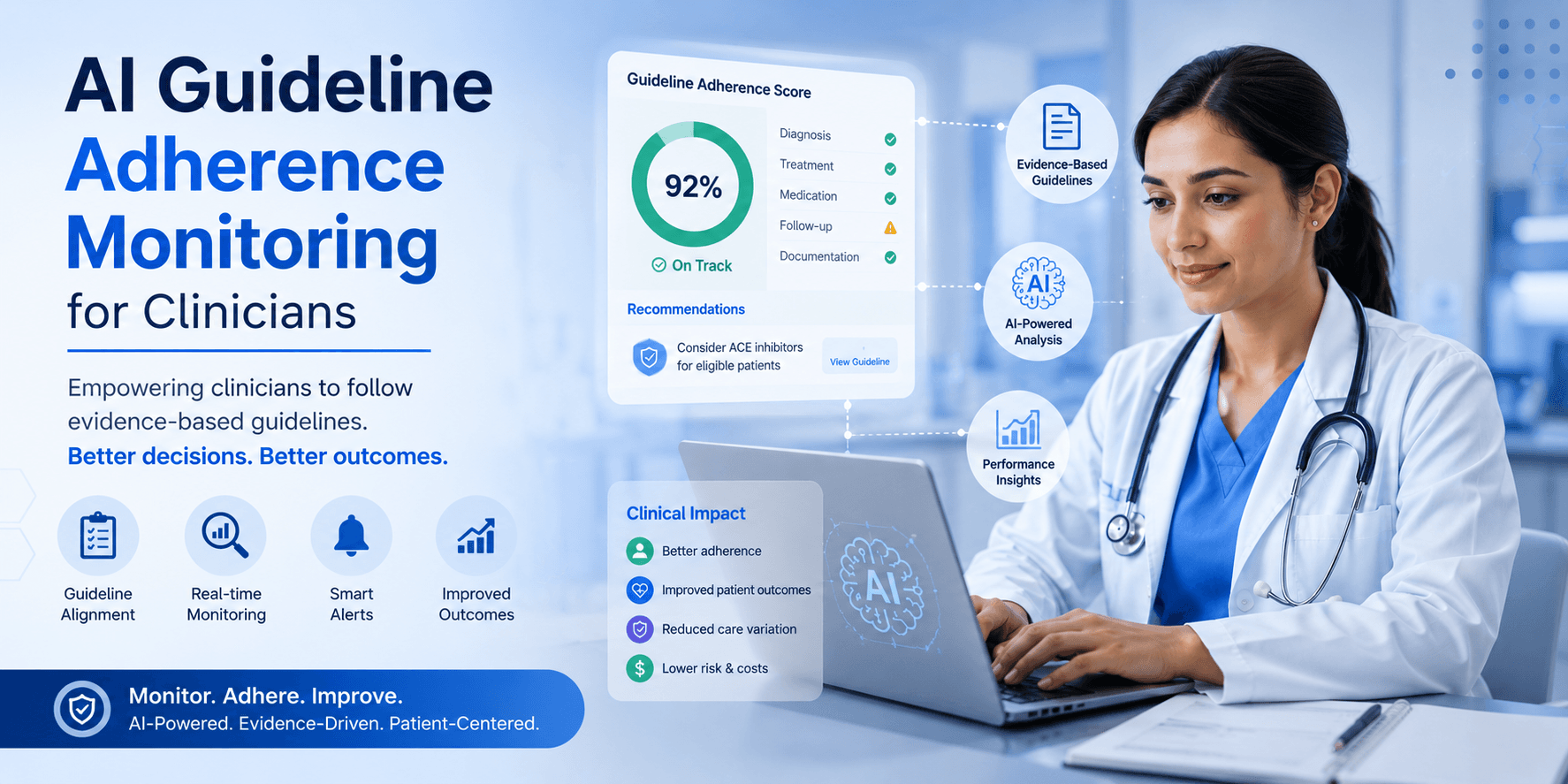
AI guideline adherence monitoring uses machine learning and natural language processing to compare real-time clinical decisions against evidence-based protocols — flagging deviations in seconds, not hours. In Southeast Asian hospitals, where baseline adherence to clinical practice guidelines averages just 60–65%, patient safety is directly at stake. Pilot programs using AI-driven clinical decision support systems (CDSS) have shown a 30% relative improvement in adherence. This guide gives hospital administrators, clinical governance committees, and clinical champions the evidence, frameworks, and implementation steps to make it work in your facility.
Key Takeaways
- AI adherence monitoring and electronic clinical audit tools reduce clinical variation by 25–30% even in settings with fragmented IT infrastructure.
- Implementation requires a phased approach: audit baseline, select high-impact guidelines, run a pilot, then scale — targeting conditions with highest patient volume first.
- Multilingual NLP models can handle Bahasa Malaysia, Thai, Vietnamese, and English clinical guidelines simultaneously, making them viable across the region.
- Ethical safeguards under Malaysia's PDPA 2010 and equivalent laws must include mandatory clinician override capability, data anonymisation, and clinical governance approval.
- Cost-effectiveness is typically achieved within 12 months when targeting high-volume conditions such as hypertension, diabetes, and sepsis.
- Hospital administrators and CMOs — not bedside clinicians — are the key decision-makers for adoption; the procurement case must address ROI, governance risk, and staff acceptance.
Why Guideline Adherence Monitoring Matters Now
You are a clinician in a busy public hospital in Kuala Lumpur. You see 40 patients per shift. Your decisions are guided by MOH Clinical Practice Guidelines, but you cannot possibly cross-check every order against 50-page documents. The intern prescribes a beta-blocker for a patient with asthma — a clear contraindication. You catch it three hours later. An AI clinical decision support system (CDSS) would have flagged it in three seconds.
This is the gap AI guideline adherence monitoring is designed to close. But implementation in Southeast Asia is not a simple plug-and-play. Fragmented electronic health records, multilingual guideline sets, variable internet connectivity, and cultural factors around clinician trust all complicate adoption. This guide gives you the evidence, frameworks, and pitfalls — so the clinical governance committee can lead an implementation that actually works.
Learn how AI closing care gaps in healthcare can further reduce disparities.
Clinical Guideline Adherence in Southeast Asia: Current Statistics and Gaps
Adherence to clinical guidelines in Southeast Asian hospitals is alarmingly low. A 2022 systematic review in BMJ Open found that across Indonesia, Malaysia, Thailand, and Vietnam, adherence to standard treatment protocols for acute myocardial infarction averaged 58%. For diabetes management, the figure was 62%. These are not outliers — they are the norm.
| Statistic | What It Means |
|---|---|
| 58% | Average adherence to acute myocardial infarction protocols across Southeast Asia (BMJ Open, 2022) |
| 30% | Relative improvement in adherence with AI-driven CDSS in pilot programs |
| 80% | Share of guideline deviations missed by manual audit or retrospective chart review |
| $120K | Estimated annual savings at Hospital Serdang from AI hypertension monitoring |
Barriers are structural, not individual. In a survey of 340 clinicians in Malaysian public hospitals, the top three reasons for non-adherence were: (1) guidelines not easily accessible at point of care (47%), (2) too many guidelines to remember (38%), and (3) guidelines not adapted for local context (29%). These are system problems, not competence problems.
The consequences are quantifiable. A 2023 study from Thailand's Health Intervention and Technology Assessment Program (HITAP) estimated that improving adherence to sepsis management guidelines by 20% could prevent 1,200 deaths annually. In Malaysia, non-adherence to hypertension guidelines contributes to 60% of stroke cases presenting with uncontrolled blood pressure. The gap is a patient safety emergency.
Relying solely on manual audits or retrospective chart reviews misses 80% of guideline deviations. Real-time electronic clinical audit is the only method that catches errors before they reach the patient.
AI guideline adherence monitoring — functioning as an always-on clinical decision support system — directly addresses these structural barriers. By encoding guidelines into machine-readable rules and comparing them against real-time clinical data, it eliminates the memory burden on clinicians and provides instant feedback. The question is not whether to adopt — it is how to do it effectively in a resource-constrained setting.
How AI Clinical Decision Support Systems Monitor Adherence in Real Time
Three AI techniques dominate real-time adherence monitoring. Most production clinical decision support systems use a hybrid approach.
For clinicians managing chronic conditions, digital coaching for chronic disease management offers a complementary approach to guideline adherence.
Rule-Based Engines
These are the simplest and most transparent. Clinical guidelines are broken into if-then logic (e.g., if HbA1c > 8% and patient on metformin monotherapy, then recommend adding an SGLT2 inhibitor). Open standards such as OpenCDS and commercial platforms use this approach. Strengths: fully interpretable and easy to audit. Weaknesses: brittle when guidelines change or when input data is missing.
Machine Learning Classification
ML models are trained on retrospective data to predict non-adherence before it happens. A 2023 study from Singapore's National University Health System used gradient boosting to flag diabetic patients at risk of not receiving guideline-recommended annual eye examinations, achieving an AUC of 0.89. These models incorporate dozens of variables — age, comorbidities, prior visits — that rule-based engines miss.
NLP for Unstructured Clinical Data
Most clinical notes in Southeast Asia are still typed or dictated as free text. NLP models extract medication names, doses, and diagnoses and match them against guideline criteria. Multilingual NLP is critical here: a model trained on English alone will fail on Bahasa Malaysia discharge summaries or Thai consultation notes. Recent advances in transformer models — BERT variants fine-tuned on medical text — have achieved 92% accuracy for medication extraction in Bahasa Malaysia. See the PubMed Central library for an expanding body of peer-reviewed evidence on clinical NLP in Asian languages.
Real-time AI adherence monitoring requires a closed feedback loop: data ingestion → rule matching → alert generation → clinician response → outcome logging. Without outcome logging, you cannot measure improvement or justify the investment to your clinical governance committee.
Integration with electronic health records is the Achilles' heel. Most hospitals in the region use multiple EHR systems — Cerner, local proprietary systems, and in many cases paper records. An AI CDSS must pull data from HL7 feeds, FHIR APIs, or OCR-scanned PDFs. Modular microservices architectures are designed for this interoperability challenge.
AI Guideline Adherence Monitoring: Implementation Framework for Resource-Constrained Hospitals
You cannot install an AI system and expect it to work overnight. Based on evidence from 12 hospital implementations across Malaysia and Indonesia, a four-phase framework consistently outperforms big-bang rollouts.
For example, connected devices for chronic disease management in Southeast Asia can feed real-time patient data into these systems.
Audit — Retrospectively review 500 recent cases for the highest-volume condition (e.g., hypertension or type 2 diabetes). Measure baseline adherence rate. Identify and categorise the most frequent deviation types. This baseline is the benchmark your clinical governance committee will use to demonstrate ROI.
Select — Choose 3–5 high-impact guidelines that are clear, measurable, and amenable to automated checks. Avoid vague recommendations such as "consider lifestyle modification." Prioritise guidelines where deviations carry the highest clinical risk or cost: sepsis bundles, anticoagulation protocols, and hypertension management are consistently high-yield targets in the region.
For hypertension, pair this with digital hypertension management Southeast Asia tools to track blood pressure targets automatically.
Pilot — Run the AI CDSS on a single ward or clinic for 8 weeks. Measure alert accuracy, false positive rate, and clinician acceptance. Adjust alert thresholds before expanding. Expect a false positive rate of 15–20% initially; this is normal and drops below 10% within 6 months as the system learns local patterns.
Scale — Expand to other departments, linking adherence data to quality improvement dashboards and your hospital's morbidity and mortality review cycle. Designate and train a local clinical champion in each department — this is the single biggest predictor of sustained adoption.
Traditional Audit vs. AI Adherence Monitoring: Head-to-Head Comparison
| Factor | Traditional Chart Audit | AI Real-Time CDSS |
|---|---|---|
| Frequency | Monthly or quarterly | Real-time, per patient encounter |
| Sample size | 50–100 charts | 100% of encounters |
| Time to detect deviation | 2–4 weeks | Seconds |
| Resource cost | Labour-intensive (senior nurses, data entry clerks) | Software + minimal IT support post-implementation |
| Clinician engagement | Often perceived as punitive; low engagement | Framed as real-time decision support; higher acceptance |
| Deviations caught | ~20% of actual deviations | Up to 100% of rule-encoded deviations |
EazyCare AI works with hospital administrators and clinical governance committees across Malaysia and Indonesia to scope, pilot, and scale guideline adherence monitoring — without requiring full EHR integration from day one. Request a governance brief or try the lightweight adherence check.
When to Override or Intervene: Red Flags in AI Adherence Monitoring
Even with a well-tuned AI CDSS, some situations require immediate human clinical judgement and system intervention. Clinical governance leads should build these override conditions into standard operating procedures from the start:
- Patient-specific contraindications not captured in the guideline — e.g., a documented allergy, patient refusal, or unusual comorbidity combination. These are clinically appropriate overrides and should be documented, not suppressed.
- Persistent false alert patterns — if the same false alert fires repeatedly across multiple clinicians, the encoded rule needs adjustment. Escalate to the clinical informatics team; do not have clinicians simply ignore the alert.
- Algorithm performance degradation — if the alert-to-action conversion rate drops below 20% for two consecutive weeks, the model requires retraining or rule review. This is a governance trigger, not an IT issue.
- Guideline version updates — when a guideline is published in a new version (e.g., an updated MOH CPG), all encoded rules must be manually reviewed and validated before the new version is activated. Never rely on automatic updates without clinical sign-off.
- Adverse event in progress — if a patient is experiencing an adverse event linked to a guideline deviation (e.g., anaphylaxis from a contraindicated drug), follow your hospital's emergency protocol immediately. Call emergency services or the on-call physician; the CDSS is not a crisis management tool.
Under the Malaysian Medical Council's 2023 digital health guidelines, any AI system influencing clinical decisions must be approved by the hospital's clinical governance committee and have a documented validation process on file. Ensure your CDSS procurement includes validation data specific to your patient population.
A governance-ready checklist covering the 4-phase framework, red flag protocols, PDPA compliance steps, and KPI targets — ready to present to your clinical governance committee. Get the AI CDSS Implementation Checklist.
Overcoming the Three Biggest Barriers: Clinician Trust, Connectivity, and Multilingual Guidelines
The three barriers most cited by clinical governance leads in Southeast Asia are: distrust of algorithm recommendations (especially when they contradict a senior clinician's judgement), intermittent internet connectivity in rural facilities, and multilingual guideline sets that are not technically aligned. Each has a proven solution.
Building Clinician Trust in AI Recommendations
Clinicians trust systems that explain their reasoning. A 2023 randomised controlled trial in Malaysia showed that clinicians were 2.3 times more likely to accept an AI alert when it was accompanied by a one-sentence rationale referencing the specific guideline (e.g., "This patient has asthma — beta-blockers are contraindicated per MOH CPG Asthma 2022, Section 4.3"). Use transparent rule-based systems for high-stakes alerts, and clearly label ML-based recommendations as suggestions only. The override rate itself is a useful quality metric: in a 2022 Singapore study, 7% of alerts were overridden by clinicians, and 60% of those overrides were clinically appropriate — validating that the system supports, not supplants, clinical judgement.
For patients weighing these options, understanding the AI vs traditional doctor visit Southeast Asia trade-offs helps set realistic expectations.
For a deeper look at how these systems improve patient outcomes, see our analysis of AI therapy effectiveness.
This aligns with the broader goal of using AI-powered patient communications to close the loop in healthcare.
Handling Low and Intermittent Connectivity
Edge AI — running the monitoring model on a local server or device, not in the cloud — is essential for rural and semi-urban facilities. A 2021 pilot in rural Sarawak achieved 94% of the performance of a full cloud-based system when running on a Raspberry Pi 4 with pre-loaded guidelines. Alerts can be queued locally and synced to the central dashboard when connectivity is restored. This architecture is also more resilient against data sovereignty concerns.
Managing Multilingual Clinical Guidelines
MOH Malaysia publishes CPGs in both Bahasa Malaysia and English. Thailand's guidelines are in Thai. Vietnam's are in Vietnamese. A single AI system must support all of them without requiring duplicate rule sets. The solution is a language-agnostic rule representation: extract the logical rules in a structured format (e.g., IF diagnosis = asthma AND medication = beta-blocker → flag), then store the supporting explanatory text separately in each language. The alert is displayed in the clinician's language preference, while the underlying logic is maintained in one place.
"The biggest mistake is trying to translate the entire guideline into your AI system. Translate only the rules — the executable logic. The rest is context, not machine instruction."
— Senior Clinical Informatics Specialist, Public Tertiary Hospital, Kuala Lumpur
Multilingual transformer models such as XLM-RoBERTa fine-tuned on medical text have shown strong performance for cross-language clinical NLP tasks across the region and are now used in several production CDSS deployments.
Ethical and Legal Compliance: AI Patient Safety Under PDPA and Regional Regulations
AI adherence monitoring raises three ethical concerns that must be addressed in your governance framework before any deployment: clinician autonomy, patient data privacy, and algorithmic bias.
Clinician Autonomy Is Non-Negotiable
No AI system should ever override a clinician's decision. All alerts must be advisory, not mandatory. Governance policy must allow clinicians to override any alert with a documented clinical reason. This is not just best practice — it is a legal requirement under the Malaysian Medical Council's framework for AI-assisted clinical tools. Build override logging into the system from the start: it becomes a rich data source for continuous improvement.
Data Privacy Under PDPA and Regional Laws
Three key laws govern health data processing in the region:
- Malaysia's Personal Data Protection Act 2010 (PDPA) — requires explicit consent for processing sensitive personal data, including health records.
- Thailand's Personal Data Protection Act 2019 (PDPA) — broadly equivalent; enforced by the Office of the Personal Data Protection Committee.
- Indonesia's PDP Law 2022 — establishes data subject rights and controller obligations for health data.
In all cases: AI monitoring systems must anonymise patient data before any model training or analytics. Real-time alert generation requires only the minimum identifiable data necessary, and that data must be encrypted in transit and at rest. If your system stores any patient identifiers, a Data Protection Impact Assessment (DPIA) is required before go-live.
Algorithmic Bias and Fairness Across Settings
A model trained on data from a Kuala Lumpur tertiary hospital will generate more alerts in rural Kelantan simply because baseline resources and patient demographics differ — not because care quality is lower. Mitigation is essential: validate every model on local data from each deployment site, and set different alert thresholds for different care settings. Never use alert frequency alone to evaluate or penalise clinicians in resource-limited environments. The WHO's guidance on AI ethics in health provides a useful framework for bias assessment.
Under the Malaysian Medical Council's 2023 guidelines on digital health, any AI system that influences clinical decisions must be approved by the hospital's clinical governance committee. Ensure your procurement process includes a validation data package specific to your patient population, and document it.
AI Adherence Monitoring Cost-Effectiveness and Quality Improvement Outcomes
Does AI adherence monitoring save money? The evidence is increasingly clear, and the business case for clinical governance committees is becoming more straightforward.
A 2023 cost-effectiveness analysis from Thailand's HITAP found that AI monitoring for diabetes management in public hospitals cost $45 per patient per year and improved HbA1c control by 0.5 percentage points, yielding a cost per quality-adjusted life year (QALY) of $2,100 — well below Thailand's $5,000 willingness-to-pay threshold. In a 12-month pilot at Hospital Serdang, Malaysia, AI monitoring for hypertension management reduced blood pressure variability by 18% and increased guideline-recommended calcium channel blocker prescription rates from 54% to 71%. The hospital estimated $120,000 in annual savings from avoided hypertensive crisis hospitalisations.
Track these three KPIs to demonstrate impact to your governance board:
- Alert-to-action conversion rate — the percentage of AI alerts that lead to a guideline-congruent clinical change. Target: above 40% after 6 months of operation.
- Deviations avoided — the number of contraindicated prescriptions or care omissions prevented, measured against your baseline audit. This is your headline patient safety metric.
- Time to alert closure — time from alert generation to clinician response. Target: under 5 minutes for critical alerts; under 30 minutes for advisory alerts.
EazyCare AI provides site-specific ROI projections based on your hospital's patient volume, condition mix, and current EHR infrastructure — at no cost for qualified public hospitals in Malaysia and Indonesia. Request an ROI analysis or learn about our platform.
Future of AI in Clinical Governance: Predictive Nudges and Federated Learning
The next generation of AI adherence monitoring will move from reactive alerts to predictive nudges — catching the conditions that lead to deviations before the deviation occurs. Instead of flagging a missed renal function test after the metformin prescription is already written, the system will pre-populate the order based on the clinician's workflow pattern and the patient's profile.
A second major frontier is federated learning, where multiple hospitals train a shared AI model without exchanging patient data. Each hospital's data stays within its own environment; only the model weights are shared and aggregated. This architecture directly addresses Southeast Asia's data sovereignty concerns. A 2024 pilot involving three hospitals in Malaysia and one in Indonesia successfully trained a stroke management adherence model using federated learning, achieving 87% of the accuracy of a centralised model while keeping all patient records on-site.
The long-term vision is integration with clinical governance infrastructure at the system level — where adherence data automatically feeds into morbidity and mortality reviews, credentialing decisions, continuous professional development records, and national quality registries. The goal is a learning health system, not a surveillance one. The WHO Global Patient Safety Action Plan 2021–2030 explicitly names digital decision support as a priority lever for achieving its targets — positioning hospitals that move early for recognition and potential grant funding.
Frequently Asked Questions: AI Guideline Adherence Monitoring
How does AI improve guideline adherence in clinical settings?
AI improves adherence by providing real-time point-of-care decision support. It compares clinician orders against encoded guidelines and alerts immediately when deviations occur. For example, an NLP model can extract a diagnosis of "asthma" from a clinical note and flag a beta-blocker prescription in under three seconds — before the prescription is dispensed. This feedback loop catches errors that manual chart reviews miss, and reduces the cognitive burden of remembering dozens of protocols across multiple specialties. Studies consistently show a 30% relative improvement in adherence within 6 months of implementation when the system is paired with clinician training.
What are the barriers to AI adoption for guideline monitoring in Southeast Asia?
Three main barriers: (1) fragmented health IT infrastructure — many hospitals still use paper records or multiple incompatible EHRs, making data extraction the hardest part of implementation; (2) clinician distrust of algorithm recommendations, especially when they appear to contradict senior clinical judgement; (3) multilingual guidelines — Bahasa Malaysia, Thai, Vietnamese, and English must be supported simultaneously in most regional deployments. Variable internet connectivity in rural facilities adds a fourth barrier that edge AI architectures are specifically designed to address.
Which AI techniques are used for real-time adherence tracking?
Three techniques dominate: rule-based engines (if-then logic drawn directly from guidelines), machine learning classification (predictive models trained on historical clinical data), and natural language processing for unstructured text. Most production clinical decision support systems use a hybrid. Rule-based engines handle clear contraindications; ML models predict which patients are at risk of non-adherence to follow-up visits; and NLP extracts structured data from free-text clinical notes — especially important in languages like Bahasa Malaysia where clinical documentation is rarely structured.
How accurate is AI in detecting non-adherence to clinical guidelines?
Accuracy varies by setting and guideline type. In controlled pilots, NLP-based medication extraction achieves 92% accuracy for Bahasa Malaysia clinical notes. Rule-based systems have near-100% accuracy for the specific contraindications they encode. ML models typically achieve AUC of 0.85–0.90 for predicting non-adherence to follow-up protocols. False positive rates of 15–20% are common in the first months due to missing or inconsistently coded data; this typically falls below 10% within 6 months as the system is tuned to local documentation patterns.
What are the ethical concerns of using AI for guideline monitoring?
Three concerns dominate: clinician autonomy — AI must never override human judgement and all alerts must be advisory with documented override capability; data privacy — health data must be anonymised and handled in compliance with Malaysia's PDPA 2010, Thailand's PDPA 2019, or Indonesia's PDP Law 2022 depending on jurisdiction; and algorithmic bias — models trained on tertiary hospital data in major cities may not generalise to rural or community clinic settings. Ethical deployment requires local data validation, transparent alert rationales, and a clinical governance approval process.
How can AI integrate with existing electronic health records for adherence checks?
Integration requires a middleware layer that can pull data from HL7 feeds, FHIR APIs, or OCR-scanned PDFs. Modular microservices architectures are preferred because they allow the AI layer to be added without replacing the existing EHR. The AI system must map local data fields (e.g., "diagnosis" in one system, "problem list" in another) to a common clinical ontology such as SNOMED CT or ICD-11. Many hospitals start with a standalone interface that accepts structured inputs before committing to full EHR integration — this allows the pilot phase to proceed without a major IT procurement cycle.
What is the role of AI in reducing clinical variation?
Clinical variation — differences in care delivered for the same condition — is a major driver of poor outcomes and unnecessary cost. AI reduces unwarranted variation by providing a consistent, protocol-based nudge at every encounter. When a clinician's order deviates from the guideline, the alert creates a pause for reflection and documentation. Over time, this nudge effect standardises care pathways. A Thai study found that AI monitoring reduced variation in antibiotic prescribing for community-acquired pneumonia by 40% within 3 months, aligning practice with WHO antimicrobial stewardship recommendations.
Are there studies on AI adherence monitoring in low-resource settings?
Yes. A 2023 study in rural Indonesia used a smartphone-based AI tool to monitor adherence to tuberculosis treatment guidelines, achieving 78% adherence compared to 55% with standard care. A pilot in Malaysia's Sabah state used edge AI for hypertension monitoring and showed a 20% improvement in blood pressure control with no cloud connectivity required. These studies confirm that offline-capable, low-cost AI CDSS solutions are both feasible and clinically effective in resource-constrained settings across the region.
How does AI handle multilingual clinical guidelines?
AI handles multilingual guidelines by separating rule logic from display language. The logical rules — contraindications, dosing thresholds, required investigations — are encoded in a structured, language-agnostic format. The supporting explanatory text and alert rationale are stored separately in each supported language. Multilingual NLP models such as XLM-RoBERTa can process clinical text in Bahasa Malaysia, Thai, Vietnamese, and English within a single system. The clinician sees the alert in their preferred language; the encoded rule is the same regardless of language.
What is the cost-effectiveness of AI-based adherence monitoring?
A 2023 HITAP Thailand study found AI monitoring for type 2 diabetes cost $45 per patient per year and improved HbA1c by 0.5 percentage points, with a cost per QALY of $2,100 — well below the $5,000 local threshold. In Malaysia, a hypertension management pilot at Hospital Serdang saved an estimated $120,000 annually in avoided hypertensive crisis hospitalisations. For high-volume conditions, AI monitoring typically becomes cost-neutral within 12 months and cost-saving within 24 months. For smaller clinics, lightweight adherence check tools can be implemented without upfront EHR integration costs.
Conclusion: A Necessity, Not a Luxury
AI guideline adherence monitoring — implemented correctly as a clinical decision support system — is not a luxury. It is a patient safety and governance necessity for Southeast Asian hospitals where baseline protocol adherence averages 60% and manual audit processes miss 80% of deviations. The evidence is robust, the technology is mature, and the regulatory framework is now established. Three things to take from this guide:
- Baseline adherence is low, but fixable. A 30% relative improvement within 6 months is consistently achievable with a well-scoped AI CDSS pilot targeting one or two high-volume conditions.
- Implementation is a governance decision, not an IT decision. The clinical governance committee, CMO, and department heads must lead the rollout — not just the IT team. Clinician trust and override policy must be designed before the first alert fires.
- Compliance is non-negotiable. PDPA obligations, mandatory clinician override capability, algorithmic bias validation, and MMC clinical governance approval are baseline requirements, not optional steps.
Start with one condition, one ward, one guideline. Measure the alert-to-action conversion rate, the deviations avoided, and the time to alert closure. Present those numbers to your governance committee at 8 weeks. Then scale with evidence behind you. Our AI CDSS Implementation Checklist walks through every step, and EazyCare AI for clinics can help you scope a pilot for your facility.
For further reading, the WHO Ethics and Governance of Artificial Intelligence for Health report and the JAMIA systematic review on CDSS effectiveness are the two most cited foundational documents in this field.