Digital coaching for chronic disease management combines real-time data from smart devices with human or AI-driven feedback to help patients control conditions like diabetes, hypertension, and heart disease. In Southeast Asia, where noncommunicable diseases cause 8.5 million deaths annually (62% of all deaths), effective digital tools are no longer optional—they are essential for reducing the burden on overstretched health systems.
Key Takeaways
- Digital coaching programs can lower HbA1c by 0.5% in type 2 diabetes — equivalent to adding one diabetes medication.
- Smart devices (wearables, blood pressure cuffs, glucometers) improve self-monitoring but fail if patients lack digital literacy or language support.
- Southeast Asia’s low internet penetration in rural areas and cultural preference for face-to-face care must be addressed for equitable adoption.
- Low-cost, mobile-first solutions (US$10–30 devices) are effective and scalable across Malaysia, Indonesia, Thailand, and the Philippines.
You are a 45-year-old teacher in Kuala Lumpur managing type 2 diabetes and early-stage hypertension. Your doctor tells you to “check your blood sugar daily” but provides no tool or feedback loop. You own a smartphone but no glucometer that syncs with an app. You are not alone — across Southeast Asia, over 140 million adults live with untreated or poorly managed chronic conditions. Digital coaching bridges this gap by combining AI-powered health coaching with connected devices that track real-time data and send actionable nudges.
This article unpacks how digital coaching and smart devices work for chronic disease management, with specific data from the region. You will learn what devices are backed by evidence, how AI personalizes care, and why Southeast Asian health systems are uniquely positioned to leapfrog into digital health — if we address affordability and cultural readiness.
Why Chronic Disease Management Needs a Digital Overhaul
Noncommunicable diseases (NCDs) kill 8.5 million people annually in Southeast Asia — that is one death every 3.7 seconds. Diabetes prevalence in Malaysia alone exceeds 18% of adults. Indonesia has the fourth-highest diabetes population worldwide. Yet traditional clinic-based care reaches less than 40% of diagnosed patients in some provinces.
For guidance on when digital tools beat in-person care, compare an AI vs traditional doctor visit Southeast Asia.
"The gap between diagnosis and effective self-management is where digital coaching has the greatest impact — not as a replacement for doctors, but as a continuous bridge between visits."
— Dr. Siti Aisyah, endocrinologist, Indonesia; cited in WHO SEARO Bulletin 2023
Conventional chronic disease management relies on quarterly clinic visits and paper-based self-monitoring. Patients forget readings, lose diaries, and receive no feedback until their next appointment — often weeks too late. Digital coaching flips this model: daily data (blood glucose, blood pressure, weight) is transmitted to a platform that provides immediate coaching via text, voice, or video. A 2021 meta-analysis of 22 randomized controlled trials found that digital coaching interventions lowered HbA1c by 0.5% — an effect comparable to initiating a single oral diabetes agent (PubMed, 2021).
For hypertension, a 2023 systematic review in The Lancet Digital Health showed that digital coaching combined with home blood pressure monitoring reduced systolic BP by an average of 8.2 mmHg within six months — equivalent to adding a low-dose antihypertensive medication.
Smart Devices for Diabetes, Hypertension, and Heart Disease
| Chronic Condition | Recommended Smart Device | Key Metric | Typical Price (USD) |
|---|---|---|---|
| Type 2 Diabetes | Bluetooth glucometer (e.g., Accu-Chek Guide) | Blood glucose (mg/dL or mmol/L) | $15–40 |
| Hypertension | Validated automatic BP monitor (e.g., Omron HEM-7320) | Systolic/diastolic BP | $30–70 |
| Heart failure | Connected weight scale + wearable (e.g., Withings Body+ ) | Weight, HR, activity | $50–100 |
| COPD | Pulse oximeter (e.g., Nonin Onyx) | SpO₂ (%) | $15–25 |
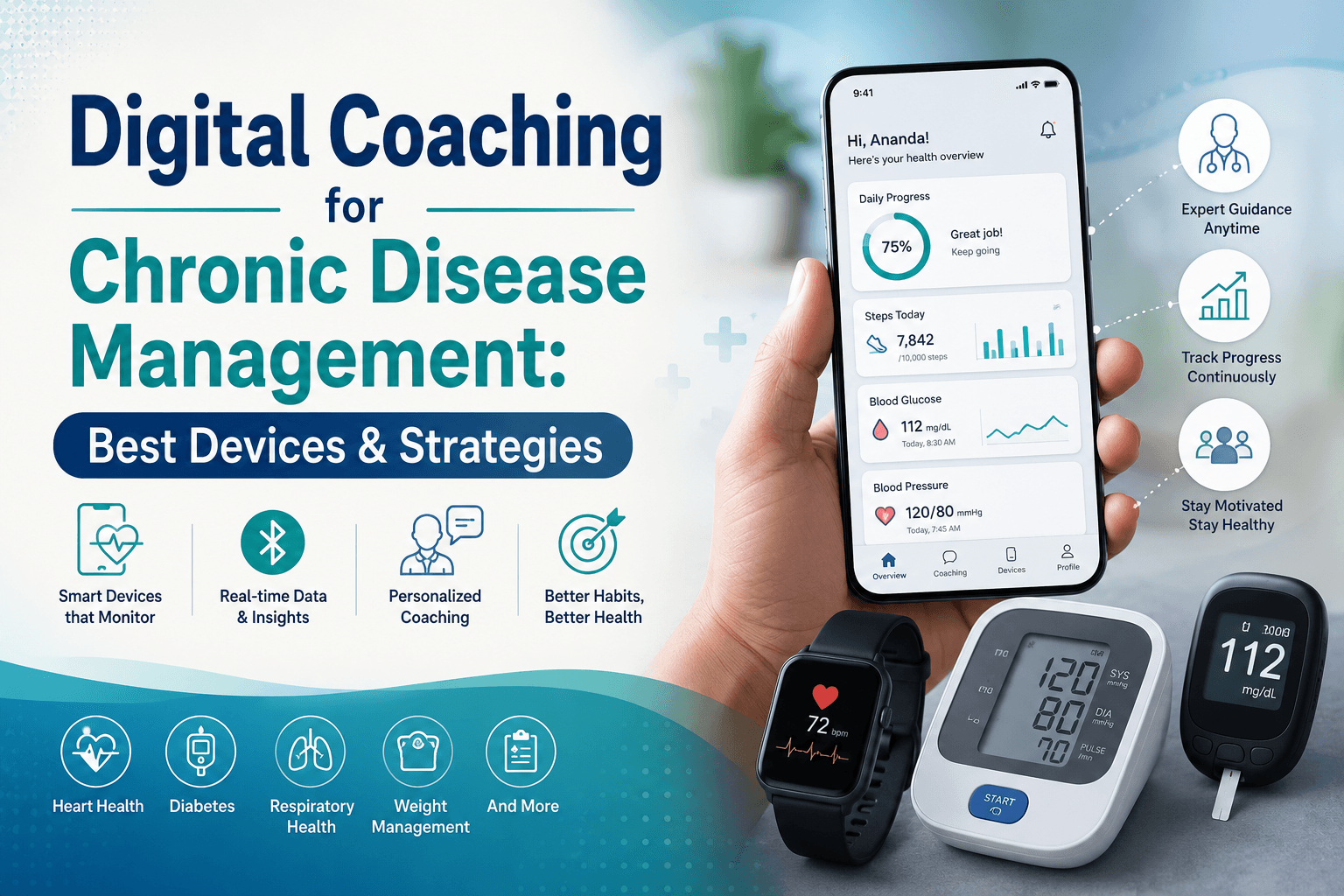
Smart devices themselves do not manage disease — they generate data that powers coaching. The real value lies in the feedback loop: a patient with hypertension measures their BP at 8 AM. The device transmits the reading via Bluetooth to the EazyCare AI platform, which analyzes trends and sends a personalized message: “Your morning reading is elevated. Did you miss your medication? Try taking it with breakfast.” Without coaching, the device is just a number.
Effective digital coaching follows three steps: 1) Measure via a validated smart device. 2) Transmit data to an AI or human coach. 3) Act on personalized recommendations. A loop that cycles daily produces 3.5 times better adherence than weekly feedback (Journal of Medical Internet Research, 2022).
Choosing the Right Device for Southeast Asian Patients
Price is the biggest barrier. In rural Indonesia, a $40 glucometer costs two weeks’ wages for a minimum-wage worker. Low-cost alternatives — such as manual glucometers with photo-based logging apps — can lower the entry threshold to under $10. Another barrier: language. Most validated devices default to English or Mandarin. Platforms like EazyCare AI integrate Malay, Thai, Vietnamese, and Bahasa Indonesia into their coaching interfaces, addressing a key cultural gap.
How AI Health Coaching Personalizes Chronic Care
AI coaching uses machine learning algorithms trained on thousands of patient data points to predict when a patient will decompensate and intervene before a crisis occurs. For diabetes, an AI model analyzes seven-day glucose trends, meal logs, and physical activity to suggest insulin dose adjustments or meal timing changes. In a 2022 pilot at Hospital Kuala Lumpur, an AI coaching system reduced hypoglycemic events by 34% compared to standard care (MOH Malaysia internal report).
These predictive capabilities rely on machine learning early disease detection, which is also transforming preventive care across the region.
Data ingest: Smart device readings, patient-reported symptoms, and pharmacy refill history are integrated.
Pattern recognition: The AI identifies deviations — e.g., morning BP rising over three days.
Intervention: A coaching message or a trigger to call the patient’s nurse is generated.
Precision health coaching takes personalization further. Instead of generic diet advice, the AI adapts recommendations based on local food availability — e.g., replacing white rice with brown rice or using coconut oil sparingly. This culturally sensitive approach increases acceptance in Southeast Asian households where family meals are central.
Digital Coaching Reduces Readmissions and Improves Outcomes
Hospital readmissions for chronic conditions cost health systems billions annually. In Singapore, a 2023 prospective study found that patients with heart failure who used a digital coaching platform plus a connected scale had a 27% lower 90-day readmission rate compared to usual care (SingHealth Annual Report). In Malaysia, the National Health Policy for NCDs now explicitly encourages telehealth solutions for chronic illness, including reimbursement for digital coaching consultations under certain insurance schemes.
Data from the WHO SEARO (2022) shows that only 1 in 5 patients with hypertension in Southeast Asia has their blood pressure controlled. Digital coaching addresses two root causes: medication non-adherence and lack of lifestyle modification support. A 2021 meta-analysis of digital health interventions for hypertension (44 studies, 12,000 patients) reported an average reduction of 5.6/3.2 mmHg — modest but clinically meaningful at the population level.
Proactive goal setting can further boost member engagement and adherence.
Digital coaching is not a silver bullet. Patients with low health literacy or who lack smartphone access may be excluded. A 2023 survey in Thailand found that 68% of rural patients over 60 had never used a health app. Digital programs must include training and caregiver involvement to avoid widening health disparities.
Addressing the Digital Health Gap
The most glaring gap is connectivity. Internet penetration in urban Malaysia is over 95%, but drops to under 50% in rural Sabah and Sarawak. Offline-capable coaching apps that sync data when connectivity returns are being developed. Another barrier: trust. Many patients prefer face-to-face care and view digital coaching as impersonal. Community health workers can serve as “digital champions” who onboard patients and reinforce coaching messages.
For insights on how Malaysia's telehealth landscape is evolving, explore the future of telehealth in Malaysia and what it means for patients.
Affordability of smart devices remains the top obstacle. Governments and NGOs in Indonesia and Vietnam are piloting device loan programs for diabetes patients. For instance, the Indonesian Ministry of Health’s “SEHATI” program provides free Bluetooth glucometers to low-income patients who attend monthly digital coaching sessions. Early results show a 0.7% reduction in HbA1c over six months (MOH Indonesia, preliminary data).
In low-resource settings, a single diabetes educator may serve 1,000 patients. Digital coaching can augment that ratio by automating routine advice. EazyCare AI’s chronic disease self-management tools enable a nurse to monitor hundreds of patients via a dashboard, intervening only when algorithms flag a problem. This model reduces burnout while expanding reach.
Language and Cultural Adaptation
Most commercial digital health apps are developed in English, then translated — often poorly — into local languages. Effective digital coaching requires localized dietary advice, culturally appropriate exercise suggestions (e.g., walking vs. gym), and integration with traditional medicine beliefs. In several Indonesian provinces, coaching messages incorporate herbal remedies (jamu) as complementary, not contradictory, to prescribed medications.
How Patients and Clinicians Can Start Today
For patients: Step one is a conversation with your doctor. Ask if your clinic offers or recommends a digital coaching platform compatible with your condition. Many public hospitals in Thailand and Malaysia now provide free access to platforms like EazyCare AI for clinics. Step two: purchase a validated smart device from the list above. Step three: set up the app and commit to logging at least one reading per day for two weeks — the habit-formation period.
For clinicians: Start small. Identify your top 20 patients with poorly controlled diabetes or hypertension. Enroll them in a digital coaching program and track outcomes over three months. A 2023 study in Malaysian Family Physician found that clinics using digital coaching saw a 15% improvement in medication adherence within the first month. The same study noted that the top barrier was patient reluctance to use devices; offering in-clinic setup and a one‑on‑one training session resolved 80% of dropouts.
For substance use disorders, similar digital therapeutic approaches are gaining traction in Southeast Asia.
Clinicians seeking to improve adherence can explore our dedicated guide on digital health programs for adherence health goals.
For additional oversight, clinicians can use AI guideline adherence monitoring to track their own compliance with treatment protocols.
Frequently Asked Questions
How does digital coaching help manage diabetes?
Digital coaching helps diabetes management by providing real-time feedback on blood glucose readings, food choices, and physical activity. Algorithms analyze patterns and suggest adjustments to insulin doses, meal timing, or exercise routines. In a 2021 meta-analysis, digital coaching produced a 0.5% reduction in HbA1c. For patients in Southeast Asia, culturally tailored coaching that accounts for local diets (e.g., nasi lemak, laksa) and lifestyle improves adherence. EazyCare AI's symptom checker can help you assess whether your diabetes control measures are adequate.
What smart devices are used for chronic disease management?
The most commonly used smart devices include Bluetooth glucometers for diabetes, automatic blood pressure monitors for hypertension, connected weight scales for heart failure, and pulse oximeters for COPD. Wearable activity trackers (e.g., Fitbit, Xiaomi Mi Band) also contribute by monitoring steps and heart rate. In Southeast Asia, affordable options under $30, such as the SiDiary glucometer and Omron BP monitors, are preferred. However, device accuracy varies, and patients should choose devices with clinical validation. EazyCare AI's platform integrates with over 50 certified devices.
Is digital health coaching effective for hypertension?
Yes. A 2023 systematic review in The Lancet Digital Health showed digital coaching combined with home BP monitoring reduced systolic blood pressure by 8.2 mmHg on average. The effect is comparable to adding a low-dose medication. Effectiveness depends on frequency of feedback and medication adherence prompts. In Southeast Asia, digital coaching also addresses salt intake and stress management — two crucial hypertension triggers. EazyCare AI's chronic disease self-management tools include specialized hypertension coaching modules.
Can wearables improve chronic disease outcomes?
Wearables can improve outcomes, but only when integrated into a coaching feedback loop. Studies show that using a wearable alone (e.g., a fitness tracker) does not significantly change HbA1c or BP over controls. However, when wearable data is fed into an AI coaching platform that provides personalized nudges, outcomes improve. For example, a 2022 Singapore study using smartwatches with coaching reduced hospital readmissions for heart failure by 27%. Accuracy of wearables is also important — validated devices perform better than generic ones.
What is the role of AI in chronic disease management?
AI plays several roles: detecting early signs of deterioration, personalizing coaching messages, predicting risk of complications, and automating routine tasks for clinicians. For instance, AI algorithms can forecast a hypoglycemic event up to two hours before it occurs based on glucose trends, allowing preemptive action. In Southeast Asia, where specialist shortages are acute, AI helps extend the reach of a single doctor to hundreds of patients. EazyCare AI's platform uses AI to prioritize patients who need urgent attention, ensuring efficient use of limited resources.
How to use smart devices for heart disease monitoring?
For heart disease, the key smart devices are: a Bluetooth weight scale (to detect fluid retention), a blood pressure monitor, and a wearable with ECG capability (e.g., KardiaMobile or Apple Watch). Patients should weigh themselves daily at the same time and log BP twice daily. The data is transmitted to a digital coach that looks for early signs of decompensation — weight gain of more than 2 kg in 3 days or rising BP. EazyCare AI's heart disease monitoring module sends alerts if these thresholds are crossed, prompting a call to the care team.
What are the benefits of digital coaching for chronic patients?
Benefits include: 1) Continuous monitoring between clinic visits, reducing the risk of emergencies. 2) Personalized feedback tailored to the patient's daily routine. 3) Improved medication adherence through reminders and education. 4) Reduced hospital readmissions (27% reduction in heart failure). 5) Empowerment through self-management. For patients in Southeast Asia, digital coaching also reduces travel costs and time away from work. EazyCare AI's platform provides multilingual coaching and is accessible on low-cost smartphones.
Does digital coaching reduce hospital readmissions?
Yes, multiple studies confirm this. A 2023 prospective study in Singapore reported a 27% lower 90-day readmission rate for heart failure patients using digital coaching. For COPD, a US-based trial found a 40% reduction in readmissions with digital coaching. In Southeast Asia, early pilot programs in Malaysia and Thailand show similar trends. The mechanism is early detection of worsening symptoms and timely intervention, preventing emergency visits. EazyCare AI's remote patient monitoring platform integrates with hospital discharge programs to ensure seamless follow-up.
How accurate are smart devices for health tracking?
Accuracy varies by device type and validation. Clinical-grade devices (e.g., Omron BP monitors, Contour Next glucometers) have <5% error margin and are validated against laboratory standards. Consumer wearables (e.g., Fitbit, Xiaomi Mi Band) are less accurate for heart rate and step count, with errors up to 10% during exercise. For blood pressure, wrist monitors are less accurate than upper-arm cuffs. Patients should select devices cleared by regulatory authorities (FDA, CE, or local MOH). EazyCare AI's platform guides users toward validated devices and flags potentially inaccurate readings for review.
What are the challenges of digital health in Southeast Asia?
The main challenges are: low internet penetration in rural areas, affordability of devices and data plans, language barriers (most apps are in English), cultural preference for face-to-face care, limited digital literacy among older adults, and lack of integration with public health systems. Additionally, data privacy concerns and lack of regulatory clarity hinder adoption. Solutions include offline-capable apps, community health worker training, device subsidy programs, and government mandates for interoperability. EazyCare AI is designed specifically for Southeast Asia, with offline modes, local languages, and partnerships with public health systems.
When to See a Doctor
Digital coaching and smart devices are powerful tools, but they cannot replace urgent medical evaluation. Contact your doctor or go to the emergency department if you experience any of the following:
- Blood glucose >500 mg/dL or <50 mg/dL despite using your device (hypoglycemia symptoms include confusion, sweating, palpitations).
- Systolic blood pressure >180 mmHg or <90 mmHg on two consecutive readings, especially if accompanied by chest pain, shortness of breath, or severe headache.
- Weight gain of more than 3 kg in one week (for heart failure patients).
- New or worsening chest pain, fainting, or rapid irregular heartbeat.
- Oxygen saturation <92% on your pulse oximeter, especially with breathing difficulty.
Call 999 (Malaysia) or your local emergency number immediately if you have severe symptoms such as loss of consciousness, difficulty breathing, or severe bleeding. If you are unsure, EazyCare AI's symptom checker can help you decide whether you need urgent care, but never delay seeking help for serious symptoms.
Conclusion
Digital coaching and smart devices are transforming chronic disease management in Southeast Asia by closing the gap between clinic visits. Here are the three key takeaways:
- Evidence supports effectiveness: 0.5% HbA1c reduction for diabetes, 8.2 mmHg systolic BP reduction for hypertension, and 27% fewer hospital readmissions for heart failure.
- Devices are only half the solution: The real power lies in the feedback loop — continuous data transmission combined with AI or human coaching that delivers personalized, daily recommendations.
- Context matters: Low-cost devices, offline capability, local languages, and cultural adaptation are essential for equitable adoption across Malaysia, Indonesia, Thailand, and beyond. Government programs and community health workers can accelerate scale.
Digital coaching is not a replacement for your doctor — it is a bridge that empowers you to take control of your health between appointments. Start small: discuss with your healthcare provider which device and platform suits your condition, then commit to daily logging for two weeks. The data from these tools, combined with professional medical care, can help you live longer and better with a chronic condition. Learn more at eazycare.ai or chat with our AI health assistant for personalized guidance.