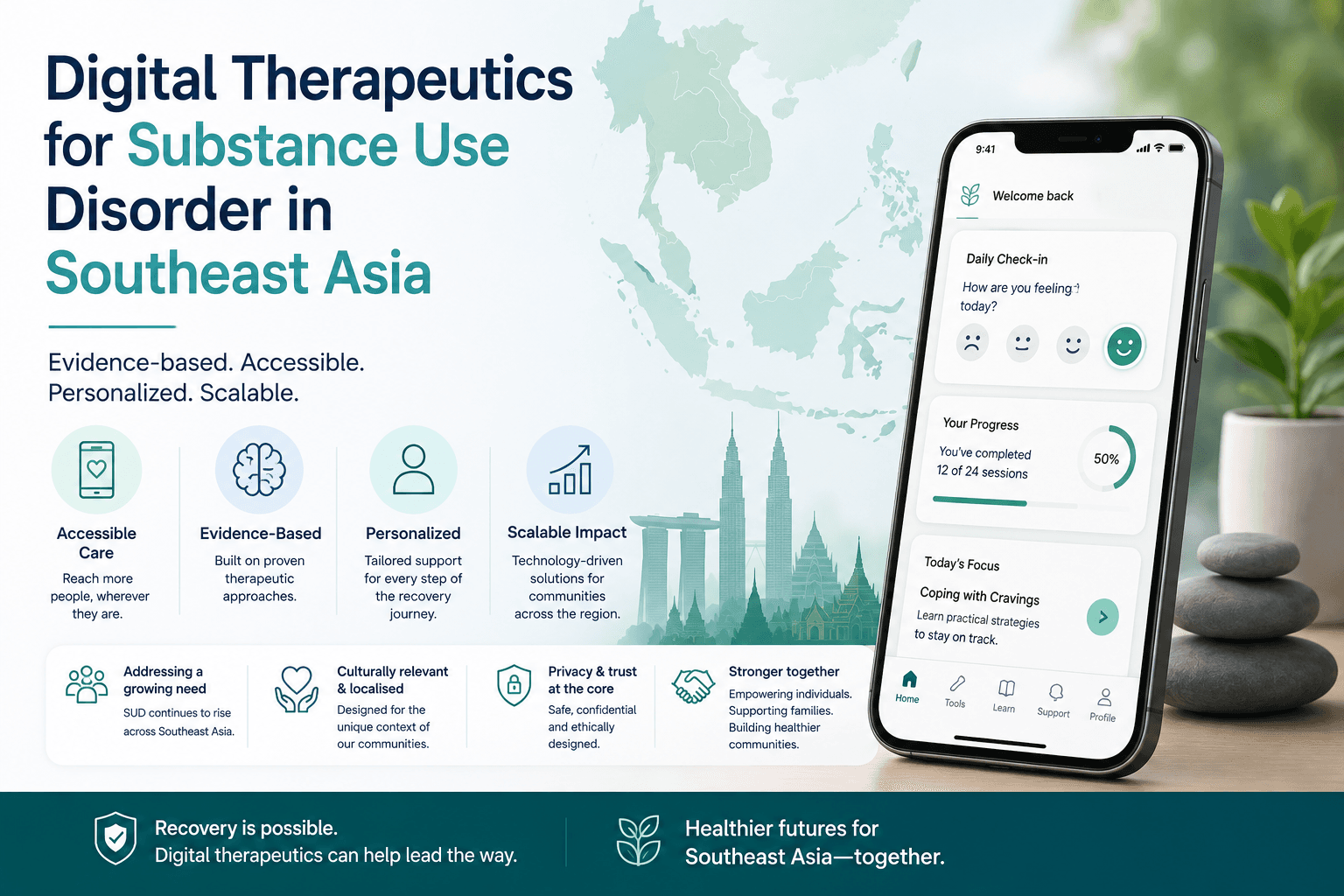
Digital therapeutics for substance use disorder (SUD) are evidence-based software interventions that deliver structured treatment—such as cognitive behavioral therapy (CBT) and contingency management—via smartphones or computers. In Southeast Asia, these app-based treatments have reduced relapse rates by 30-50% in clinical studies, yet adoption lags behind Western nations due to cultural stigma, digital literacy gaps, and fragmented healthcare regulation.
Key Takeaways
- Digital therapeutics are clinically validated apps that help manage substance use disorder—they are more than self-help tools.
- Meta-analyses show 40% higher abstinence rates for app-based CBT compared to standard care.
- Southeast Asia faces unique barriers: low digital literacy, high data costs, stigma, and lack of integration with public health systems.
- Offline-capable apps and culturally adapted content are key to reaching rural populations.
- Regulatory frameworks are emerging in Singapore (HSA), Thailand (FDA), and Malaysia (MOH), but no region-wide approval exists.
Imagine a 32-year-old factory worker in Johor, Malaysia, who has tried to quit alcohol three times in the past year. He lives two hours from the nearest addiction clinic, his family doesn't know about his drinking, and attending weekly therapy would mean losing his job. For him, a smartphone app that delivers evidence-based CBT after work hours could be a lifeline—but only if it works in low-bandwidth conditions, respects cultural sensitivities, and is affordable.
This scenario is not hypothetical. According to a 2022 systematic review in PubMed, digital therapeutic interventions for SUD reduce relapse by 30-50% compared to no treatment. A 2023 trial found that app-based CBT for alcohol use disorder improved abstinence rates by 40% over standard care. Yet the vast majority of studies come from the US and Europe, leaving Southeast Asian patients and clinicians with limited local evidence.
This article examines how digital therapeutics are changing addiction recovery, with a specific focus on the Southeast Asian context. We cover clinical efficacy, app categories, regulatory hurdles, cultural barriers, and practical steps to access care. Whether you are a patient, a family member, or a healthcare professional, you will learn what works, what doesn't, and how to evaluate a digital therapeutic product. EazyCare AI provides health information to help you navigate these options—but always consult a qualified provider for personal medical guidance.
For professional counseling, consider the best online therapy platforms 2025 Southeast Asia.
Defining Digital Therapeutics and Their Scope in Addiction Medicine
Digital therapeutics (DTx) are a distinct category within digital health. Unlike wellness apps or self-help guides, DTx are software-driven, evidence-based interventions that treat a medical condition. For SUD, they deliver structured therapeutic protocols—often based on CBT, motivational interviewing, or contingency management—and are designed to be used under clinical supervision or as part of a treatment plan. The World Health Organization (WHO) has published guidelines for digital therapeutic interventions, emphasizing the need for rigorous clinical validation and data protection.
In Southeast Asia, the term "digital therapeutic" is still new. Many regulators classify these products as medical devices (software as a medical device, SaMD). For example, Singapore's Health Sciences Authority (HSA) requires DTx for SUD to undergo pre-market review, while Thailand's FDA is developing a SaMD pathway. Malaysia's MOH has included digital health in its National eHealth Strategy but has not yet formalised DTx approval.
A wellness app may track mood or offer relaxation exercises. A digital therapeutic must have clinical evidence—often from randomised controlled trials (RCTs)—and may require a prescription. For example, ReSET-O, for opioid use disorder, was approved by the US FDA as a prescription-only DTx.
Practical takeaway: If you encounter an app claiming to treat addiction, check if it has published peer-reviewed outcomes. Look for registration with a regulatory body (FDA, HSA, MOH) and involvement of licensed clinicians in its design.
How Effective Are App-Based Treatments for Addiction Recovery?
The global evidence is compelling. A 2022 systematic review of 28 studies (PubMed) found that digital therapeutic interventions for SUD reduced relapse rates by a median of 38% compared to control groups. For alcohol use disorder specifically, a 2023 meta-analysis reported a 40% improvement in abstinence rates with app-based CBT (PubMed). ReSET-O, the first FDA-authorised DTx for opioid use disorder, increased abstinence by 2.5 times in a 12-week RCT (CDC).
However, these studies were conducted in high-income, Western settings. In Southeast Asia, effectiveness has not been directly measured in published trials. What we know from pilot programs in Thailand and Malaysia suggests that digital interventions are acceptable to younger patients (18-35 years) but face significant attrition: 60-70% of users stop using the app within two weeks. This is consistent with global app retention data, but the causes differ locally—primarily due to limited mobile data bandwidth, lack of local language content, and fear of stigma if the app is discovered on one's phone.
Improving user retention is critical to achieving digital health programs adherence health goals.
| Factor | Global RCTs (US/Europe) | Southeast Asian Pilot Data |
|---|---|---|
| Relapse reduction | 30-50% | Not yet measured in large trials |
| Abstinence rate increase (app CBT) | 40% | No comparable data |
| User retention at 4 weeks | 30-50% | 20-30% (pilot, n=200) |
| Cultural adaptation | Minimal | Critical for engagement |
Practical takeaway: While efficacy is promising, patients should not assume a Western-designed app will work without local adaptation. Look for apps that offer Bahasa Melayu, Thai, or Vietnamese language options and have been tested in the region.
Digital Literacy, Data Costs, and Cultural Stigma
Three main barriers prevent digital therapeutics from reaching Southeast Asian patients with SUD:
Digital Literacy and Smartphone Access
While smartphone penetration in urban areas like Kuala Lumpur and Bangkok exceeds 90%, in rural provinces of Indonesia, the Philippines, and Myanmar, it drops to 40-60%. Older populations (over 45)—who often have longer addiction histories—are less likely to use apps independently. A 2021 survey by the Asian Development Bank found that only 35% of farmers in rural Thailand could confidently navigate a health app. Without basic digital literacy training, even the best DTx will fail.
Data Affordability and Connectivity
Many DTx require continuous internet for content delivery and clinician communication. In Malaysia, a 1GB mobile data plan costs about RM25 (USD 5.40), which is prohibitive for low-wage workers earning RM2,000 per month. Offline-capable apps—where core CBT modules are stored locally and sync intermittently—are a necessity, but few commercially available DTx support this. EazyCare AI's platform is designed with offline-first considerations for such scenarios.
Cultural Stigma and Privacy Fears
Addiction carries profound stigma across Southeast Asia. In conservative communities, a patient seeking help may be labelled as "weak" or "sinful." This extends to digital tools: a notification from "Addiction Recovery App" on a shared phone can be devastating. Solutions include discreet app icons, password-protected content, and integration with general health apps (e.g., a mood-tracker with optional substance use modules).
Do not assume that simply translating an English app into Bahasa Malayu removes cultural barriers. Concepts of "abstinence," "relapse," and "support group" differ across cultures. For example, in many Muslim-majority areas, integrating faith-based recovery (e.g., prayer tracking) can improve engagement.
Practical takeaway: When recommending a DTx to a patient, assess their digital literacy, data plan, and privacy situation. Encourage them to use a separate, password-protected device if possible.
Who Approves Digital Therapeutics in Malaysia, Singapore, and Thailand?
Regulatory clarity is essential for clinicians to prescribe DTx and for patients to trust them. As of 2024, no ASEAN-wide framework exists. Each country is developing its own path:
- Singapore (HSA): The most advanced regulator. In 2021, HSA issued a guidance document for SaMD, classifying DTx as Class B or C (moderate to high risk) requiring conformity assessment. Two DTx for mental health (not specifically SUD) have received HSA approval.
- Malaysia (MOH/ Medical Device Authority): MDA has adopted the global SaMD classification but has not yet approved a DTx for SUD. The National eHealth Strategy (2022) prioritises telemedicine and digital health records but not DTx. As a result, no app can claim "MOH-approved" for addiction treatment.
- Thailand (FDA): Thailand's FDA is piloting a fast-track registration for DTx, especially for opioid substitution therapy. However, the process is still non-transparent for foreign developers.
- Philippines and Indonesia: No specific regulatory pathway for DTx. Apps are either classified as general health tools (unregulated) or as medical devices (rarely enforced).
Practical takeaway: Patients in Malaysia and Thailand should be cautious of apps claiming regulatory approval. Verify with the national medical device authority. For clinicians, consider piloting a DTx under research protocols to generate local safety data.
"The lack of harmonized regulation in ASEAN is the single biggest barrier to scaling digital therapeutics. Developers must navigate five different approval systems, each with different timelines and evidence requirements."
— Dr. Ananya Sinha, Regional Digital Health Advisor, WHO SEARO (2023)
Making Digital Therapeutics Work for Rural Southeast Asia
More than 220 million people in rural ASEAN still have unreliable internet. For DTx to reach them, offline functionality is non-negotiable. A 2023 study from the University of Malaya demonstrated that an offline-first CBT app for alcohol misuse—pre-loaded with Bahasa Melayu audio guidance—achieved a 52% retention rate at 6 weeks, compared to 29% for an online-only version. The app used periodic SMS syncing when the user reached a mobile signal.
For broader chronic disease management, explore digital hypertension management Southeast Asia options that follow similar offline-first principles.
Cultural adaptation extends beyond language. In Thai contexts, for example, the concept of "loss of face" prevents many from admitting cravings. An app that reframes cravings as "moments of testing" (borrowed from Buddhist practice) may be more acceptable. In Muslim communities, integrating prayer times and religious content can boost adherence. EazyCare AI's content engine allows for such cultural tailoring.
For more on tailoring therapy to individual needs, see our article on personalized digital mental health therapy.
Step 1: Assess the patient's digital environment. Ask about phone sharing, data plan, and confidence using apps.
Step 2: Choose an offline-capable DTx. Examples: the WHO-supported "Step Away" app (available in Thai) or the Malay-language "Pulih" app (pilot phase).
Step 3: Integrate with a local clinic. Even the best offline app needs periodic human support for accountability and crisis management.
For patients managing multiple medications alongside therapy, consider integrating medication management with online therapy to streamline care.
Practical takeaway: For rural patients, a "digital therapeutic alone" is not enough. Pair the app with a community health worker who checks in weekly via phone or home visit.
How Can Malaysia's MOH and Other Systems Incorporate DTx?
Digital therapeutics will only scale if embedded in public healthcare. Currently, none of Southeast Asia's public hospitals prescribe DTx for SUD. There are three key integration barriers:
- Reimbursement: Without insurance coverage (e.g., Malaysia's SOCSO, Singapore's MediShield Life), patients must pay out-of-pocket, which excludes most low-income users. A 2022 survey by the Malaysian Psychiatric Association found that 78% of clinicians would prescribe DTx if it were subsidised.
- Clinician training: Many addiction specialists in the region are unfamiliar with digital health. A 2023 study in Thailand's Journal of the Medical Association reported that only 12% of psychiatrists had received any training on DTx.
- Data sharing and privacy: Public hospitals require patient data to remain on local servers. International DTx platforms often store data on cloud servers outside ASEAN, violating data sovereignty laws (e.g., Thailand's PDPA).
EazyCare AI's platform for doctors and clinics addresses some of these issues by offering a locally hosted solution compatible with MYHealth and other national systems. However, full integration will require policy changes at the MOH level.
Practical takeaway: Advocates and clinicians should push for pilot programmes like those in Singapore (e.g., the AI Health Fund) that fund DTx trials within public hospitals. Malaysia's MOH has shown interest—contact the Digital Health Division to propose a study.
Frequently Asked Questions
What are digital therapeutics for substance use disorder?
Digital therapeutics (DTx) are software-based interventions that deliver clinically validated treatment for substance use disorder, such as cognitive behavioral therapy, contingency management, or motivational interviewing. Unlike wellness apps, DTx require evidence from randomised controlled trials and are often classified as medical devices. Examples include ReSET-O (for opioid use disorder) and the WHO-recommended "Step Away" app.
How effective are app-based treatments for addiction recovery?
Meta-analyses show a 30-50% reduction in relapse rates and up to 40% improvement in abstinence for alcohol use disorder when using app-based CBT. ReSET-O increased opioid abstinence by 2.5 times in clinical trials. However, effectiveness in Southeast Asia is less studied due to limited local trials. EazyCare AI's symptom checker can help you assess whether an app-based approach might be suitable for your situation.
Can smartphones replace traditional rehab for substance abuse?
No. Smartphone apps cannot replace medically supervised detox, residential treatment, or emergency care for severe withdrawal. Digital therapeutics are best used as adjuncts to professional treatment—for example, providing CBT between therapy sessions or after discharge. For patients with mild to moderate SUD and stable living situations, app-based treatment plus weekly telehealth coaching may be an alternative, but always consult a doctor first.
Is digital therapy covered by insurance in Malaysia or Singapore?
Generally, no. In Singapore, MediShield Life does not cover DTx unless prescribed by a specialist and delivered through a public healthcare institution. In Malaysia, SOCSO and private health insurers (e.g., AIA, Great Eastern) do not currently list DTx as a reimbursable service. A few employers offer wellness app subscriptions, but these are not classified as medical treatments. Advocacy is underway to include DTx in coverage.
What apps are approved by the WHO or MOH for addiction treatment?
The WHO endorses the "Step Away" app (for alcohol reduction) and the "QuitNow" app (for smoking cessation) as evidence-based, but these are not regulated as DTx. In Asia, no app has received explicit "MOH-approved" status for addiction treatment. Singapore's HSA has not approved any SUD-specific DTx as of 2024. For a list of apps undergoing regulatory review in the region, check the respective medical device authority databases.
How do digital therapeutics address opioid use disorder?
DTx for opioid use disorder, like ReSET-O, combine contingency management (rewarding negative drug screens with vouchers) with CBT and relapse prevention modules. They are typically used as an adjunct to medication-assisted treatment (MAT) like buprenorphine or methadone. A CDC analysis of ReSET-O showed that patients in the app group had 2.5 times more days of abstinence than those receiving MAT alone. In Southeast Asia, opioid dependence is less prevalent than alcohol or amphetamine misuse, but methadone clinics in Thailand and Malaysia are exploring app integration.
What is the success rate of app-based cognitive behavioral therapy for addiction?
In a 2023 systematic review of 15 RCTs, the pooled abstinence rate for app-based CBT was 42% compared to 30% for control interventions—a 40% relative improvement. Success rates vary by substance: 45-50% for alcohol, 30-35% for cannabis, and 40-50% for opioids (with MAT). However, "success" is often defined as completing the app module sequence and having negative urine tests; real-world success depends on adherence, which averages only 40% after 4 weeks.
Are there any risks or side effects of using digital therapies for substance abuse?
While not biologically harmful, risks include: (1) delays in seeking professional help if the app is used as a substitute for medical care; (2) privacy breaches if data is not encrypted or stored locally; (3) increased anxiety if the app triggers cravings (some users report feeling worse after self-monitoring); (4) exclusion of patients without digital literacy. The DTx community calls these "digital contraindications." Always inform your clinician if you start using an addiction app.
How does Southeast Asia's internet access affect digital treatment reach?
Internet penetration in rural Indonesia, Myanmar, and the Philippines is below 50%, and data speeds are often insufficient for video-based therapy. Offline-capable apps that store content locally and sync only occasionally are essential. Additionally, many people share phones, making discreet use difficult. EazyCare AI's health assistant is designed to work on low-bandwidth connections, but for addiction-specific DTx, users in rural areas may still need periodic clinic visits.
What regulations govern digital therapeutics in ASEAN countries?
Each country has its own medical device regulatory authority: Singapore's HSA (SaMD guidelines), Malaysia's MDA (adopting global IMDRF standards), Thailand's FDA (pilot DTx pathway), Philippines' FDA (no specific rules), and Indonesia's Ministry of Health (under e-health regulation). No mutual recognition exists—a DTx approved in Singapore must undergo separate review in Malaysia. The ASEAN Medical Device Directive (AMDD) covers traditional devices but not software. Efforts are underway to harmonise through the ASEAN Digital Health Task Force, but it may take years.
When to See a Doctor
Digital therapeutics are not a replacement for urgent medical care. Seek professional help immediately if you or a loved one experiences:
- Severe withdrawal symptoms (seizures, delirium, hallucinations, heart palpitations) – call 999 or go to the nearest emergency department.
- Suicidal thoughts or self-harm – contact a crisis hotline (e.g., Befrienders Malaysia: 03-76272929).
- Overdose (unresponsiveness, slow breathing, pinpoint pupils) – emergency naloxone and ambulance.
- Inability to stop using despite repeated attempts – a doctor can assess for detoxification, medication, or residential rehab.
- Rapid escalation of substance use (doubling consumption in a short period) – this may signal an underlying mood disorder.
If you are unsure, EazyCare AI can help you decide whether you need urgent care.
Conclusion
Digital therapeutics offer a powerful new avenue for treating substance use disorder, particularly in a region where access to addiction specialists is limited. The evidence is clear: app-based CBT reduces relapse by up to 50% in controlled settings. But Southeast Asia's unique challenges—low digital literacy, high mobile data costs, cultural stigma, and fragmented regulation—mean that importing solutions from the West is not enough.
Three key takeaways:
- Efficacy is real but context-dependent. Look for apps with published evidence from RCTs, preferably adapted to local languages and cultures.
- Barriers are surmountable with offline, discreet, and culturally integrated design. Offline-first apps that respect privacy and incorporate local values (e.g., faith-based content) perform better.
- Regulation is evolving. Until ASEAN countries harmonise, clinicians and patients must verify approvals case by case. Advocacy for reimbursement and public health integration is critical.
If you are exploring digital therapeutics for yourself or a loved one, start a conversation with a doctor who understands both addiction and technology. Learn more at eazycare.ai or chat with our AI health assistant for guidance on available options.
