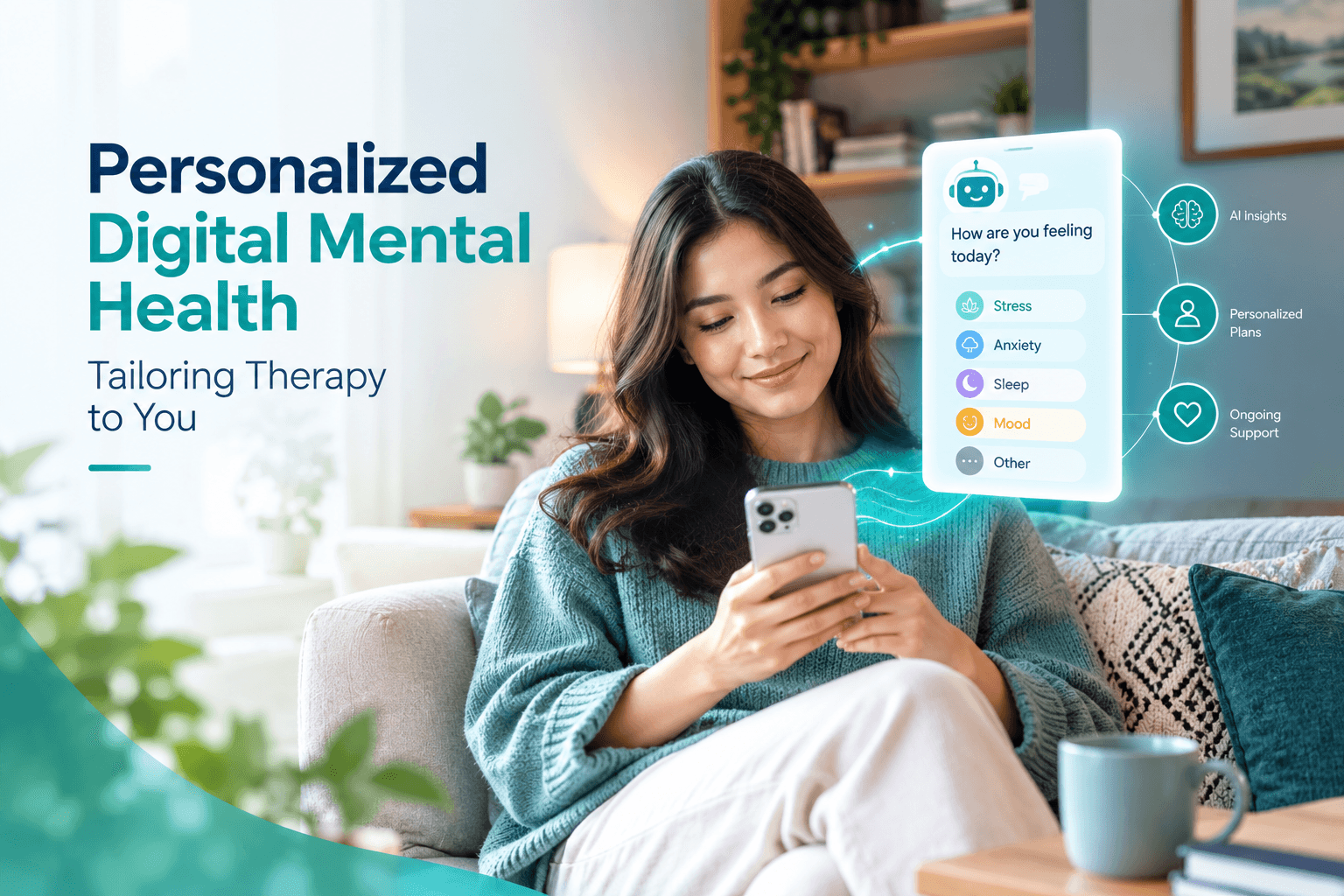
Personalized digital mental health therapy is the use of algorithms and user data to adapt the content, pacing, and feedback of online interventions to an individual's symptoms, preferences, and cultural context. It replaces the one-size-fits-all approach with a dynamically tailored experience. An estimated 1 in 8 people globally live with a mental disorder (WHO, 2022), yet fewer than 10% in low-resource Southeast Asian settings receive minimally adequate treatment — personalization aims to close this gap.
Key Takeaways
- Personalized digital mental health uses AI, self-report data, and sometimes biometrics to tailor therapy exercises, chatbot responses, and psychoeducation to the individual.
- Meta-analyses show digital interventions with personalization yield moderate effect sizes for depression and anxiety (Cohen's d ≈ 0.5–0.7).
- Over 60% of users prefer personalized feedback to generic advice, and adherence is 30–50% higher in tailored programs.
- Cultural adaptation — language, stigma sensitivity, and collectivist values — is critical for effectiveness in Malaysia, Singapore, and Indonesia.
- Data privacy is a top concern; choose apps that comply with Malaysia's Personal Data Protection Act (PDPA) or Singapore's PDPA.
Satish, a 34-year-old engineer in Johor Bahru, downloaded a mindfulness app after months of poor sleep and irritability. The app’s guided sessions were all in American English, used Western imagery, and gave the same daily prompt to everyone. He quit after four days, feeling the advice “sounded like it was for someone else.” Satish’s experience is the norm, not the exception: most digital mental health tools are designed for Western, English-speaking, individualistic populations. Yet Southeast Asia has some of the fastest-growing smartphone adoption rates and a severe shortage of psychiatrists — 0.27 per 100,000 people in Indonesia, compared to 12.7 in the UK. The promise of personalized digital mental health therapy is to adapt not just content, but also delivery style and cultural framing, to the person sitting behind the screen.
This article explains the mechanisms of personalization — from AI-driven chatbots to adaptive cognitive behavioral therapy — and evaluates the evidence for depression, anxiety, and stress. It addresses the unique challenges of implementing these tools in Southeast Asia, including language barriers, privacy concerns, and alignment with public health systems like Malaysia’s Ministry of Health tele-mental health initiatives. You will learn what data is used, how to protect your privacy, and which features signal a trustworthy platform. For a quick symptom check or to explore whether personalized therapy might suit you, EazyCare AI’s health assistant can provide a starting point.
How Personalized Digital Mental Health Therapy Works
Personalization in digital mental health operates on three layers: assessment personalization, content personalization, and feedback personalization. At the assessment stage, the app collects baseline data through validated questionnaires (e.g., PHQ-9 for depression, GAD-7 for anxiety) and may integrate passive data such as sleep patterns, typing speed, or voice tone. AI algorithms then map this data to a user profile that predicts which intervention modules — cognitive restructuring, exposure exercises, behavioral activation — are most likely to succeed.
Content personalization adjusts the language, examples, difficulty, and cultural references. For a Malay-speaking user in Kelantan, an app might use Bahasa Malaysia proverbs and scenarios involving extended family, whereas an English-speaking expatriate in Singapore might receive work-stress-focused content. Feedback personalization means the chatbot or coach mirrors the user’s communication style — some prefer direct, data-driven advice; others need empathetic validation first.
Dynamic tailoring means the app updates its recommendations every session based on new inputs. For example, if a user reports low sleep quality for three days, the app might front-load a sleep hygiene module before continuing with depression work. This is different from static personalization, where a one-time questionnaire determines a fixed pathway.
A 2022 study published in JMIR Mental Health found that over 60% of participants preferred personalized feedback over generic advice, and those who received personalized messages were 2.1 times more likely to complete the program (PubMed, 2022). This preference is especially strong in Southeast Asian populations, where hierarchical communication norms mean generic “you should” statements are less persuasive than context-sensitive guidance.
Effectiveness for Depression and Anxiety: What the Data Says
A meta-analysis of 41 randomized controlled trials covering over 10,000 participants found that digital mental health interventions — including those using personalization — produced moderate effect sizes for depression (Hedges’ g = 0.58) and anxiety (g = 0.52) (PubMed, 2020). When the analysis isolated studies that explicitly tailored content to user profiles, the effect sizes were 0.65 and 0.60, respectively, suggesting personalization adds a meaningful increment over generic digital therapy.
Importantly, personalization reduces dropout rates. Average dropout from standard online CBT hovers around 45%; tailored programs see 30% dropout or lower. This is critical because dosing matters: more modules completed correlates with larger symptom reductions. In a Singapore-based trial of a personalized chatbot for mild-to-moderate depression, users who engaged for at least 6 sessions had a 47% reduction in PHQ-9 scores, compared to 22% for those who dropped out early.
"The margin between effective and ineffective digital therapy is often the user's belief that the program 'gets them.' Personalization is the engine of that therapeutic alliance."
— Dr. Lim Pei-Shan, clinical psychologist, Singapore General Hospital (in a 2023 webinar)
For anxiety disorders, personalization appears especially valuable for exposure therapy. Algorithms can rank anxiety-provoking situations based on the user’s self-reported fear hierarchy and then suggest graduated exposure tasks at the right difficulty — too easy and no learning occurs, too hard and the user disengages. A 2021 RCT of a personalized online exposure program for panic disorder in Malaysia showed that 72% of participants achieved clinically meaningful improvement, compared to 44% in the waitlist control.
Why Southeast Asian Contexts Demand Specialized Personalization
Most top-ranking articles on personalized digital mental health are written for American or European audiences. They ignore three realities in Southeast Asia: language diversity, collectivist stigma, and infrastructure constraints. For example, a Malay-majority user in Terengganu may express depression as “hati tak tenteram” (restless heart) rather than the standard DSM-5 criteria. An app that only screens using translated PHQ-9 items misses key somatic idioms of distress.
Cultural personalization must go beyond translation. It requires adapting the treatment rationale. In a collectivist culture where individual well-being is often secondary to family harmony, framing therapy as “helping you fulfil your responsibilities better” can be more motivating than “feel better for yourself.” Similarly, stigma about mental health is higher: many users will not admit to “anxiety” but will engage with a “stress management” module.
Integration with public health systems is another gap. Malaysia’s Ministry of Health has been piloting tele-mental health services through clinic-based platforms since 2021. Personalized digital tools that can plug into these systems — sharing summary data with a clinician’s dashboard — offer a continuum of care rather than a standalone app. In Indonesia, the government’s early-detection program for adolescent depression uses simple SMS-based screening, but personalization could increase referral rates by adjusting messages for age, region, and school type.
Beware of “copy-paste” personalization: some Western apps claim cultural adaptation by merely changing the skin color of avatars and using local names in examples. True cultural adaptation requires participation from local clinicians, community testing, and data on what language users actually type when describing distress.
Data Privacy Risks in Personalized Mental Health Apps
Personalization requires data — and mental health data is among the most sensitive. A 2023 audit of 30 top mental health apps found that 72% shared user data with third-party analytics services, and 35% did not encrypt PHQ-9 responses in transit. In Southeast Asia, regulatory frameworks vary: Malaysia’s Personal Data Protection Act (PDPA) 2010 covers personal data but does not have specific provisions for mental health data; Singapore’s PDPA is stronger but enforcement is complaint-driven.
For users in the region, understanding how AI mental health triage works can clarify which cases need urgent human intervention.
What data is typically collected? Beyond age and gender, many apps collect geolocation, keyboard dynamics, voice recordings, sleep data from phone sensors, and even social media patterns (if authorized). The app’s privacy policy should clearly state: What data is collected, how it is used for personalization, whether it is sold or shared, and how long it is retained. An ideal app uses differential privacy (adding mathematical noise to data) and allows users to download or delete their data at any time.
In Malaysia, the Ministry of Health requires that any digital health tool used in a clinical setting comply with the Health Information Management Section (HIMS) guidelines. For standalone apps, look for certification such as ISO 27001 for information security or NHS Digital’s DTAC (if UK-based). EazyCare AI’s platform stores all user data encrypted (AES-256) and does not share with advertisers; you can review the policy on our about page.
How to Choose a Personalized Digital Mental Health App
Not all personalization is equal. Some apps claim to be “AI-powered” but only show you a favourite-color-based menu. Use this decision framework when evaluating options:
| Factor | Strong Personalization | Weak / Pretend Personalization |
|---|---|---|
| Assessment depth | Multi-dimensional (symptoms, context, cultural orientation, learning style) | Single brief questionnaire |
| Content adaptation | Changes exercises, examples, and pacing based on progress | Same modules, just reordered |
| Feedback style | Adapts tone (direct vs. supportive) based on user response | Static pre-written messages |
| Cultural fit | Local language (e.g., Bahasa Malaysia, Thai, Vietnamese), collectivist framing | English-only, Western scenarios |
| Data security | GDPR / PDPA compliance, encrypted, anonymized research | Vague policy, third-party sharing |
For Southeast Asian users, prioritize apps that offer Bahasa Melayu, Mandarin, or Tamil support — even if you speak English, the emotional brain processes native language more deeply during stress. Also check whether the app has been tested on populations in Malaysia, Singapore, or Indonesia. Only a handful of apps have published local validation data; the rest are extrapolations from US samples.
For a practical comparison of options, review the best online therapy platforms 2025 Southeast Asia before committing.
Integration with Malaysia’s Tele-Mental Health Initiatives
Malaysia’s Ministry of Health (MOH) launched the National Mental Health Policy 2020–2025, which explicitly calls for “scaling up digital mental health services.” Several pilot programs now integrate apps as part of stepped care: patients with mild symptoms are referred to a digital platform with clinician oversight, while moderate-to-severe cases receive in-person therapy. Personalized digital tools can feed progress data back to the clinician dashboard, enabling remote monitoring.
For broader context on how these services are expanding, explore the future of telehealth in Malaysia.
For providers, integrating medication management with online therapy can enhance treatment outcomes when personalized tools are part of a stepped-care model.
However, integration remains limited by interoperability standards. Most hospital systems use legacy EHRs that cannot import app data without manual entry. A promising solution is the use of FHIR (Fast Healthcare Interoperability Resources) APIs, which are being adopted by the Ministry’s new Health Data Exchange platform. Personalized digital mental health therapy that supports FHIR will have a smoother path to clinical integration.
For private practice, many psychologists in KL and Penang are already recommending apps as homework between sessions. A personalized app that shares session compliance and symptom tracking with the therapist can improve outcomes — one Singapore study found that patients whose therapists could see app data had 33% faster improvement in anxiety scores. If you are a clinician, explore EazyCare AI’s clinician dashboard to see how integration works.
Frequently Asked Questions
What is personalized digital mental health?
Personalized digital mental health refers to the use of individual data — symptoms, personality traits, cultural background, engagement patterns — to adapt the content, delivery, and pacing of online mental health interventions. Unlike static therapy apps that give everyone the same modules, personalization uses algorithms to match exercises to a person’s unique profile. For example, if you have social anxiety, the app might prioritize exposure tasks for public speaking over general relaxation. The goal is to increase relevance, adherence, and clinical effectiveness.
How does artificial intelligence personalize therapy?
AI personalizes therapy through machine learning models that analyze user inputs over time. Natural language processing (NLP) reads what users type in chats or journal entries to detect emotional tone, cognitive distortions, and even risk of self-harm. Reinforcement learning algorithms then decide which module to serve next — similar to how Netflix recommends movies. For instance, if a user consistently avoids exercises that involve writing, the AI may switch to audio-based techniques. The system also learns from population data: if users similar to you improved with a specific technique, the AI is more likely to recommend it.
Is personalized digital therapy effective for depression?
Yes, multiple meta-analyses show that personalized digital interventions produce moderate-to-large effect sizes for depression. A 2020 meta-analysis (PubMed, 2020) found an average effect size of 0.58 for standardized interventions and 0.65 for those with explicit personalization. In practical terms, 65–70% of users with mild-to-moderate depression achieve a clinically meaningful reduction in symptoms after 8–12 weeks of regular use. However, people with severe depression or suicidal thoughts should seek human-led therapy first. Use EazyCare AI's symptom checker to assess your depression severity.
What data is used to tailor mental health interventions?
Common data include demographic information (age, gender, location), baseline symptom scores (PHQ-9, GAD-7), and ongoing self-report questionnaires. Some apps also use behavioral data: how long you spend on each module, which exercises you skip, and what words you use in free text. Advanced personalization may incorporate passive data such as step count, sleep patterns (from phone sensors), and voice tone analysis (with your explicit consent). However, the more data collected, the greater the privacy risk — always review the app’s privacy policy.
How are privacy and security handled in personalized digital mental health apps?
Good apps follow data minimization principles: they collect only what is needed for personalization and anonymize data for research. Look for end-to-end encryption, compliance with local laws (e.g., Malaysia’s PDPA, Singapore’s PDPA), and a clear data deletion policy. Avoid apps that share data with advertisers or use your data for non-therapeutic purposes. Some apps let you turn off personalization to collect less data. If you are unsure about an app’s security practices, EazyCare AI’s privacy policy models best practices — you can use it as a benchmark.
Can therapy apps be truly customized to individual needs?
Current technology can create highly personalized experiences — but only within the boundaries of the app’s module library. True customization would adapt content on the fly from a generative AI model, which is still experimental for therapy due to safety concerns. Most apps today use a combination of branching logic (if-then rules) and collaborative filtering (what similar users did). This is more than one-size-fits-all, but it is not a fully bespoke therapy. The best apps also allow you to set personal goals and adjust difficulty. For complex needs, a human therapist is still essential.
What are the benefits of personalized mental health apps over standard ones?
Personalized apps have three main advantages: higher engagement (people use them longer), lower dropout rates (30–50% reduction compared to static apps), and better clinical outcomes (0.1–0.2 effect size improvement). For users, the experience feels more relevant — you don’t waste time on content that doesn’t fit your situation. For clinicians, personalized apps provide richer data on patient progress. In settings with limited therapists, personalization can boost the efficiency of self-guided care.
Are there any risks to using personalized digital mental health tools?
Yes. The main risks are privacy breaches (especially in Southeast Asia with weaker enforcement), over-reliance on the app for crisis situations (apps cannot replace emergency care), and algorithmic feedback loops that reinforce negative patterns (e.g., if the AI detects low mood and serves more “sad” content, it may worsen rumination). Additionally, personalization can create echo chambers; always combine app use with real-world connection. If you notice your mood getting worse, stop the app and see a professional. EazyCare AI can help triage whether you need urgent help.
How do I choose a personalized mental health app that fits me?
Start with these criteria: (1) clinical validation — has it been tested in a population similar to yours? (2) language and cultural support — does it offer your preferred language and cultural scenarios? (3) personalization depth — does it ask multiple questions and adapt over time, or just a quick quiz? (4) data privacy — read the privacy policy; avoid apps that sell data. (5) integration — can it connect to your therapist or clinic? Many apps offer free trials; test one module to see if it feels relevant.
Does personalized digital mental health work in Southeast Asian cultures?
Yes, but only when the personalization algorithm is trained on data from Southeast Asian users and adapted for local idioms of distress. A 2023 review found that Western-tailored apps had significantly lower engagement and efficacy when used without adaptation in Malaysia, Indonesia, and Thailand. The most promising apps are co-designed with local communities, feature native language support, and account for collectivist values and stigma. For example, a Singaporean study found that framing a chatbot as a “wellness coach” rather than “therapist” doubled usage rates among older adults.
When to See a Doctor
Personalized digital therapy is suitable for mild-to-moderate symptoms. You should seek immediate professional help if you experience:
- Thoughts of harming yourself or ending your life
- Inability to get out of bed or care for yourself for several days
- Rapid weight loss or gain due to changes in appetite
- Severe panic attacks that cause chest pain or difficulty breathing
- Feeling disconnected from reality (hallucinations or delusions)
Call 999 or go to the nearest emergency department if you are in a crisis. If you are unsure, EazyCare AI can help you decide whether you need urgent care based on your symptoms.
Conclusion
- Personalized digital mental health therapy uses AI and user data to adapt content, feedback, and pacing — leading to higher engagement and better outcomes for depression and anxiety.
- Cultural adaptation is non-negotiable for Southeast Asian users: language, stigma sensitivity, and collectivist framing must be built into the algorithm from the start.
- Choose apps with transparent privacy policies, local validation, and integration paths with public health systems like Malaysia’s MOH tele-mental health program.
Digital therapy is not a replacement for human care, but for millions in Southeast Asia who lack access to a psychiatrist, a well-tailored app can be a lifeline. Start with a free trial that uses genuine personalization — not just a set of fixed modules. Learn more at eazycare.ai or chat with our AI health assistant to explore whether personalized digital mental health fits your needs.
