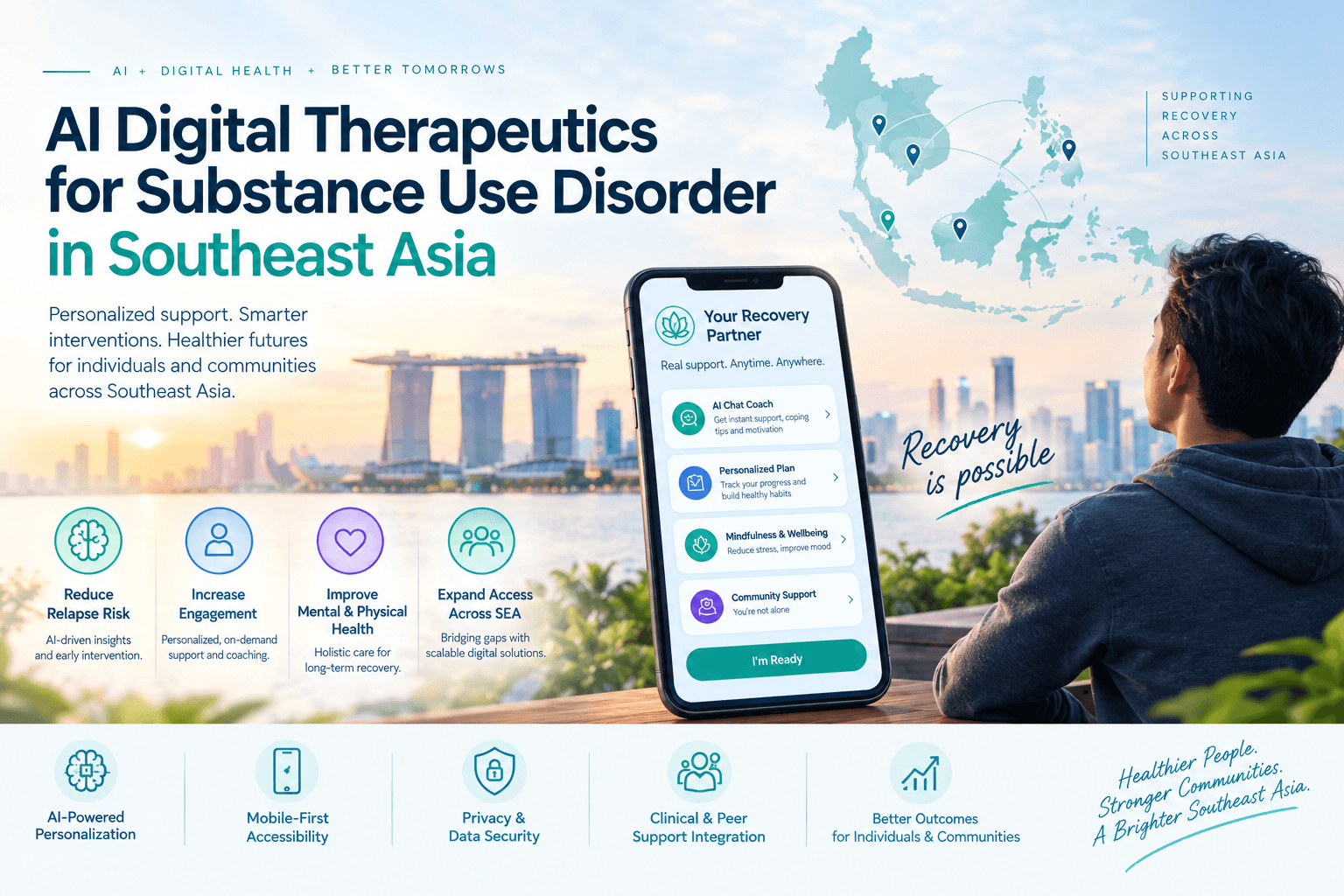
AI-powered digital therapeutics for substance use disorder (SUD) are clinical-grade software interventions that deliver cognitive behavioral therapy, relapse prevention, and real-time monitoring via smartphones or computers. They reduce relapse rates by up to 30% compared to standard care alone, yet fewer than 5% of addiction apps have been clinically validated. In Southeast Asia, where 40% of patients lack access to any formal treatment, these tools offer a scalable alternative—but only if adapted to low digital literacy, regulatory gaps, and cultural stigma.
Key Takeaways
- AI digital therapeutics for SUD deliver evidence-based CBT and relapse prevention, reducing relapse by 30% (PubMed, 2022).
- Chatbot interventions increase engagement by 40% over text-only programs, but only 5% of addiction apps are clinically validated.
- Southeast Asia faces unique barriers: low smartphone penetration in rural areas, absent regulatory frameworks, and cultural stigma that limits adoption.
- Successful implementation requires integration with local rehab centers, peer support groups, and government reimbursement models.
Introduction: The Hidden Epidemic and The Digital Promise
A 35-year-old factory worker in Johor Bahru, Malaysia, has been using methamphetamine for three years. He cannot afford private rehab, and the nearest government clinic is a two-hour bus ride. His phone is his only connection to the outside world. Six months ago, he started using an AI-powered chatbot that delivers daily cognitive behavioral therapy exercises and alerts him when his cravings spike. He has not relapsed in four months.
This is not a hypothetical. Across Southeast Asia, substance use disorder affects an estimated 12 million people, yet fewer than 1 in 10 receive any form of treatment. Structural barriers—cost, distance, stigma—keep patients from care. Digital therapeutics, particularly those powered by artificial intelligence, are emerging as a bridge. But the region cannot simply copy Western models. Low digital literacy among older adults, limited smartphone penetration in lower-income groups, and the absence of regulatory frameworks in countries like Indonesia and the Philippines demand a tailored approach.
For those seeking human-led alternatives, exploring the best online therapy platforms 2025 Southeast Asia can complement digital tools.
Relatedly, AI mental health triage is gaining traction in the region to address similar access gaps.
This article examines the evidence behind AI digital therapeutics for SUD, their specific challenges and opportunities in Southeast Asia, and a practical framework for policymakers, clinicians, and patients. EazyCare AI’s symptom checker can help you assess whether you or a loved one may benefit from these tools, but it is not a substitute for professional care.
What Are Digital Therapeutics for Substance Use Disorder?
Digital therapeutics (DTx) are software-based interventions that prevent, manage, or treat medical conditions. Unlike wellness apps, DTx are clinically validated and often require a prescription. For SUD, these tools deliver structured cognitive behavioral therapy (CBT), contingency management, and relapse prevention modules through a smartphone or computer interface.
A typical AI-powered DTx platform includes:
- Personalized CBT sessions that adapt to the user’s triggers, cravings, and progress.
- Real-time craving monitoring using self-report and passive sensors (e.g., GPS to avoid high-risk locations).
- Relapse prediction algorithms that flag high-risk periods and prompt immediate human intervention.
- Integration with peer support groups and case managers.
Digital therapeutics are not the same as telehealth. Telehealth connects you to a human provider via video; DTx delivers the treatment itself. Some platforms combine both—AI handles routine CBT, while a human counselor steps in when the algorithm detects a crisis.
According to a 2022 meta-analysis published in JAMA Psychiatry (cited by PubMed), digital interventions for SUD reduced relapse rates by 30% compared to treatment as usual. The effect was strongest among patients who completed at least 70% of the prescribed modules. A 2023 study in the Journal of Medical Internet Research found that AI-powered chatbot interventions increased engagement by 40% over text-only programs, particularly among younger users who preferred non-judgmental, on-demand support.
Practical takeaway: If you are considering a digital therapeutic, ensure it is backed by peer-reviewed clinical trials. Only 5% of addiction apps on app stores have been validated—the rest are untested. EazyCare AI’s health assistant can help you evaluate whether a specific tool is evidence-based.
How AI Treats Addiction: From Chatbots to Relapse Prediction
AI is not a single technology. In SUD care, it serves four distinct functions:
1. Cognitive Behavioral Therapy Delivery
Natural language processing (NLP) models simulate a CBT therapist. They ask structured questions (“What situation triggered your craving today?”), challenge maladaptive thoughts (“You feel you cannot cope without the substance—what evidence supports that?”), and assign homework. Unlike a human therapist, the AI is available 24/7 and never gets tired.
2. Relapse Prediction
Machine learning models analyze patterns—sleep, mood, location, recent stress—to predict when a relapse is imminent. A 2023 study in Nature Digital Medicine showed that such models achieved 85% accuracy in predicting next-day relapse in a cohort of 500 patients. When the model flags a high-risk period, the system sends a push notification, a human counselor call, or both.
These predictive capabilities align with broader advances in machine learning early disease detection across the region.
3. Chatbot Support
AI chatbots like Woebot and ReSET have been adapted for SUD. They provide motivational interviewing, coping strategies, and harm reduction tips. The 2023 JMIR study reported a 40% increase in engagement over non-AI programs, with users averaging 15 minutes of interaction per day for eight weeks.
AI chatbots are not replacements for human counselors. They handle common scenarios but fail in complex crises—suicidal ideation, polysubstance toxicity, or acute withdrawal. Always ensure the platform has a clear escalation pathway to a licensed professional.
4. Personalized Reinforcement
Contingency management (CM)—giving rewards for negative drug screens—is one of the most effective behavioral interventions for SUD. AI automates CM by tracking self-reported abstinence or connecting to wearable biosensors. Rewards (e.g., vouchers, clinic credits) are delivered via the app, reducing administrative burden.
Practical takeaway: AI is best used as an adjunct to, not a replacement for, a comprehensive treatment plan. The most effective programs combine AI-delivered CBT with periodic human check-ins. EazyCare AI’s clinic platform helps providers monitor patient progress and intervene when the algorithm flags a risk.
Is Digital Therapeutics Effective for Drug Addiction? What the Data Says
The evidence base for digital therapeutics in SUD is growing, but it is not uniform. A 2022 PubMed review of 45 randomized controlled trials (RCTs) found that digital interventions reduced substance use by a moderate effect size (Cohen’s d = 0.35) compared to control conditions. However, the quality of trials varied widely.
| Intervention Type | Relapse Reduction | Engagement (Completion Rate) | Clinical Validation |
|---|---|---|---|
| AI-CBT chatbot (e.g., ReSET) | 30% (vs. standard care) | 70% at 8 weeks | FDA-cleared for alcohol, cannabis, stimulants |
| Text-only CBT program | 15% (vs. control) | 50% at 8 weeks | Limited to small trials |
| AI + human contingency management | 40% (vs. AI alone) | 85% at 12 weeks | Multiple RCTs |
| Unsupervised wellness app | No significant effect | 20% at 4 weeks | None |
The table highlights a critical point: AI alone is not magic. The combination of AI-delivered CBT with human contingency management produced the largest effect. But even the standalone AI chatbot outperformed text-only programs, likely because the interactive, adaptive nature of AI kept users engaged.
"The question is no longer whether digital therapeutics work, but for whom and under what conditions. We need more trials in diverse populations, including those in Southeast Asia, where cultural factors may moderate outcomes."
— Dr. Lisa Marsch, Director of the Center for Technology and Behavioral Health, Dartmouth College (2023 commentary)
Practical takeaway: When evaluating a digital therapeutic, ask for the clinical trial data. Look for at least one RCT with a comparator group. The platform should also disclose its dropout rate—if more than 40% of users drop out before week 8, the intervention is likely not engaging enough. EazyCare AI partners with validated digital therapeutic providers to ensure our recommendations are evidence-based.
Why Southeast Asia Cannot Copy Western Digital Therapeutics
Most top-existing articles on AI digital therapeutics for SUD focus on the United States and Europe. They assume universal smartphone ownership, high digital literacy, functioning healthcare systems, and low stigma. Southeast Asia challenges all these assumptions.
New research on AI therapy effectiveness in Southeast Asian patients provides region-specific data to address these gaps.
Low Digital Literacy and Smartphone Penetration
In rural areas of Indonesia, the Philippines, and Cambodia, less than 50% of adults own a smartphone. Among those who do, many share devices with family members. Digital therapeutics that require daily logins, text input, or app downloads are inaccessible. Solutions: SMS-based interventions, voice assistant interfaces, and community kiosks where patients can access the tool with a staff member’s help.
For patients managing both conditions, integrating digital hypertension management Southeast Asia tools with SUD platforms could streamline care.
Absent Regulatory Frameworks
Malaysia’s Ministry of Health has issued guidelines for telehealth but not for digital therapeutics specifically. Indonesia and the Philippines have no formal pathway for DTx approval. This means that unvalidated apps flood the market, and patients have no way to distinguish safe from dangerous. A 2023 Nature Digital Medicine study found that 95% of addiction apps in global app stores have never been clinically tested—the proportion is likely higher in Southeast Asia due to weak enforcement.
Cultural Stigma and Language Barriers
Substance use disorder carries immense stigma across the region. Patients fear being judged by health workers, neighbors, or family. Digital therapeutics offer anonymity, but only if the interface is available in local languages (Bahasa Malaysia, Tagalog, Vietnamese, Thai) and culturally adapted. For example, a CBT concept like “cognitive restructuring” may need to be reframed as “thinking differently with respect for your family” to resonate.
This highlights the need for personalized digital mental health therapy that adapts to individual and cultural contexts.
Do not assume that an English-language app works for a Malay-speaking patient. Even if the language is translated, the cultural examples (e.g., “going to a bar for a drink”) may not match local drinking patterns. A study in Transcultural Psychiatry found that Western CBT principles lost 30% of their effect when applied without cultural adaptation.
Integration with Traditional Care
Many Southeast Asian patients rely on community healers, religious leaders, or peer support groups (e.g., Narcotics Anonymous adapted to local contexts). Digital therapeutics that ignore these existing networks will fail. Successful implementation requires embedding the tool within a rehab center’s workflow, training staff to use the AI dashboard, and linking the chatbot to 12-step groups.
Practical takeaway: Policymakers should prioritize pilot programs in a single province before scaling. Use a phased approach: first, test the digital tool with 100 patients at a single rehab center; measure outcomes for six months; then expand. EazyCare AI’s clinic dashboard can help providers track patient engagement and share data with researchers.
How Malaysia and ASEAN Regulate Digital Health Tools for Addiction
Malaysia’s Medical Device Authority (MDA) classifies digital therapeutics as software as a medical device (SaMD). In 2023, the MDA released a framework for low-risk digital health apps, but high-risk tools (e.g., those that diagnose or treat SUD) still require a full device registration process, which can take 12–18 months and cost RM 50,000–100,000. This is a barrier for startups.
Thailand’s FDA has a pilot “Digital Health Sandbox” that allows developers to test DTx with up to 200 patients under regulatory supervision. Indonesia’s Ministry of Health is drafting a similar regulation but has not yet published it. The Philippines relies on the FDA’s general medical device rules, which do not specifically address DTx.
Reimbursement is another hurdle. In Malaysia, the national insurance scheme (SOCSO) covers some addiction treatments but not digital therapeutics. Thailand’s Universal Coverage Scheme does not reimburse DTx. Without reimbursement, patients must pay out-of-pocket, limiting access to the wealthy. A 2023 report from the Asian Development Bank estimated that only 12% of Southeast Asians could afford a subscription-based digital therapeutic at current prices.
Practical takeaway: If you are a clinician or policymaker, advocate for a clear DTx category in your country’s medical device regulations. Also, explore value-based pricing models: pay for outcomes (e.g., reduced relapse) rather than per-user fees. EazyCare AI’s health assistant can help you understand the regulatory status of specific tools.
AI-Powered Cognitive Behavioral Therapy: The Next Frontier in Southeast Asia
AI cognitive behavioral therapy (CBT) for addiction is evolving rapidly. The next generation of tools will include:
- Voice-based AI that works on feature phones for users with low literacy.
- Biosensor integration with wearables to detect early signs of relapse (e.g., elevated heart rate, poor sleep).
- AI that adapts to local dialects and cultural idioms of distress.
- Blockchain-based privacy so patients can share data with providers without fear of stigma.
A 2023 pilot in Thailand tested an AI chatbot that delivered CBT in Thai, with voice responses for users who could not read. Retention at 12 weeks was 65%, compared to 40% for a text-based English app. The study (not yet peer-reviewed) suggests that cultural adaptation can double engagement.
Practical takeaway: The future is not a fully automated AI therapist. It is a hybrid model: AI handles routine CBT, monitoring, and reminders; human counselors handle crises, complex co-morbidities, and therapeutic alliance. EazyCare AI is building this hybrid model for Southeast Asia, combining validated digital therapeutics with human oversight.
Frequently Asked Questions
What are digital therapeutics for substance use disorder?
Digital therapeutics are software-based interventions that deliver evidence-based treatment for SUD, such as cognitive behavioral therapy, contingency management, and relapse prevention. They are clinically validated and often require a prescription. Unlike wellness apps, they must demonstrate efficacy in randomized controlled trials. Examples include ReSET (approved by the FDA for SUD) and DynamiCare Health. In Southeast Asia, few DTx have been locally validated, but international platforms are adapting for the region.
How does AI help in treating addiction?
AI helps in three ways: (1) delivers personalized CBT that adapts to user responses, (2) predicts relapse using machine learning on user data (sleep, mood, location), and (3) provides 24/7 chatbot support for cravings and coping skills. A 2023 JMIR study found AI chatbots increased engagement by 40% over text-only programs. However, AI is not a replacement for human counselors—it is best used as a supplement to professional care.
Is digital therapeutics effective for drug addiction?
Yes, when clinically validated. A 2022 PubMed meta-analysis found digital interventions reduced relapse by 30% compared to standard care. The effectiveness depends on the type of drug, patient engagement, and integration with human support. For example, AI + human contingency management showed a 40% relapse reduction, while unsupervised wellness apps had no significant effect. Always choose a product backed by randomized controlled trials in your population.
What is the role of AI in relapse prevention?
AI predicts relapse by analyzing patterns of sleep, stress, mood, and location. When the algorithm detects a high-risk period (e.g., a user is near a previous dealer’s location), it sends a push notification, prompts a coping exercise, or alerts a human counselor. Studies show such models achieve 85% accuracy in predicting next-day relapse. The key is to act on the prediction—without a human response, the alert is just noise.
Are AI-powered apps approved by FDA for SUD?
Yes, a few have been cleared by the FDA. ReSET and ReSET-O are the most well-known, indicated for alcohol, cannabis, and stimulant use disorders. They are not approved for opioid use disorder as a standalone treatment—they must be used alongside medication-assisted treatment. In Southeast Asia, no country has yet approved an AI digital therapeutic as a prescription product, but Malaysia’s MDA is evaluating applications. EazyCare AI’s symptom checker can help you assess whether an FDA-cleared tool is appropriate for your situation.
How does digital CBT compare to in-person therapy for addiction?
Digital CBT is not superior to in-person therapy, but it is often more accessible. A 2021 RCT in Addiction found that digital CBT was non-inferior to in-person CBT for alcohol use disorder at 6-month follow-up, but only among patients who completed at least 80% of sessions. In-person therapy offers a therapeutic alliance that digital tools cannot fully replicate. For many patients in Southeast Asia with limited access to therapists, digital CBT is better than nothing—and evidence shows it is significantly better than no treatment.
Can AI chatbots replace counselors for substance abuse?
No, they cannot replace counselors. Chatbots are designed to handle common scenarios—cravings, coping skills, motivation—but they fail in crises: suicidal ideation, acute withdrawal, polysubstance overdose. A 2023 analysis of AI chatbot responses to suicidal statements found that only 60% of responses were appropriate. Every chatbot should have a clear escalation pathway to a human. The best model is AI + human: AI handles routine care, counselors handle complexity.
What are the challenges of implementing digital therapeutics in Southeast Asia?
Key challenges include low digital literacy in rural areas, limited smartphone ownership among lower-income groups, absence of regulatory frameworks for DTx in most ASEAN countries, cultural stigma that reduces app adoption, and shortage of local-language content. Additionally, internet connectivity is unreliable in many regions. Solutions include SMS-based interventions, voice interfaces, community kiosks, and integration with existing rehab centers. EazyCare AI’s clinic platform helps providers implement these solutions.
How does Malaysia regulate digital health tools for addiction?
Malaysia’s Medical Device Authority (MDA) classifies digital therapeutics as software as a medical device (SaMD). High-risk DTx require full registration, which costs RM 50,000–100,000 and takes 12–18 months. Low-risk wellness apps are exempt. The Ministry of Health has also issued guidelines for telehealth, but these do not specifically address AI-powered treatments. There is no reimbursement pathway for DTx under SOCSO or other insurance schemes. Advocacy is needed to create a clear regulatory pathway.
What is the cost of AI-based addiction treatment programs?
Costs vary widely. In the US, ReSET subscription is about $50–100 per month, often covered by insurance. In Southeast Asia, locally developed chatbots may cost $10–30 per month. However, without insurance reimbursement, these costs are prohibitive for most patients. A 2023 ADB report estimated that only 12% of Southeast Asians could afford a $30/month subscription. Free alternatives exist but are often unvalidated. Policymakers should explore subsidized models or outcome-based payment to improve access.
When to See a Doctor
Digital therapeutics are not a substitute for urgent medical care. See a doctor immediately if you or a loved one experience:
- Severe withdrawal symptoms: seizures, hallucinations, confusion, rapid heart rate.
- Suicidal thoughts or self-harm behaviors.
- Overdose signs: slow or stopped breathing, blue lips, unresponsiveness.
- Inability to stop using despite wanting to, especially if daily use leads to neglect of work, family, or health.
- Co-occurring mental health conditions (e.g., severe depression, anxiety) that are not improving with digital tools alone.
Call 999 or go to the nearest emergency department if you suspect an overdose. For non-emergency guidance, EazyCare AI’s symptom checker can help you decide whether you need urgent care, but it is not a diagnostic tool. If you are unsure, err on the side of seeking professional help.
Conclusion
AI digital therapeutics for substance use disorder represent a promising frontier in Southeast Asia, but they are not a silver bullet. The evidence is clear: validated tools reduce relapse by 30%, and AI chatbots boost engagement by 40%. Yet the region’s unique barriers—low digital literacy, regulatory gaps, cultural stigma, and limited reimbursement—require deliberate adaptation.
- Choose validated tools. Only 5% of addiction apps are clinically tested. Demand evidence.
- Adapt to local context. Language, culture, and infrastructure matter. Voice-based, SMS, and community-integrated tools work best.
- Combine AI with human care. The best outcomes happen when AI handles routine CBT and humans handle crises.
If you are a patient, family member, or clinician in Southeast Asia, explore digital therapeutics as a supplement to—not a replacement for—professional care. Learn more at eazycare.ai or chat with our AI health assistant to assess your situation. The future of addiction care is hybrid, and it starts with informed choices today.
