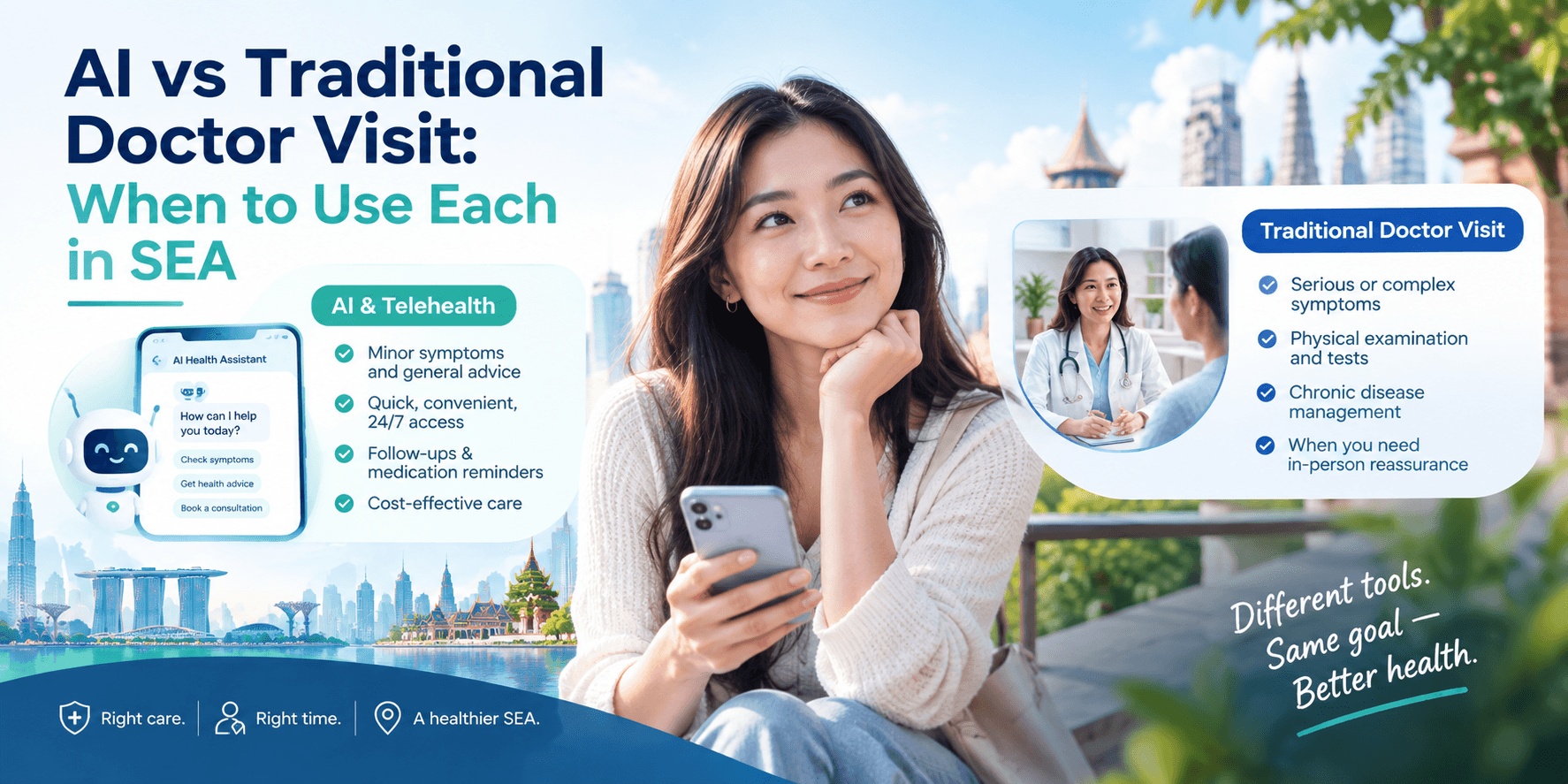
The question "AI vs traditional doctor visit" in Southeast Asia is not about replacement—it is about triage. AI symptom checkers can achieve diagnostic accuracy comparable to mid-level clinicians for specific conditions, while doctors remain irreplaceable for complex, chronic, and culturally-nuanced care. In a region where 70% of ASEAN countries face a doctor-to-patient ratio below WHO recommendations, understanding when to use each is now a survival skill, not a convenience.
Key Takeaways
- AI diagnostic accuracy reaches 90-95% for specific pattern-based conditions like skin cancer and diabetic retinopathy, but drops significantly for multi-system or atypical presentations.
- Traditional doctor visits in Southeast Asia cost between RM50-RM250 (Malaysia) and SGD50-SGD250 (Singapore) for private consultations, while AI health apps range from free to RM30 per month.
- Cultural trust, language barriers, and internet connectivity—not just clinical accuracy—determine whether AI or a human doctor is the right first step in ASEAN.
- Tropical diseases like dengue and malaria require local epidemiological knowledge that current AI models often lack, making doctor consultation critical in endemic areas.
- The optimal strategy is sequential: use AI for triage and health literacy, then escalate to a doctor for confirmation, physical examination, or red-flag symptoms.
Why This Decision Now Matters More Than Ever
At 2:47 AM, a mother in Kuala Lumpur notices her 3-year-old has a fever of 38.9°C, a faint rash on the torso, and is lethargic. Her phone offers two paths: open an AI symptom checker that responds in 30 seconds, or wait until 9 AM for a clinic visit. In that moment, she is not choosing between technologies—she is choosing between speed and certainty, between convenience and the fear of missing dengue.
This scenario plays out thousands of times daily across Southeast Asia, where the healthcare landscape is uniquely challenging. The region faces a doctor-to-patient ratio of 1:2,000 in some rural areas of Indonesia and the Philippines, compared to 1:500 in urban Singapore. Meanwhile, internet penetration has reached 96% in Malaysia and 92% in Thailand, creating the digital infrastructure for AI health tools to flourish. Yet only 12% of Southeast Asians report having used an AI health application in the past year, according to a 2023 survey by the Asian Development Bank.
The gap between availability and adoption is not about technology—it is about trust. This article provides a quantitative, evidence-based comparison of AI versus traditional doctor visits specifically for Southeast Asian patients. You will learn the diagnostic accuracy of each approach, the cost differentials across ASEAN countries, the regulatory landscape in Malaysia and Singapore, and—critically—when choosing AI first is genuinely safe versus when it is a dangerous gamble. EazyCare AI's symptom checker offers a starting point for your health decisions, but understanding its limits is the first step to using it wisely.
AI Diagnosis Accuracy vs Doctors: The Numbers Behind the Hype
The most cited statistic in the AI healthcare debate comes from a 2022 study published in Nature Medicine, which found AI systems can achieve diagnostic accuracy of up to 95% for skin cancer detection—matching or exceeding the 92% average of board-certified dermatologists. Similarly, a systematic review in PubMed (2020) reported AI diagnostic accuracy of 90.5% for diabetic retinopathy compared to 88.4% for human graders. These numbers have driven a wave of optimism that AI could democratize specialist-level diagnosis across underserved regions.
However, these figures require careful interpretation. The 95% accuracy for skin cancer applies to a narrow task: classifying dermoscopic images of suspicious lesions. It does not mean AI can diagnose a patient presenting with fatigue, weight loss, and joint pain—a presentation that could be anything from tuberculosis to lupus to depression. A 2023 meta-analysis in The Lancet Digital Health found that AI diagnostic accuracy drops to 72% when patients present with multiple, non-specific symptoms, compared to 88% for primary care physicians in the same scenario.
Why AI Excels at Pattern Recognition
AI systems are trained on millions of labeled images and electronic health records. They excel at identifying patterns that are statistically consistent: a mole that looks like melanoma, a retinal scan showing microaneurysms, a chest X-ray with a specific pneumonia pattern. For these tasks, AI offers a distinct advantage—it does not get tired, it does not have implicit biases from a single doctor's limited experience, and it can process 10,000 images in the time a human reads 100.
Where Doctors Still Win: Context and Complexity
Doctors bring something AI fundamentally lacks: the ability to integrate a patient's life context. A 2021 study in BMJ Quality & Safety found that 62% of misdiagnoses in primary care stem from a failure to consider the patient's social context—housing instability, food insecurity, cultural health beliefs, or a history of trauma. AI cannot ask why a patient in a rural Kelantan village is hesitant to take medication prescribed by a male doctor, or understand that a patient's "stomach pain" is actually a culturally-acceptable way to describe anxiety and panic attacks.
Accuracy measures whether the AI identifies the correct disease. Utility measures whether the AI's recommendation leads to better patient outcomes. An AI might correctly identify a skin lesion as benign (accuracy), but if it fails to recommend a biopsy for a lesion it incorrectly classifies as benign, the utility is zero for that patient. Doctors are trained to consider the cost of false negatives versus false positives—a calculation AI does not inherently make.
The practical takeaway: For pattern-based, image-dependent conditions (skin lesions, retinal disease, certain radiology findings), AI is at least as accurate as a doctor. For undifferentiated symptoms, chronic disease management, and any condition requiring physical examination, a doctor remains the gold standard.
For those considering AI-driven mental health support, emerging data on AI therapy effectiveness in Southeast Asia offers valuable insights.
For a deeper look at what AI can and cannot handle, read our analysis on whether AI can replace a doctor.
For mental health concerns, AI triage tools are emerging across the region, but they carry distinct ethical risks.
AI Health App Cost vs Doctor Visit: The Real Price of Each Option
Cost is the single most decisive factor for most Southeast Asian patients. The price differential is stark. In Malaysia, a private general practitioner consultation costs between RM50 and RM120 (USD 11-26), while a specialist visit at a private hospital ranges from RM150 to RM350 (USD 32-75). In Singapore, a public polyclinic visit costs SGD 25-50 (USD 19-38) with subsidies, but a private GP consultation runs SGD 50-100 (USD 37-75). In Indonesia, a private clinic visit in Jakarta costs IDR 150,000-300,000 (USD 10-20).
By contrast, AI health apps range from free (with ads) to RM30-50 per month (USD 7-11) for premium features like unlimited symptom checks, medication reminders, and health tracking. EazyCare AI offers a freemium model where basic symptom checking is free, with premium features for chronic disease monitoring. This means a year of unlimited AI health consultations costs less than a single specialist visit in Singapore.
| Service | Malaysia (MYR) | Singapore (SGD) | Indonesia (IDR) | AI Health App |
|---|---|---|---|---|
| GP Consultation | 50-120 | 50-100 | 150k-300k | 0-30/month |
| Specialist Visit | 150-350 | 150-300 | 500k-1.5M | Included in premium |
| Diagnostic Tests (basic) | 50-200 | 50-200 | 200k-500k | Not available |
| Annual Cost (4 visits/year) | 200-480 | 200-400 | 600k-1.2M | 0-360 |
But the cost comparison is incomplete without considering the hidden costs of a wrong AI diagnosis. If an AI symptom checker misses a case of dengue—which presents with fever, headache, and muscle pain, similar to a common viral infection—the patient may delay seeking care until they develop severe plasma leakage, which carries a 2-5% fatality rate if untreated. The cost of a dengue hospitalization in Malaysia averages RM3,000-5,000 (USD 650-1,100), which is 10-50 times the cost of a simple GP visit that could have caught it earlier.
The practical takeaway: AI is significantly cheaper per consultation, but the total cost of care can be higher if it leads to delayed diagnosis of serious conditions. Use AI for what it is good at—triage, health education, and chronic disease monitoring—but do not let cost be the sole factor in deciding whether to see a doctor.
When to Use AI Health App vs Traditional Doctor: A Decision Framework
The decision between AI and a doctor is not binary—it is sequential and context-dependent. Based on a review of clinical guidelines and AI capabilities, here is a practical framework for when to use each approach.
Use AI First When:
- You have a single, well-defined symptom like a rash, a headache, or a sore throat that has lasted less than 48 hours. AI symptom checkers are 80-90% accurate for these presentations.
- You need health information between doctor visits. AI excels at explaining medication side effects, dietary restrictions, or what to expect during recovery.
- You are monitoring a chronic condition like diabetes or hypertension. AI can track blood sugar trends, medication adherence, and lifestyle factors, flagging anomalies for your doctor.
- You want a second opinion. AI can provide a differential diagnosis list that might prompt you to ask your doctor questions you had not considered.
See a Doctor First When:
- You have red flag symptoms: chest pain, shortness of breath, severe abdominal pain, sudden vision changes, or a fever above 39.5°C that does not respond to antipyretics.
- You have multiple, overlapping symptoms. AI accuracy drops to 72% for multi-system presentations, while a doctor's diagnostic accuracy remains above 85%.
- You have a pre-existing condition like heart disease, kidney failure, or an autoimmune disorder. AI does not have access to your full medical history unless you provide it, and even then, it cannot perform a physical exam.
- You live in or have recently traveled to a dengue or malaria-endemic area. Local doctors have epidemiological knowledge that AI models lack. In 2023, Malaysia reported 123,000 dengue cases—a 45% increase from 2022—and the clinical presentation can be subtle.
AI health apps require stable internet. In rural Sabah, Sarawak, or the Philippine provinces, internet penetration drops to 60-70%, and connectivity is often slow or intermittent. If you are in a low-connectivity area, do not rely on an AI app for urgent health decisions—go to a clinic or call a telehealth service that works over voice calls.
The practical takeaway: Use the "48-hour rule"—if your symptoms are mild and have lasted less than 48 hours, AI triage is reasonable. If symptoms persist beyond 48 hours, worsen, or you have any red flag symptoms, see a doctor.
Healthcare AI in ASEAN: Regulatory Gaps and What They Mean for You
The regulatory landscape for AI in healthcare across Southeast Asia is fragmented and evolving. The World Health Organization (WHO) published its Ethics and Governance of Artificial Intelligence for Health guidance in 2021, setting six key principles including protecting autonomy, promoting well-being, and ensuring transparency. However, these are recommendations, not binding regulations.
Malaysia has taken the most proactive stance in the region. In 2023, the Ministry of Health (MOH) Malaysia released its Digital Health Blueprint 2023-2030, which explicitly addresses AI governance. The blueprint requires that any AI-based medical device undergo review by the Medical Device Authority (MDA) under the Medical Device Act 2012. However, the MDA's classification system was designed for traditional medical devices, and as of early 2024, no AI-based diagnostic tool has received full MDA approval—they operate under a "soft touch" regulatory sandbox.
Singapore, through the Health Sciences Authority (HSA), has a more mature framework. In 2023, HSA introduced the AI in Healthcare Guidelines, which require AI systems to undergo clinical validation, have a human-in-the-loop for high-risk decisions, and maintain audit trails. Singapore also leads ASEAN in AI adoption, with 45% of public hospitals using some form of AI-assisted diagnostics.
For patients navigating this evolving landscape, understanding the future of telehealth in Malaysia is essential to making informed choices.
Indonesia, the Philippines, and Vietnam have no specific AI healthcare regulations as of 2024, relying instead on general data protection laws. This regulatory gap means that patients in these countries have limited legal recourse if an AI health app provides incorrect advice.
"The absence of regulation does not mean the absence of risk. It means the risk is transferred to the patient."
— Dr. Anjali Sharma, Health Policy Researcher, NUS Singapore
The practical takeaway: In Malaysia and Singapore, AI health apps are subject to some oversight, but the regulatory framework is still catching up with the technology. Always check whether an AI health app discloses its limitations, data privacy policies, and whether it has been clinically validated.
Cultural Trust and Traditional Medicine: The Invisible Factor in AI Adoption
Across Southeast Asia, healthcare decisions are not purely clinical—they are cultural. In Malaysia, a 2022 survey by the Malaysian Medical Association found that 68% of patients consult a traditional medicine practitioner (TCM, Ayurveda, or Malay traditional medicine) before or alongside seeing a medical doctor. This is not a rejection of modern medicine; it is a parallel system of care that addresses cultural beliefs about health, illness, and the body.
AI health apps face a trust deficit in this context. A 2023 study in the Journal of Medical Internet Research found that only 34% of Malaysian respondents said they would trust an AI symptom checker for a serious condition, compared to 82% who trusted a human doctor. The reasons cited were not about accuracy—they were about empathy, cultural understanding, and the ability to ask follow-up questions.
This trust gap is compounded by language. While English is widely spoken in Singapore and urban Malaysia, AI health apps are predominantly developed in English. A 2023 analysis found that only 12% of AI health apps available in Southeast Asia offer full support in Bahasa Malaysia, Thai, or Vietnamese. This creates a two-tier system where English-speaking patients benefit from AI, while non-English speakers are excluded.
Trust in healthcare is a function of perceived competence (does the provider know what they are doing?) and perceived benevolence (does the provider care about me?). AI can demonstrate competence through accuracy statistics, but it struggles with benevolence—the human touch that signals "I understand your fear, your pain, your cultural context." Doctors in Southeast Asia are trained to provide this, and it is why they remain the first choice for serious or emotionally charged health decisions.
The practical takeaway: If you are from a cultural background where traditional medicine plays a significant role, or if you feel more comfortable communicating in your native language, a human doctor—or a hybrid approach that combines AI with a human consultation—is likely a better fit for your needs.
Dengue, Malaria, and the Limits of AI in Tropical Disease Diagnosis
No discussion of AI versus doctors in Southeast Asia is complete without addressing tropical diseases. Dengue alone accounts for 1.5 million reported cases in ASEAN annually, with a 2023 surge pushing Malaysia to 123,000 cases and Thailand to 150,000. The clinical challenge is that dengue presents with non-specific symptoms—fever, headache, myalgia, and retro-orbital pain—that overlap significantly with influenza, chikungunya, and even COVID-19.
AI symptom checkers are particularly weak here. A 2023 evaluation of 15 popular AI symptom checkers found that only 4 included dengue in their differential diagnosis when presented with classic symptoms, and none asked about mosquito exposure or recent travel to endemic areas. This is not a failure of AI technology per se—it is a failure of training data. Most AI models are trained on Western datasets where dengue is rare, so the algorithms are not optimized for the epidemiological patterns of Southeast Asia.
Doctors in endemic areas, by contrast, have an almost reflexive awareness of dengue. A 2022 study in The American Journal of Tropical Medicine and Hygiene found that Malaysian primary care physicians correctly suspected dengue in 91% of confirmed cases, based on clinical presentation alone, before any laboratory testing. This is because they have seen hundreds of cases and have learned the subtle signs—a positive tourniquet test, a falling platelet count, or a patient who reports severe retro-orbital pain.
The practical takeaway: For any febrile illness in a dengue-endemic area, do not rely on an AI symptom checker. See a doctor for a clinical evaluation and, if indicated, a rapid diagnostic test. The cost of a false negative is too high.
Frequently Asked Questions
Can AI replace your doctor?
No. AI cannot replace a doctor for comprehensive care. While AI achieves 90-95% accuracy for specific pattern-based tasks like skin cancer detection, it lacks the ability to perform physical examinations, integrate social context, or manage complex chronic diseases. In Southeast Asia, where cultural trust and traditional medicine play significant roles, doctors provide a level of empathy and contextual understanding that AI cannot replicate. The most effective approach is using AI for triage and health education, with doctors for diagnosis, treatment, and ongoing care. EazyCare AI's symptom checker can help you assess your symptoms, but it is not a substitute for professional medical judgment.
When should I use an AI health app instead of visiting a doctor?
Use an AI health app when you have a single, mild symptom lasting less than 48 hours (like a headache, rash, or sore throat), need health information between doctor visits, or are monitoring a chronic condition like diabetes. AI is also useful for a second opinion or to prepare questions for your doctor. However, see a doctor if you have red flag symptoms (chest pain, shortness of breath, severe pain), multiple overlapping symptoms, pre-existing conditions, or live in a dengue-endemic area with a fever. EazyCare AI's symptom checker can help you decide which category your symptoms fall into.
Is AI diagnosis as accurate as a doctor?
For specific, pattern-based conditions, yes. AI achieves 95% accuracy for skin cancer detection (Nature Medicine, 2022) and 90.5% for diabetic retinopathy (PubMed, 2020), matching or exceeding human performance. However, for undifferentiated symptoms like fatigue, weight loss, or multi-system presentations, AI accuracy drops to 72%, compared to 88% for primary care physicians. The accuracy also depends on the quality of training data—AI models trained on Western datasets perform poorly on tropical diseases common in Southeast Asia. For most clinical scenarios, a doctor remains more accurate due to their ability to integrate physical examination findings and patient context.
What are the risks of relying on AI for medical advice?
The primary risks are misdiagnosis, delayed care, and a false sense of security. AI symptom checkers may miss atypical presentations of serious conditions like dengue, appendicitis, or early-stage cancer. They also cannot perform physical examinations, so they may miss key clinical signs. Additionally, AI models can perpetuate biases present in their training data, potentially leading to under-diagnosis in certain populations. In Southeast Asia, where regulatory oversight varies by country, patients may have limited legal recourse if an AI app provides incorrect advice. Always use AI as a triage tool, not a diagnostic authority, and seek medical care for persistent or severe symptoms.
How does AI help in healthcare in Southeast Asia?
AI addresses critical healthcare gaps in Southeast Asia, where the doctor-to-patient ratio is 1:2,000 in some rural areas. AI-powered diagnostic tools can screen for diabetic retinopathy with 90.5% accuracy, helping to prevent blindness in diabetic patients who lack access to ophthalmologists. AI also supports telemedicine platforms, enabling remote consultations in a region with 96% internet penetration in Malaysia. In Singapore, 45% of public hospitals use AI-assisted diagnostics. AI also helps with health education, medication adherence, and chronic disease monitoring, empowering patients to take a more active role in their health. EazyCare AI is part of this ecosystem, offering accessible symptom checking and health information.
What conditions can AI diagnose?
AI is most accurate for conditions with clear, pattern-based presentations. These include skin cancers (95% accuracy), diabetic retinopathy (90.5%), certain types of pneumonia on chest X-rays, and specific radiological findings like brain hemorrhages. AI can also assist in diagnosing common conditions like conjunctivitis, otitis media, and urinary tract infections based on symptom patterns. However, AI struggles with conditions requiring physical examination or laboratory tests, such as appendicitis, pneumonia (without imaging), or autoimmune diseases. It also performs poorly on tropical diseases like dengue and malaria, which require epidemiological knowledge and clinical experience. For any serious or persistent symptoms, a doctor's evaluation is essential.
Should I trust AI more than a human doctor?
No. While AI offers advantages in speed, accessibility, and consistency for specific tasks, it cannot replace the clinical judgment, empathy, and contextual understanding of a human doctor. A 2023 study found that 82% of Malaysian patients trust human doctors more than AI for serious conditions. Doctors can perform physical examinations, interpret subtle clinical signs, and consider social and cultural factors that AI cannot. The optimal approach is to use AI as a decision-support tool—to prepare for your doctor visit, understand your symptoms, or monitor a chronic condition—while relying on your doctor for diagnosis and treatment. Trust your doctor, and use AI to become a more informed patient.
Are there any regulations for AI in healthcare in Malaysia?
Yes, but they are still evolving. Malaysia's Medical Device Authority (MDA) regulates AI-based medical devices under the Medical Device Act 2012, but no AI diagnostic tool has received full approval as of early 2024—they operate under a regulatory sandbox. The Ministry of Health's Digital Health Blueprint 2023-2030 provides a roadmap for AI governance, emphasizing patient safety, data privacy, and transparency. Singapore has a more mature framework through the Health Sciences Authority, which requires clinical validation and human oversight for high-risk AI systems. However, other ASEAN countries like Indonesia, the Philippines, and Vietnam have no specific AI healthcare regulations, leaving patients with limited protection.
How much does an AI health consultation cost vs a doctor visit?
AI health consultations are significantly cheaper. In Malaysia, a private GP visit costs RM50-120, while a specialist costs RM150-350. In Singapore, a private GP costs SGD 50-100. By contrast, AI health apps range from free to RM30-50 per month for unlimited symptom checks and health tracking. EazyCare AI offers a freemium model with basic symptom checking at no cost. However, the cost comparison is incomplete without considering the cost of a wrong diagnosis. A missed dengue case requiring hospitalization costs RM3,000-5,000 in Malaysia—50 times the cost of a GP visit. For serious symptoms, the cost of a doctor visit is a worthwhile investment in your health.
Can AI detect diseases early better than doctors?
For certain conditions, yes. AI excels at detecting early signs of disease in medical imaging. For example, AI can detect diabetic retinopathy with 90.5% accuracy, often before a human grader, and can identify subtle changes in retinal scans that may be missed by the human eye. Similarly, AI can detect early-stage lung cancer on CT scans with high sensitivity. However, for conditions that require a physical examination or laboratory tests—like early-stage cancers that are not visible on imaging—doctors have the advantage. AI also cannot detect diseases that present with non-specific symptoms, where a doctor's clinical acumen is essential. The best approach is combining AI screening with regular doctor check-ups.
When to See a Doctor
While AI symptom checkers are valuable tools, certain symptoms demand immediate medical attention. Do not rely on an AI app for these red flags:
- Chest pain or pressure lasting more than 5 minutes, especially if accompanied by sweating, nausea, or shortness of breath—this could indicate a heart attack.
- Shortness of breath at rest or with minimal exertion, which may signal a pulmonary embolism, severe asthma, or heart failure.
- Sudden severe headache (the "worst headache of your life"), which could indicate a subarachnoid hemorrhage.
- Sudden weakness, numbness, or difficulty speaking—classic signs of a stroke. Time is brain; call 999 immediately.
- Fever above 39.5°C (103°F) that does not respond to antipyretics, especially in children under 2 or adults over 65.
- Severe abdominal pain that is localized to the lower right side (possible appendicitis) or accompanied by vomiting and a rigid abdomen.
- Vomiting blood, coughing up blood, or black, tarry stools—signs of gastrointestinal bleeding.
- Seizures, confusion, or altered mental status—especially in a child with a fever, which could indicate meningitis or dengue with neurological involvement.
- Rapidly spreading rash that is painful or accompanied by fever—this could be meningococcal disease or a severe drug reaction.
- Any symptom in a child under 3 months with a fever above 38°C (100.4°F), even if the child seems well.
Call 999 or go to the nearest emergency department if you or a loved one experiences any of these symptoms. Do not wait to see if the symptoms resolve on their own.
If you are unsure whether your symptoms warrant a doctor's visit, EazyCare AI can help you assess your situation and decide whether you need urgent care. But when in doubt, err on the side of caution—a doctor's visit is always a better outcome than a missed diagnosis.
Conclusion
The choice between AI and a traditional doctor visit in Southeast Asia is not about picking a winner—it is about using each tool where it is strongest. Based on the evidence presented, here are the three key takeaways:
- AI is a powerful triage tool, not a diagnostic authority. Use AI symptom checkers for mild, single symptoms, health education, and chronic disease monitoring. For pattern-based conditions like skin lesions, AI is as accurate as a doctor—but for complex or multi-system presentations, its accuracy drops to 72%.
- Cost savings from AI can come at the price of safety. While AI consultations are 10-50 times cheaper than a doctor visit, a missed diagnosis of a serious condition like dengue can result in hospitalization costs 50 times higher than a simple GP visit. Factor in the cost of being wrong, not just the cost of the consultation.
- Context matters more than technology. Cultural trust, language barriers, internet connectivity, and local disease patterns all influence whether AI or a doctor is the right first step. In dengue-endemic areas, always see a doctor for a fever. If you prefer your native language or have cultural health beliefs, a human doctor is likely a better fit.
The future of healthcare in Southeast Asia is not AI or doctors—it is AI and doctors working together. AI can handle the data, the pattern recognition, and the 24/7 availability. Doctors provide the clinical judgment, the empathy, and the cultural understanding that no algorithm can replicate. Your job as a patient is to know which one you need, and when.
Learn more at eazycare.ai or chat with our AI health assistant to start your health journey with the right first step.