AI symptom checkers are digital tools that use machine learning to match your reported symptoms with a database of medical conditions, generating probability-based suggestions. They can help you decide whether to self-care, visit a clinic, or seek emergency attention. A 2023 meta-analysis in npj Digital Medicine found that their sensitivity for urgent conditions is 0.81, but specificity is only 0.54 — meaning they often over-recommend seeking care.
Key Takeaways
- AI symptom checkers combine pattern recognition with medical knowledge bases; they are not diagnostic tools.
- Accuracy varies by condition and population; in Southeast Asia, language barriers and limited internet reduce reliability.
- Never rely solely on an AI checker for emergencies or rare diseases — always confirm with a clinician.
- Regulatory oversight in ASEAN is still evolving; use only tools that disclose their data practices and are integrated with local health systems.
Introduction: Why Everyone Is Downloading a Symptom Checker
You wake up with a headache, sore throat, and mild fever. Your first instinct might be to open a browser or an app, type your symptoms, and see what the AI says. In Southeast Asia, where out-of-pocket clinic visits can cost RM50–150 and waiting times in public hospitals stretch hours, digital health tools have become the first stop for millions. Malaysia’s MySejahtera app alone has over 40 million users. But how much should you trust that AI-generated list of possible conditions?
This article breaks down the mechanics of AI symptom checkers — the algorithms, the training data, the failure modes — and gives you a practical framework for deciding when to trust them. We focus on the specific challenges facing users in Malaysia, Indonesia, Thailand, Vietnam, and the Philippines: patchy internet, multilingual populations, and a patchwork of regulations that rarely require clinical validation. By the end, you will know not only how these tools work, but also how to use them without endangering your health. EazyCare AI's symptom checker is designed with these regional realities in mind, but no tool replaces a human clinician.
How AI Symptom Checkers Actually Work
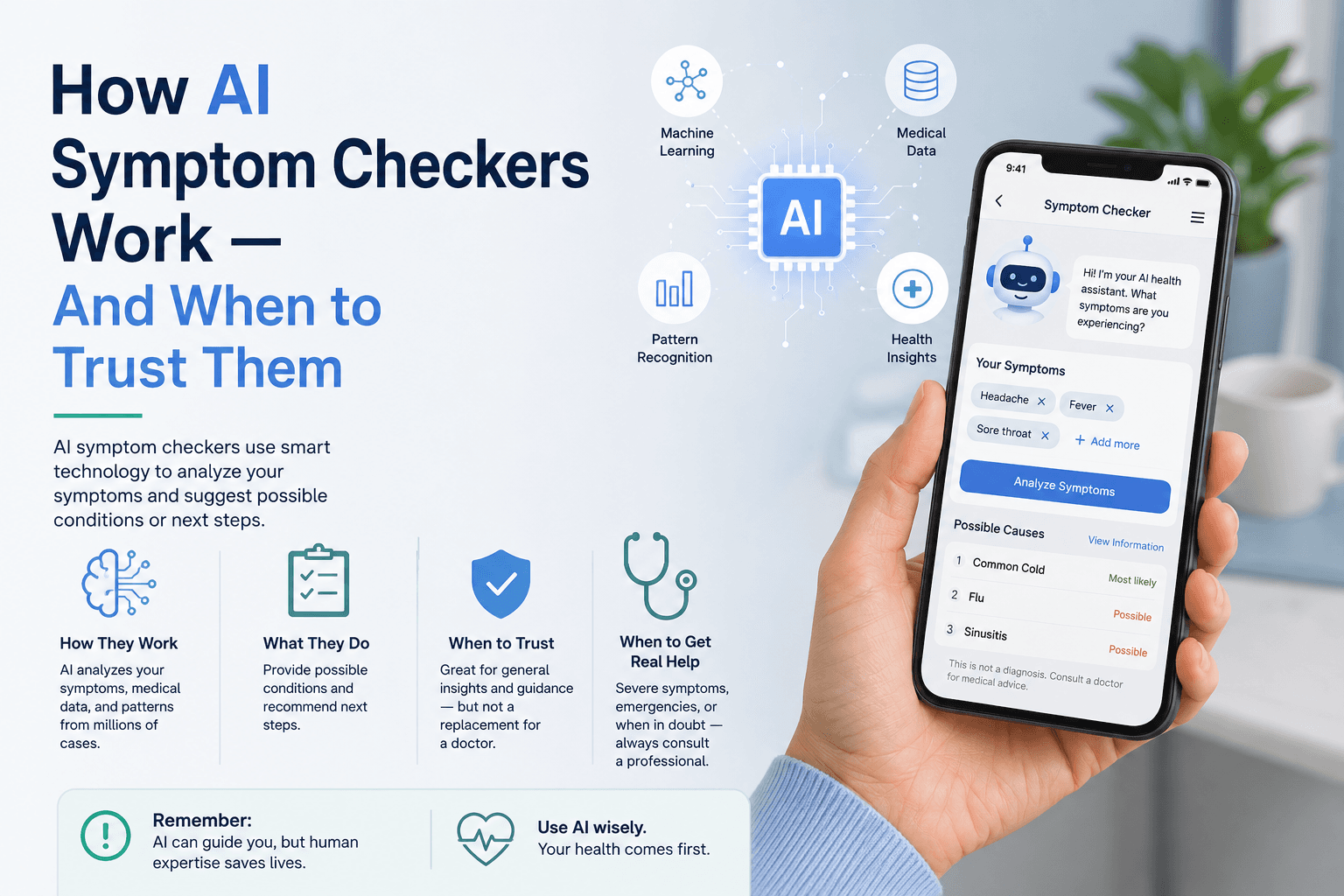
Behind the simple interface of an AI symptom checker lies a complex pipeline. First, you enter your symptoms — usually through a chatbot interface that asks structured questions: location, duration, severity, associated factors. The app then feeds these inputs into a machine learning model trained on millions of de-identified patient records, medical textbooks, and clinical guidelines. The model outputs a ranked list of possible conditions with probability scores.
For a deeper look at how these models identify patterns, see this guide on machine learning early disease detection.
Most checkers use one of two approaches:
- Rule-based systems: Hard-coded decision trees derived from clinical guidelines. Example: headache + fever + stiff neck → high probability of meningitis.
- Neural networks: Deep learning models that learn statistical patterns from data. They can capture subtle interactions but are prone to overfitting on training populations.
The best tools combine both: a rule-based triage layer (to catch emergencies) and a neural net for differential diagnosis. However, the training data is overwhelmingly from Western populations (US, UK, Europe). Skin colour variations, genetic differences, and local infectious diseases (dengue, typhoid, hand-foot-mouth disease) are poorly represented. A checker trained on US data will miss the dengue rash pattern common in Southeast Asian patients.
AI symptom checkers do not "diagnose" in the medical sense. They calculate conditional probabilities: given symptom X, what is the most likely condition in the training data? A diagnosis requires physical examination, lab tests, and clinical judgment — none of which the AI has access to.
Integration with local health systems also matters. Some apps pull in regional epidemiology (e.g., dengue season alerts in Malaysia) or connect to telemedicine platforms. Without that, the AI is guessing in the dark. EazyCare for clinics enables this integration, linking AI triage directly to real clinicians who can validate the output.
How Accurate Are AI Symptom Checkers? The Numbers You Need
The 2023 meta-analysis in npj Digital Medicine pooled data from 34 studies covering over 2 million cases. The pooled sensitivity for urgent conditions was 0.81 (meaning 81% of urgent cases were correctly flagged), but specificity was only 0.54 — meaning 46% of non-urgent cases were incorrectly told to seek urgent care. That leads to massive overburdening of emergency departments.
Accuracy drops further for rare diseases. A checker might give you a 0.2% probability for a condition you actually have, because the prevalence in training data is low. For common conditions like upper respiratory infections, accuracy can reach 90%, but for something like leptospirosis (common in rice-field workers in Thailand), it may not even appear on the list.
A 2015 BMJ study found that online symptom checkers correctly identified the most likely diagnosis only 34% of the time. That number has improved with newer algorithms, but it is still far from replacement-level. The fundamental limitation: symptoms alone are ambiguous. Chest pain could be GERD, costochondritis, or myocardial infarction — only a doctor can differentiate with an ECG and exam.
To understand the limits of AI in diagnosis, it helps to ask whether AI can replace a doctor.
Do not use AI symptom checkers to diagnose yourself if you have dangerous symptoms: sudden severe headache, chest tightness, difficulty breathing, confusion, or bleeding. These require immediate medical attention. The AI may suggest "anxiety" when you are having a stroke.
In Southeast Asia, language adds another layer of error. If you type "sakit kepala" (headache in Malay) into an English-trained checker, the natural language processing may misinterpret it. Some localised apps exist (e.g., by HealthHub Singapore or MySejahtera), but their algorithms are often less sophisticated than global tools. Always use a checker that supports your language and was validated on local data.
When Can You Trust an AI Symptom Checker?
Trust depends on context. The following framework helps you decide:
| Situation | Trust the AI? | Why |
|---|---|---|
| Mild, common symptoms (runny nose, mild fever, cough) | Partly – use for self-care ideas, not diagnosis | Checkers are good at ruling out serious causes for common symptoms |
| Chronic vague symptoms (fatigue, weight change, joint aches) | No – see a doctor for blood tests and imaging | AI cannot detect patterns from lab values or physical exam |
| Suspected dengue or hand-foot-mouth disease during outbreak | Yes – if linked to local epidemiology | Regional AI tools can factor in seasonality |
| Emergency red flags (chest pain, severe headache, fever >40°C) | Never – call 999 immediately | AI specificity is low; it may delay urgent care |
| Second opinion after seeing a doctor | Yes – use to ask questions you forgot | AI can provide drug interactions and follow-up advice |
Trust the tool when it says "this is likely not serious" only if you are young, healthy, and symptoms fit a pattern you recognise. If you are over 60, pregnant, or have chronic conditions (diabetes, heart disease), the AI's risk calculations are unreliable because training data underrepresents these groups.
Unique Challenges in Southeast Asia: Language, Infrastructure, Culture
Most AI symptom checkers were built in Silicon Valley or London. They assume fast internet, English proficiency, and a healthcare system that responds quickly. In rural Philippines or Indonesia, loading a chatbot can take minutes on 2G networks. The user types "sakit ng ulo" (Tagalog) and gets a confusing English response. The AI does not understand that "bellyache" in a Vietnamese farmer might be hookworm, not IBS.
Cultural distrust of AI is also real. A 2022 survey in Malaysia found that 68% of respondents preferred a human doctor even for minor symptoms, citing fear of misdiagnosis. That is rational. AI checkers that do not integrate into local care pathways (e.g., booking a clinic appointment or linking to MySejahtera) feel like dead ends. To build trust, tools must be transparent about their limitations and offer a clear next step — like a teleconsultation.
For mental health concerns, AI symptom checkers increasingly integrate with AI mental health triage to screen for conditions like depression or anxiety.
Regulatory gaps are another concern. The ASEAN Medical Device Directive does not clearly classify AI symptom checkers as medical devices. Some apps are marketed as "wellness tools" to avoid scrutiny. In Malaysia, only the Medical Device Authority (MDA) recently started requiring registration for AI-based triage software. Always check if the app you use is registered with your country's health ministry. EazyCare AI complies with ISO 27001 for data security and follows WHO digital health guidelines.
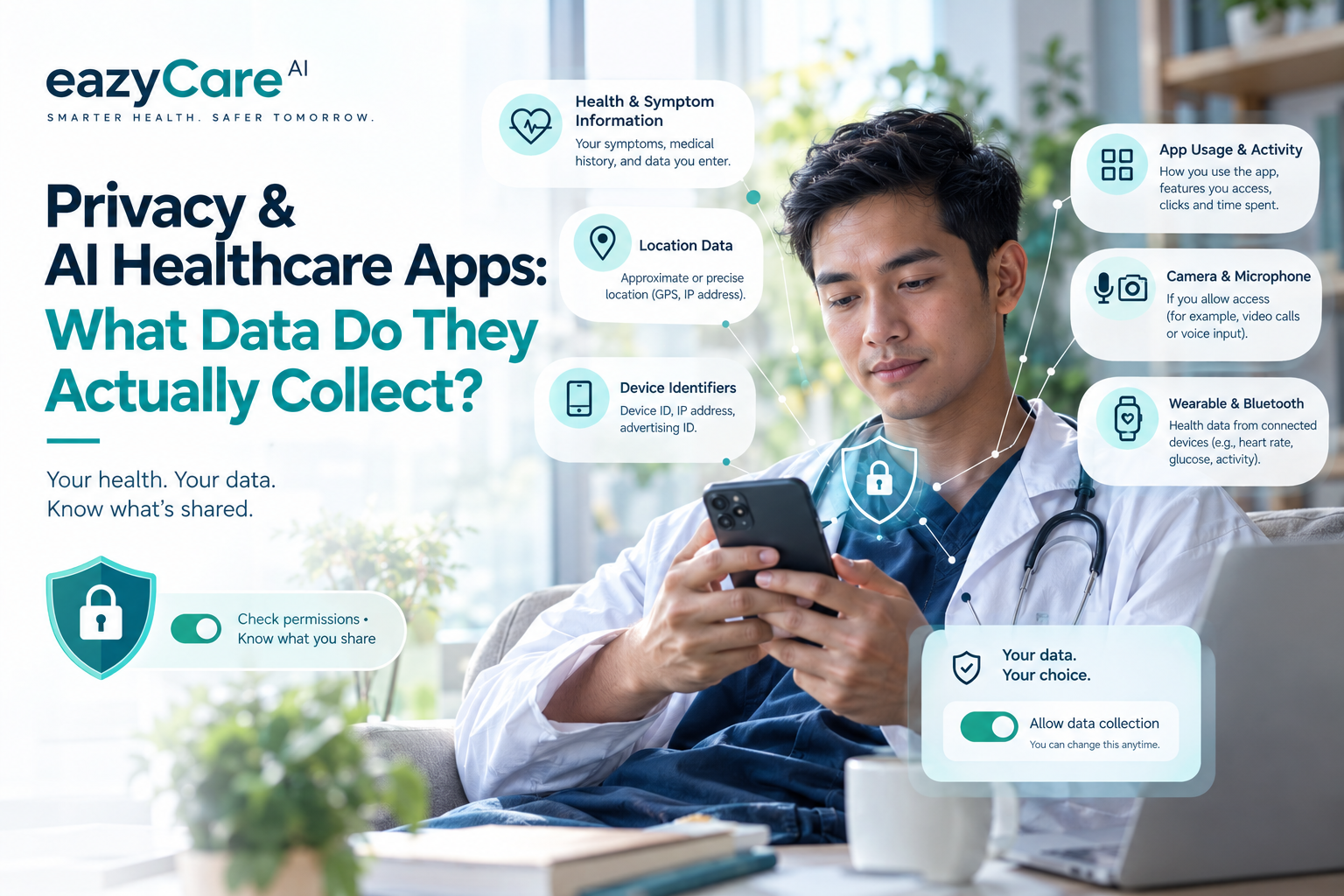
Understanding the data collection practices of these apps is equally important.
AI Symptom Checkers vs. Telemedicine vs. In-Person Visits
These three options form a triage ladder. The table below compares them across key dimensions:
| Criteria | AI Symptom Checker | Telemedicine | In-Person Visit |
|---|---|---|---|
| Cost | Free to RM10 (premium features) | RM20–80 per consultation | RM30–150 (public subsidy available) |
| Speed | 2–5 minutes | 15–30 minutes wait | 1–4 hours (public hospital) |
| Diagnostic accuracy | 34–81% depending on condition | ~80% (limited by no physical exam) | ~90%+ (with labs and exam) |
| Handles emergencies | No (over-triaging common) | Can redirect to ER | Yes, with immediate care |
| Rare disease detection | Very low (prevalence bias) | Moderate if specialist | High with testing |
| Access in rural areas | Requires smartphone + internet | Requires internet + audio/video | Physical travel needed |
Use AI checkers as a screening tool, not a final decision. If the AI suggests something serious, confirm via telemedicine or a clinic visit. A 2023 study in JAMA Network Open showed that patients who used an AI checker before teleconsultation had a 12% higher satisfaction rate because they arrived prepared with questions.
For ongoing conditions, explore how AI chronic disease management can help monitor your health over time.
What’s Coming Next: Localised AI and ASEAN Integration
The future of AI symptom checkers in Southeast Asia lies in hyperlocalisation. Startups are training models on hospital records from Bangkok, Kuala Lumpur, and Jakarta. They are incorporating languages like Thai (with its complex script) and Vietnamese (tonal variations). They are also partnering with public health ministries to integrate with apps like MySejahtera and Indonesia's SATUSEHAT. Within two years, we may see AI checkers that know the dengue hotspots on your street.
However, challenges remain: data privacy laws are uneven (Thailand’s PDPA is stricter than Indonesia’s), and many patients still lack digital literacy. Clinicians are also pushing back — they worry that AI will increase unnecessary visits or, worse, create a hubris of self-diagnosis. EazyCare AI is building for this future by training on diverse Southeast Asian populations and ensuring clinicians stay in the loop. The goal is not to replace the doctor, but to make every patient smarter before they walk into the clinic.
Frequently Asked Questions
How accurate are AI symptom checkers?
Accuracy varies widely. A 2023 meta-analysis in npj Digital Medicine pooled data from 34 studies and found a pooled sensitivity of 81% for urgent conditions but specificity of only 54%, meaning they over-recommend seeking care. For common conditions, accuracy can reach 90%; for rare diseases it drops below 30%. No AI checker is FDA-approved for diagnosis; they are triage aids.
Can AI symptom checkers replace a doctor?
No. AI symptom checkers cannot perform physical exams, order lab tests, or interpret scans. They provide a probability list based on symptoms alone, which is insufficient for diagnosis. A 2015 BMJ study found that checkers correctly identified the primary diagnosis only 34% of the time. They are best used as a preliminary screening tool to inform your conversation with a healthcare provider.
What is the best AI symptom checker?
There is no single “best” tool because effectiveness depends on your location, language, and health system. For Southeast Asia, EazyCare AI is localised for Malay, Thai, Vietnamese, and Tagalog. Other popular tools include Babylon Health (limited in Asia), Ada Health, and Buoy Health. Check if the app is registered with your country’s health authority and if it integrates with local telemedicine services.
How do AI symptom checkers work?
They use natural language processing to interpret your symptom description, then feed the data into a decision algorithm — either rule-based (decision trees) or machine learning (neural networks). The algorithm matches your symptom profile against a database of condition-symptom associations, usually derived from medical literature and de-identified patient records. The output is a ranked list of possible conditions with urgency recommendations.
Are AI symptom checkers safe to use?
They are generally safe if used as a complementary tool, not a replacement for professional medical advice. The main risk is over-trusting the AI and delaying care for serious conditions. In 2020, a study in PLOS ONE found that checkers missed sepsis in 24% of cases. To stay safe, always follow the tool’s emergency prompts and if you feel something is wrong, see a doctor regardless of what the AI says. EazyCare AI’s symptom checker includes a clear red-flag warning system.
What conditions can AI symptom checkers detect?
They perform best on common, acute conditions with distinctive symptom patterns: upper respiratory infections, urinary tract infections, skin rashes, and minor injuries. Chronic and vague conditions (fatigue, weight loss) are harder. Regional tools are better at detecting endemic diseases like dengue, malaria, and hand-foot-mouth disease. AI checkers can also help identify conditions that have clear diagnostic criteria, such as sinusitis or allergic rhinitis.
Do AI symptom checkers work for rare diseases?
Poorly. Because training data is dominated by common conditions, rare diseases are underrepresented. The AI will assign very low probabilities to them, even if you have a classic presentation. For example, a checker might suggest “muscle strain” for a woman with early symptoms of Guillain-Barré syndrome. If you have a family history of a rare disease or persistent unusual symptoms, skip the AI and go straight to a specialist.
How do AI symptom checkers handle emergencies?
Most include a triage module that flags red-flag symptoms (e.g., sudden severe headache, chest pain, difficulty breathing, loss of consciousness) and immediately recommends calling emergency services. However, the 2023 meta-analysis showed that specificity is low — 46% of non-urgent cases were over-triaged. That means you should trust the AI’s “go to emergency” recommendation, but not its “it’s okay to stay home” advice if you feel seriously unwell.
What data do AI symptom checkers collect?
They typically collect symptoms, age, sex, duration of illness, and sometimes location and medical history. Some apps also track device information for analytics. Depending on local laws (e.g., Thailand’s PDPA, Malaysia’s PDPA 2010), data must be anonymised and stored securely. Always read the privacy policy. Avoid using checkers that sell your data to advertisers or pharmaceutical companies. EazyCare AI adheres to ISO 27001 and does not share personal health data with third parties.
Are AI symptom checkers approved by health authorities?
Regulatory approval varies by country. In the EU, some have CE marking as medical devices. In the US, the FDA has only cleared a few for “triage and information”. In Southeast Asia, Malaysia’s MDA and Singapore’s HSA have begun classifying AI-based symptom checkers as medical devices, but many apps still operate unregulated. Always verify if the app lists its registration number. EazyCare AI is registered with the Malaysian Medical Device Authority (MDA). If you are unsure, EazyCare AI's symptom checker can help you assess your symptoms while respecting local regulations.
When to See a Doctor
Immediate medical attention is needed if you experience any of the following:
- Sudden, severe headache (worst of your life) or head injury with loss of consciousness
- Chest pain, pressure, or tightness radiating to arm, jaw, or back
- Difficulty breathing, wheezing, or feeling like your throat is closing
- Sudden weakness or numbness on one side of the body, slurred speech, or facial droop
- Fever above 40°C (104°F) with confusion, stiff neck, or rash that does not blanch when pressed
- Severe abdominal pain with vomiting blood or black/tarry stools
- Suicidal thoughts or intent
Call 999 (or your local emergency number) immediately for any of these. Do not wait for an AI symptom checker to confirm. If you are unsure whether your symptoms are serious, EazyCare AI can help you decide whether you need urgent care — but when in doubt, err on the side of safety.
Conclusion
AI symptom checkers are a powerful addition to the healthcare toolkit, especially in Southeast Asia where access to clinicians is uneven. But they are not magic. Here are the three key takeaways:
- Know the limitations: AI checkers have moderate sensitivity but low specificity — they often over-recommend urgent care. They perform worst on rare diseases, children, elderly, and pregnant women.
- Use them for screening, not diagnosis: Treat the AI’s list as a conversation starter with your doctor. It can help you prepare questions and understand possible conditions, but never make final medical decisions based on it alone.
- Choose localised, transparent tools: Use symptom checkers that are trained on regional data, support your language, and are registered with your country’s health authority. EazyCare AI meets these criteria and integrates with local telemedicine services.
The best use of an AI symptom checker is to become a more informed patient — not a self-diagnosing one. Learn more at eazycare.ai or chat with our AI health assistant to explore your symptoms in a safe, clinically guided environment.