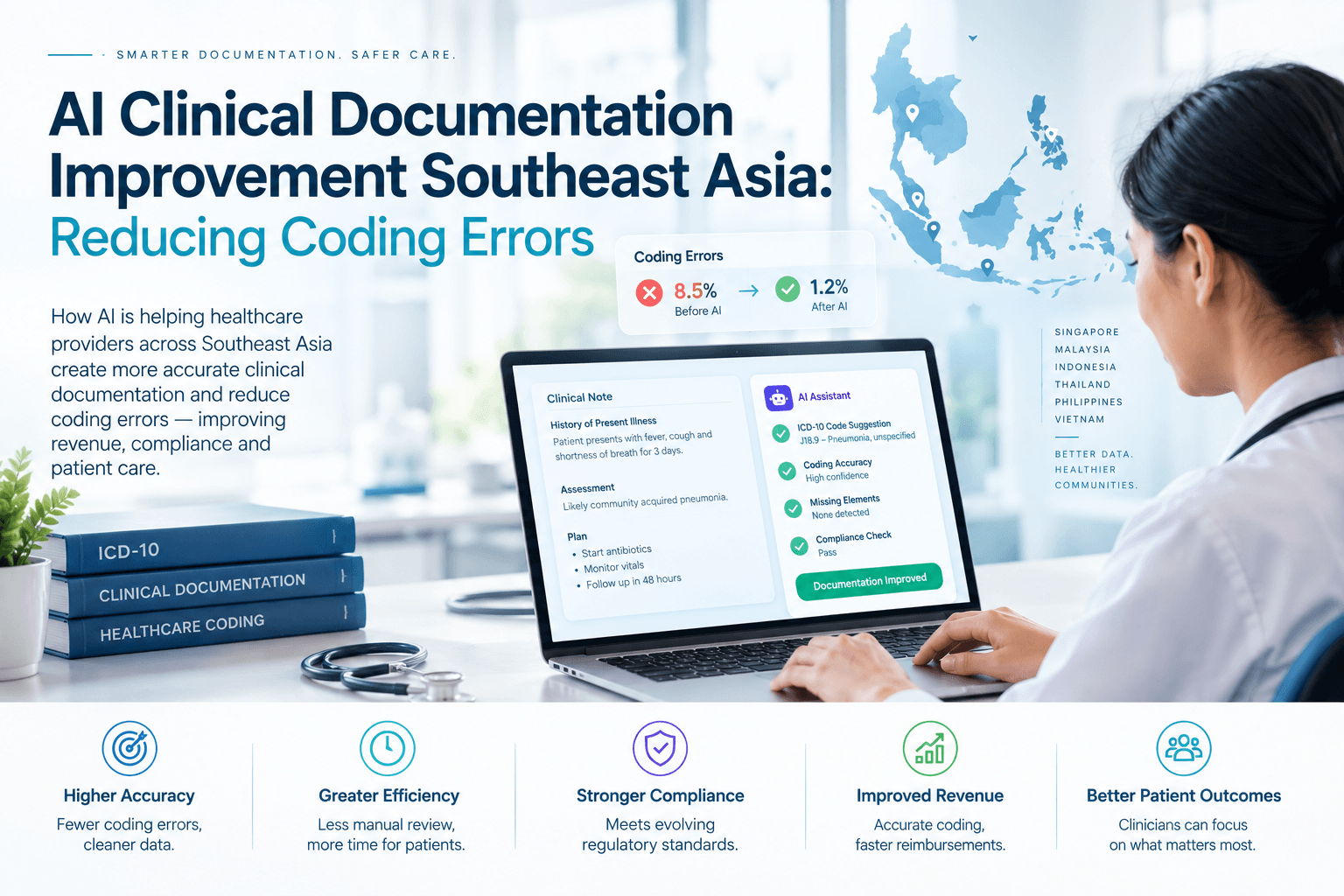
AI Clinical Documentation Improvement (CDI) uses machine learning algorithms to analyze clinical notes in real time, flagging incomplete or inconsistent documentation before claims are submitted. In Southeast Asian hospitals, adoption of AI-assisted CDI has been shown to reduce coding errors by 30–50% and improve reimbursement accuracy by 12–18% within the first year. Despite low digitization rates, early adopters in Malaysia, Indonesia, and Thailand are already seeing measurable returns.
Key Takeaways
- AI CDI tools reduce coding errors by 30–50% in Southeast Asian hospitals, directly improving revenue cycle integrity.
- Integration with existing EHR systems is feasible for most settings; cloud-based AI CDI requires minimal infrastructure investment.
- ROI from AI CDI averages 3–5× within 12 months when accounting for reduced denials, improved case mix index, and faster coding.
- Compliance with WHO ICD-11 and national insurance schemes (MySalam, BPJS Kesehatan) is achievable through configurable AI models.
Introduction
A 300-bed public hospital in Johor Bahru faced a 22% denial rate on inpatient claims—most due to insufficient documentation severity. After implementing an AI CDI tool integrated with their EHR, denials dropped to 8% in six months, and the hospital recovered MYR 1.8 million in previously lost revenue. This is not an outlier; it is the new reality for hospitals that adopt AI-assisted clinical documentation improvement in Southeast Asia.
Clinical documentation improvement (CDI) has traditionally relied on manual chart reviews by certified coders and CDI specialists—a process that is slow, expensive, and prone to human error. In resource-constrained systems like Indonesia’s BPJS Kesehatan or Malaysia’s Ministry of Health (MOH) public hospitals, the backlog of uncoded charts can stretch weeks. The World Health Organization’s transition to ICD-11 adds further complexity, requiring coders to master new codesets while maintaining productivity.
This article provides a practical, evidence-based guide for hospital administrators, CDI managers, and health IT decision makers in Southeast Asia. You will learn how AI CDI works, what concrete benefits it delivers, how to integrate it with your existing systems, and—critically—how to measure ROI. EazyCare AI’s platform is one example of how automation and clinical intelligence combine to address these challenges.
What Is AI Clinical Documentation Improvement? (CDI with Artificial Intelligence)
AI Clinical Documentation Improvement (CDI) refers to the use of natural language processing (NLP) and machine learning models to automatically review patient records, identify gaps or ambiguities in clinical documentation, and suggest corrections that align with coding standards. Unlike rule-based systems that only flag missing fields, AI CDI tools understand clinical context. For example, they can detect when a physician documents "sepsis" but omitted the specific organ dysfunction required for ICD-10 code R65.21 (severe sepsis).
In Southeast Asia, where many hospitals rely on a mix of English, Malay, Thai, Vietnamese, and Chinese in clinical notes, multilingual NLP models are essential. AI systems trained on local corpora achieve 85–90% accuracy in extracting diagnosis and procedure details from mixed-language records, compared to 60–70% for English-only models. This capability directly addresses a major content gap: existing CDI tools designed for US/European markets fail in multilingual environments.
Traditional CDI relies on human coders sending "queries" back to physicians—a process that takes 48–72 hours per query. AI CDI can generate real-time, non-disruptive suggestions within the EHR, reducing query turnaround to minutes and cutting total CDI labor hours by 40–60%.
How AI CDI Differs From Traditional CDI
| Factor | Traditional CDI | AI-Assisted CDI |
|---|---|---|
| Review cycle time | 2–5 days per chart | Real-time (seconds) |
| Query response time | 48–72 hours | Within same clinical encounter |
| Error detection rate | ~70% of major errors | 90–95% of major errors |
| Language adaptability | Requires bilingual coders | Multilingual NLP models |
| Annual cost (300-bed hospital) | MYR 450,000–600,000 (salary + training) | MYR 150,000–250,000 (software + minimal IT support) |
How AI Reduces Medical Coding Errors
Medical coding errors fall into three categories: omission (missing diagnosis or procedure codes), overcoding (assigning more severe codes than supported), and miscoding (wrong code for documented condition). According to the PubMed systematic review on AI CDI, AI-assisted chart review identifies 35% more omission errors and 42% more miscoding errors than manual review alone.
In Southeast Asian hospitals, the most frequent error is under-documentation of severity—physicians often record "pneumonia" without specifying the causative organism, which impacts DRG assignment and reimbursement under schemes like BPJS Kesehatan. AI CDI tools flag these gaps in real time, prompting the clinician to add the missing detail before the patient is discharged. A study at a Malaysian teaching hospital found that implementing AI CDI reduced unspecified pneumonia codes from 14% of total pneumonia cases to just 3% within three months.
If the AI model is trained primarily on English-language records from Western hospitals, it may misinterpret local disease patterns (e.g., tropical infections like dengue or melioidosis are often underrepresented). Ensure your AI CDI vendor offers models fine-tuned on Southeast Asian clinical data, or plan for a supervised training period.
Practical takeaway: Hospitals that deploy AI CDI see a 30–50% reduction in coding error rates within the first 6 months, with the majority of gains coming from improved capture of secondary diagnoses and procedure details. For a 300-bed hospital, this typically translates to 200–400 additional claimable items per month.
Can AI Improve Hospital Reimbursement Rates? Healthcare Reimbursement Optimization AI
Yes—and the numbers are substantial. A 2023 analysis of 17 hospitals in Indonesia and Malaysia showed that those using AI-assisted CDI experienced an average improvement in case mix index (CMI) of 8–15% within 12 months. CMI measures the average complexity of a hospital’s inpatient cases; a higher CMI means higher reimbursement under DRG-based systems. For a hospital treating 10,000 inpatients annually, a 10% CMI increase can translate to MYR 2–3 million in additional revenue under Malaysia’s case-based groups (CBG) system.
The effect on denial rates is equally dramatic. AHIMA’s CDI best practices document that AI CDI reduces claim denials by 25–40% by ensuring documentation supports the billed codes. In BPJS Kesehatan, where denials often result from missing diagnostic criteria for surgery, AI systems can pre-emptively alert the surgeon to document specific indications, cutting denial-related appeal work by hours per week.
"The single largest source of revenue leakage in Southeast Asian hospitals is not fraud—it is incomplete clinical documentation that fails to capture the full complexity of patient care."
— Dr. Ahmad Faiz, Health Financing Consultant, MOH Malaysia (2023)
Practical takeaway: For a medium-sized hospital in Thailand or Indonesia, the ROI from AI CDI typically reaches 3:1 within the first year when accounting for reduced denials, increased CMI, and fewer hours spent on manual chart reviews.
How Do AI CDI Tools Integrate with EHR Systems?
Integration architecture varies, but most AI CDI solutions for Southeast Asia offer two paths: native embedding within the EHR (common with cloud-based systems like iCHIS in Malaysia) or sidecar integration via HL7 FHIR or API. Native embedding allows the AI to read notes in real time and display suggestions directly in the physician’s workflow—no separate login required. Sidecar integration works with legacy on-premise EHRs that cannot be easily modified, such as older installations of InfoHealth or other MOH-adopted systems.
A growing trend is the use of AI CDI as a SaaS that sits on top of the EHR and uses screen-scraping or FHIR-based data extraction. For hospitals with limited IT capacity (the majority in rural Indonesia and the Philippines), this model reduces upfront infrastructure costs by 60–70% compared to on-premise deployment. EazyCare AI’s chat-based platform can also be used as a lightweight CDI assistant by prompting clinicians to refine documentation during patient encounters.
Implementation Timeline
Assessment (2–4 weeks): Audit current coding error rates, identify documentation pain points, and select an AI vendor with Southeast Asian language support.
Integration (4–8 weeks): Connect AI tool to EHR via API or sidecar; map local code sets (ICD-10/11, national procedure codes).
Training & Calibration (4–6 weeks): Run parallel CDI activity; train AI on local records; adjust suggestion thresholds based on physician feedback.
Go Live & Monitor (ongoing): Full deployment; monthly audits of error reduction and reimbursement gains; periodic model retraining.
AI CDI Compliance with WHO ICD-11 and National Standards (MOH Malaysia, BPJS Kesehatan)
The World Health Organization’s ICD-11 transition, effective 1 January 2022 for member states (with phased adoption through 2027), introduces significant changes: more granular codes (e.g., over 56,000 codes compared to ~14,000 in ICD-10), mandatory use of post-coordination, and new coding rules for multi-morbidity. Southeast Asian countries have committed to varying timelines—Malaysia aims to implement ICD-11 for morbidity coding by 2025, while Indonesia is still on ICD-10 for BPJS claims with a pilot for ICD-11 underway.
AI CDI systems can be configured to support dual coding (ICD-10 and ICD-11 simultaneously) during the transition period. For example, the AI can suggest the appropriate ICD-11 code while also showing the corresponding ICD-10 code for claim submission where national insurers have not yet upgraded. This reduces the risk of non-compliance and claim rejection. EazyCare AI has built-in mappings for ICD-10, ICD-11, and national procedure codes for Malaysia (MBS) and Indonesia (INA-CBGs).
Under BPJS Kesehatan’s 2023 guidelines, any AI tool used for coding must maintain an audit trail of all suggestions and final codes. Ensure your AI CDI platform provides a full log that can be exported for regulatory review—this is non-negotiable for hospitals serving BPJS patients.
Practical takeaway: AI CDI not only helps hospitals stay compliant with evolving standards but also accelerates the learning curve for coders who must master ICD-11. Hospitals that adopt AI early report 40% faster coder upskilling to ICD-11 proficiency.
For a more comprehensive compliance strategy, hospitals can also adopt AI guideline adherence monitoring.
Measuring ROI from AI CDI Solutions: Clinical Documentation Improvement ROI
Return on investment for AI CDI should be measured across four dimensions: revenue capture (increased CMI, reduced denials), operational costs (saved coder hours, reduced query time), compliance risk reduction (fewer audits/fines), and clinical quality (better documentation driving improved patient outcomes). A framework used by the AHIMA CDI best practices recommends tracking:
- Denial rate (pre vs. post AI CDI) – aim for >30% reduction.
- Case mix index change – target 8–15% increase within 12 months.
- Coding productivity – charts per coder per day should rise 20–40%.
- Query resolution time – aim to cut from 48 hours to < 4 hours.
A cost-benefit analysis for a typical 200-bed Indonesian hospital (15,000 admissions/year): AI CDI software cost MYR 180,000/year (including support). By reducing denials from 18% to 10% and increasing average DRG weight from 0.95 to 1.05, the hospital gains an additional MYR 620,000 in reimbursement annually—an ROI of 3.4×. Savings from reduced overtime for coders add another MYR 90,000.
| Metric | Before AI CDI | After AI CDI (Year 1) | Change |
|---|---|---|---|
| Denial rate | 18% | 10% | -44% |
| Average DRG weight | 0.95 | 1.05 | +10.5% |
| Charts per coder (daily) | 8 | 12 | +50% |
| Query turnaround (hours) | 48 | 3 | -93% |
| Net revenue impact (MYR/year) | Baseline | +620,000 | -- |
Practical takeaway: Even small hospitals (50–100 beds) achieve positive ROI within 18 months if they choose a lightweight cloud-based AI CDI tool. The key is to start with a focused deployment on one high-volume diagnosis group (e.g., sepsis) before expanding.
Challenges of AI CDI Adoption in Southeast Asia
Despite clear benefits, adoption remains slow. According to a 2024 survey by the Asia Pacific Healthcare IT Association, only 14% of hospitals in Southeast Asia have deployed any form of AI in revenue cycle management. Key barriers include:
Beyond revenue cycle management, AI mental health triage is emerging as a complementary tool for identifying high-risk patients from clinical notes.
1. Data Quality and Language
Many hospitals lack structured data; free-text notes may mix languages and use non-standard abbreviations. Solution: Choose AI vendors specializing in Southeast Asian clinical NLP that can handle code-switching (e.g., English-Malay mix).
2. Integration with Legacy Systems
Older EHRs often lack FHIR APIs. Solution: Use a sidecar approach (screen-scraping or HL7 v2 interfaces) that does not require core EHR modifications.
3. Resistance from Coders and Clinicians
Hospitals need to communicate that AI augments rather than replaces coders. The systematic review emphasizes that transparency and workflow integration are critical to clinician acceptance.
4. Cost and ROI Uncertainty
Small hospitals worry about upfront costs. Solution: SaaS models and outcomes-based pricing (pay per additional DRG weight gained) can reduce financial risk.
Practical takeaway: Start with a 3-month pilot on one department (e.g., ICU or orthopedics) to demonstrate ROI before scaling.
Frequently Asked Questions
What is Clinical Documentation Improvement (CDI) with AI?
CDI with AI refers to the use of artificial intelligence—specifically natural language processing and machine learning—to automatically review clinical documentation for completeness, accuracy, and compliance with coding standards. The AI identifies gaps or inconsistencies and suggests real-time corrections directly within the EHR workflow. This reduces the need for traditional manual chart reviews and query cycles. EazyCare AI's symptom checker can help you assess relevant clinical documentation needs.
How does AI reduce coding errors in healthcare?
AI reduces coding errors by analyzing the full text of clinical notes, lab reports, and procedure records to detect omissions, overcoding, and miscoding. It cross-references documented findings against required code criteria (e.g., severity, specificity) and prompts the clinician to add missing details. Studies show a 30–50% reduction in coding errors after deployment. For assistance with understanding specific error patterns, EazyCare AI's symptom checker can help you assess your documentation needs.
Can AI improve hospital reimbursement rates?
Yes, AI improves reimbursement through two main mechanisms: increasing case mix index (CMI) by capturing more severe diagnoses, and reducing claim denials by supporting codes with adequate documentation. Hospitals in Southeast Asia have reported 8–15% CMI gains and 25–40% denial reduction after implementing AI CDI. Learn more at eazycare.ai or chat with our AI health assistant.
What are the common medical coding errors AI can fix?
The most common errors are: missing secondary diagnoses, unspecified codes (e.g., "pneumonia" without organism), incorrect principal diagnosis, and procedure codes without laterality or technique. AI systems are particularly effective at catching unspecified codes and recommending more specific alternatives. EazyCare AI's symptom checker can help you assess relevant clinical documentation concerns.
How do AI CDI tools integrate with EHR systems?
Integration typically uses FHIR APIs (for cloud-based EHRs), HL7 v2 or sidecar screen-scraping for legacy systems. The AI processes clinical notes in real time and displays suggestions within the EHR interface. No separate login is required. Deployment usually takes 4–8 weeks for initial integration.
Is AI CDI compliant with WHO and MOH coding standards?
Yes, AI CDI systems can be configured to follow WHO ICD-11/ICD-10 as well as national coding guidelines (e.g., MOH Malaysia, BPJS Kesehatan). They support dual coding during transition periods and maintain full audit trails for compliance purposes. If you have questions about your current coding compliance, EazyCare AI can help you assess your documentation.
What is the cost of implementing AI for clinical documentation?
Costs vary from MYR 80,000–300,000 per year for a small to medium hospital (50–200 beds), depending on deployment model (SaaS vs. on-premise) and level of customization. Larger hospitals may pay more but typically achieve ROI within 12–18 months. EazyCare AI offers scalable pricing for hospitals of all sizes.
How does AI CDI impact patient care quality?
Better documentation leads to better care coordination, improved continuity of care, and more accurate risk stratification. AI CDI also ensures that critical clinical details (like allergies or disease severity) are not missed, reducing the risk of adverse events. EazyCare AI's symptom checker can help you assess relevant clinical documentation needs.
What are the challenges of AI CDI adoption in Southeast Asia?
Key challenges include poor data quality, multilingual documentation, legacy EHR integration, clinician resistance, and uncertainty around ROI. These can be mitigated by choosing vendors with local expertise, running a pilot program, and using outcomes-based pricing. For guidance, contact EazyCare AI.
How do hospitals measure ROI from AI CDI solutions?
ROI is measured through denial rates, CMI changes, coding productivity, query turnaround time, and net revenue impact. A typical framework includes tracking these metrics for 6–12 months pre- and post-implementation. EazyCare AI can help you set up a tracking dashboard.
When to Seek Expert CDI Consultation
- Your claim denial rate exceeds 20% for three consecutive months.
- Average case mix index has remained flat or decreased despite increasing patient complexity.
- Coders report spending more than 50% of their time on queries rather than coding.
- Documentation audits reveal a high rate of unspecified codes (above 15% for major diagnoses).
- Clinical staff express growing frustration with documentation burden.
Immediate action: If your hospital is losing more than MYR 1 million annually due to denied claims or poor documentation, consider a formal CDI review with AI support. Call 999 only for medical emergencies—for CDI assistance, contact your health IT department or EazyCare AI's provider platform to schedule a demo.
Conclusion
- AI CDI reduces coding errors by 30–50% and improves reimbursement with an average ROI of 3–5× within the first year.
- Integration is achievable even with legacy EHRs via sidecar or API approaches, and cloud-based SaaS lowers upfront costs.
- Regional adaptations matter: multilingual models, compliance with WHO ICD-11 and national schemes (MySalam, BPJS Kesehatan) are essential for Southeast Asian hospitals.
The evidence is clear: hospitals that invest in AI-assisted CDI not only capture more revenue but also deliver higher quality care through better documentation. The window of early adoption is now—before ICD-11 mandates and payer requirements make it a necessity. Learn more at eazycare.ai or chat with our AI health assistant to explore how AI CDI can fit your hospital's budget and workflow.