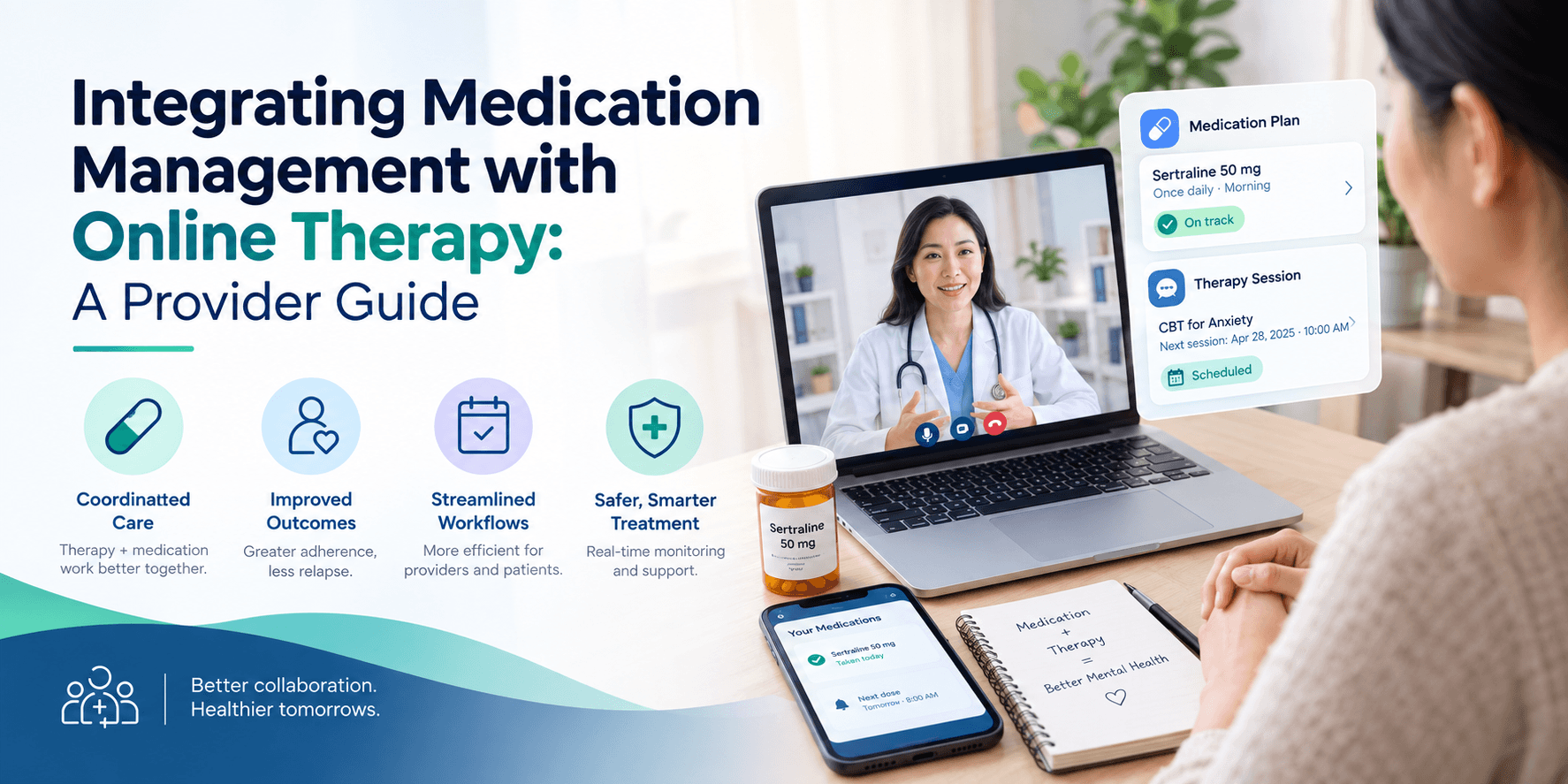
Integrating medication management with online therapy is the systematic coordination of psychiatric pharmacotherapy and psychotherapy delivered through telehealth platforms. This integration produces measurable improvements in treatment outcomes, with a meta-analysis of 17 studies showing telemedicine-based collaborative care outperforms usual care for depression by a standardized mean difference of -0.45. With approximately 1 in 8 people globally living with a mental disorder in 2019, the demand for integrated virtual mental healthcare has never been higher.
Key Takeaways
- Integrating medication management with online therapy requires a collaborative care model where psychiatrists, therapists, and primary care physicians share treatment plans and communicate regularly.
- Malaysia's MOH and Malaysian Medical Council (MMC) have specific telemedicine guidelines that govern how and when psychotropic medications can be prescribed online.
- 76% of patients find online medication management as effective as in-person psychiatric visits, according to a 2021 JMIR study.
- Controlled substances require extra safeguards, including video-first consultations, pharmacy verification, and strict documentation protocols.
- Cultural factors in Southeast Asia—including family involvement, stigma, and health beliefs—significantly impact medication adherence and must be integrated into treatment planning.
Why Integrating Medication Management with Online Therapy Matters Now
In 2020, a 34-year-old accountant in Kuala Lumpur began experiencing panic attacks that made the daily commute to a psychiatrist's office unbearable. She was not alone. Telehealth utilization for mental health services increased by 50% during the COVID-19 pandemic in the United States, and Southeast Asia followed a similar trajectory. The pandemic accelerated a shift that was already underway: the delivery of psychiatric care through screens rather than waiting rooms.
Yet the clinical reality is more complex than simply moving consultations online. Medication management requires ongoing monitoring of side effects, drug interactions, and adherence patterns. Psychotherapy requires a different set of skills—therapeutic alliance, cognitive restructuring, and behavioral activation. When these two modalities are integrated into a single online care pathway, the results are compelling. But when they are not, patients fall through the cracks.
This guide addresses a critical gap in the literature: most articles on integrating medication management with online therapy focus on Western regulatory frameworks like HIPAA and US state laws. Southeast Asian providers need region-specific guidance—particularly for Malaysia's MOH telemedicine guidelines, cultural considerations in medication adherence, and practical workflows for cross-border collaboration within ASEAN. This article covers the clinical evidence, regulatory landscape, practical workflows, and safety protocols you need to implement integrated online mental healthcare effectively.
EazyCare AI's health information platform can help providers and patients navigate these complexities with up-to-date, region-specific guidance.
For a broader look at how these services are evolving, explore the future of telehealth in Malaysia.
What the Data Says About Integrated Telehealth Care
The evidence base for integrating medication management with online therapy is no longer nascent—it is robust. A meta-analysis of 17 randomized controlled trials published in PubMed found that telemedicine-based collaborative care for depression produced a standardized mean difference of -0.45 compared to usual care. To put that in clinical terms, this effect size is comparable to the difference between placebo and standard antidepressant therapy in head-to-head trials. The number needed to treat is approximately 4, meaning one additional patient achieves remission for every four treated with integrated telehealth care.
The Journal of Medical Internet Research reported that 76% of patients found online medication management as effective as in-person visits for psychiatric conditions. This patient-perceived equivalence is critical because perceived effectiveness drives adherence. When patients believe their online care is working, they are more likely to take their medications as prescribed and engage with therapeutic homework.
Why Integration Beats Either Modality Alone
Pharmacotherapy and psychotherapy target different neural pathways. Antidepressants modulate monoamine neurotransmission, while cognitive-behavioral therapy (CBT) promotes neuroplasticity through learning and memory consolidation. When delivered together, these modalities produce synergistic effects. A patient who learns cognitive restructuring skills in therapy can apply them to manage medication side effects like initial anxiety or insomnia. Conversely, effective pharmacotherapy can reduce symptoms enough to make therapy more productive.
The practical takeaway is clear: integrating medication management with online therapy is not merely a logistical convenience—it is a clinical intervention that produces measurably better outcomes than either modality delivered in isolation.
The collaborative care model (CoCM) is a systematic approach where a primary care physician, a psychiatrist, and a care manager work together to treat mental health conditions. In telehealth, this model translates to a psychiatrist managing medications, a therapist delivering psychotherapy, and a care coordinator ensuring communication between them. The evidence for CoCM is so strong that it is now considered the gold standard for depression treatment in integrated health systems.
Telehealth Regulations in Malaysia: MOH and MMC Guidelines
Before implementing any online medication management program, providers must understand the regulatory environment. In Malaysia, the Ministry of Health (MOH) and the Malaysian Medical Council (MMC) have established specific guidelines for telemedicine practice. The MMC's "Guidelines on Telemedicine" (2019) stipulate that a valid doctor-patient relationship must be established before prescribing. This means a video consultation—not just a chat or email exchange—is required for initial assessments and for any prescription of psychotropic medications.
The MOH's "Guidelines on the Use of Telemedicine in Healthcare" further clarify that controlled substances, including benzodiazepines and stimulants, require additional safeguards. These include verifying the patient's identity through government-issued identification, confirming the pharmacy's location, and maintaining detailed electronic health records that can be audited.
Cross-Border Prescribing Within ASEAN
One of the most complex challenges for Southeast Asian providers is cross-border care. A patient in Johor Bahru may prefer to see a specialist in Singapore, but the legal frameworks differ. In Malaysia, a doctor must be registered with the Malaysian Medical Council to prescribe to patients physically located in Malaysia. This means a Singapore-based psychiatrist cannot legally prescribe to a patient in Johor without a Malaysian medical license. However, a Malaysian doctor can consult with a Singaporean specialist in an advisory capacity, provided the prescribing physician is Malaysian-registered.
Providers must verify the patient's physical location at the time of consultation and ensure their prescribing license covers that jurisdiction. This is not just a legal formality—it is a patient safety issue. A prescription written by an unlicensed provider is invalid, and a patient who cannot fill their prescription may experience withdrawal or worsening symptoms.
Benzodiazepines, stimulants, and certain antipsychotics are controlled substances under Malaysian law. Prescribing these via telehealth requires a video-first consultation, documentation of the medical necessity, and a plan for ongoing monitoring. Do not prescribe these medications without a documented risk assessment for diversion, dependence, and misuse.
How to Integrate Medication Management with Online Therapy: A Step-by-Step Approach
Implementing integrated online care requires a structured workflow. Based on clinical experience and published best practices, the following five-step process has proven effective in low-resource settings across Southeast Asia.
Initial Triage and Triage Protocol: The first contact should be a structured intake that screens for risk (suicidality, psychosis, mania) and determines the appropriate level of care. Use validated tools like the PHQ-9 and GAD-7 to establish baseline severity. This step determines whether the patient is suitable for integrated online care or requires in-person referral.
Psychiatric Assessment and Treatment Planning: The psychiatrist conducts a comprehensive video-based assessment, establishes a diagnosis, and develops a treatment plan that includes both pharmacotherapy and psychotherapy. The plan should specify target symptoms, expected time to response, and criteria for medication adjustment.
Coordinated Therapy Sessions: The therapist delivers evidence-based psychotherapy (CBT, interpersonal therapy, or behavioral activation) in weekly or biweekly sessions. The therapist and psychiatrist must communicate after each session to share progress notes and flag any concerns about medication side effects or adherence.
Remote Patient Monitoring: Implement a systematic monitoring protocol. Patients should complete a brief symptom questionnaire (PHQ-9) before each session. Automated reminders can improve adherence. For psychotropic drugs, monitor for metabolic side effects (weight, blood glucose, lipids) at baseline and at 3-month intervals.
Documentation and Audit Trail: Maintain a shared electronic health record that documents every prescription, every session note, and every communication between providers. This is not just a legal requirement—it is the backbone of safe care. A clear audit trail protects the patient and the provider.
Navigating Medication Adherence in Southeast Asian Contexts
In many Southeast Asian cultures, mental illness carries significant stigma. A 2019 study in the Lancet Regional Health – Western Pacific found that up to 60% of Malaysians with depression do not seek professional help due to stigma and a preference for family-based or religious coping. This has direct implications for medication management. Patients may be reluctant to take psychotropic medications because they fear being labeled "crazy" or because they believe their condition is a spiritual problem rather than a medical one.
Family involvement is a double-edged sword. In many Southeast Asian families, the family makes healthcare decisions collectively. This can be beneficial—family support improves adherence—but it can also be a barrier if the family is skeptical of Western medicine. Providers should actively engage family members in the treatment planning process, with the patient's consent, and address their concerns directly.
Practical Strategies for Improving Adherence
First, use a shared decision-making model. Present medication as one tool among many, not as a cure-all. Second, simplify dosing regimens. Once-daily dosing is associated with significantly better adherence than multiple daily doses. Third, address cost openly. In low-resource settings, the cost of medication is a common reason for non-adherence. Generic alternatives can reduce costs by up to 70%.
Cultural competence is not a soft skill—it is a clinical intervention that directly impacts treatment outcomes. A patient who feels understood is more likely to take their medication and engage with therapy.
Risks of Prescribing Psychotropic Medications Online and How to Mitigate Them
Telehealth prescribing carries specific risks that are less common in in-person care. These include misdiagnosis due to the lack of physical examination, medication errors due to fragmented care, and the potential for diversion of controlled substances. A 2021 JMIR study found that while 76% of patients found online medication management effective, the remaining 24% reported issues with side effects or lack of personal connection.
The most significant risk is missing a diagnosis that requires physical examination, such as a thyroid disorder that mimics depression or a cardiac condition that contraindicates certain antipsychotics. To mitigate this, providers should use a structured screening checklist and have a low threshold for ordering laboratory tests. In Malaysia, where access to laboratory services may be limited in rural areas, providers should establish relationships with local laboratories that can perform blood draws and share results electronically.
Another risk is the "pill mill" problem—unscrupulous providers who prescribe without adequate assessment. This is a reputational risk for the entire field. Providers must adhere to the MOH guidelines, which require a video-first consultation, documentation of the medical necessity, and a plan for ongoing monitoring. Documentation is not just a legal requirement—it is your primary defense against allegations of negligence or misconduct.
| Risk | Mitigation Strategy | Evidence |
|---|---|---|
| Misdiagnosis due to lack of physical exam | Use structured screening tools; order lab tests when indicated | JMIR 2021 |
| Medication errors from fragmented care | Maintain a shared electronic health record | PubMed 2019 |
| Diversion of controlled substances | Video-first consultations; verify patient identity; document medical necessity | MOH Guidelines 2019 |
| Poor adherence due to stigma | Cultural competence training; family involvement; shared decision-making | Lancet 2019 |
What Outcomes Can Providers Expect from Integrated Online Care?
The outcomes of integrating medication management with online therapy are measurable and reproducible. The PubMed meta-analysis of 17 studies found that telemedicine-based collaborative care produced a standardized mean difference of -0.45 for depressive symptoms, which translates to a number needed to treat of 4. This means that for every four patients treated with integrated telehealth care, one additional patient achieves remission compared to usual care.
Patient satisfaction is equally important. The JMIR study reported that 76% of patients found online medication management as effective as in-person visits. This high satisfaction rate is likely driven by the convenience of online care, which eliminates travel time and reduces the stigma associated with visiting a psychiatric clinic. In Southeast Asia, where mental health services are often concentrated in urban centers, online care can be the difference between receiving treatment and going without.
For providers, the business case is clear: integrated online care reduces no-show rates, increases patient retention, and allows for more efficient use of psychiatrist time. A psychiatrist can manage a larger panel of patients through asynchronous messaging and structured check-ins, while a therapist handles the ongoing psychotherapy.
Frequently Asked Questions
Can online therapists prescribe medication?
No, in most jurisdictions, including Malaysia, only licensed physicians (medical doctors) can prescribe medication. Psychologists, counselors, and social workers cannot prescribe unless they have additional medical training and a special license. If you are seeing an online therapist who is not a physician, they cannot prescribe medication. They can, however, collaborate with a psychiatrist who can prescribe. If you need medication, ask your therapist for a referral to a psychiatrist who offers telehealth services. EazyCare AI's symptom checker can help you assess whether you need medication management.
How does medication management work in online therapy?
Medication management in online therapy follows a structured process. First, a psychiatrist conducts a comprehensive video-based assessment to establish a diagnosis and determine if medication is appropriate. If it is, the psychiatrist prescribes the medication and schedules follow-up appointments, typically every 2-4 weeks initially, then less frequently as the patient stabilizes. The psychiatrist monitors for side effects, adjusts dosages, and orders lab tests when necessary. The therapist and psychiatrist communicate regularly to coordinate care. This process is governed by the collaborative care model, which emphasizes shared decision-making and regular communication between all providers.
What are the legal requirements for prescribing medication via telehealth?
In Malaysia, the Malaysian Medical Council (MMC) requires that a valid doctor-patient relationship be established before prescribing. This means a video consultation—not just a chat or email—is required for initial assessments and for any prescription of psychotropic medications. The MOH's guidelines further require that the doctor be registered with the Malaysian Medical Council and that the patient's physical location be verified at the time of consultation. For controlled substances, additional safeguards include verifying the patient's identity through government-issued identification and documenting the medical necessity of the prescription. Providers must also maintain detailed electronic health records that can be audited.
How do therapists and psychiatrists collaborate in telehealth?
Effective collaboration between therapists and psychiatrists in telehealth requires a structured communication protocol. Typically, this involves a shared electronic health record where both providers document their sessions and progress notes. After each session, the therapist and psychiatrist communicate to share updates and flag any concerns. This can be done through secure messaging, brief phone calls, or scheduled team meetings. The collaborative care model formalizes this process by designating a care coordinator who ensures that communication happens and that the treatment plan is followed. This approach has been shown to improve outcomes by up to 45% compared to usual care.
What are the risks of prescribing psychotropic medications online?
The primary risks include misdiagnosis due to the lack of physical examination, medication errors due to fragmented care, and the potential for diversion of controlled substances. A physical examination can sometimes reveal underlying medical conditions that mimic psychiatric disorders, such as thyroid dysfunction or vitamin deficiencies. To mitigate these risks, providers should use structured screening tools and have a low threshold for ordering laboratory tests. For controlled substances, providers must verify the patient's identity, document the medical necessity, and have a plan for ongoing monitoring. The risk of diversion is real, but it can be managed with careful prescribing practices and patient education.
How to integrate medication management with online therapy effectively?
Effective integration requires a structured workflow. Start with a comprehensive triage to determine the appropriate level of care. Then, have a psychiatrist conduct a video-based assessment and develop a treatment plan that includes both medication and therapy. The therapist delivers evidence-based psychotherapy, and the psychiatrist monitors medication. Regular communication between the therapist and psychiatrist is essential. Use a shared electronic health record to document all interactions. Implement remote patient monitoring, such as weekly PHQ-9 questionnaires, to track progress. Finally, maintain a clear audit trail. This five-step process has been shown to improve outcomes and patient satisfaction.
What is the collaborative care model in telehealth?
The collaborative care model (CoCM) is a systematic approach to mental healthcare where a primary care physician, a psychiatrist, and a care manager work together to treat mental health conditions. In telehealth, this model translates to a psychiatrist managing medications, a therapist delivering psychotherapy, and a care coordinator ensuring communication between them. The evidence for CoCM is strong: a meta-analysis of 17 studies found that telemedicine-based collaborative care for depression was more effective than usual care, with a significant reduction in depressive symptoms (standardized mean difference = -0.45). This model is now considered the gold standard for depression treatment in integrated health systems.
Are there specific guidelines for telemedicine in Malaysia?
Yes, Malaysia has specific guidelines for telemedicine. The Malaysian Medical Council's "Guidelines on Telemedicine" (2019) require that a valid doctor-patient relationship be established before prescribing. The MOH's "Guidelines on the Use of Telemedicine in Healthcare" further clarify that controlled substances require additional safeguards, including video-first consultations and verification of the patient's identity. Providers must be registered with the Malaysian Medical Council to prescribe to patients physically located in Malaysia. Cross-border prescribing within ASEAN is complex, and providers must verify the patient's physical location and ensure their prescribing license covers that jurisdiction.
How to ensure patient safety in online medication management?
Patient safety in online medication management requires a multi-layered approach. First, use a video-first consultation for all initial assessments and for any prescription of psychotropic medications. Second, use structured screening tools to rule out underlying medical conditions. Third, maintain a shared electronic health record to ensure all providers have access to the same information. Fourth, implement remote patient monitoring to track symptoms and side effects. Fifth, have a clear protocol for handling adverse events, including a 24/7 emergency contact. Finally, document everything. A clear audit trail protects the patient and the provider. EazyCare AI's symptom checker can help you assess whether you need medication management.
What are the outcomes of integrated online therapy and medication management?
The outcomes are measurable and reproducible. A meta-analysis of 17 studies found that telemedicine-based collaborative care for depression produced a standardized mean difference of -0.45, which translates to a number needed to treat of 4. This means that for every four patients treated with integrated telehealth care, one additional patient achieves remission compared to usual care. Patient satisfaction is also high: 76% of patients found online medication management as effective as in-person visits. For providers, integrated online care reduces no-show rates, increases patient retention, and allows for more efficient use of psychiatrist time.
When to See a Doctor
While integrating medication management with online therapy is effective for most patients, certain symptoms require immediate in-person evaluation. Do not delay seeking help if you or a loved one experience any of the following:
- Suicidal ideation with a plan or intent — this is a psychiatric emergency requiring immediate intervention.
- New or worsening symptoms of mania — including decreased need for sleep, grandiosity, or rapid, pressured speech.
- Signs of serotonin syndrome — including agitation, confusion, rapid heart rate, and muscle twitching, especially after a dose change.
- Severe allergic reactions to medication — including hives, difficulty breathing, or swelling of the face, lips, or tongue.
- New-onset seizures or loss of consciousness — these may indicate a serious neurological condition.
- Severe withdrawal symptoms — including confusion, hallucinations, or seizures, especially after stopping a medication abruptly.
Call 999 or go to the nearest emergency department if you experience any of these symptoms. Do not wait for a scheduled appointment. If you are unsure whether your symptoms warrant urgent care, EazyCare AI can help you decide whether you need immediate medical attention.
Conclusion
Integrating medication management with online therapy is no longer an experimental approach—it is an evidence-based standard of care. The data is clear: telemedicine-based collaborative care outperforms usual care for depression, and 76% of patients find online medication management as effective as in-person visits. For Southeast Asian providers, the opportunity is significant, but so is the responsibility to navigate the regulatory landscape, address cultural barriers, and ensure patient safety.
Here are the three key takeaways from this guide:
- Integration works: The collaborative care model, which coordinates pharmacotherapy and psychotherapy, produces a number needed to treat of just 4 for depression.
- Regulations are clear: In Malaysia, video-first consultations, MMC registration, and detailed documentation are non-negotiable for prescribing psychotropic medications online.
- Cultural competence is clinical: Addressing stigma, involving family, and simplifying dosing regimens are not optional—they are interventions that directly impact adherence and outcomes.
If you are a provider looking to implement or improve your integrated online care model, start with a structured workflow, invest in a shared electronic health record, and prioritize regular communication between your team members. If you are a patient or caregiver, know that integrated online care is a safe, effective option—provided you choose a provider who follows the guidelines outlined here.
Learn more at eazycare.ai or chat with our AI health assistant to assess your symptoms and determine whether integrated online care is right for you.
