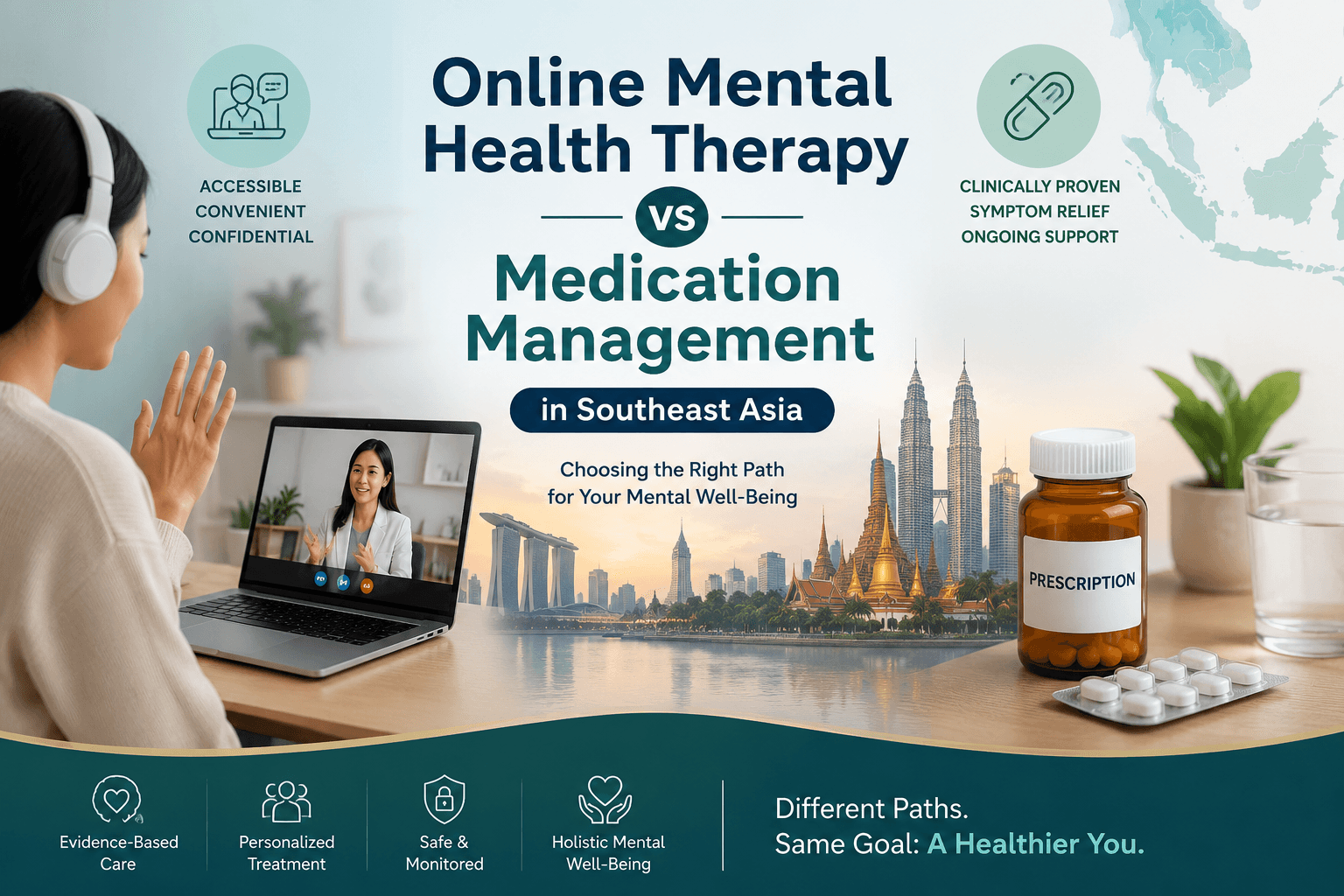
Online mental health therapy and medication management are two distinct but complementary approaches to treating depression and anxiety. The choice between them—or their combination—depends on symptom severity, personal preference, cost, and access to licensed professionals. In Southeast Asia, where 1 in 8 people live with a mental disorder (WHO, 2019), the digital divide and cultural stigma further complicate the decision.
Key Takeaways
- Online cognitive behavioral therapy (iCBT) is as effective as face-to-face therapy for depression and anxiety, based on a meta-analysis of 17 studies (Carlbring et al., 2018).
- Medication management via telepsychiatry shows similar patient satisfaction and adherence to in-person care (Hilty et al., 2018).
- Combining online therapy with medication is more effective than either alone for moderate-to-severe depression.
- Over 30% of Southeast Asian respondents in a 2021 WHO survey would consider online mental health services due to cost and convenience.
- Cultural stigma and language barriers remain the biggest obstacles to access in the region.
Imagine a 28-year-old accountant in Jakarta who has been waking up with a heavy chest and a sense of dread for three months. She knows she should talk to someone, but the nearest psychiatrist is a two-hour drive away, and the cost of a session rivals her weekly grocery budget. She types "online therapy Indonesia" into her phone—and faces a confusing array of apps, platforms, and promises. This is the reality for millions across Southeast Asia, where mental health services are both scarce and stigmatized.
This article compares online therapy (talk therapy, typically CBT) versus medication management (antidepressants prescribed by a psychiatrist) for common mental health conditions. We will examine effectiveness, cost, cultural fit, and the unique challenges of using these services in Malaysia, Indonesia, the Philippines, Thailand, and Vietnam. By the end, you will have a clear framework to decide which path—or combination—suits your situation. For a quick, private assessment of your symptoms, EazyCare AI's symptom checker can help you understand whether you need therapy, medication, or both.
Why Southeast Asia Needs Online Mental Health Care Now
The numbers are stark. The WHO estimates that 970 million people globally lived with a mental disorder in 2019, with anxiety and depressive disorders being the most common. In Southeast Asia, the treatment gap—the difference between those who need care and those who receive it—is estimated at 76% to 85% for depression. The region has only 0.3 psychiatrists per 100,000 population in Indonesia, compared to 15 per 100,000 in high-income countries.
Emerging research on the gut health second brain shows how your digestive system influences anxiety and depression.
Chronic insomnia also affects millions in the region, and digital therapeutics for chronic insomnia offer a new treatment option.
Online mental health services have emerged as a partial solution. According to a 2021 WHO survey across Indonesia, Malaysia, Philippines, and Thailand, over 30% of respondents said they would consider online mental health services due to cost and convenience. Telepsychiatry platforms like ThoughtFull (Malaysia) and MindPeers (Indonesia) now offer both therapy and medication management, reducing travel time and cost. However, the digital divide remains: internet penetration in rural areas of the Philippines is only 25%, and language barriers limit access to English-only platforms.
As these platforms expand, AI mental health triage is emerging to help match patients to the right level of care.
Online mental health therapy refers to structured talk therapy sessions with a licensed psychologist or counselor conducted via video, voice, or text. Medication management involves a psychiatrist prescribing and monitoring psychotropic drugs, typically antidepressants or anxiolytics, through teleconsultations.
Cultural stigma remains a powerful deterrent. In many Southeast Asian cultures, mental illness is seen as a personal weakness or a family shame. A 2020 study in Malaysia found that 60% of respondents believed that "mental illness is a sign of personal failure." Online platforms offer anonymity, which can reduce the fear of being seen entering a therapist's office. Yet, the same anonymity can also lead to misuse—patients may skip therapy and rely solely on medication, or vice versa, without professional guidance.
Key takeaway: The digital transformation of mental health care in Southeast Asia is not just about convenience—it is about closing a massive treatment gap. But technology alone cannot solve the cultural and regulatory barriers.
To improve outcomes, platforms must adopt patient engagement strategies for closing care gaps in Southeast Asia.
Online Therapy vs Medication: What the Data Says
Effectiveness of Online Therapy
A landmark meta-analysis published in Psychological Medicine (Carlbring et al., 2018) pooled data from 17 randomized controlled trials comparing internet-based cognitive behavioral therapy (iCBT) to face-to-face therapy for depression and anxiety. The result: iCBT was non-inferior to in-person therapy, with effect sizes of 0.87 for depression and 0.76 for anxiety. This means that for most patients, an online therapy program can produce the same improvement as sitting in a therapist's office.
However, the data also reveals a dropout rate of 20–30% in online therapy, compared to 10–15% in face-to-face settings. Patients who lack motivation, have poor internet connectivity, or face language barriers are more likely to drop out. The quality of the platform matters: guided iCBT (with weekly therapist check-ins) outperforms fully automated programs.
Emerging data on AI therapy effectiveness for Southeast Asian patients shows promising results.
Effectiveness of Online Medication Management
Telepsychiatry medication management has been studied extensively. A 2018 review by Hilty et al. in Telemedicine and e-Health examined 20 outcomes studies and found that telepsychiatry medication management showed similar patient satisfaction and adherence rates compared to in-person care. The key is that the psychiatrist must have a reliable video connection and access to the patient's medical history, including lab results for liver function and side effects.
For chronic physical conditions, digital hypertension management Southeast Asia platforms offer comparable remote care.
Online medication management is not appropriate for all patients. Those with severe depression, suicidal ideation, bipolar disorder, or psychosis require in-person evaluation at least initially. Do not attempt to manage these conditions solely through a teleconsultation app.
Combined Therapy + Medication
The strongest evidence supports a combined approach for moderate-to-severe depression. A 2016 Lancet meta-analysis found that the combination of antidepressants and CBT produced a response rate of 62% compared to 46% for medication alone and 38% for therapy alone. Unfortunately, very few Southeast Asian platforms offer integrated care within the same service. Most patients must navigate separate providers for therapy and medication, which can lead to fragmented care.
AI patient communication tools are now boosting outcomes for patients using these platforms.
| Approach | Response Rate (depression) | Dropout Rate | Best for |
|---|---|---|---|
| Online therapy alone | 60–70% (mild-moderate) | 20–30% | Mild depression, anxiety, adjustment disorders |
| Online medication management alone | 45–55% (moderate-severe) | 15–25% | Moderate depression, panic disorder, OCD |
| Combined therapy + medication | 62% | 15–20% | Moderate-to-severe depression, chronic anxiety |
Key takeaway: For mild anxiety or depression, start with online therapy. For moderate-to-severe symptoms, combine therapy with medication management under a psychiatrist's supervision.
Mental Health Stigma in Southeast Asia: A Barrier to Both Options
Stigma is not uniform across the region. In Thailand, mental health is increasingly discussed in urban areas, but in rural Isaan, it remains taboo. In the Philippines, the Mental Health Act of 2018 has improved awareness, but many still view therapy as a "Western luxury." In Vietnam, the term "bệnh tâm thần" (mental illness) carries a heavy stigma that deters even educated professionals from seeking care.
Online therapy can help reduce stigma by offering privacy. A patient in a conservative Malaysian family can attend sessions from a locked room without anyone knowing. Yet, the anonymity also means that some patients may use it to avoid confronting the deeper issues that require family involvement, like relationship conflicts or intergenerational trauma.
Traditional healing practices are deeply embedded in Southeast Asian cultures. In Indonesia, dukun (traditional healers) are often the first stop for mental distress. In the Philippines, hilot (massage therapists) and spiritual counselors are widely consulted. A 2019 study in Transcultural Psychiatry found that 40% of Filipino patients with depression had consulted a traditional healer before seeking Western medical help. Online mental health platforms that integrate or acknowledge these practices—rather than dismissing them—may achieve higher acceptance.
For a deeper look at how technology can adapt to individual needs, explore personalized digital mental health therapy.
For long-term conditions, consider how AI chronic disease management can complement your mental health care.
For those with co-occurring physical symptoms, exploring virtual physical therapy for musculoskeletal pain may complement your mental health care.
For long-term conditions, digital coaching chronic disease management can complement mental health care.
"The most effective digital mental health interventions in Southeast Asia will be those that respect local beliefs, offer multi-language support, and bridge the gap between traditional healing and evidence-based medicine."
— Dr. Rizky, psychiatrist, University of Indonesia
Key takeaway: When choosing between online therapy and medication, consider how each option aligns with your cultural values and family dynamics. If stigma is a major concern, online therapy offers greater anonymity. If you believe in a combination of traditional and modern approaches, look for platforms that offer culturally sensitive counseling.
How to Choose Between Online Therapy and Medication Management
Use the following framework to guide your decision. It is not a substitute for a professional assessment, but it can help you prepare for a consultation.
Assess severity. If you have been feeling sad, anxious, or irritable for less than 2 weeks, and your daily functioning is intact, start with online therapy. If symptoms have lasted >2 weeks, you have lost interest in activities, or you cannot work or study, consider medication management.
Check for red flags. Any thoughts of suicide, self-harm, or hallucinations require immediate in-person emergency care. Do not rely on online services for crisis management.
Evaluate cost. Online therapy in Malaysia typically costs RM80–150 per session (USD 17–32). Online psychiatrist consultation ranges from RM150–300 (USD 32–64). In Indonesia, therapy can be as low as IDR 150,000 (USD 10) on platforms like MindPeers. Medication costs vary: generic SSRIs like fluoxetine may cost IDR 50,000 (USD 3.3) per month, while newer medications can be 10x more.
Consider insurance coverage. In Singapore, some private insurance policies cover telepsychiatry (e.g., Healthway Medical). In Malaysia, the national insurance scheme (SOCSO) covers certain mental health services but not all. In the Philippines, PhilHealth covers 10 sessions of outpatient mental health care, but only in accredited facilities—not all online platforms qualify. Check with your insurer before booking.
Try a combined approach. If you have moderate-to-severe depression, do not choose between therapy and medication. Use both. Many online platforms now offer referral networks: a therapist can recommend a telepsychiatrist, and vice versa. EazyCare AI's health assistant can help you find nearby providers who offer integrated care.
Key takeaway: The decision is not binary. Most patients benefit from a combination tailored to their severity, budget, and cultural context.
Online Mental Health Platforms in Southeast Asia: A Comparative Overview
Several platforms operate across the region, but each faces unique regulatory and licensing challenges. Below is a comparison of the most prominent options.
| Platform | Countries | Services | Cost Range | Language |
|---|---|---|---|---|
| ThoughtFull | Malaysia, Singapore | Therapy, coaching, employee wellness programs | RM80–150/session | English, Malay, Mandarin |
| MindPeers | Indonesia | Therapy, self-guided programs, community support | IDR 150,000–300,000 | Indonesian, English |
| BetterHelp | Global (including SEA) | Therapy only (no medication) | USD 60–90/week | English, Spanish, limited others |
| Klinik Psyche | Malaysia | Psychiatry (medication management only) | RM150–300/session | English, Malay |
| Halodoc | Indonesia | General medicine, psychiatry (medication), some therapy | IDR 100,000–500,000 | Indonesian |
Regulatory Differences
Each country has its own rules for telemedicine and online prescribing. In Malaysia, the Medical Council allows teleconsultations but requires that the first visit be in-person for medication management. In Indonesia, the Ministry of Health permits telepsychiatry for follow-ups only; initial prescriptions must be made in-person. The Philippines has no specific law on telepsychiatry, but the Professional Regulation Commission requires that psychologists be licensed in the patient's location. This creates a patchwork that can confuse both clinicians and patients.
Never purchase psychiatric medications from online pharmacies without a prescription. Counterfeit antidepressants are common in Southeast Asia, especially on unauthorized platforms. Always use a licensed telepsychiatry service that issues a proper prescription.
For patients in rural areas, community health workers (CHWs) play a crucial role. In Indonesia, the government's Puskesmas (community health centers) are integrating telepsychiatry with CHW support. A pilot program in East Java showed that CHW-assisted telepsychiatry improved medication adherence by 35% compared to usual care. This model is being replicated in Thailand and Vietnam.
Key takeaway: When choosing a platform, check whether it is licensed in your country, offers services in your language, and can provide both therapy and medication management if needed. For a quick assessment of which platform suits your needs, try EazyCare AI's symptom checker.
Frequently Asked Questions
Is online therapy as effective as in-person therapy for depression?
Yes, for most patients. A meta-analysis of 17 randomized controlled trials (Carlbring et al., 2018) found that internet-based cognitive behavioral therapy (iCBT) is non-inferior to face-to-face therapy for depression and anxiety. However, online therapy has higher dropout rates (20–30%) and may be less effective for patients with severe symptoms or those who lack motivation. If you have mild-to-moderate depression, online therapy is a good first-line option. EazyCare AI's symptom checker can help you assess your depression severity.
Can an online therapist prescribe medication?
No, in most countries. Online therapists (psychologists, counselors) cannot prescribe medication. Only licensed psychiatrists (medical doctors) can prescribe antidepressants. Some telepsychiatry platforms offer medication management, but the psychiatrist must conduct a virtual consultation first. In Southeast Asia, regulations vary: Malaysia and Indonesia require the first prescription to be in-person, while Singapore allows tele-consultations for re-fills. Always confirm the clinician's credentials before booking.
What is the difference between online therapy and medication management?
Online therapy involves structured talk sessions with a psychologist or counselor to address thought patterns and behaviors. Medication management involves a psychiatrist prescribing and monitoring drugs like SSRIs to correct brain chemistry. Therapy addresses the root cause of distress; medication rapidly reduces symptoms. Both are evidence-based, but they serve different roles. For mild conditions, therapy alone is sufficient. For moderate-to-severe conditions, combining both yields the best outcomes.
How do I choose between therapy and medication for anxiety?
Start by assessing your symptoms. If your anxiety is situational (e.g., work stress, social situations) and you can still function, online therapy (CBT) is highly effective. If your anxiety is constant, interferes with sleep or appetite, or includes panic attacks, medication (e.g., SSRIs) may be more appropriate first. Many patients benefit from starting therapy while medication stabilizes their mood. Use EazyCare AI's symptom checker to get a personalized recommendation.
Are online mental health services covered by insurance in Southeast Asia?
Coverage varies widely. In Singapore, some private insurers (e.g., AIA, Great Eastern) cover telepsychiatry consultations. In Malaysia, SOCSO covers limited sessions for mental health, but only for workplace-related issues. In Indonesia, BPJS Kesehatan covers some psychiatric consultations at public facilities, but not online. In the Philippines, PhilHealth covers 10 sessions of outpatient mental health care, but only at accredited facilities—many online platforms do not qualify. Always check with your insurer before booking. EazyCare AI can help you find providers that accept your insurance.
What are the risks of using online medication management without therapy?
Medication alone has a higher relapse rate. A 2016 Lancet meta-analysis found that the combination of antidepressants and CBT produced a 62% response rate vs. 46% for medication alone. Without therapy, patients may not develop coping skills, and they often stop taking medication once they feel better, leading to relapse. Additionally, side effects of antidepressants (insomnia, weight gain, sexual dysfunction) are harder to manage without therapeutic support. If you choose medication management, insist on a combined care plan.
How effective is combining online therapy with medication?
Very effective. The same 2016 Lancet meta-analysis showed that the combination of CBT and antidepressants is superior to either alone for moderate-to-severe depression. The response rate for combined treatment is 62%, compared to 38% for therapy alone. For anxiety disorders, the combination also shows better long-term outcomes. However, finding a platform that offers both seamlessly can be challenging in Southeast Asia. Some platforms like ThoughtFull are starting to integrate referral networks.
What are the best online mental health platforms in Southeast Asia?
For therapy, ThoughtFull (Malaysia/Singapore) and MindPeers (Indonesia) are well-regarded. For medication management, Klinik Psyche (Malaysia) and Halodoc (Indonesia) offer online psychiatry. For a combined approach, try BetterHelp (global) for therapy and seek a local telepsychiatrist for medication. Always verify that the platform is licensed in your country. EazyCare AI's health assistant can recommend platforms based on your location and needs.
Can medication be managed entirely online for serious mental illness?
No, not for serious conditions like bipolar disorder, schizophrenia, or severe depression with psychosis. These require in-person evaluation for initial diagnosis and dose stabilization. Online medication management can be used for follow-up and maintenance once the patient is stable, but the first visit should be face-to-face. Many Southeast Asian countries have regulations that mandate an initial in-person visit before telepsychiatry follow-ups. If you have a serious mental illness, do not rely solely on online care.
Does online therapy work for cultural-specific issues in SEA?
It can, but only if the therapist is culturally competent. Many online platforms hire therapists from Western countries who may not understand the family dynamics, religious beliefs, or traditional healing practices of Southeast Asia. Some platforms like MindPeers specifically train therapists in Indonesian cultural contexts. Look for therapists who speak your language and have experience with your community. EazyCare AI's symptom checker can match you with culturally appropriate providers.
When to See a Doctor
Online therapy and medication management are not appropriate for all situations. Seek immediate medical attention if you experience any of the following:
- Thoughts of harming yourself or others
- Hearing voices or seeing things that are not there
- Severe agitation or inability to sit still
- Rapid weight loss or refusal to eat for more than 2 days
- Confusion, disorientation, or memory loss
- Severe panic attacks that cause chest pain or shortness of breath
Call 999 (or your local emergency number) or go to the nearest emergency department if you are in crisis. Do not wait for an online appointment.
If you are unsure whether your symptoms are urgent, EazyCare AI can help you decide whether you need emergency care.
Conclusion
Choosing between online mental health therapy and medication management in Southeast Asia requires balancing clinical evidence, cultural acceptance, cost, and access. Here are the three key takeaways:
- Online therapy is a strong first-line option for mild-to-moderate depression and anxiety, backed by meta-analyses showing non-inferiority to in-person care.
- Medication management via telepsychiatry is effective for moderate-to-severe conditions, but it works best when combined with therapy. Never rely solely on pills.
- Cultural stigma and regulatory hurdles remain significant barriers in Southeast Asia, but platforms like ThoughtFull and MindPeers are making progress. Always choose a platform that respects your language, culture, and local regulations.
Your mental health journey is not a solo expedition. Use the tools available—online therapy, medication management, community health workers, and AI-powered health assistants—to build a support system that works for you. Learn more at eazycare.ai or chat with our AI health assistant to take the first step.
