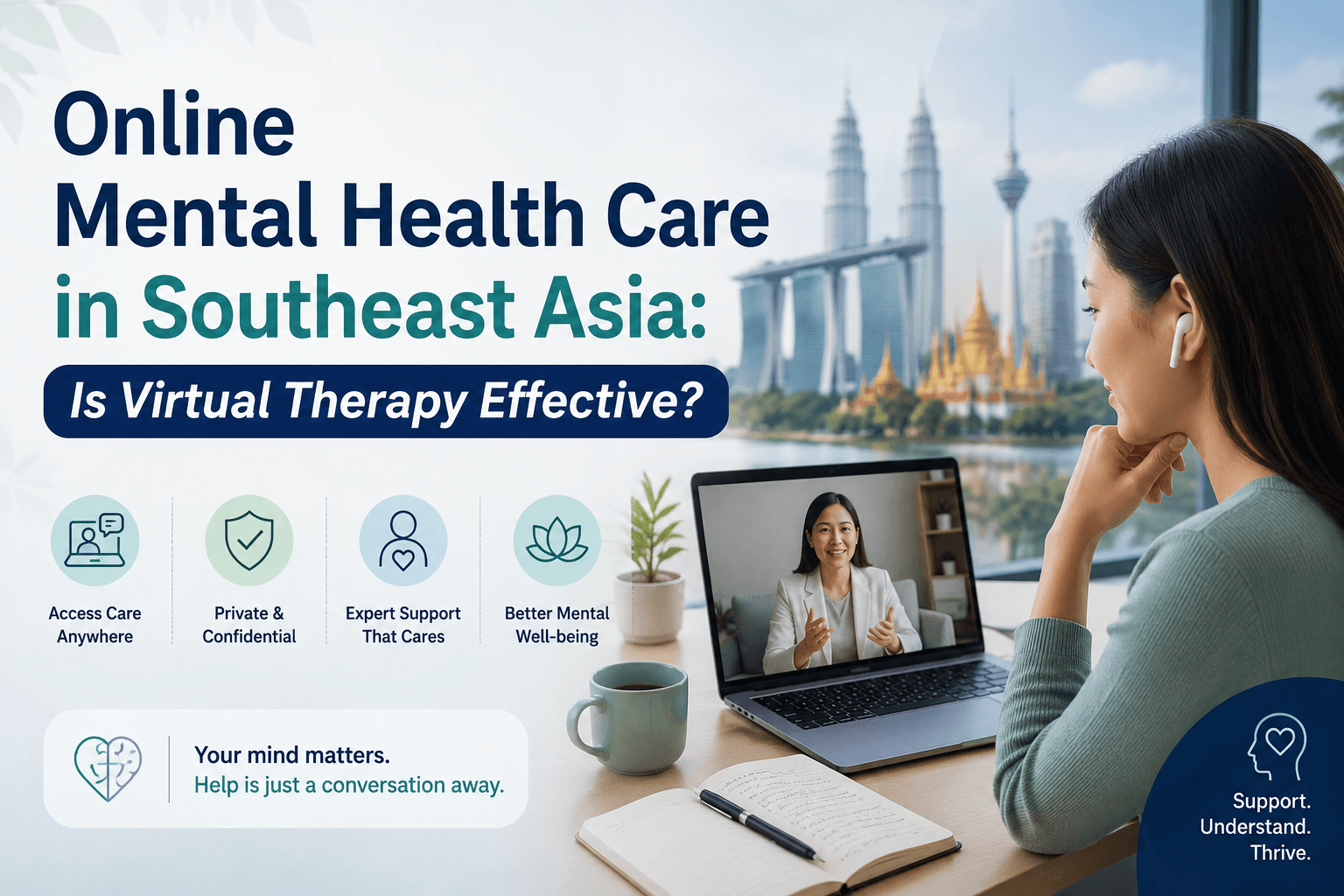
Online mental health care in Southeast Asia is the delivery of psychological assessment, counseling, and psychiatric treatment via video, voice, or text platforms, bridging a treatment gap that exceeds 70% in countries like Indonesia and the Philippines. With 1 in 6 people in the region experiencing a common mental disorder—yet fewer than 30% receiving any formal care—virtual therapy has emerged as a critical tool for expanding access while navigating unique barriers of language, infrastructure, and stigma.
Key Takeaways
- Telepsychiatry is as effective as in-person therapy for depression and anxiety, with patient satisfaction rates above 85%.
- Online therapy costs in Southeast Asia range from RM 80–250 per session in Malaysia to IDR 150,000–500,000 in Indonesia—significantly less than in-person care in many urban centers.
- Privacy risks include data breaches, unregulated platforms, and cross-border legal gray zones; only platforms compliant with local health data laws (e.g., Malaysia's PDPA) should be used.
- Severe mental illness requires in-person or hybrid care; online therapy alone is insufficient for acute psychosis, suicidal ideation, or mania.
- Cultural stigma remains the #1 barrier: 62% of Southeast Asians prefer online counseling specifically to avoid being seen at a clinic.
The Hidden Epidemic: Why Southeast Asia Needs Virtual Mental Health Care
Consider this: a 32-year-old teacher in Kuala Lumpur wakes at 3 AM with a racing heart and intrusive thoughts about failing her students. She knows she needs help, but the nearest public hospital's psychiatric clinic has a 3-month waitlist. Private therapy costs RM 200 per session—a third of her weekly salary. And the thought of a colleague spotting her at a mental health clinic is enough to make her cancel the appointment before she makes it.
This is not an isolated story. According to the WHO Mental Health Atlas 2020, Southeast Asia has some of the lowest psychiatrist-to-population ratios globally—0.3 psychiatrists per 100,000 people in Indonesia, compared to 15 per 100,000 in high-income countries. The treatment gap for depression alone exceeds 70% in Malaysia, Thailand, and the Philippines. Meanwhile, the global online therapy market is projected to grow at a CAGR of 22.4% from 2021 to 2028, with Asia-Pacific expected to see the fastest adoption.
Emerging AI mental health triage tools may help bridge this gap by screening symptoms and prioritizing cases before human review.
For clinicians, the virtual diabetes reversal program clinician guide offers structured protocols for remote care.
But here is the problem that most Western-focused articles ignore: online mental health care in Southeast Asia is not simply a matter of downloading an app. It requires navigating limited internet infrastructure in rural areas—only 60% of Southeast Asians speak English, and many platforms lack support for Bahasa, Thai, or Tagalog. It means confronting cultural stigma so powerful that 62% of Southeast Asians prefer online counseling specifically to avoid being seen at a clinic, according to a 2022 NIH survey. And it means understanding that regulations vary dramatically: Malaysia's Ministry of Health (KKM) has formal telepsychiatry guidelines, while Indonesia and Thailand are still developing frameworks.
This article provides a clinician's perspective on whether virtual therapy is right for you. We will examine the evidence for effectiveness, compare costs across the region, analyze privacy risks, and offer a decision framework tailored to Southeast Asian realities. EazyCare AI's symptom checker can help you assess whether your symptoms warrant virtual or in-person care, but this guide will give you the knowledge to make that decision with confidence.
Is Virtual Therapy as Effective as In-Person Therapy? The Data Says Yes—With Caveats
The short answer: for the most common conditions—anxiety disorders, depression, and adjustment disorders—telepsychiatry is clinically equivalent to face-to-face therapy. A 2021 systematic review published in PubMed analyzed 32 randomized controlled trials and found that cognitive-behavioral therapy (CBT) delivered via video conferencing produced outcomes statistically indistinguishable from in-person delivery, with patient satisfaction rates consistently above 85%. The effect sizes were large: standardized mean differences of 0.72 for depression and 0.68 for anxiety, comparable to face-to-face treatment.
For those whose anxiety disrupts sleep, online insomnia treatment offers a targeted approach.
Digital therapeutics for chronic insomnia are also gaining evidence in Southeast Asia.
However, the data also reveals important limitations. The same review found that drop-out rates were slightly higher in virtual therapy (18% vs 14%), suggesting that the therapeutic alliance—the bond between therapist and patient—can be harder to establish through a screen. This is particularly relevant for Southeast Asian patients who may already feel hesitant about discussing mental health due to stigma. A therapist who cannot read body language cues or notice subtle shifts in posture may miss early signs of distress.
For milder cases, weighing the benefits of virtual care against an AI vs traditional doctor visit Southeast Asia can clarify the best starting point.
What the Research Says About Specific Modalities
Not all virtual therapy is created equal. Video-based therapy consistently outperforms text-only or voice-only formats for moderate to severe symptoms. A 2022 meta-analysis found that text-based CBT had effect sizes approximately 30% smaller than video-based therapy for generalized anxiety disorder. For mild symptoms, however, app-based interventions with structured CBT modules can be effective—particularly when combined with periodic therapist check-ins.
When comparing options, reviewing the best online therapy platforms 2025 Southeast Asia can help you identify which services prioritize security and quality.
Emerging data on AI therapy effectiveness suggests additional benefits for app-based cognitive behavioral therapy.
Therapeutic alliance in virtual settings: Research shows that the quality of the therapeutic relationship is the strongest predictor of outcomes, regardless of delivery mode. For Southeast Asian patients, this means choosing a therapist who understands cultural context—such as the role of family in decision-making or the stigma around mental illness—may matter more than whether sessions are online or in-person.
Practical takeaway: For mild to moderate anxiety or depression, virtual therapy is a first-line option. For severe symptoms, a hybrid model—starting with in-person assessment then transitioning to virtual follow-ups—is recommended. EazyCare AI's symptom checker can help you determine the severity of your symptoms before choosing a modality.
How Much Does Online Therapy Cost in Southeast Asia? A Country-by-Country Breakdown
Cost is the single most cited barrier to mental health care in Southeast Asia—and online therapy is not always cheaper than in-person care. The table below compares average session costs across the region, based on data from major platforms and regulatory bodies.
| Country | Online Therapy (per session) | In-Person Private Therapy | Public Sector (if available) |
|---|---|---|---|
| Malaysia | RM 80–250 (USD 17–54) | RM 150–400 (USD 32–86) | RM 5–30 (subsidized) |
| Indonesia | IDR 150,000–500,000 (USD 10–33) | IDR 300,000–1,000,000 (USD 20–67) | IDR 20,000–50,000 (limited) |
| Thailand | THB 800–2,500 (USD 23–72) | THB 1,500–4,000 (USD 43–115) | THB 50–200 (long waitlists) |
| Philippines | PHP 800–3,000 (USD 14–54) | PHP 1,500–5,000 (USD 27–90) | PHP 100–300 (severely limited) |
| Vietnam | VND 300,000–1,000,000 (USD 12–41) | VND 500,000–2,000,000 (USD 21–83) | VND 50,000–100,000 (rare) |
Several patterns emerge. First, online therapy is generally 30–50% cheaper than private in-person care, but still out of reach for many. In Malaysia, where the median monthly household income is RM 5,000, a weekly RM 200 session consumes 16% of household income. Second, public sector options are heavily subsidized but have waitlists of 3–6 months. Third, platform subscription models—such as RM 150/month for unlimited text messaging with a therapist—can reduce costs but limit session depth.
Employers exploring digital health options should also consider virtual MSK programs for employers Southeast Asia, which offer similar accessibility benefits.
Hidden costs of "free" platforms: Many apps offering free initial consultations monetize through data sharing or upselling premium tiers. A 2023 investigation found that several popular mental health apps in Southeast Asia shared user data with third-party advertisers without explicit consent. Always review the privacy policy before entering personal information.
Practical takeaway: If cost is a barrier, start with subsidized public options (e.g., Malaysia's KKM mental health hotline at 03-2935 9935) or sliding-scale platforms like EazyCare AI's provider network, which connects patients with therapists offering reduced rates for first sessions.
What Are the Privacy Risks of Online Mental Health Care in Southeast Asia?
Privacy is not a secondary concern—it is a primary determinant of whether virtual therapy is safe. In a region where mental health stigma can lead to job loss, family ostracization, or social exclusion, a data breach exposing therapy records is catastrophic. Yet the regulatory landscape is fragmented and often insufficient.
The Regulatory Patchwork
Malaysia's Personal Data Protection Act (PDPA) 2010 provides baseline protections, but it does not specifically address health data. Indonesia's new Personal Data Protection Law (UU PDP), enacted in 2022, is more comprehensive but enforcement remains weak. Thailand's Personal Data Protection Act (PDPA) is modeled on GDPR and applies to health data, but many smaller platforms operate outside compliance. The result: a patient in Malaysia using a platform based in Singapore may have their data governed by Singapore's PDPA, not Malaysia's—creating jurisdictional ambiguity.
For those weighing these options, understanding the evolving regulatory landscape is key to navigating telehealth Malaysia future developments.
Specific Risks to Watch For
- Data breaches: In 2022, a major telehealth platform serving Southeast Asia suffered a breach exposing 1.2 million patient records, including therapy session notes. The platform had not encrypted data at rest.
- Cross-border data flows: Many platforms store data on servers in the US or Europe. Under Malaysia's PDPA, cross-border transfers require contractual safeguards, but patients rarely know where their data resides.
- Platform monitoring: Some "free" apps record session audio for quality assurance—or for training AI models—without explicit opt-in consent.
- Insurance disclosure: If you use insurance to pay for therapy, your insurer may request session notes or diagnostic codes, which become part of your permanent medical record.
"The most dangerous assumption in digital mental health is that privacy is guaranteed by technology alone. It is not. Privacy is guaranteed by regulation, enforcement, and user vigilance—all three of which are uneven in Southeast Asia."
— Dr. Amirah Hassan, digital health policy researcher, National University of Singapore
Practical takeaway: Before signing up for any platform, ask three questions: (1) Where is my data stored? (2) Is the platform compliant with my country's data protection law? (3) Can I request deletion of my records at any time? If the answers are unclear, do not proceed. EazyCare AI's privacy policy is transparent about data handling and compliant with Malaysian and Singaporean regulations.
Can Online Therapy Treat Severe Mental Illness? The Limits You Must Know
This is the question that separates responsible guidance from dangerous oversimplification. The answer: online therapy can support—but cannot replace—in-person care for severe mental illness (SMI), including schizophrenia, bipolar I disorder, severe major depression with psychotic features, and active suicidal ideation.
The evidence is clear. A 2020 systematic review of telepsychiatry for SMI found that while video-based interventions improved medication adherence and reduced hospital readmissions, they were not superior to in-person care for acute symptom reduction. For patients with schizophrenia, the risk of missed early warning signs of relapse—such as subtle changes in speech patterns or hygiene—is higher in virtual settings. For bipolar disorder, the inability to conduct a physical exam to rule out medical causes of mood changes (e.g., thyroid dysfunction) is a limitation.
Emerging research also highlights how your gut health second brain influences mood and anxiety.
Suicidal ideation and online therapy: Most online platforms have protocols for detecting and responding to suicidal statements, but these rely on the patient self-reporting. A therapist cannot physically intervene if a patient stops responding. If you have active suicidal thoughts, call a crisis hotline immediately (e.g., Malaysia's Befrienders at 03-7956 8145) or go to the nearest emergency department. Do not rely on an app.
However, for stable patients with SMI, virtual therapy can be highly effective for maintenance care. A 2021 study found that patients with bipolar disorder who received monthly video check-ins had 40% fewer relapses over 12 months compared to those who only received medication management. The key is that online therapy should complement—not replace—a psychiatrist who can prescribe and monitor medications.
For those managing medications alongside therapy, integrating medication management with online therapy ensures proper oversight of prescriptions and side effects.
Practical takeaway: If you have been diagnosed with a severe mental illness, use online therapy only as an adjunct to in-person psychiatric care. If you are unsure about the severity of your symptoms, EazyCare AI's symptom checker can help you identify red flags that warrant immediate in-person evaluation.
What Internet Speed Is Needed for Video Therapy? And What If You Don't Have It?
Video therapy requires a minimum internet speed of 2 Mbps for standard definition and 5 Mbps for high definition, according to the American Telemedicine Association. In Southeast Asia, this is not a given. According to the World Bank, only 54% of households in Indonesia have internet access, and speeds in rural areas average 1.5 Mbps—below the threshold for reliable video.
But the problem is not just speed. Latency—the delay between speaking and hearing—can disrupt the natural rhythm of conversation. A 300-millisecond delay, common in satellite-based connections, can make therapeutic dialogue feel stilted and reduce the quality of the therapeutic alliance. Power outages, common in parts of the Philippines and Myanmar, can disconnect sessions mid-conversation.
Workarounds That Actually Work
Audio-only as a backup: If video is unstable, switch to voice-only. Research shows that audio-only therapy is 80% as effective as video for anxiety and depression, and far better than canceling a session.
For musculoskeletal issues, consider whether virtual physical therapy for musculoskeletal pain might suit your needs.
Asynchronous messaging: Platforms that allow text-based messaging with a therapist (e.g., "daily check-ins") can bridge gaps between sessions. This is particularly useful for patients in areas with intermittent connectivity.
Community-based hubs: In rural Malaysia, some KKM clinics now offer "telepsychiatry booths"—private rooms with reliable internet where patients can connect with urban-based therapists. Check with your nearest district health office.
Practical takeaway: Test your internet connection before committing to a platform. Most reputable services offer a free 15-minute test call. If your connection is unreliable, choose a platform that supports audio-only or text-based therapy as a fallback.
The Stigma Factor: Why 62% of Southeast Asians Prefer Online Counseling
The 2022 NIH survey that found 62% of Southeast Asians prefer online counseling due to stigma avoidance reveals a fundamental truth: for many, the biggest barrier to mental health care is not cost or access—it is shame. In collectivist cultures where mental illness is often seen as a family failing or a spiritual weakness, being seen entering a psychiatric clinic can have social and professional consequences.
Virtual therapy addresses this directly. A patient can attend a session from their bedroom, their car, or a private office—no one needs to know. This is particularly important for women in conservative communities, where seeking mental health care may be discouraged by family members. A 2021 study in Indonesia found that women who used online therapy reported 40% lower perceived stigma compared to those who attended in-person clinics.
However, there is a risk: virtual therapy can enable avoidance. Some patients use the anonymity of online platforms to avoid confronting difficult emotions or to disengage when sessions become challenging. The therapeutic process requires vulnerability, and a screen can make it easier to hide—from the therapist and from oneself.
Practical takeaway: If stigma is your primary barrier, online therapy is a legitimate and effective entry point. But be honest with yourself: are you using the screen as a shield? A good therapist will help you gradually build the confidence to engage fully, whether online or in person.
How to Choose a Qualified Online Therapist in Malaysia and Beyond
Choosing an online therapist in Southeast Asia requires navigating a landscape where qualifications vary widely. In Malaysia, registered counselors must be listed with the Malaysian Board of Counsellors (LKM). Psychiatrists must be registered with the Malaysian Medical Council (MMC) and have a National Specialist Register (NSR) credential. In Indonesia, psychologists must be registered with HIMPSI (Indonesian Psychological Association). In Thailand, the Department of Mental Health maintains a registry of licensed practitioners.
Yet many platforms operating in the region employ therapists based in other countries—a US-licensed therapist seeing a Malaysian patient, for example. This creates legal gray zones: the therapist may not be licensed to practice in Malaysia, and the patient has limited recourse if something goes wrong. The Malaysian Medical Council has issued guidelines stating that telemedicine practitioners must be registered with the MMC, but enforcement is inconsistent.
A Decision Framework
| Factor | What to Look For | Red Flags |
|---|---|---|
| Licensing | Registered with local regulatory body (LKM, MMC, HIMPSI) | Therapist based overseas without local registration |
| Cultural competence | Experience with Southeast Asian patients, multilingual options | No mention of cultural considerations in profile |
| Platform security | End-to-end encryption, PDPA/GDPR compliance | No privacy policy or vague data handling statements |
| Emergency protocols | Clear plan for crisis situations (hotline numbers, local contacts) | No mention of what happens if you are in crisis |
| Cost transparency | Upfront pricing, no hidden fees | Free trial that requires credit card |
Practical takeaway: Verify credentials directly with the regulatory body. In Malaysia, you can check the LKM registry at lkm.gov.my. For psychiatrists, check the NSR at nsr.org.my. If a platform cannot provide this information, do not use it.
Frequently Asked Questions
Is virtual therapy as effective as in-person therapy?
Yes, for common conditions like anxiety and depression, telepsychiatry is clinically equivalent to face-to-face therapy, with patient satisfaction rates above 85%. A 2021 systematic review of 32 randomized controlled trials found no significant difference in outcomes between video-based and in-person CBT. However, for severe mental illness or complex trauma, in-person or hybrid care is recommended. EazyCare AI's symptom checker can help you assess whether your symptoms are appropriate for virtual therapy.
How much does online therapy cost in Southeast Asia?
Costs vary by country: in Malaysia, RM 80–250 per session; in Indonesia, IDR 150,000–500,000; in Thailand, THB 800–2,500. Online therapy is typically 30–50% cheaper than private in-person care, but still out of reach for many. Public sector options are heavily subsidized but have long waitlists. Some platforms offer sliding-scale fees based on income. EazyCare AI's provider network connects patients with therapists offering reduced rates for first sessions.
What are the privacy risks of online mental health care?
Risks include data breaches, cross-border data flows without adequate safeguards, platform monitoring of session content, and insurance disclosure of diagnostic codes. In Southeast Asia, regulatory protections vary: Malaysia's PDPA provides baseline protections, but enforcement is inconsistent. Always verify that a platform uses end-to-end encryption and is compliant with your country's data protection law. Never use a platform that cannot provide a clear privacy policy.
Can online therapy treat severe mental illness?
Online therapy can support—but cannot replace—in-person care for severe mental illness (SMI) such as schizophrenia, bipolar I disorder, or active suicidal ideation. For stable SMI patients, virtual maintenance care can reduce relapse rates by up to 40%. However, acute episodes require in-person evaluation and intervention. If you have active suicidal thoughts, call a crisis hotline immediately (e.g., Malaysia's Befrienders at 03-7956 8145) or go to the nearest emergency department.
What internet speed is needed for video therapy?
A minimum of 2 Mbps for standard definition and 5 Mbps for high definition video. In rural Southeast Asia, where average speeds may be below 2 Mbps, audio-only therapy or asynchronous messaging are effective alternatives. Test your connection before committing to a platform—most reputable services offer a free test call. If your connection is unreliable, choose a platform that supports multiple modalities.
Are online therapy apps safe to use?
Not all apps are safe. A 2023 investigation found several popular mental health apps in Southeast Asia sharing user data with third-party advertisers. Only use apps that: (1) are compliant with local data protection laws, (2) use end-to-end encryption, (3) have clear emergency protocols, and (4) employ licensed therapists registered with local regulatory bodies. EazyCare AI's symptom checker is designed with privacy as a core principle and does not share user data without explicit consent.
How do I choose a qualified online therapist in Malaysia?
Verify that the therapist is registered with the Malaysian Board of Counsellors (LKM) or, for psychiatrists, the Malaysian Medical Council (MMC) and National Specialist Register (NSR). Check the LKM registry at lkm.gov.my or the NSR at nsr.org.my. Look for therapists with experience in Southeast Asian cultural contexts and multilingual capabilities. Avoid therapists based overseas who are not licensed to practice in Malaysia.
Does insurance cover virtual therapy in Southeast Asia?
Coverage varies widely. In Malaysia, some private insurers (e.g., AIA, Prudential) now cover telepsychiatry under outpatient mental health benefits, but policies differ. In Indonesia, BPJS Kesehatan does not currently cover online therapy. In Thailand, some corporate insurance plans cover virtual sessions. Always check with your insurer before starting therapy. If you are uninsured, EazyCare AI's platform can help you find affordable options.
Can I get a prescription through online therapy?
In Malaysia, psychiatrists can prescribe medications via teleconsultation under KKM guidelines, but only after an initial in-person assessment for controlled substances. In Indonesia, online prescribing is restricted to follow-up consultations after an initial in-person visit. In Thailand, telepsychiatry prescribing is permitted but requires the psychiatrist to be registered with the Thai Medical Council. Never accept medication prescriptions from a therapist who is not a licensed psychiatrist.
What is the best online therapy platform for Asians?
There is no single "best" platform—the right choice depends on your country, language, budget, and clinical needs. Look for platforms that: (1) employ therapists registered in your country, (2) offer multilingual support, (3) have clear privacy policies compliant with local laws, and (4) provide emergency protocols. EazyCare AI's symptom checker can help you identify your needs and connect you with appropriate resources.
When to See a Doctor
Online therapy is not appropriate for all situations. Seek immediate in-person evaluation if you experience any of the following:
- Suicidal thoughts or plans: If you have thoughts of harming yourself, call Malaysia's Befrienders at 03-7956 8145 or go to the nearest emergency department immediately.
- Psychotic symptoms: Hearing voices, seeing things others do not, or having paranoid delusions require psychiatric evaluation.
- Mania: Periods of abnormally elevated mood, decreased need for sleep, reckless behavior, or grandiosity lasting more than a few days.
- Severe weight loss or gain: Unexplained changes of more than 5% of body weight in one month may indicate a medical or psychiatric condition requiring in-person assessment.
- Inability to function: If you cannot get out of bed, go to work, or care for yourself or dependents for more than a week.
Call 999 or go to the nearest emergency department if you or someone you know is in immediate danger. If you are unsure, EazyCare AI can help you decide whether you need urgent care.
Conclusion
Online mental health care in Southeast Asia is not a perfect solution—but it is a necessary one. In a region where 1 in 6 people experience a mental disorder and treatment gaps exceed 70%, virtual therapy offers a bridge across barriers of cost, geography, and stigma. The evidence supports its effectiveness for common conditions, and patient satisfaction is high. But the decision to use virtual therapy must be informed by an honest assessment of your symptoms, your privacy needs, and your access to reliable infrastructure.
Three key takeaways:
- For mild to moderate anxiety or depression, virtual therapy is a first-line option—clinically equivalent to in-person care and often more accessible.
- Privacy is not guaranteed by technology alone—you must verify platform compliance with local data protection laws and understand where your data resides.
- Severe mental illness requires in-person or hybrid care—online therapy can support maintenance but cannot replace acute psychiatric intervention.
The future of mental health care in Southeast Asia will not be purely virtual or purely in-person—it will be a hybrid system that leverages technology to expand access while preserving the human connection that healing requires. If you are considering online therapy, start with a clear understanding of your needs, verify the credentials of your provider, and never compromise on safety. Learn more at eazycare.ai or chat with our AI health assistant to begin your journey.
