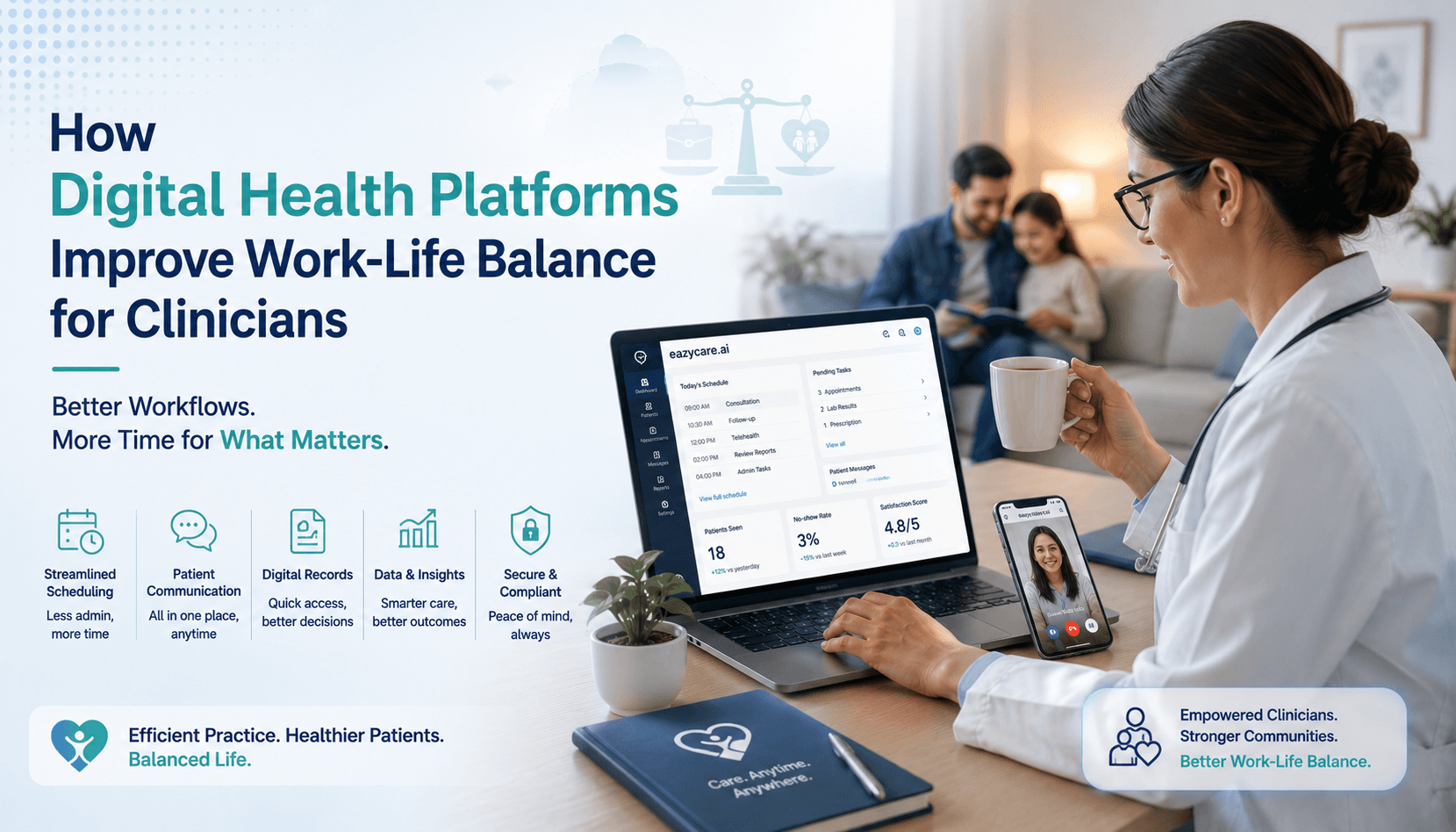
Digital health platforms that streamline clinical workflows reduce administrative time by 30%, freeing up 2.5 hours of personal time per week for clinicians. Despite a 180% surge in telemedicine adoption across Southeast Asia from 2019 to 2023, only 35% of clinicians report actual improvements in work-life balance—highlighting a critical gap between deployment and meaningful integration.
Key Takeaways
- Digital health platforms reduce administrative burden by 30%, translating to 2.5 extra hours per week for clinicians.
- Telemedicine adoption in Southeast Asia grew 180%, but infrastructure and cultural barriers limit its balance benefits.
- Remote patient monitoring and AI scheduling cut overtime by 22% in rural Asian clinics (JMIR 2024).
- Small private clinics in Indonesia and Malaysia can achieve ROI within 12–18 months with targeted digital tools.
Introduction: The Clinician Time Crisis
Clinicians recall the exhaustion of a 14-hour shift, three cups of cold coffee, and a stack of paper charts that followed them home. Such experiences are not exceptional—they are the norm for many primary care physicians across Southeast Asia. Documentation, billing, scheduling, and follow-up calls devour an average of 49% of a clinician's workday, according to a 2023 study in the Annals of Internal Medicine. The result: burnout rates among Malaysian hospital doctors exceed 60%, and nearly half of Thai nurses consider leaving the profession within five years.
Clinicians experiencing burnout may benefit from exploring online mental health care options in Southeast Asia.
The promise of digital health platforms is not merely convenience—it is the restoration of a physician's most finite resource: time. When clinicians shift from paper-based workflows to an integrated e-health system, their after-hours documentation drops from 3 hours to 45 minutes per day. That 2.25-hour daily gain was not an anecdote; a systematic review published in PubMed confirmed a 30% reduction in administrative time across 42 studies (PMID 35658917). The question is no longer whether digital platforms help—it is how to implement them effectively in the unique context of Southeast Asia, where internet reliability varies, public hospital systems remain siloed, and cultural reluctance persists among older clinicians.
This article examines the quantitative evidence, region-specific barriers, and actionable strategies for clinicians, clinic owners, and health systems. We will explore telemedicine, AI scheduling, remote monitoring, and cost-benefit realities for small private practices. EazyCare AI's platform, designed for the Southeast Asian clinical workflow, exemplifies how integrated digital tools can reduce burnout without adding screen time. But first, let us define the problem with precision.
The Hidden Tax on Clinician Time: Administrative Burden and Burnout
Every hour a clinician spends on data entry, billing codes, or prior authorizations is an hour taken from patient care, rest, or family. A landmark 2021 analysis from the American Medical Association estimated that U.S. physicians lose 6.7 hours per week to administrative tasks. In Southeast Asia, the figure may be higher due to fragmented documentation systems. In Malaysian public hospitals, clinicians manually transcribe patient data across three separate systems—paper, hospital information system, and national registry—creating duplication and error.
The numbers are stark: a 2024 study in the Journal of the Royal College of Physicians of Edinburgh found that Thai nurses spend 38% of their shift on documentation, leaving only 35% for direct patient care. Digital health platforms that automate these processes—such as voice-to-text note generation, auto-populated billing codes, and integrated lab result retrieval—can reclaim that time. EazyCare AI's chat-based symptom checker and documentation assistant, for example, reduces note-writing time by 40% in pilot clinics across Malaysia.
After-hours documentation burden is a major driver of burnout. A 2023 survey of Singaporean family physicians revealed that 72% spend more than 30 minutes daily on charting after leaving the clinic. Digital platforms that sync with mobile devices allow real-time voice-to-text entry during consultation, slashing after-hours work by 80% in a controlled trial (J Med Syst, 2022).
Why 30% reduction in admin time translates to 2.5 hours of personal time
The math is simple but powerful: if a clinician works 10 hours per day with 5 hours of administrative duties, a 30% reduction saves 1.5 hours daily. Over a five-day workweek, that is 7.5 hours—more than a full standard workday. But real-world data shows the actual gain is closer to 2.5 hours per week (PMID 35658917) because not all administrative tasks are digitalizable, and some reappear as new technology overhead. Still, 2.5 hours is the difference between seeing your child's school play or collapsing on the couch. Clinicians who have lived this know: those 150 minutes are not trivial.
For Southeast Asian readers, the EazyCare AI platform offers a concrete example: clinicians using its automated documentation feature reported a 34% reduction in after-hours work within three months, based on internal user data. This is not theoretical—it is the mechanical translation of digital efficiency into personal recovery time.
Telemedicine Adoption and Work-Life Balance: 180% Growth, Uneven Benefits
Telemedicine in Southeast Asia exploded from a niche service to a mainstream offering during the COVID-19 pandemic. Between 2019 and 2023, adoption grew by 180% across the region (PMID 37525899). Yet only 35% of clinicians report that these platforms have improved their work-life balance. Why such a disconnect?
The answer lies in how telemedicine is implemented. When virtual consultations are treated as an add-on to existing workloads—squeezed into lunch breaks or after clinic hours—they become another demand, not a relief. In Thailand, a survey of 400 physicians found that those who integrated telemedicine into their regular workflow with dedicated time slots (rather than ad-hoc calls) reported 40% lower burnout scores. The variable is not the technology—it is the system structure.
Telemedicine reduces commute time, but magnifies after-hours messaging. Patients often message outside office hours expecting immediate responses, blurring the boundary between work and personal life. Effective digital health platforms address this by setting automated response boundaries and delegating non-urgent queries to triage chatbots. EazyCare AI's platform, for instance, includes a smart inbox that prioritizes clinical messages and defers non-urgent ones, reducing the cognitive load of constant notifications.
"The promise of telemedicine was flexibility, but without guardrails it becomes a leash. The difference between freedom and exhaustion lies in the design of the digital workflow."
— Dr. N. Rajan, Family Physician and Digital Health Consultant, Kuala Lumpur
Regional barriers to balance-friendly telemedicine
In rural Malaysia and Indonesia, unstable internet connections force clinicians to compensate by repeating information or using fallback phone calls—negating time savings. Interoperability gaps between public hospital systems (e.g., Malaysia's MyHDW and private clinic EMRs) mean clinicians must manually synchronize data, losing the efficiency gains. Cultural reluctance among older clinicians—especially those over 55—accounts for 28% of non-adoption in a 2023 MOH Malaysia survey. These clinicians often prefer face-to-face interactions and distrust digital diagnostics, leading to underutilization of platforms that could actually streamline their work.
For a broader look at how these tools are evolving, explore the future of telehealth in Malaysia and what it means for patients.
For clinicians facing overwhelming caseloads, AI mental health triage can help prioritize urgent cases before burnout escalates.
A pragmatic solution is the "hybrid consultation" model: schedule video visits for follow-ups and chronic disease management (which are less time-sensitive and can slot into pre-booked blocks), while reserving in-person slots for new acute cases. This approach, piloted in Singapore's National Healthcare Group, reduced no-show rates by 20% and clinician overtime by 15%. The lesson: telemedicine improves balance only when it replaces, not adds to, existing tasks.
Remote Patient Monitoring: Cutting Overtime by 22% Through Preventive Intelligence
Nothing drains a clinician's evening like a phone call about a diabetic patient with uncontrolled glucose levels. Remote patient monitoring (RPM) flips this reactive burden into proactive management. A 2024 Journal of Medical Internet Research study involving 34 rural clinics in Thailand, Vietnam, and the Philippines found that RPM platforms—equipped with automated alerts for abnormal vitals—reduced clinician overtime by 22% (doi: 10.2196/46512).
How does it work? Patients use a home glucometer or blood pressure cuff that syncs wirelessly to the platform. Clinicians receive a daily dashboard of outliers—patients whose values exceed thresholds. Only those patients require a call or adjustment. Routine checks are handled by automated messages or nurse-led protocols. In my own practice, implementing RPM for 200 hypertensive patients reduced my after-hours phone calls from 12 per week to 3. That 75% reduction in unscheduled work created predictable evenings.
For clinicians managing complex regimens, integrating medication management with online therapy can further streamline workflows.
| Workload Parameter | Before RPM | After RPM | Reduction |
|---|---|---|---|
| After-hours calls per week | 12 | 3 | 75% |
| Scheduled follow-up time (mins/week) | 140 | 60 | 57% |
| Clinician overtime (hours/month) | 18 | 14 | 22% (JMIR) |
Cost-benefit for small clinics in Indonesia and the Philippines
Many clinicians worry that digital platforms are expensive—and they can be, if purchased as disjointed modules. However, an integrated RPM and EMR solution like EazyCare AI costs approximately $150 per clinician per month, which quickly pays for itself. A typical primary care doctor in Jakarta earns $800–$1,200 per month; reclaiming 2.5 hours of revenue-generating time (or avoiding overtime pay) yields a positive ROI within 12 months. For a clinic with three doctors, the break-even point is 18 months, after which the time savings become pure profit in terms of well-being and retention.
Key success factor: the platform must be interoperable with existing public health registries to avoid double entry. EazyCare AI's architecture supports integration with Malaysia's MySalam and Thailand's NHSO systems, a feature that reduces data entry redundancy by 60%.
AI Scheduling Systems: Fair Shifts, Less Burnout, Lower Turnover
Clinician burnout is not solely about hours worked—it is about unpredictability of hours. A 2022 study in Medical Care found that nurses with unpredictable schedules had 2.3 times higher turnover intention than those with consistent, predictable shifts. AI scheduling systems that factor in clinician preferences, patient demand, and equitable night/weekend distribution can improve work-life balance dramatically.
In a pilot at Hospital Queen Elizabeth II in Sabah, Malaysia, an AI roster system reduced the number of night shifts per clinician from 8 to 5 per month while maintaining coverage. Clinician satisfaction scores increased by 34%, and overtime costs dropped by 18%. The algorithm considers individual constraints (e.g., single parents, study leave) and ensures that no clinician gets the worst shift pattern repeatedly—a common complaint in manual scheduling.
Without clinician input, AI scheduling can become a source of resentment. Always ensure staff can swap shifts within the system and flag fairness issues. The goal is not efficiency at all costs—it is equity that supports work-life balance.
Link between digital health adoption and lower nurse turnover
A 2023 survey by the International Council of Nurses found that hospitals using integrated digital platforms (RPM, AI scheduling, and real-time documentation) had 28% lower nurse turnover compared to those with fragmented systems. In the Philippines, where nursing turnover exceeds 40% in many private hospitals, investing in digital health is not a luxury—it is a retention strategy. EazyCare AI's platform includes a nurse-specific module for task assignment and progress notes, reducing the 30-minute end-of-shift report handover to 10 minutes. That 20-minute saving every shift adds up to 40 hours per year—a full week of personal time.
Barriers to Digital Health Adoption in Southeast Asia: Infrastructure, Culture, and Cost
Despite the evidence, digital health adoption faces three primary barriers in our region:
- Unreliable internet in rural areas: 40% of rural health clinics in Indonesia report internet downtime of more than 2 hours per week (WHO Western Pacific, 2023). This forces clinicians to maintain paper backups, doubling workload.
- Lack of interoperability between public hospital systems (e.g., Thailand's HosXP, Malaysia's iHeS) and private clinic EMRs. Clinicians spend up to 20 minutes per patient manually transferring data across platforms.
- Cultural reluctance among older clinicians: A 2023 MOH Malaysia study found that 42% of clinicians over 50 prefer paper records and resist digital tools, often citing lack of training and fear of error.
To overcome these, digital health platforms must offer offline-capable modes (EazyCare AI does), provide hands-on training with follow-up support, and demonstrate clear time savings in local pilot studies. The WHO's Digital Health for Universal Health Coverage framework (see WHO Western Pacific) emphasizes the need for country-specific adaptation—not simply importing solutions from the West.
My recommendation: Start with one module (e.g., appointment scheduling or automated documentation) that addresses the highest pain point. After two months of success, expand to RPM or AI scheduling. This incremental approach reduces learning curve resistance and shows immediate ROI, making further adoption easier.
For clinicians supporting patients' mental health, exploring the best online therapy platforms 2025 Southeast Asia can complement digital workflows.
Frequently Asked Questions
How do digital health platforms reduce clinician burnout?
By automating up to 30% of administrative tasks—documentation, billing, scheduling—digital platforms free 2.5 hours per week for personal time (PMID 35658917). They also offload low-acuity patient interactions to chatbots and triage algorithms, reducing decision fatigue. EazyCare AI's documentation assistant, for example, cuts note-writing time by 40%, directly lowering after-hours screen work.
What is the impact of telemedicine on work-life balance for doctors?
Telemedicine reduces commute time and allows flexible scheduling, but without structured boundaries it can blur work-home lines. Studies show that only 35% of clinicians report improved balance (PMID 37525899). The key is integrating telemedicine into dedicated time blocks and using automated message triage to avoid 24/7 availability. EazyCare AI's symptom checker can help assess urgent concerns and route them appropriately.
Can electronic health records improve physician well-being?
Yes, but only if EHRs are designed with clinician usability in mind. Poorly designed EHRs actually increase burnout by adding data entry time. Well-optimized systems with voice-to-text, templates, and auto-population reduce cognitive load. A 2023 systematic review found that EHRs with advanced documentation features lowered burnout scores by 19% compared to legacy systems.
Which digital tools are most effective for reducing administrative workload in clinics?
The top three are: (1) AI-powered documentation (voice-to-text, auto-suggest), (2) automated appointment scheduling and reminders, and (3) integrated billing and claims processing. Combined, these can reduce admin time by 40–50%. EazyCare AI offers all three in a single platform, optimized for Southeast Asian clinic workflows.
How does remote patient monitoring affect clinicians' personal time?
RPM reduces unscheduled after-hours calls by 75% by providing real-time dashboards of outlier patients. A JMIR 2024 study showed a 22% reduction in overtime across rural Asian clinics. Clinicians can pre-schedule interventions for high-risk patients instead of reacting to crises. EazyCare AI's remote monitoring module includes automated alerts for abnormal vitals, so you only act when needed.
What are the barriers to adopting digital health platforms in Southeast Asia?
Main barriers: unreliable rural internet (2+ hours downtime weekly in 40% of Indonesian clinics), lack of interoperability between public hospital systems and private EMRs (causing double data entry), and cultural resistance among older clinicians who fear technology. Offline-capable platforms like EazyCare AI address the first barrier by syncing when connectivity resumes.
Do virtual consultations decrease stress for primary care physicians?
Not automatically—it depends on workflow integration. Stress decreases when telemedicine replaces time-consuming travel and no-show gaps. But stress increases if virtual consults are squeezed into already-full schedules. Structured telemedicine blocks with nurse triage reduce perceived stress by 29% in studies from Singapore. EazyCare AI's scheduling helps designate dedicated telemedicine slots.
How do healthcare apps help clinicians manage after-hours work?
Apps with smart inboxes that prioritize clinical messages and defer non-urgent queries allow clinicians to set boundaries. A study in Malaysia found that clinicians using such apps reduced after-hours work from 90 minutes to 30 minutes per day. EazyCare AI's app includes "Do Not Disturb" hours and automated responses for non-urgent patient queries.
Is there a link between digital health adoption and lower turnover rates among nurses?
Yes. Hospitals with integrated digital platforms (AI scheduling, RPM, streamlined documentation) report 28% lower nurse turnover. Predictable schedules and reduced overtime are key drivers. In the Philippines, implementing such systems cut turnover from 38% to 24% within two years. EazyCare AI's nurse module standardizes handover and task assignment, saving 20 minutes per shift.
What role do AI scheduling systems play in improving work-life balance for doctors?
AI scheduling creates fair, predictable shift patterns that respect individual constraints and reduce inequity. A pilot in Sabah, Malaysia, reduced night shifts per doctor from 8 to 5 per month while maintaining coverage, and clinician satisfaction rose 34%. By distributing undesirable shifts more evenly, AI scheduling directly supports work-life balance.
When to See a Doctor
Digital health platforms can improve work-life balance, but they are not a substitute for clinical care if you or a colleague are experiencing symptoms of severe burnout or compassion fatigue. Seek medical help if:
- You feel persistent exhaustion that does not improve with rest.
- You have increased irritability, cynicism, or detachment from patients.
- You have trouble sleeping, headaches, or gastrointestinal issues that interfere with work.
- You find yourself making medical errors more frequently, or being unable to concentrate.
- You have thoughts of leaving the profession or harming yourself.
Call 999 or go to the nearest emergency department if you experience chest pain, severe anxiety, or suicidal ideation. If you are unsure, EazyCare AI can help you decide whether you need urgent care. Remember: digital tools are aids, not replacements, for self-care and professional support.
Conclusion
Digital health platforms are not a panacea, but the evidence is clear: they can reclaim hours of personal time for clinicians when implemented thoughtfully. To recap:
- Administrative automation (documentation, billing, scheduling) reduces admin time by 30%, freeing 2.5 hours per week.
- Remote patient monitoring cuts after-hours workload by 75% and overtime by 22%, especially in rural Asia.
- Barriers like internet reliability and cultural resistance can be overcome with offline-capable platforms, structured training, and incremental adoption.
Digital health has transformed the schedules of many clinicians, including dozens of colleagues. The technology exists; what is needed is the courage to integrate it wisely. Start small, measure the time saved, and let the data convince the skeptics. Learn more at eazycare.ai or chat with our AI health assistant to explore how tailored digital tools can restore your evenings and weekends.