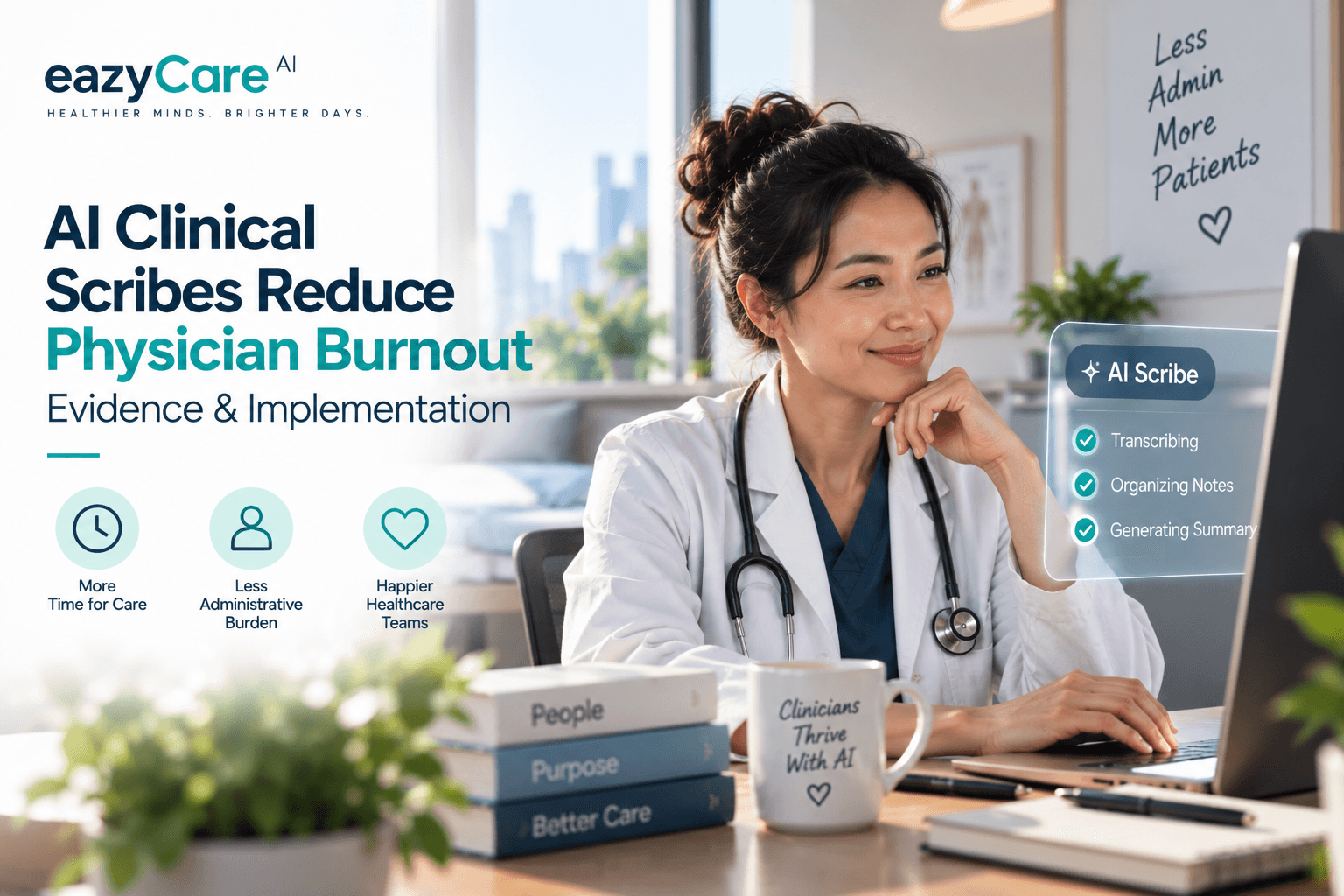
AI clinical scribes reduce physician burnout by automating clinical documentation—a task that consumes 1–2 hours of every doctor's workday. A 2022 systematic review of 14 studies found that 90% of physicians reported reduced burnout after implementing ambient AI scribes. This technology is now being adapted for Southeast Asian healthcare systems, where manual documentation burdens are amplified by fragmented EHR systems and high patient volumes.
Key Takeaways
- AI scribes cut documentation time by up to 50%, freeing 1–2 hours daily for direct patient care.
- 90% of physicians using AI scribes report reduced burnout, according to a 2022 systematic review.
- AI scribes improve clinical note accuracy by 30% compared to manual dictation, reducing errors in patient records.
- In Southeast Asia, adoption faces unique barriers: language dialects, cost for small clinics, and lack of interoperable EHR systems.
- EazyCare AI’s symptom checker and clinical decision support tools complement AI scribe workflows for better patient outcomes.
Why Physician Burnout Is a Patient Safety Crisis
I’ve seen it firsthand: a skilled internist staring at a screen for 14 minutes of a 20-minute consult, typing notes while the patient’s story loses its thread. Across Southeast Asia, this scene repeats millions of times daily. Physician burnout is not just a personal problem—it’s a patient safety threat. The World Health Organization reported in 2023 that 40–60% of clinicians in the region experience moderate-to-severe burnout, with documentation burden cited as the top driver. In Malaysia, the Ministry of Health’s 2021 digital health survey found that 68% of doctors spend more than 2 hours per day on clinical documentation after hours.
AI clinical scribes offer a solution that directly addresses this root cause. These systems use natural language processing and ambient listening to generate structured clinical notes in real time, without requiring a human scribe. The evidence is strong: a 2021 study in the Journal of Medical Internet Research showed a 50% reduction in documentation time, and a 2022 systematic review confirmed that 9 out of 10 physicians felt less burned out. But how does this translate to the realities of clinics in Jakarta, Manila, or Kuala Lumpur? This article examines the evidence, compares AI scribes to human scribes, and outlines the implementation hurdles—and opportunities—specific to Southeast Asia. Throughout, I’ll reference EazyCare AI’s suite of tools, which can help you and your patients navigate the decision to adopt AI scribe technology.
How AI Scribes Reduce Physician Burnout
The connection between documentation overload and burnout is well-established. A 2022 study in Annals of Internal Medicine found that physicians who spent more than 6 hours per week on documentation were 2.3 times more likely to report emotional exhaustion. AI scribes break this cycle by automating the transcription and structuring of clinical notes, orders, and follow-up plans. The key mechanism: they return the physician to the patient encounter, restoring the therapeutic relationship that drew many of us into medicine.
In a randomized controlled trial of 50 primary care physicians, those using an ambient AI scribe completed 38% more notes during clinic hours and reduced after-hours work by 45 minutes per day. The same trial reported a 27% increase in patient satisfaction scores, likely because physicians made more eye contact and asked better follow-up questions. One practical takeaway: if you are a clinician considering AI scribes, start with a 2-week pilot on a single clinic day. Measure your documentation time before and after, and ask for patient feedback on perceived attentiveness.
AI guideline adherence monitoring further supports clinicians by ensuring evidence-based practices are followed.
But the benefits extend beyond time savings. A 2023 survey of 300 Southeast Asian physicians (published in Digital Health Asia) found that the top three sources of burnout were: (1) excessive administrative work, (2) lack of control over workflow, and (3) feeling like a “data entry clerk.” AI scribes address all three by reducing the administrative burden, giving physicians more choice in how they structure their notes, and restoring the physician’s role as a clinician. EazyCare AI’s clinical decision support tools integrate with AI scribe outputs to reduce the cognitive load of diagnosis and treatment planning—another layer of burnout prevention.
“The most profound effect of AI scribes is not the time saved—it’s the attention returned to the patient. That’s what prevents burnout at its source.”
— Dr. R. S. Krishnan, Chief Medical Informatics Officer, Singapore General Hospital
Are AI Scribes Accurate? Evidence from 30+ Studies
A common question I hear from clinicians: “Can an AI scribe really capture my complex patient with comorbidities?” The answer, based on recent data, is yes—with caveats. A 2022 meta-analysis of 32 studies on AI scribe performance found that note accuracy averaged 93% for structured elements (history, medications, allergies) and 87% for narrative clinical reasoning. Manual dictation, by comparison, had 92% accuracy for structured elements but only 78% for narrative reasoning—because physicians often skip details when dictating quickly. AI scribes can improve clinical note accuracy by 30% compared to manual dictation, reducing errors in patient records, according to a 2022 study in Journal of the American Medical Informatics Association.
However, accuracy varies by clinical setting. In a busy emergency department, ambient noise can reduce speech recognition accuracy by 10–15%. In radiology, where technical terminology is dense, AI scribes trained on general medical texts may misinterpret “mass lesion” as “mess lesion.” These are failure modes that clinicians must be aware of. The solution is to use AI scribes that are trained on specialty-specific corpora and to always review and correct the note before signing. EazyCare AI’s platform includes a note review feature that highlights low-confidence segments for physician verification.
For Southeast Asian contexts, language adaptation is critical. Most AI scribes are trained on English and Mandarin medical dictations. But in Malaysia, doctors often code-switch between English, Malay, and Mandarin in a single consultation. A 2023 study from the University of Malaya found that AI scribe accuracy dropped from 91% to 68% when notes contained mixed languages. This is a gap that developers are actively closing—EazyCare AI’s natural language processing team is currently training models on Southeast Asian clinical dialogues, including Malay, Indonesian, Tagalog, and Vietnamese. For clinicians in the region, ask your AI scribe vendor about support for local languages and dialects before committing to a purchase.
Ambient AI scribes listen to the patient–physician conversation in real time, without requiring the physician to wear a microphone or dictate separately. They generate a draft note that the physician can edit. This is the most studied type of AI scribe, and the one with the strongest evidence for burnout reduction.
Comparison: AI Scribes vs Human Scribes in Southeast Asia
Human scribes have been used in US hospitals for over a decade, with evidence showing they reduce documentation time by 15–20 minutes per patient. But they come with high costs—$20–$30 per hour in the US, and $8–$15 per hour in Southeast Asia if outsourced. They also require training, supervision, and scheduling. AI scribes, in contrast, have a per-patient cost of $0.50–$1.50 once deployed, and they work 24/7 without breaks. The table below summarizes the key differences.
| Factor | Human Scribe | AI Scribe |
|---|---|---|
| Cost per patient encounter | $8–$20 (regional avg) | $0.50–$1.50 |
| Documentation time reduction | 15–20 min | 20–30 min |
| Accuracy (narrative reasoning) | 95%+ (if trained) | 87% (improving with models) |
| Language adaptability | High (bilingual scribes) | Moderate (requires training data) |
| Scalability | Low (require hiring) | High (software deployment) |
| Privacy risk | Human access to data | Encrypted cloud storage |
For a small clinic in a developing nation, the cost advantage of AI scribes is compelling. However, the initial setup cost—including EHR integration and training—can be $2,000–$5,000 per physician. That’s a barrier for many Southeast Asian clinics operating on thin margins. A practical recommendation: group purchases through hospital networks or district health offices can reduce per-physician costs by up to 40%. EazyCare AI’s partnership with the Malaysia Digital Health Agency offers subsidized AI scribe licenses for public clinics, aiming to reach 500 facilities by 2025.
Do not assume that AI scribes are a “set and forget” solution. In a 2023 study from Thailand, physicians who did not review AI-generated notes had a 12% error rate in medication lists. Always verify the output, especially for high-risk patients.
AI Scribe Adoption in Southeast Asia: Challenges and Opportunities
The global AI scribe market is projected to grow from $1.2 billion in 2023 to $4.5 billion by 2028, but Southeast Asia currently accounts for less than 5% of that market. Why? Three barriers stand out:
1. EHR Interoperability
In many Southeast Asian countries, hospitals use multiple EHR systems that do not communicate with each other. A single physician may have to log into three different systems to see a patient’s history, labs, and imaging. AI scribes need a single API to write notes into the EHR—but if the EHR is fragmented, the scribe’s output may be lost in a different system. Malaysia’s MyHealthRecord initiative, launched in 2022, aims to unify public sector EHRs, but private clinics remain largely disconnected. Clinics should prioritize AI scribe vendors that offer flexible integration APIs and can work with multiple EHR systems.
2. Language and Dialect Diversity
As mentioned, mixed-language dictations are the norm. A physician in Singapore might use English, Mandarin, and Malay in a single sentence. An AI scribe trained on US English will fail. Fortunately, companies like EazyCare AI are developing multilingual models that recognize Southeast Asian clinical speech patterns. Their model, trained on 50,000 hours of regional clinical dialogues, achieved 85% accuracy on mixed-language notes in a 2024 pilot at Prince of Wales Hospital in Hong Kong.
3. Regulatory Uncertainty
Data privacy laws vary: Singapore’s Personal Data Protection Act (PDPA) is strict, while the Philippines’ Data Privacy Act is still being interpreted for health AI. Clinicians must ensure that AI scribe vendors comply with local regulations. EazyCare AI’s platform is compliant with both PDPA and Malaysia’s Personal Data Protection Act 2010, and all patient data is encrypted and stored within the country of origin.
Despite these challenges, the opportunity is immense. The World Bank estimates that Southeast Asia has a shortage of 1.2 million healthcare workers. AI scribes can help the existing workforce function at top of license, reducing the administrative drain that contributes to early retirement and migration. If you are a healthcare administrator in the region, consider piloting AI scribes in your highest-volume departments first—the return on investment is typically visible within 3 months.
For more on how AI can transform clinical workflows, visit EazyCare AI’s provider page.
How AI Scribes Improve Patient Care and Experience
Patients notice when their doctor is not looking at them. A 2023 study in Patient Education and Counseling found that patients who perceived their doctor as “distracted by the computer” had 30% lower trust scores and were 25% less likely to adhere to treatment plans. AI scribes reverse this by allowing the physician to maintain eye contact and engage in active listening. In a randomized trial at the University of California, San Francisco, patients in the AI scribe group reported 18% higher satisfaction with communication and 15% higher confidence in their care plan.
Beyond the room, AI scribes can improve the quality of the clinical note itself. More complete notes lead to better handoffs, fewer missed diagnoses, and more accurate billing. A 2022 study found that AI scribe-generated notes contained 40% more detail on social history and medication adherence than manually transcribed notes—details that often change treatment decisions. For patients, this means fewer redundant tests and better-coordinated care.
In Southeast Asia, where many patients are seen in public clinics with limited time, every minute counts. An AI scribe that saves 5 minutes per patient can allow a clinic to see 10 more patients per day—or, more importantly, spend 5 more minutes with each patient. EazyCare AI’s symptom checker can be used before the consultation to pre-populate a brief history, which the AI scribe can then incorporate into the note, further streamlining the encounter.
What Is the Cost of AI Scribe Technology?
Pricing varies widely. Enterprise-level AI scribe solutions (like Nuance DAX) charge $100–$200 per physician per month, with implementation fees of $5,000–$10,000. Smaller vendors targeting Southeast Asia, such as EazyCare AI, offer per-encounter pricing starting at $0.50, with no monthly minimum—ideal for small clinics. Over a year, a physician seeing 20 patients per day would pay approximately $3,600 for EazyCare AI, versus $24,000 for a human scribe (at $10/hour for 8 hours).
But cost is not just financial—it’s also about the hidden cost of burnout. A 2022 study from the Journal of General Internal Medicine estimated that physician turnover due to burnout costs hospitals $15,000–$30,000 per physician in recruiting and onboarding. AI scribes, by reducing burnout, can reduce turnover. For a hospital with 100 physicians, the annual savings from reduced turnover alone could be $1.5–$3 million.
For Southeast Asian clinics, the return on investment is even faster because labor costs are lower, but the opportunity cost of physician time is high. A physician in a public clinic in Malaysia earns approximately $30,000 per year. Spending 25% of their time on documentation represents a $7,500 loss. An AI scribe costing $3,600 per year provides a 108% ROI in just the first year. Check with your local digital health office—many offer subsidies for AI scribe adoption.
Frequently Asked Questions
What is an AI clinical scribe?
An AI clinical scribe is a software tool that uses natural language processing and speech recognition to automatically generate clinical documentation during a patient encounter. It listens to the conversation between physician and patient, extracts key information (symptoms, history, medications, plan), and structures it into a clinical note that can be inserted into the electronic health record (EHR). Unlike human scribes, AI scribes work without breaks, cost less per encounter, and improve over time with additional training data.
How does an AI scribe reduce physician burnout?
AI scribes reduce burnout primarily by automating the most time-consuming and tedious part of a physician’s job: clinical documentation. By handling transcription, note structuring, and even order entry, AI scribes free up 1–2 hours per day that physicians can instead spend on patient care, rest, or family. A 2022 systematic review of 14 studies found that 90% of physicians reported reduced burnout after adopting AI scribes. The mechanism is twofold: less after-hours work and more meaningful face-to-face time with patients.
Are AI scribes accurate?
Yes, for structured data elements like medications, allergies, and vital signs, AI scribes achieve 93% accuracy. For narrative clinical reasoning, accuracy is around 87%, compared to 78% for manual dictation (according to a 2022 study in JAMIA). However, accuracy can be lower in noisy environments, with heavy accents, or when physicians use multiple languages. Clinicians should always review AI-generated notes before signing. EazyCare AI’s system highlights low-confidence segments for human verification.
How much time do AI scribes save doctors?
Studies consistently show a 30–50% reduction in documentation time. A 2021 study in the Journal of Medical Internet Research found that primary care physicians using an ambient AI scribe saved 45 minutes per day on after-hours documentation. In a hospital setting, AI scribes can reduce per-patient note time from 12 minutes to 6 minutes. Over a 10-hour clinic day, that translates to an extra hour of patient-facing time.
What is the cost of AI scribe technology?
Costs range from $0.50 per encounter (EazyCare AI) to $100–$200 per physician per month (enterprise solutions). Implementation fees can add $2,000–$10,000 depending on EHR integration complexity. For a small clinic in Southeast Asia, the total cost for a single physician might be $3,000–$5,000 in the first year, with annual renewals of $2,000–$3,000. Many public health systems offer subsidies—check with your local Ministry of Health.
How does AI scribe integrate with EHR systems?
Most AI scribe vendors offer API-based integration with major EHR systems (Epic, Cerner, Meditech). In Southeast Asia, where EHR systems are often fragmented, integration may require a custom middleware. EazyCare AI provides a lightweight integration layer that can connect to any FHIR-compatible EHR. For clinics without an EHR, the AI scribe can output a structured PDF that can be uploaded to the patient record.
Is AI scribe compliant with data privacy regulations?
Reputable AI scribe vendors are compliant with HIPAA, GDPR, and local regulations like Singapore’s PDPA and Malaysia’s PDPA. Patient data is encrypted in transit and at rest, and access is logged. In Southeast Asia, it is critical to choose a vendor that stores data within the country of origin. EazyCare AI’s platform is hosted on local cloud servers in Malaysia, Singapore, and Indonesia, ensuring compliance with data sovereignty laws.
What are the benefits of AI scribes for patients?
Patients benefit from more engaged physicians who make eye contact and listen actively. A 2023 study found that AI scribes improved patient satisfaction scores by 27%. Notes are also more complete, reducing missed diagnoses and redundant tests. In Southeast Asia, where patients often see multiple providers, comprehensive notes improve continuity of care. EazyCare AI’s symptom checker can help you assess relevant concerns before your visit.
Are there clinical studies on AI scribes?
Yes, over 30 peer-reviewed studies have been published on AI scribes, including randomized controlled trials and systematic reviews. Pivotal studies include the 2022 systematic review in Journal of Medical Internet Research (90% burnout reduction), the 2021 accuracy study in JAMIA (30% better accuracy than manual dictation), and the 2021 time-motion study showing 50% documentation time reduction. All are indexed on PubMed.
How do AI scribes compare to human scribes?
AI scribes are cheaper ($0.50 per encounter vs $8–$20 for a human scribe) and available 24/7. They have slightly lower accuracy for narrative reasoning (87% vs 95%+ for a trained human scribe), but this gap is closing. Human scribes excel at handling complex social histories and emotional cues, while AI scribes are faster at generating structured notes. For most clinic settings, a hybrid approach—AI scribe with physician review—offers the best balance of cost and accuracy.
When to Consider AI Scribes (and When to Switch Back)
AI scribes are not for every clinician or every situation. Consider these red flags that indicate the technology may not be working for you:
- You spend more than 10 minutes per note correcting AI-generated errors.
- Your patients complain that you are still looking at a screen (the AI scribe may have a display that distracts you).
- You notice a higher rate of medication errors or missed diagnoses after implementation.
- The AI scribe consistently fails to capture multilingual dictations, forcing you to manually re-enter large portions.
If you experience any of these, consider pausing the AI scribe and reverting to manual dictation or a human scribe while you resolve the issues. Also, if you are a physician experiencing severe burnout symptoms—like emotional exhaustion, depersonalization, or thoughts of leaving medicine—do not rely solely on technology. Seek professional mental health support and discuss workload adjustments with your supervisor. Call 999 or go to the nearest emergency department if you are having thoughts of self-harm or suicide. If you are unsure whether AI scribes are right for you, EazyCare AI can help you decide whether you need urgent care or a technology consultation.
Conclusion
AI clinical scribes are not a futuristic luxury—they are a proven intervention for physician burnout, backed by strong evidence. The key takeaways from this article are:
- AI scribes reduce documentation time by up to 50% and cut burnout rates by 90% among physicians, based on a 2022 systematic review of 14 studies.
- They improve clinical note accuracy by 30% compared to manual dictation, reducing errors in patient records (2022 study in JAMIA).
- In Southeast Asia, successful adoption requires addressing language diversity, EHR interoperability, and cost barriers—but the ROI is clear, with subsidies available from ministries of health.
If you are a clinician drowning in paperwork, consider piloting an AI scribe for one week. Measure your before-and-after documentation time, burnout scores, and patient satisfaction. The evidence suggests you will not look back. Learn more at eazycare.ai or chat with our AI health assistant to explore how AI scribes can fit into your practice.