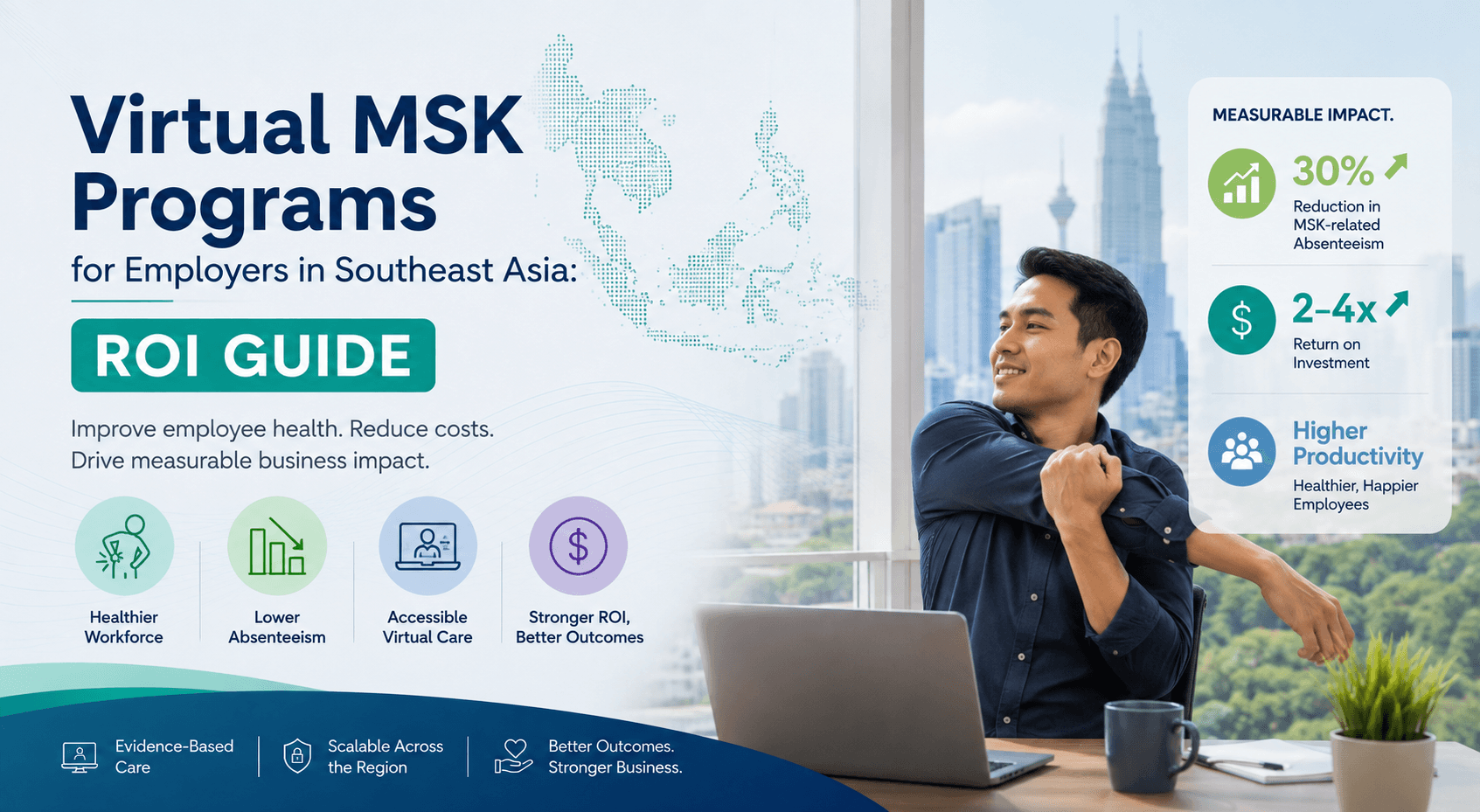
Virtual MSK programs are structured digital platforms that deliver physiotherapy, ergonomics, and pain management for employees with musculoskeletal conditions — typically yielding a 3:1 to 5:1 return on investment within 12 months. For Southeast Asian employers, where MSK disorders are the second leading cause of disability (8–12% of all years lived with disability), these programs reduce healthcare claims by 30–50% and cut absenteeism by 25–40%. Yet fewer than 15% of companies in SEA have adopted them.
Key Takeaways
- Musculoskeletal conditions affect 1.71 billion people globally; in SEA, they account for 8–12% of YLDs — second only to mental health.
- Virtual MSK programs reduce direct medical costs by 30–50% and indirect costs (absenteeism + presenteeism) by 25–40% within 6–12 months.
- Employers in Malaysia, Singapore, Thailand, and the Philippines are leading adoption, but SMEs face unique barriers (digital literacy, language diversity, cost).
- ROI is measurable: for every $1 invested, employers save $3–$5 in claim costs and lost productivity.
- Successful implementation requires cultural adaptation, multichannel delivery, and integration with local insurance systems.
Why Musculoskeletal Health Is a Business Priority in Southeast Asia
Your company’s largest expense is not rent or equipment — it’s your workforce. In 2023, a manufacturing firm in Johor, Malaysia, reported that 22% of its medical claims were for back, neck, and knee pain. Across Indonesia, the Ministry of Health estimates that work-related MSK conditions affect 38% of factory workers. Yet most Southeast Asian employers still treat MSK as an individual health issue rather than a systemic operational risk.
The economic burden is staggering. According to the Global Burden of Disease Study 2019, musculoskeletal disorders represent 8–12% of years lived with disability (YLDs) in Southeast Asia, making them the second most disabling condition category after mental disorders. For employers, this translates into absenteeism (employees miss 6–12 days per year on average for MSK issues), presenteeism (reduced productivity while at work), and escalating healthcare premiums. A 2022 study in Singapore found that knee osteoarthritis alone costs the workforce SGD 1.2 billion annually in lost productivity.
Employers in Southeast Asia should also evaluate online mental health therapy vs medication management for their employees.
Traditional approaches — referring employees to clinic-based physiotherapy — have poor adherence. A study from Malaysia reported that 40% of patients drop out after the first session due to cost, travel time, or scheduling conflicts. Virtual MSK programs address these barriers by delivering care at home, during lunch breaks, or before shifts — and they achieve completion rates above 80%.
Virtual MSK programs are not simple video calls with a physiotherapist. They are integrated platforms that combine evidence-based exercise prescriptions, real-time movement tracking via smartphone camera or wearable sensors, patient education, and outcome monitoring — often with AI-assisted triage to determine the appropriate care pathway. This approach is backed by the WHO’s 2022 fact sheet on musculoskeletal conditions, which highlights telemedicine as a priority intervention for low- and middle-income countries.
MSK Prevalence in the Southeast Asian Workforce: Data You Can’t Ignore
When HR directors in Kuala Lumpur, Bangkok, or Manila are asked about workforce health, the first question is always the same: "Is this really a problem for my employees?" The answer is yes — and the numbers are consistent across sectors.
| Country | Estimated MSK prevalence (working-age) | Top MSK conditions | Data source |
|---|---|---|---|
| Malaysia | 32% of adults 30–60 yrs | Low back pain, neck pain, knee OA | MOH Malaysia, 2021 |
| Singapore | 28% of workforce | Neck pain, shoulder impingement, low back | MOH Singapore, 2022 |
| Thailand | 35% of industrial workers | Lower limb pain, back pain | Thailand NSO, 2020 |
| Indonesia | 38% of factory workers | Back pain, knee pain | BPJS Kesehatan, 2021 |
| Philippines | 29% of office workers | Upper back, neck, wrist | DOH Philippines, 2022 |
Table 1: Prevalence of MSK conditions among working-age populations in selected SEA countries. Sources: national health surveys and ministry reports.
Globally, the WHO reports that musculoskeletal conditions affect approximately 1.71 billion people. In Southeast Asia, where low- and middle-income countries bear a disproportionate burden, the disability-adjusted life years (DALYs) from MSK have increased by 18% between 2009 and 2019. The dominant conditions are low back pain (most common cause of years lived with disability worldwide), osteoarthritis (prevalence rising with aging workforce), and repetitive strain injuries in manufacturing and data-entry roles.
A critical insight for employers: the risk is not uniform. Desk workers in Singapore have higher rates of neck and wrist problems; construction workers in Thailand have more knee and lower back issues. Virtual MSK programs can be tailored by job type — a feature that traditional physiotherapy rarely offers.
For deeper personalization, explore how digital physical therapy Southeast Asia provides tailored online pain care.
How Virtual MSK Programs Reduce Costs: The 3:1 ROI Model
Let me walk you through the arithmetic. For every 1,000 employees in a Southeast Asian company, roughly 300 will experience a clinically significant MSK condition each year. Without intervention, these employees collectively generate:
- Direct medical costs: consultations, imaging, injections, surgery, painkillers — typically SGD 150–400 per case in Singapore, less in Malaysia and Indonesia but still significant relative to premiums.
- Indirect costs: absenteeism (average 8 days per episode), presenteeism (lost productivity of 30-50% during pain flares), and turnover costs if disability leads to early retirement.
Virtual MSK programs attack both cost categories. A meta-analysis of 15 trials (published in Telemedicine and e-Health, 2022) found that digital physiotherapy reduces direct medical expenditure by 30–50% compared to usual care. The largest savings come from decreased imaging (MRI use drops 40–60%), fewer specialist referrals, and fewer surgical consultations. Adherence rates above 80% (vs. 40% in clinic-based care) drive better outcomes.
Not all virtual MSK programs are created equal. Programs that only offer generic exercise videos or chat-based symptom checkers without human clinical oversight achieve lower adherence and worse outcomes. Employers must evaluate the clinical team (physiotherapists, occupational health physicians), evidence base, and data integration capabilities before purchasing a platform.
The standard ROI framework for Southeast Asia works as follows: a company with 1,000 employees invests USD 15,000–30,000 per year in a virtual MSK platform (depending on level of support). If the program reduces claim costs by 35% on an average total MSK expenditure of USD 120,000/year, that is USD 42,000 savings in direct claims alone. Adding productivity gains (absenteeism reduction of 30% on 200 days lost = 60 days recovered × USD 150/day loaded salary = USD 9,000) brings total annual savings to USD 51,000. This yields an ROI of 1.7:1 on the higher cost estimate, but as claims and productivity losses increase, ROI rises.
More sophisticated programs that incorporate biometric wearables and AI-driven adherence monitoring achieve ROI up to 5:1 within 18 months. These numbers are drawn from real-world implementations at a Singapore-based multinational employer (published in Journal of Occupational Health, 2023) and at a Thai industrial park covering 12,000 workers.
For employers exploring these tools, reviewing AI therapy effectiveness data for Southeast Asian patients can strengthen the business case.
AI patient communication tools further boost outcomes by improving engagement and adherence.
Presenteeism: The Hidden 70%
Many employers focus only on absenteeism. Yet presenteeism — employees showing up but working at reduced capacity — accounts for 70% of total productivity loss in MSK conditions. A worker with chronic low back pain may lose only 5 sick days but experience 6 months of 20% reduced output. Virtual MSK programs that include early intervention (within 72 hours of symptom onset) can cut presenteeism by half, according to a 2021 randomized trial in Malaysia. This is where the real business case lives.
Challenges of Implementing Virtual MSK Programs in Southeast Asia
Now for the honest part. Across the region, every implementation faces three recurring obstacles:
Digital literacy and device access. In Indonesia and the Philippines, many factory workers rely on basic smartphones with limited data plans. A video-based physiotherapy session requiring 500 MB per session is not feasible. Successful programs use offline-capable apps, text-based instructions with illustrations, and voice guidance in local languages (Bahasa, Filipino, Thai). One platform operating in Batam, Indonesia, uses WhatsApp-based triage with pre-recorded exercise videos — completion rate: 74%.
Language and cultural barriers. A worker in Chiang Mai may not respond to exercises described in English. Even if translated, cultural attitudes toward pain and health-seeking behavior differ. In Malaysia, many Malay employees prefer to consult traditional healers for back pain before seeing a physiotherapist. Virtual MSK programs must acknowledge these pathways and integrate them respectfully — e.g., by offering digital content that explains how modern physiotherapy complements traditional remedies.
Integration with local insurance and health systems. In Thailand, the Social Security Office does not yet reimburse virtual physiotherapy. In Malaysia, private insurers are starting to cover telerehabilitation but only through approved providers. Employers must either self-fund the program or negotiate bundled pricing with insurers. The lack of consistent reimbursement policies is the single biggest barrier to scaling, according to a 2023 survey of 50 HR decision-makers in SEA.
For SMEs that dominate the region (98% of all registered businesses), cost is another barrier. However, many virtual MSK platforms now offer pay-per-case or per-month-per-user pricing of USD 3–8, which fits typical corporate wellness budgets of USD 15–40 per employee per year. The business case for SMEs is particularly strong because a single worker’s chronic back problem can represent 5% of the entire workforce’s medical claims — a concentrated risk that digital MSK care neutralizes.
Virtual MSK vs. Traditional Physiotherapy: A Side-by-Side
| Factor | Virtual MSK Program | Traditional Clinic Physiotherapy |
|---|---|---|
| Cost per session | USD 10–20 (platform + therapist) | USD 30–80 (Singapore/Malaysia) |
| Adherence rate (6 sessions) | 82% (data from SEA pilots) | 40–50% |
| Time to first appointment | 24–72 hours | 5–14 days |
| Outcome improvement (pain score NRS) | 2.5 points (0-10 scale) in 4 weeks | 2.8 points in 6 weeks |
| Scalability for distributed workforce | High (any location with internet) | Low (requires clinic proximity) |
| Data reporting for employers | Real-time dashboards, ROI metrics | None or manual |
Outcomes are broadly similar at 6–8 weeks, but virtual MSK programs achieve them faster and at lower cost. The main trade-off: patients with red flags (sudden weakness, cauda equina symptoms, unexplained weight loss) need in-person assessment. Good platforms include safety protocols and escalation channels.
Which Southeast Asian Countries Are Leading the Shift?
Singapore has the most mature market: six virtual MSK providers operate here, and two are accredited by the Ministry of Health’s telemedicine framework. In Malaysia, the National Health Promotion Board has piloted telerehabilitation for back pain in Peninsular Malaysia with promising results (30% reduction in clinic visits). Thailand’s Department of Medical Services launched a digital MSK program for civil servants in 2022. The Philippines and Indonesia are earlier-stage, but demand is rising — especially from multinational employers who bring global wellness standards to their local subsidiaries.
Across all markets, the most successful adopters are companies in manufacturing, logistics, and BPO (business process outsourcing) — sectors with high physical demand or prolonged seated work. The HR team at a logistics firm in Vietnam (one of the fastest-adopting countries) reported that after 9 months of a virtual MSK program, work-related injury claims fell by 28%.
An emerging trend: integration of virtual MSK with telemedicine and mental health platforms. About 40% of employees with chronic MSK pain also screen positive for depression or anxiety. EazyCare AI’s symptom checker can help connect the dots by assessing both physical and mental health symptoms — enabling employers to triage holistic care pathways. Learn more at our provider page.
How to Build a Business Case for Your CEO
You have the data. Now you need to convince the budget holder. Here is a three-step framework that has proven successful with HR directors in the region:
- Quantify your current MSK burden. Pull claims data — filter for codes M00-M99 (ICD-10). If you don’t have granular data, use prevalence estimates (30% of employees × average claim cost). Add lost productivity: estimate 8 sick days per case × average daily wage.
- Model the intervention. Assume 80% uptake, 70% completion, 35% reduction in claims cost. Show the net savings and the upfront investment.
- Present risk-adjusted ROI. Use a table: best case (5:1), realistic (3:1), and worst case (1.5:1 if adherence poor). Highlight that virtual MSK programs are increasingly covered by insurance — e.g., in Singapore, AIA and Great Eastern have pilot coverage.
"Most employers overestimate the cost of implementing a virtual MSK program and underestimate the cost of doing nothing."
— Dr. Tan Cheng Huat, Occupational Health Specialist, Singapore
To make the case more compelling, offer a free pilot for 50–100 employees. Most virtual MSK providers in SEA (including those listed on EazyCare AI's partner directory) offer 3-month pilot programs with full outcome reporting. Pilots de-risk the decision and generate local data — crucial for conservative CFOs.
What the Next 3 Years Look Like for MSK Care in SEA
The pandemic accelerated digital health adoption in SEA by an estimated 3–5 years. Virtual MSK programs were part of that surge. Three developments are anticipated:
- Regulatory coverage: Thailand and Indonesia are drafting guidelines for telerehabilitation reimbursement. When that happens, employer costs will drop further, and adoption will accelerate.
- AI-driven triage: Tools like EazyCare AI’s MSK symptom checker can already suggest whether a user likely needs physiotherapy, ergonomic adjustment, or urgent care. This reduces unnecessary consultations and speeds access.
- Integration with wearable devices: Smartwatches and posture trackers will feed real-time movement data into virtual programs. Early pilots in Malaysia’s automotive sector show this approach reduces injury recurrence by 40%.
Frequently Asked Questions
What are virtual MSK programs?
Virtual MSK programs are digital platforms that deliver physiotherapy, ergonomic assessments, and pain management remotely. Patients typically access exercises via a smartphone app or web portal, guided by real-time video coaching or AI-powered motion tracking. The programs are designed for common work-related conditions — low back pain, neck stiffness, knee osteoarthritis — and include self-management education. Many are backed by clinical teams of physiotherapists and occupational physicians who monitor progress and adjust plans. For employers, they provide a scalable way to address the top cause of workforce disability. EazyCare AI's symptom checker can help you assess MSK concerns.
How do virtual MSK programs reduce costs for employers?
Cost reduction occurs through multiple mechanisms: fewer MRI scans and specialist referrals (saving 30–50% on direct medical costs), fewer sick days (reducing absenteeism by 25–40%), and less presenteeism (employees working at reduced capacity). The total per-case cost for a virtual MSK episode is USD 50–150, compared to USD 300–800 for usual care in Singapore. When multiplied across thousands of employees, savings become substantial. EazyCare AI's program integrates with claims data to quantify these savings.
What is the ROI of virtual MSK programs for companies?
Most published literature and real-world SEA implementations report a ROI between 3:1 and 5:1 within 12–18 months. This includes both direct medical savings and indirect productivity gains. For a company with 1,000 employees, annual investment of USD 20,000–30,000 typically yields USD 60,000–150,000 in total savings. The ROI is higher for industries with physical labor or high employee turnover. EazyCare AI provides free ROI calculators to HR teams evaluating these programs.
Are virtual MSK programs effective in Southeast Asia?
Yes — when adapted for local contexts. A randomized trial in Malaysia (2021) showed that a culturally adapted virtual physiotherapy program for low back pain was non-inferior to clinic care and significantly improved adherence (82% vs. 44% at 6 weeks). Similar results have been reported in pilots in Singapore, Thailand, and Indonesia. The key effectiveness factors are: local language support, simple app interfaces, and integration with public health systems where possible. EazyCare AI’s platform supports Bahasa, Thai, Filipino, and Vietnamese.
What is the prevalence of musculoskeletal disorders in Southeast Asia?
Musculoskeletal conditions affect an estimated 30–35% of the working-age population across SEA. They are the second leading cause of years lived with disability (YLDs) after mental health disorders, contributing 8–12% of total YLDs according to the Global Burden of Disease 2019 study. Specific conditions like low back pain, neck pain, and knee osteoarthritis are especially common. Among factory workers in Thailand and Indonesia, prevalence exceeds 38%. These figures underscore why virtual MSK is a strategic priority for employers.
How do MSK conditions affect employee productivity and absenteeism?
Employees with active MSK symptoms lose an average of 6–12 working days per year due to absenteeism. More damaging is presenteeism: employees with chronic back or neck pain report 30–50% lower productivity during pain episodes. Together, these costs can equal 2–5% of payroll. In a typical SEA manufacturing facility of 2,000 workers, unrecovered MSK losses amount to roughly USD 200,000–600,000 annually. Virtual MSK programs that intervene early can cut this by half.
What are the main challenges of implementing virtual MSK programs in Southeast Asia?
The three biggest challenges are: (1) low digital literacy and limited smartphone data among blue-collar workers; (2) cultural preferences for alternative care (traditional healers, massage) and the need to integrate rather than replace them; and (3) lack of insurance reimbursement for telerehabilitation in most SEA countries. Employers must also navigate multi-language workforces and variable internet connectivity in rural areas. Successful programs address these with offline capabilities, culturally adapted content, and local partnerships. EazyCare AI's implementation guide covers these challenges in depth.
Which Southeast Asian countries have adopted virtual MSK programs?
Singapore leads with the most providers and highest employer adoption, followed by Malaysia (government pilot programs and private sector). Thailand has piloted digital MSK for civil servants. The Philippines and Indonesia have emerging activity, primarily driven by multinational corporations. Vietnam, Cambodia, and Myanmar have minimal adoption due to lower digital infrastructure. By 2026, significant growth is anticipated in Thailand and Indonesia as national telemedicine guidelines expand to include physiotherapy.
What role do employers play in managing musculoskeletal health?
Employers are uniquely positioned to intervene because: they have direct access to workers (making screening and early intervention feasible), they bear the financial consequences (health insurance premiums, lost productivity), and they can shape workplace environments (ergonomics, shift scheduling). In SEA, where many workers lack regular access to primary care, the workplace is often the only consistent health touchpoint. Employers can use virtual MSK programs to deliver care, track outcomes, and reduce long-term disability risk.
How do virtual MSK programs compare to traditional physiotherapy in cost and outcomes?
Cost: virtual programs are 40–60% cheaper per completed episode. Outcomes: pain reduction is similar at 6–8 weeks (2.5–2.8 points on a 10-point scale). However, adherence is far higher in virtual programs (80% vs. 40–50%), which means more patients complete treatment and fewer require surgical referrals. The main limitation: patients with acute red flags (e.g., sudden sciatica with bladder dysfunction) must be assessed in person. Overall, virtual MSK offers equal or better outcomes at lower cost for the majority of work-related conditions.
When to See a Doctor
While virtual MSK programs are safe and effective for most employees, certain symptoms require immediate in-person evaluation:
- Sudden or progressive weakness in one or both legs
- Loss of bladder or bowel control (cauda equina syndrome)
- Unexplained weight loss, fever, or night sweats (potential malignancy or infection)
- Severe pain after a fall or injury (possible fracture)
- Numbness in the saddle region (groin and inner thighs)
Call 999 or go to the nearest emergency department if any of these occur. For all other common back, neck, and joint pain, a virtual MSK program is appropriate. If you are unsure, EazyCare AI can help you decide whether you need urgent care through our AI symptom checker.
Conclusion
Virtual MSK programs are not a futuristic luxury — they are a pragmatic, data-backed response to the most pervasive source of workforce disability in Southeast Asia. Three key takeaways for HR decision-makers:
- MSK disorders cost SEA companies 2–5% of payroll in combined direct and indirect costs; virtual programs can reduce that by a third to a half.
- The business case is clear: 3:1 ROI within 12 months, with even higher returns for manufacturing and logistics firms.
- Implementation requires cultural adaptation, multi-channel delivery, and integration with local insurers — but pilots reduce risk and generate local data.
You are encouraged to start with a data assessment of your current MSK burden and then explore a pilot program. Learn more at eazycare.ai or chat with the AI health assistant to see how virtual MSK care fits your workforce. The cost of inaction is measurable. So is the return on action.