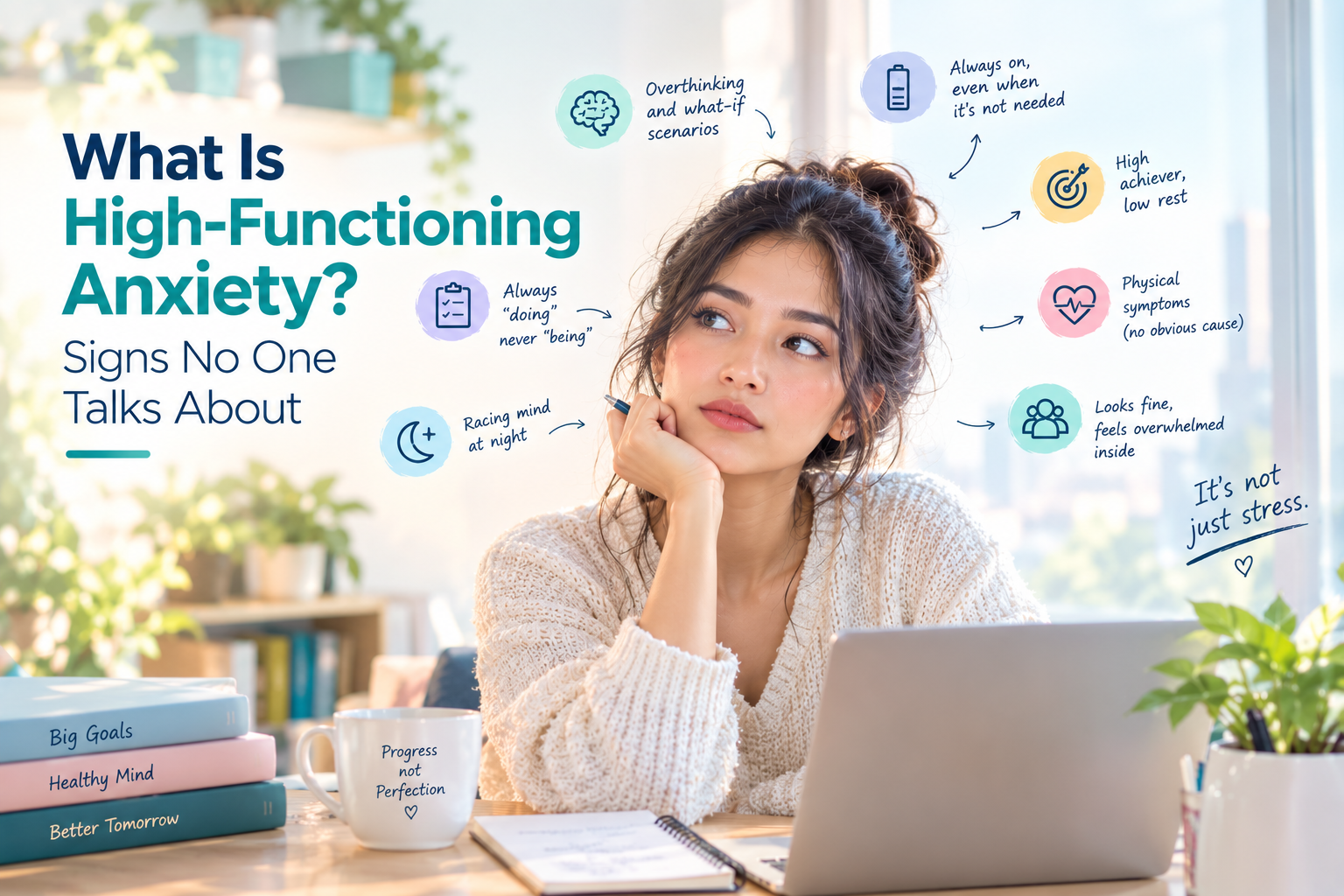
High-functioning anxiety is a pattern of persistent internal anxiety that coexists with an outward appearance of competence, success, and control. It is not a formal psychiatric diagnosis, but research suggests that many individuals with anxiety disorders maintain high external functioning—often delaying treatment by years. Globally, an estimated 301 million people lived with an anxiety disorder in 2019, making it the most common mental health condition worldwide.
Key Takeaways
- High-functioning anxiety is real but not an official diagnosis. It describes people who meet external markers of success while struggling with chronic anxiety internally.
- Southeast Asian cultural factors like "saving face," kiasu mentality, and family pressure amplify hidden anxiety and discourage help-seeking.
- Common hidden signs include overwork, perfectionism, people-pleasing, constant mental chatter, and physical tension without an obvious cause.
- Effective management includes therapy (especially CBT), self-compassion, boundary-setting, and—when needed—medication. Early intervention prevents progression to burnout or depression.
Why the Most Successful People Are Often the Most Anxious
Imagine a mid-level executive in Kuala Lumpur who leads every meeting with precision, delivers projects ahead of schedule, and mentors junior staff. At home, she manages her children's tuition schedules, cooks dinner, and stays in touch with extended family. From the outside, she appears to have everything under control. Inside, her mind races with worst-case scenarios: What if I forget an important deadline? What if my boss thinks I'm incompetent? Am I doing enough for my kids? She sleeps four hours a night and describes herself as "tired but wired."
This is a classic presentation of high-functioning anxiety—a pattern that remains hidden precisely because of visible success. In Southeast Asia, where cultural deference, family obligations, and the pressure to never show weakness are deeply ingrained, high-functioning anxiety can be mistaken for diligence, ambition, or "just being responsible." The problem is that without recognition and intervention, this hidden distress can escalate into burnout, depression, or physical illness.
This article explores the less-discussed signs of high-functioning anxiety, why it flourishes in Southeast Asian contexts, how to distinguish it from ordinary stress, and—most importantly—practical, evidence-based ways to manage it. For readers navigating the complex intersection of ambition and anxiety, EazyCare AI's health assistant can help you reflect on your symptoms and find appropriate support.
What Is High-Functioning Anxiety? (And What It Is Not)
High-functioning anxiety is not listed in the Diagnostic and Statistical Manual of Mental Disorders (DSM-5) or the International Classification of Diseases (ICD-11). However, a 2022 scoping review in Psychiatry Research noted that a substantial proportion of individuals with diagnosed anxiety disorders continue to function effectively at work and in social roles, often at a high level. The term "high-functioning" captures this paradox: internal distress masked by external achievement.
Clinicians describe high-functioning anxiety as a subtype of Generalized Anxiety Disorder (GAD) or other anxiety conditions where compensatory behaviors—overpreparation, perfectionism, excessive planning—allow the person to maintain performance. According to the World Health Organization, anxiety disorders are characterized by excessive fear, worry, and related behavioral disturbances. In high-functioning presentations, the behavioral disturbances drive productivity rather than impairment, which delays recognition.
High-functioning anxiety is not about the absence of impairment—it is about the ability to mask it. Individuals often develop elaborate coping mechanisms that maintain a facade of control while internally suffering from chronic worry, muscle tension, racing thoughts, and fatigue.
It is important to distinguish high-functioning anxiety from high performance driven by healthy motivation. Healthy drive comes with flexibility, self-compassion, and the ability to rest. High-functioning anxiety is rigid: the person cannot stop pushing because stopping triggers unbearable guilt or fear of failure. The key difference is internal peace—or the lack of it.
The Hidden Signs of High-Functioning Anxiety That Nobody Talks About
Because high-functioning anxiety hides behind success, its symptoms are often normalized or even celebrated. The following table contrasts common observations with what is actually happening internally.
| Outward Behavior | Internal Experience |
|---|---|
| Early arrival at meetings, always prepared | Compulsive overplanning driven by fear of being judged |
| Saying "yes" to every request | Inability to set boundaries due to fear of disappointing others |
| High academic or career achievement | Never feeling "good enough"; imposter syndrome |
| Appearing calm under pressure | Internal racing heart, shallow breathing, sweating |
| Constant busyness; avoids free time | Idle moments trigger intrusive worries; rest feels unsafe |
| Overly responsible for others' emotions | People-pleasing as a strategy to maintain approval |
Additional hidden signs include chronic fatigue despite full calendars, difficulty sleeping because the mind "won't shut off," physical tension (neck, shoulders, jaw), digestive issues (IBS is common with anxiety), and a persistent sense of dread that something terrible is about to happen. Many people with high-functioning anxiety cannot articulate why they feel anxious—they simply believe "this is how life is."
"The most painful thing about high-functioning anxiety is that the people around you admire your strength while you feel like you're drowning."
— Clinical observation in Southeast Asian primary care, 2022
Why High-Functioning Anxiety Thrives in Southeast Asia
In many Southeast Asian cultures, mental health struggles are viewed as signs of weakness, a lack of discipline, or a failure to "save face." The stigma is reinforced by family expectations, community judgment, and religious or spiritual beliefs that misfortune stems from personal failings. A 2020 systematic review of anxiety disorders in Southeast Asia (PubMed, 33158513) found that prevalence estimates range from 3.5% to 20.1%—but the authors note significant underreporting due to stigma and lack of culturally adapted screening tools.
Three cultural factors particularly fuel high-functioning anxiety in the region:
1. The "Save Face" Imperative
In collectivist societies, maintaining the appearance of competence and harmony is paramount. Admitting anxiety would shame the individual and their family. As a result, many learn to suppress distress and over-function to prove their worth. This external validation becomes a fragile bedrock for self-esteem.
2. Kiasu Mentality and Hypercompetition
In countries like Singapore and Malaysia, the "kiasu" attitude—a fear of missing out or losing to others—drives relentless comparison. Academic tracking, competitive workplace cultures, and parental pressure to excel create an environment where anxious overpreparation is rewarded, even encouraged.
3. Family and Community Obligations
Filial piety and extended family involvement mean that individual accomplishments are shared accomplishments—and failures are shared failures. This can amplify the perceived cost of relaxing standards, leading to chronic overwork and difficulty saying no to family demands.
When high-functioning anxiety goes unaddressed in these cultural contexts, it often leads to burnout by the mid-30s or a collapse into major depression. The same drive that propelled someone through university and promotions can exhaust them completely.
The path to healing requires unlearning the belief that your worth is tied to productivity. This is a hard truth for many Southeast Asian professionals, but it is essential for long-term health.
High-Functioning Anxiety at Work: The Productivity Trap
The workplace is where high-functioning anxiety is most visible—and most deceptive. Employees with this pattern are often high performers who receive praise for their diligence. They are the first to arrive, last to leave, and rarely take leave. But inside, they operate from a place of fear: fear of being criticized, fear of being seen as lazy, fear of losing their job if they slow down.
A 2021 survey by the Malaysian Psychiatric Association found that work-related stress is the top trigger for anxiety in Malaysian adults. The recent rise of WhatsApp messages after hours, always-on digital culture, and hybrid-work ambiguity has only worsened the problem. People with high-functioning anxiety are especially vulnerable because they cannot trust themselves to stop—they need external permission to rest.
Specific workplace signs include:
- Refusing to delegate because "no one else will do it right"
- Overdelivering on every task, even low-priority ones
- Physical symptoms before meetings (racing heart, sweating, nausea)
- Inability to unwind after work; continuing to check emails
- Using alcohol or excessive caffeine to modulate mood
Over time, these patterns increase the risk of burnout—a state of emotional, physical, and mental exhaustion accompanied by depersonalization and reduced professional efficacy. The World Health Organization now recognizes burnout as an occupational phenomenon. If you recognise these patterns in yourself, it's not a character flaw; it's a signal that your coping strategies have become maladaptive. For clinicians and HR professionals, the EazyCare AI platform for healthcare providers offers tools to identify and support employees experiencing this productivity trap.
High-Functioning Anxiety vs. General Anxiety vs. Stress
Many readers wonder: Is this anxiety, or just normal stress from a busy life? The distinction is critical, because treatment paths differ.
| Factor | Stress | Generalized Anxiety Disorder (GAD) | High-Functioning Anxiety (subtype) |
|---|---|---|---|
| Duration | Short-lived, related to a specific trigger | Persistent (≥6 months) | Persistent (often years, sometimes since childhood) |
| Impact on functioning | Mild to moderate; resolves when trigger ends | Significant impairment in social or work roles | Appears unimpaired; often high-functioning |
| Primary driver | External demand (deadline, exam, conflict) | Uncontrollable worry about many things | Fear of failure, perfectionism, drivenness |
| Response to rest | Relief | No relief; worry continues | Guilt or increased anxiety when not productive |
| Self-perception | "I'm under a lot of pressure right now." | "Something is wrong with me." | "I'm fine; I just need to work harder." |
High-functioning anxiety shares features with GAD—particularly chronic worry and physical tension—but the distinguishing factor is the compensatory overachievement. People with high-functioning anxiety are often unaware that their "strength" is actually a symptom. If you cannot take a holiday without feeling guilty or planning every minute, you may be dealing with more than ordinary stress.
How to Manage High-Functioning Anxiety Without Losing Your Edge
The goal of treatment is not to eliminate anxiety entirely—some anxiety can be motivating—but to shift from fear-driven to choice-driven action. Evidence-based strategies include:
1. Cognitive Behavioral Therapy (CBT)
CBT is the gold standard for anxiety disorders. A therapist helps the individual identify the thought patterns that drive overworking (e.g., "If I don't plan every detail, I will fail") and test those predictions in graded steps. The 2022 scoping review highlighted CBT as effective for high-functioning presentations, though tailoring is needed to address the patient's resistance to slowing down.
Identify the "anxiety driver": Write down one situation that triggered excessive worry and the automatic thought that came with it.
Challenge the thought: Ask yourself, "What is the evidence that this must be perfect? What is the worst that could happen—and could I handle it?"
Experiment with "good enough": Deliberately submit a piece of work that meets 80% of the standard. Notice that the world does not end.
2. Mindfulness and Self-Compassion
Mindfulness helps people with high-functioning anxiety become aware of their internal state without judgment. Self-compassion—treating oneself as kindly as one would treat a good friend—is particularly important for those who are highly critical of themselves. A 2018 meta-analysis found that self-compassion interventions significantly reduced anxiety and depression.
3. Medication
For moderate to severe cases, selective serotonin reuptake inhibitors (SSRIs) like escitalopram or sertraline can reduce the baseline level of anxiety, making it easier to implement psychological strategies. This should always be discussed with a psychiatrist or primary care doctor.
4. Lifestyle Anchors
Sleep, exercise, and nutrition are non-negotiable. High-functioning anxiety often leads to sleep deprivation (because of a racing mind) and reliance on caffeine. Limiting caffeine to before noon and creating a wind-down routine can restore the nervous system's balance. For personalised guidance, EazyCare AI's symptom checker can help you assess your current coping patterns and suggest initial steps.
When to See a Doctor
While high-functioning anxiety may feel manageable for years, it can escalate. Seek professional help (a general practitioner, psychiatrist, or psychologist) if you experience any of the following red flags:
- Your anxiety has lasted more than 6 months and is not responding to self-help strategies.
- You are using alcohol, drugs, or other substances to cope.
- You have thoughts of self-harm or suicide. (Call 999 or go to the nearest emergency department immediately.)
- You experience panic attacks—sudden episodes of intense fear with palpitations, shortness of breath, dizziness, or a feeling of impending doom.
- You feel physically exhausted all the time and cannot remember the last time you felt rested.
- Your relationships suffer because you are always working or too irritable to connect.
If you are unsure whether your symptoms warrant a visit, EazyCare AI can help you decide. Use the AI health assistant to reflect on your symptoms and receive guidance on next steps. Remember: seeking help is not a sign of weakness—it is a sign that you value your long-term health over short-term appearances.
Frequently Asked Questions About High-Functioning Anxiety
What are the hidden signs of high-functioning anxiety?
The hidden signs include perfectionism, overpreparation, chronic people-pleasing, difficulty resting, mental chatter that never stops, physical tension (especially in neck and shoulders), and a constant need for reassurance that you are doing enough. These signs are often mistaken for diligence or high standards.
Can you have anxiety and still be successful?
Yes—that is the hallmark of high-functioning anxiety. Many successful professionals, executives, and parents live with chronic anxiety but channel it into overworking to maintain a façade of control. However, success achieved through anxiety often comes at the cost of personal well-being and relationships. EazyCare AI's symptom checker can help you assess whether your success is costing too much.
Is high-functioning anxiety a real mental health condition?
It is not an official diagnosis in the DSM-5 or ICD-11, but mental health professionals widely recognise the pattern. The closest formal diagnosis is Generalized Anxiety Disorder (GAD) with high-functioning presentation. The lack of a label does not invalidate the suffering; it simply reflects the need for more research, as highlighted in the 2022 scoping review in Psychiatry Research.
How does high-functioning anxiety differ from regular anxiety?
Regular anxiety often impairs functioning—causing avoidance, missed work, or social withdrawal. High-functioning anxiety paradoxically enhances productivity in the short term. People push through their fear to achieve, but internally they are exhausted. The key difference is the compensatory overachievement that masks the distress.
Why do I feel anxious even when everything is going well?
This is common in high-functioning anxiety. The brain has become hypervigilant, scanning for potential threats even when none exist. It may be a learned response from early experiences where high stakes were attached to mistakes. Therapy, particularly CBT, can help break this pattern of "waiting for the other shoe to drop."
What is the connection between perfectionism and anxiety?
Perfectionism and anxiety are deeply linked. The relentless drive to meet impossibly high standards creates constant fear of failure. Every imperfect outcome feels catastrophic. High-functioning anxiety often includes "adaptive perfectionism" in the workplace, but the cost is chronic dissatisfaction and burnout. Learning to accept "good enough" is a crucial skill.
How can I tell if I have anxiety or just stress?
Stress is reactive—it arises from specific demands and subsides when they are resolved. Anxiety is anticipatory: it worries about future threats even when the current demand is met. If you cannot relax after completing a major project, or if you worry about things going wrong months in advance, that points to anxiety rather than ordinary stress.
What physical symptoms are common with high-functioning anxiety?
Common physical symptoms include chronic muscle tension (especially in the neck, shoulders, and jaw), headaches, fatigue, digestive issues (IBS, nausea), rapid heartbeat, trembling, sweating, and sleep disturbances. Many people with high-functioning anxiety experience "tension-type" headaches and assume they are just tired.
Does high-functioning anxiety ever go away?
With appropriate treatment, symptoms can significantly improve. Untreated, the pattern often persists and may worsen with age or during times of major life transitions. Recovery involves learning to tolerate uncertainty, set boundaries, and rest without guilt. Full remission is possible for many people, especially if they address underlying beliefs about self-worth and productivity.
How do I stop overthinking at work?
Practical steps: set a time limit for decisions (e.g., 5 minutes for low-stakes decisions); use a "worry log" to postpone rumination to a specific time each day; practice opposite action—when you want to recheck something, resist once and trust your first effort. If overthinking is pervasive, consider CBT with a therapist who specializes in anxiety.
Conclusion
High-functioning anxiety is the quiet crisis of the accomplished—the feeling of drowning while wearing a crown of success. In Southeast Asia, where cultural pressures amplify both the tendency to overwork and the stigma of seeking help, this pattern is especially common and especially dangerous.
Three key takeaways to remember:
- Your "strength" may be a symptom. Chronic overpreparation and inability to rest are not virtues; they are signs that your nervous system is stuck in high gear.
- Cultural shame is a barrier, not a truth. Mental health is health. Seeking help is not a loss of face; it is taking responsibility for your well-being.
- Recovery is possible without losing your drive. The goal is not to become lazy, but to shift from fear-driven to choice-driven action.
If this article resonated with you, your next step does not have to be drastic. Start by acknowledging that your experience is valid. Then, consider speaking with a mental health professional. For a confidential, no-judgment starting point, chat with the EazyCare AI health assistant to clarify your symptoms and explore options. You are not alone, and you are not broken—you are experiencing a treatable condition that millions of people live with. The first step toward freedom is seeing it.
