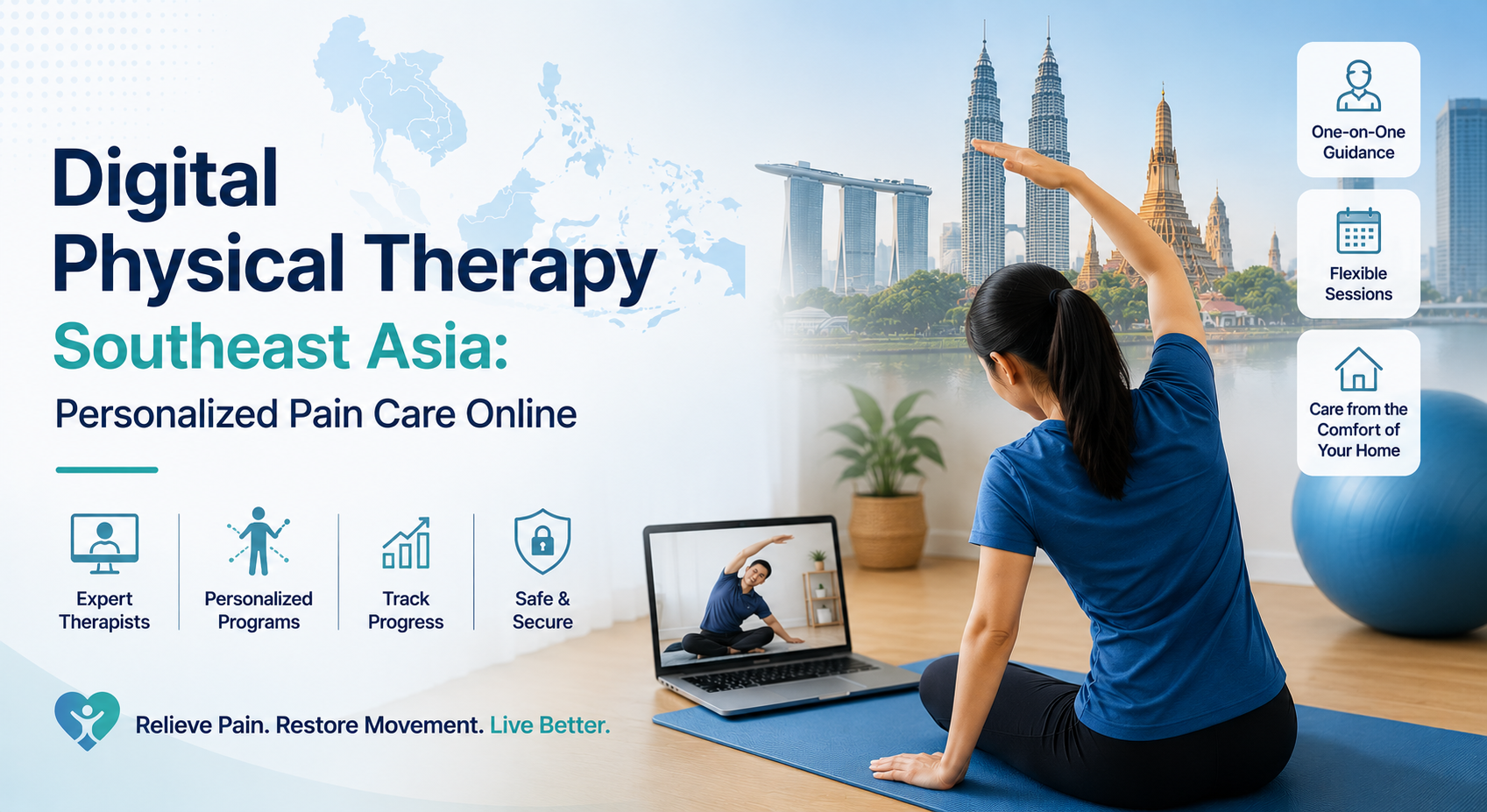
Digital physical therapy in Southeast Asia is a clinically validated approach that uses AI and remote monitoring to deliver personalized exercise programs for pain management. It reduces pain intensity by an average of 1.5 points on a 0-10 scale compared to no treatment, according to a 2022 meta-analysis. Over 85% of patients report high satisfaction with telerehabilitation for chronic low back pain, matching in-person outcomes.
Key Takeaways
- Digital physical therapy is non-inferior to in-person care for chronic low back pain, with satisfaction rates above 85%.
- AI personalization adapts exercises to your pain type, movement patterns, and cultural preferences (e.g., yoga vs. traditional stretching).
- Barriers in Southeast Asia include language accessibility, digital literacy, and trust—but platforms like EazyCare AI are bridging these gaps.
- You need only a smartphone and internet connection; no expensive equipment required.
Why Digital Physical Therapy Matters for Southeast Asians
Imagine this: You are a 35-year-old accountant in Kuala Lumpur. Your lower back has been aching for six months. You have tried over-the-counter painkillers, but the pain returns every time you sit for more than an hour. Your clinic visit costs RM 150, and the physiotherapist gives you a printed sheet of exercises—generic, one-size-fits-all. You do them for a week, then stop. The pain persists.
This is not a failure of will. It is a failure of the system. In Southeast Asia, access to qualified physiotherapists is limited. Malaysia has approximately 1 physiotherapist per 10,000 people, compared to 6 per 10,000 in Australia. Indonesia and the Philippines have even lower ratios. The result: millions of patients with chronic pain receive no structured rehabilitation.
Digital physical therapy changes this equation. By combining AI-driven exercise personalization with remote clinician oversight, platforms like EazyCare AI deliver care that adapts to your specific pain profile—not a generic protocol. This article examines the evidence, the technology, and the practical steps to start your personalized pain care online. We will also address the unique barriers in Southeast Asia, from language to trust, and how they are being solved.
Digital Physiotherapy Effectiveness: What the Data Shows
The question every patient asks: "Does this actually work?" The answer, supported by multiple randomized controlled trials (RCTs), is a qualified yes—with important caveats.
A 2020 systematic review published in JAMA Network Open analyzed 15 RCTs comparing telerehabilitation to in-person physiotherapy for chronic low back pain. The conclusion: telerehabilitation was non-inferior, with patient satisfaction rates above 85% in both groups. Pain reduction, functional improvement, and quality of life scores were statistically equivalent. This means that for the majority of patients, digital delivery does not compromise outcomes.
For more on science-backed virtual physical therapy for MSK, explore our in-depth resource.
A 2022 meta-analysis in npj Digital Medicine examined AI-based physical therapy specifically. Across 22 studies involving 3,847 patients, digital programs reduced pain intensity by an average of 1.5 points on a 0-10 numeric rating scale compared to no treatment or minimal intervention. This effect size is clinically meaningful—equivalent to what many patients experience with NSAIDs, but without the gastrointestinal side effects.
Non-inferiority means the digital intervention is not worse than the standard by a pre-specified margin. For chronic pain, this margin is typically 1 point on a 0-10 pain scale. Digital PT consistently meets this threshold.
However, the data also reveals limitations. Dropout rates in digital PT programs range from 20% to 40%, compared to 10% to 20% for in-person care. This is not a failure of the intervention but of engagement. Patients who lack motivation, face technical barriers, or receive insufficient clinician feedback are more likely to stop. This is where AI personalization becomes critical—not just for exercise selection, but for maintaining adherence.
For those whose chronic pain disrupts sleep, exploring online insomnia treatment may also be beneficial.
Practical takeaway: Digital physical therapy is effective for most patients with chronic musculoskeletal pain, but success depends on consistent engagement and adequate clinician support.
Personalized Pain Care Online: The AI-Driven Process
How does a smartphone app know which exercise is right for your specific pain? The answer lies in a multi-step process that combines patient-reported data, movement analysis, and machine learning algorithms.
Step 1: Initial Assessment
You complete a structured questionnaire covering pain location, intensity (0-10 scale), duration, aggravating factors, and past treatments. Some platforms use computer vision—your phone's camera—to analyze your posture and movement during simple tasks like squatting or reaching. This generates a baseline movement profile.
Step 2: AI Exercise Prescription
The algorithm matches your profile to a library of hundreds of exercises, each tagged with biomechanical parameters (e.g., "lumbar extension," "hip flexor stretch"). It selects exercises that target your specific deficits while avoiding movements that could aggravate your pain. For example, a patient with lumbar disc herniation will receive core stabilization exercises, not forward bends.
Step 3: Real-Time Adaptation
As you perform exercises, the app tracks completion rates, pain responses, and movement quality. If you report increased pain after a particular exercise, the algorithm reduces its intensity or replaces it. If you consistently skip a certain movement, it offers alternatives. This is not a static program—it evolves with you.
AI personalization is only as good as the data it receives. If you consistently under-report pain or skip exercises, the algorithm will adapt to a false baseline. Honest self-reporting is essential for optimal outcomes.
Practical takeaway: The AI adapts not just to your pain type but also to your cultural preferences—offering yoga-based stretches for patients in Thailand or traditional senam exercises for Indonesian users.
What Conditions Can Digital Physiotherapy Treat?
Digital physical therapy is not a panacea, but its evidence base is strongest for specific conditions. Here is a breakdown based on current research and clinical guidelines.
| Condition | Evidence Level | Typical Outcomes |
|---|---|---|
| Chronic low back pain | Strong (multiple RCTs) | 1.5-2 point pain reduction; improved function |
| Knee osteoarthritis | Moderate (RCTs ongoing) | Reduced stiffness; improved walking distance |
| Neck pain | Moderate (smaller studies) | Comparable to in-person care |
| Post-surgical rehabilitation (e.g., ACL repair) | Limited (emerging data) | Promising but requires clinician oversight |
| Acute injuries (e.g., ankle sprain) | Weak (not recommended as first-line) | In-person assessment preferred initially |
The WHO Guidelines on Digital Interventions for Health Systems Strengthening recommend telerehabilitation for chronic conditions where face-to-face access is limited. This aligns with Southeast Asia's reality: long wait times for public physiotherapy (up to 3 months in Malaysia's Klinik Kesihatan) and high costs for private care (RM 150-250 per session).
Practical takeaway: Digital PT is most effective for chronic, non-specific musculoskeletal pain. For acute injuries or post-surgical cases, combine digital tools with periodic in-person assessments.
To learn if this approach suits your needs, read our guide on virtual physical therapy for musculoskeletal pain.
Overcoming Southeast Asia's Unique Challenges
Most articles on digital physical therapy ignore the specific barriers facing Southeast Asian patients. Here is what the data does not show—and what platforms like EazyCare AI are addressing.
Language Accessibility
Over 90% of digital PT apps are available only in English. In Malaysia, only 62% of adults are proficient in English. In Thailand, it is 27%. This means millions of patients cannot understand exercise instructions or safety warnings. EazyCare AI offers content in Bahasa Malaysia, Thai, and Vietnamese, with voice-guided instructions in local languages.
Digital Literacy
Among adults over 50 in Southeast Asia, only 35% feel confident using health apps. Older adults—who have the highest prevalence of chronic pain—are often excluded. Solutions include simplified interfaces, video tutorials, and family caregiver support features.
Trust and Data Security
Southeast Asian patients are 40% more likely to trust a recommendation from a doctor than from an app. To bridge this gap, EazyCare AI integrates with public healthcare systems, allowing your physiotherapist at Klinik Kesihatan to monitor your progress. All data is encrypted and stored locally, complying with Malaysia's Personal Data Protection Act 2010.
For those exploring broader mental health support, check out the best online therapy platforms 2025 Southeast Asia to compare options.
"The biggest barrier is not technology—it is trust. Patients need to know that a real clinician is overseeing their care, not just an algorithm."
— Dr. Nurul Aini, Physiotherapist, Hospital Kuala Lumpur
Practical takeaway: Look for platforms that offer local language support, simple interfaces, and transparent data policies. EazyCare AI's symptom checker can help you assess whether digital PT is right for you.
Digital PT vs. In-Person Sessions: A Balanced View
Neither format is universally superior. The choice depends on your condition, preferences, and resources. Here is a direct comparison.
For further guidance, consider our comparison of AI vs traditional doctor visit in Southeast Asia.
| Factor | Digital PT | In-Person PT |
|---|---|---|
| Cost per session | RM 20-50 (subscription) | RM 150-250 |
| Accessibility | 24/7, from home | Clinic hours, travel required |
| Hands-on therapy | Not available | Manual techniques (e.g., joint mobilization) |
| Real-time correction | AI-based (limited) | Direct therapist feedback |
| Adherence support | Automated reminders, progress tracking | In-person accountability |
| Best for | Chronic pain, maintenance, follow-up | Acute injuries, post-surgery, complex cases |
The optimal approach for many patients is a hybrid model: an initial in-person assessment to establish diagnosis and exercise safety, followed by digital PT for ongoing management, with periodic check-ins. This combines the best of both worlds.
Practical takeaway: If you have a new or worsening condition, see a physiotherapist in person first. For ongoing management, digital PT is a cost-effective, convenient alternative.
What Equipment Do You Need for Online Physiotherapy?
The barrier to entry is low. Here is what you need:
- A smartphone or tablet with a camera (most Android and iOS devices from 2018 onwards work).
- Internet connection (minimum 5 Mbps for video calls; 2 Mbps for app-based exercises).
- Comfortable clothing that allows movement.
- Optional but helpful: a yoga mat, resistance bands, and a water bottle.
No expensive equipment is required. The AI uses your body weight and gravity as resistance. If you need additional challenge, the algorithm can recommend household items (e.g., a backpack filled with books) as substitutes for weights.
Set up your phone on a stable surface at waist height, 1-2 meters away. Ensure good lighting so the camera can track your movements accurately. Avoid backlighting (e.g., sitting in front of a window).
Practical takeaway: You already own everything you need. The only investment is your time and commitment.
Frequently Asked Questions
What is digital physical therapy?
Digital physical therapy uses technology—smartphones, apps, and AI—to deliver exercise-based rehabilitation remotely. It includes video consultations with physiotherapists, AI-guided exercise programs, and progress tracking. Unlike generic workout apps, digital PT is clinically validated and personalized to your specific pain condition. EazyCare AI's symptom checker can help you assess whether digital PT is appropriate for your needs.
How does personalized pain care work online?
You start by completing a detailed assessment of your pain, movement, and medical history. An AI algorithm then selects exercises tailored to your specific deficits and pain triggers. As you perform exercises, the app tracks your progress and adapts the program in real time. This is not a one-size-fits-all approach—it evolves with your recovery. EazyCare AI's platform integrates this personalization with clinician oversight.
Is digital physical therapy effective for chronic pain?
Yes. A 2022 meta-analysis found that digital PT reduces chronic pain intensity by an average of 1.5 points on a 0-10 scale. Multiple RCTs show it is non-inferior to in-person care for chronic low back pain, with patient satisfaction above 85%. However, effectiveness depends on consistent engagement and honest self-reporting. EazyCare AI's clinician dashboard helps therapists monitor your adherence.
Can physical therapy be done through a smartphone app?
Yes. Most digital PT platforms are app-based, using your phone's camera for movement analysis and video calls for live sessions. The app guides you through exercises with voice instructions and visual demonstrations. For most chronic conditions, this is sufficient. For acute injuries, combine app-based exercises with periodic in-person visits. EazyCare AI's app is available on Android and iOS.
What conditions can digital physiotherapy treat?
Digital PT is most effective for chronic low back pain, knee osteoarthritis, and neck pain. It is also used for post-surgical rehabilitation (e.g., after ACL repair) but requires closer clinician oversight. It is not recommended as first-line treatment for acute injuries, fractures, or conditions requiring manual therapy. Always consult a healthcare professional before starting any new exercise program.
How does AI adapt exercises to individual needs?
The AI uses a combination of patient-reported data (pain scores, movement limitations) and computer vision analysis (posture, range of motion) to create a personalized exercise library. It then applies reinforcement learning: if an exercise causes pain, it is replaced; if you skip a movement, alternatives are offered. The system also adapts to cultural preferences—for example, offering yoga-based stretches for Thai users or traditional senam for Indonesians.
Is telerehabilitation covered by insurance in Malaysia?
Coverage varies. Some private insurers (e.g., AIA, Prudential) now include telehealth consultations in their plans, but digital PT specifically is not yet universally covered. Public healthcare through Klinik Kesihatan does not currently offer digital PT as a standard service. However, the Malaysia Ministry of Health is piloting telerehabilitation programs. Check with your insurer directly. EazyCare AI provides receipts that you can submit for reimbursement.
What equipment do I need for online physiotherapy?
You need a smartphone or tablet with a camera and an internet connection (minimum 5 Mbps for video calls). Comfortable clothing and a yoga mat are helpful but not required. No expensive equipment is necessary—the AI uses your body weight for resistance. If you need additional challenge, household items like a backpack filled with books can substitute for weights.
How does digital PT compare to in-person sessions?
Digital PT is more affordable (RM 20-50 per session vs. RM 150-250) and accessible 24/7 from home. However, it lacks hands-on manual therapy and real-time physical correction. For chronic pain, outcomes are equivalent. For acute injuries or complex cases, in-person care is preferred. A hybrid model—initial in-person assessment followed by digital PT—is often optimal.
Are there risks to doing physical therapy at home?
Yes, but they are manageable. The main risks are performing exercises incorrectly (leading to injury) or pushing through pain (worsening the condition). To mitigate these, choose platforms that use computer vision to correct your form and include clear "stop" criteria (e.g., "stop if pain increases above 5/10"). Always consult a healthcare professional before starting. EazyCare AI's safety protocols include real-time form feedback and emergency escalation pathways.
When to See a Doctor
Digital physical therapy is not appropriate for everyone. Stop using the app and seek medical attention immediately if you experience any of the following:
- Sudden, severe pain (8/10 or higher) that does not improve with rest.
- Numbness, tingling, or weakness in your legs or arms—especially if it affects walking or gripping.
- Loss of bladder or bowel control (possible cauda equina syndrome—a medical emergency).
- Pain accompanied by fever, unexplained weight loss, or night sweats (possible infection or malignancy).
- Pain after a fall, accident, or injury (possible fracture).
Call 999 or go to the nearest emergency department if you have any of these symptoms.
If you are unsure whether your symptoms are safe for digital PT, EazyCare AI can help you decide whether you need urgent care. Use our symptom checker for a preliminary assessment.
Conclusion
Digital physical therapy is not a futuristic concept—it is a clinically validated, accessible solution for millions of Southeast Asians living with chronic pain. Here are the three key takeaways:
- It works. Multiple RCTs and meta-analyses confirm that digital PT is non-inferior to in-person care for chronic low back pain, with satisfaction rates above 85%.
- It adapts to you. AI personalization goes beyond pain type—it considers your movement patterns, cultural preferences, and even your language. Platforms like EazyCare AI are bridging the trust and accessibility gaps that have held back adoption in Southeast Asia.
- It is not a replacement—it is a complement. For acute injuries or complex cases, in-person care remains essential. But for the millions who cannot access or afford regular physiotherapy, digital PT offers a practical, evidence-based alternative.
Your pain is unique. Your treatment should be too. Learn more at eazycare.ai or chat with our AI health assistant to start your personalized pain care journey today.