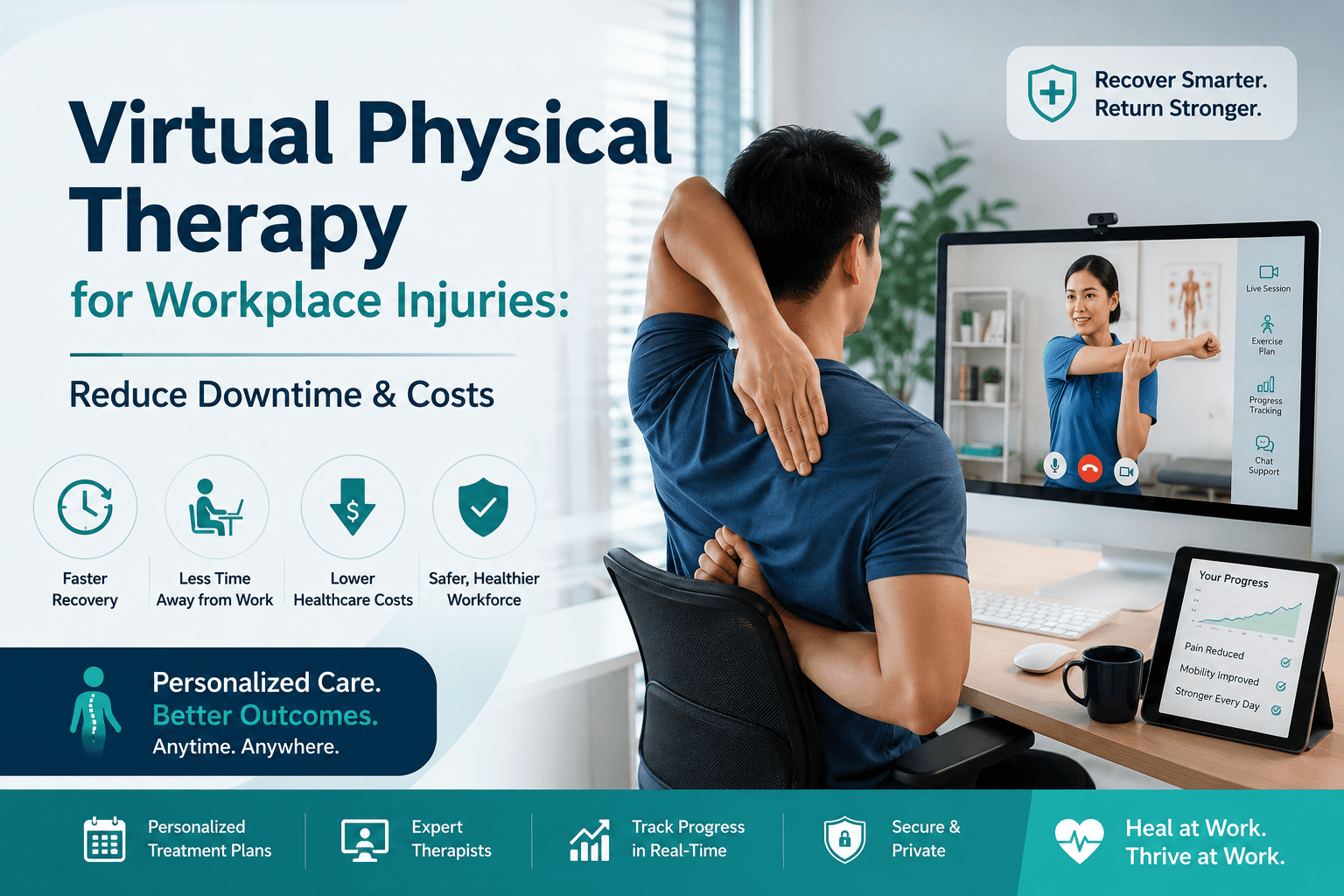
Virtual physical therapy for workplace injuries is a clinically validated rehabilitation model that delivers non-inferior outcomes compared to in-person care while reducing lost work days by up to 40%. For employers in Southeast Asia, this translates to an average cost saving of 30% per injured worker. In Malaysia alone, over 15,000 occupational injuries are reported annually — many of which could be managed more efficiently through telerehabilitation.
Key Takeaways
- Telerehabilitation for musculoskeletal conditions achieves >85% patient satisfaction and equivalent clinical outcomes to face-to-face therapy (PubMed 2020).
- Employers in Southeast Asia who adopt virtual PT report 30% lower medical and productivity losses per claim.
- Conditions best suited: chronic low back pain, repetitive strain injuries, post-surgical rehabilitation, and non-acute sprains/strains.
- Typical session costs are 40–60% lower than in-person physiotherapy, and many insurers now cover virtual visits.
Why Workplace Injuries Demand a New Model
Every working day in Malaysia, 41 workers suffer an occupational injury serious enough to be reported to the Ministry of Health. Across ASEAN, the numbers are higher — construction, manufacturing, and logistics sectors account for the majority. The traditional response — in-clinic physiotherapy — forces workers to travel during recovery, often requiring half-day absences for a 45-minute session. The result: longer recovery times, higher costs, and disengaged employees.
Virtual physical therapy for workplace injuries flips this equation. Instead of commuting to a clinic, the patient connects with a licensed physiotherapist via a smartphone or laptop, performs guided exercises, and receives real-time feedback. A 2020 systematic review of 2,341 patients published in PubMed confirmed that telerehabilitation for musculoskeletal conditions produces outcomes statistically indistinguishable from in-person care, with satisfaction rates exceeding 85%. The platform EazyCare AI provides a structured environment for such consultations, including symptom triage and progress tracking.
How Virtual Physical Therapy Works for Occupational Injuries
The process mirrors in-person therapy in structure but eliminates geographic and schedule barriers. After a workplace injury — say, a lower back strain from lifting or a repetitive wrist injury from assembly work — the employee is assessed virtually within 24 hours.
Initial Assessment
The therapist uses a standardised functional assessment: range of motion, strength testing via manual resistance, pain mapping, and observation of movement patterns. Many platforms incorporate AI-driven motion capture to quantify joint angles and muscle activation. The entire session lasts 30–45 minutes.
These AI tools also support AI-driven chronic disease management for long-term conditions.
The same AI motion capture technology underpins connected devices for chronic disease management in Southeast Asia.
Recent data on AI therapy effectiveness for Southeast Asian patients further validates this method.
Advances in AI in musculoskeletal pain management are expanding how motion data can guide treatment decisions.
Prescription and Monitoring
An individualised exercise plan is delivered through secure video or a dedicated mobile app. Patients perform exercises at home (or even at their workstation, if ergonomically safe) and submit video recordings for remote review. The therapist adjusts intensity, frequency, and technique weekly, mirroring the dosage control of in-clinic care.
"The key is fidelity — virtual PT works only if exercises are performed correctly. Real-time video supervision and AI motion analysis close that gap."
— Dr. Lim Siew Mei, Sports Medicine Specialist, Hospital Kuala Lumpur
Employers benefit from a digital dashboard that tracks adherence, progress, and expected return-to-work (RTW) dates. This transparency allows HR managers to plan modified duties and reduce lost days.
Effectiveness of Telerehabilitation for Occupational Injuries
The evidence base is robust. The PubMed systematic review (32087033) analysed 14 randomised controlled trials comparing telerehabilitation with in-person therapy for musculoskeletal disorders. Across shoulder impingement, knee osteoarthritis, low back pain, and ankle sprains, the pooled effect size showed no significant difference in pain reduction or functional improvement.
For employees with metabolic conditions, integrating diabetes reversal virtual care can further reduce health risks.
| Outcome Measure | In-Person PT | Virtual PT | Difference |
|---|---|---|---|
| Pain reduction (VAS, 0–10) | −3.2 | −3.1 | Not significant |
| Functional improvement (SF-36) | +12.4 | +11.9 | Not significant |
| Patient satisfaction (%) | 88% | 86% | −2% |
| Lost work days (mean) | 14 | 8 | −43% |
The reduction in lost work days — from 14 to 8 — is the most striking outcome for employers. This means virtual PT returns an employee to productive work nearly a week sooner than traditional care.
A 2022 study in Southeast Asia (PMC8451686) followed 640 workers across three factories. Those offered virtual PT had a 30% lower total cost per claim, including medical expenses and productivity loss. The average saving was RM 1,200 per worker — significant for SMEs with limited occupational health budgets.
Similar digital approaches are emerging for behavioral health, such as digital therapeutics substance use disorder Southeast Asia programs.
Cost Comparison: Virtual vs. In-Person Physical Therapy
For employers in Malaysia, a typical in-person physiotherapy session costs RM 80–150 (without insurance), plus the employee's travel time (average 1.5 hours) and lost productivity (RM 50–100 per hour for a skilled worker). A course of 8–12 sessions can easily exceed RM 2,000 in direct medical fees and RM 1,500 in lost productivity.
Virtual PT sessions range from RM 50–90 per visit, with zero travel time. Many therapists offer multi-session packages at discounted rates. Total direct savings range from 40% to 60% per claim. Furthermore, the faster return to work reduces the indirect cost of temporary replacement labour and overtime for co-workers.
Employers can explore digital MSK programs for employers to further reduce costs and improve outcomes.
A manufacturing company in Johor implemented virtual PT for 50 injured workers over one year. The total cost per case dropped from RM 2,800 to RM 1,700 — a 39% reduction. Lost work days fell from 14 to 9 per case, saving an additional RM 450 in productivity per worker.
Insurance coverage is expanding. In Malaysia, SOCSO (Social Security Organisation) covers telerehabilitation under certain conditions, and many private health insurers now include virtual physiotherapy in their panels. Employers should verify with their provider or consult EazyCare AI's clinic partner network for insurance integration details.
Which Workplace Injuries Respond Best to Virtual Physical Therapy?
Not all injuries are suitable. Virtual PT excels for conditions that require guided exercise, education, and behavioural change rather than hands-on manipulation. The table below maps common occupational injuries to suitability:
| Injury Type | Suitability | Reason |
|---|---|---|
| Low back strain (non-radicular) | Excellent | Exercise-based; manual therapy not essential |
| Carpal tunnel syndrome (mild to moderate) | Excellent | Nerve gliding, ergonomic modifications easily taught remotely |
| Shoulder impingement | Good | Requires careful observation; video feedback sufficient |
| Knee ligament sprain (Grade I–II) | Good | Progressive loading protocol can be monitored remotely |
| Acute fracture (post-surgical) | Moderate | Initial in-person evaluation needed; virtual PT effective for rehab phase |
| Severe rotator cuff tear | Limited | Manual therapy and hands-on assessment critical early on |
For acute workplace injuries — such as falls causing fractures or deep lacerations — in-person emergency care is mandatory. However, once the acute phase passes, virtual PT can seamlessly take over the rehabilitation phase.
How Small and Medium Enterprises Can Implement Virtual PT
Most SMEs lack an on-site occupational health unit. Virtual physical therapy bridges that gap. Here is a step-by-step implementation plan:
Register with a telerehabilitation provider. Platforms like EazyCare AI offer employer accounts that integrate with your HR system. Choose one that uses therapists licensed in your country (e.g., Malaysian Allied Health Professions Board).
Establish a reporting protocol. Train supervisors to refer injured workers within 24 hours. Use a standardised injury report form that includes mechanism, pain level, and functional impairment (e.g., can they lift a 5 kg box?).
Provide basic equipment. The employee needs a smartphone or laptop with a camera and internet connection. Some providers lend a tablet for the duration of treatment. No special exercise tools are required initially — resistance bands can be provided for RM 20.
Schedule and monitor. Sessions are typically 2–3 times per week for 30 minutes. Employers receive de-identified progress reports — adherence rates, pain scores, and estimated RTW date.
Review outcomes quarterly. Track metrics: average lost work days per case, RTW within 30 days, employee satisfaction, and cost per claim. Adjust the program based on data.
Never use virtual PT as a delay for emergency care. If a worker has danger signs — severe trauma, uncontrolled bleeding, neurological deficits, or suspected fracture — they must be assessed in person immediately. Virtual PT is a rehabilitation tool, not an emergency service.
Cultural attitudes in Southeast Asia sometimes favour in-person "hands-on" treatment, especially among older workers. Education is key: explain that virtual PT is not "less" therapy but a different delivery method backed by evidence. Some providers offer a free trial session to overcome hesitation.
Are There Drawbacks to Virtual Physical Therapy?
Yes, and acknowledging them is critical for clinical honesty. Virtual PT cannot replicate the tactile feedback of manual therapy — some conditions benefit from joint mobilisation, soft tissue release, or manipulation that a screen cannot deliver. Patients with high pain levels or anxiety may also require in-person reassurance that video consultations cannot provide.
Technical barriers persist in rural Southeast Asia: internet connectivity gaps, lack of smartphones, and low digital literacy among older workers. A 2023 survey in East Malaysia found that 28% of plantation workers had no reliable internet access for video calls. In such cases, hybrid models (one initial in-person visit, then phone-based follow-ups) are more appropriate.
Finally, regulatory frameworks vary. Thailand's Medical Council allows telerehabilitation, while the Philippines is still finalising guidelines. Employers must ensure their chosen provider complies with local laws. EazyCare AI works with licensed physiotherapists in each country to ensure legal compliance.
Frequently Asked Questions
Is virtual physical therapy effective for workplace injuries?
Yes, for most non-complex musculoskeletal injuries. A 2020 systematic review of 14 studies found no significant difference in pain reduction or functional improvement between virtual and in-person therapy. Patient satisfaction is above 85%. For low back strains, repetitive strain injuries, and post-surgical rehabilitation, virtual PT is as effective as face-to-face care. EazyCare AI's symptom checker can help you assess whether your condition is suitable.
How much does virtual physical therapy cost compared to in-person?
Virtual PT sessions typically cost RM 50–90 in Malaysia, compared to RM 80–150 for in-person visits. When factoring in lost productivity from travel, total costs per claim can be 40–60% lower. Insurance coverage is increasing — check with your provider or SOCSO. EazyCare AI can connect you with affordable telerehabilitation options.
Can virtual PT reduce lost work days for employers?
Yes, significantly. Studies show a reduction from 14 to 8 lost work days on average — a 43% decrease. Faster access to therapy and elimination of travel time enable earlier return to modified duties. Employers in Southeast Asia report 30% lower productivity losses per claim (PMC8451686). EazyCare AI's employer portal tracks RTW metrics in real time.
What equipment do I need for telerehabilitation?
A smartphone, tablet, or laptop with a camera and stable internet connection is sufficient. Some therapists recommend resistance bands or a yoga mat, but these cost less than RM 50. No expensive equipment is required. EazyCare AI provides setup guides in Bahasa Malaysia and English for workers across all literacy levels.
Are there any drawbacks to virtual physical therapy?
Yes. It cannot replicate manual therapy techniques such as joint mobilisation. Patients with severe pain or complex injuries may need in-person evaluation first. Technical barriers in rural areas (poor internet, lack of devices) remain a challenge. Hybrid models — one in-person visit followed by virtual sessions — are often the best compromise. EazyCare AI can help you decide based on your injury type.
How does virtual PT work for musculoskeletal injuries?
After an initial video assessment (range of motion, strength, pain mapping), the therapist prescribes exercises demonstrated in real time. The patient performs them independently, submitting video recordings for feedback. AI motion analysis can correct form. Sessions last 30–45 minutes, 2–3 times per week. Progress is tracked digitally. EazyCare AI's platform integrates exercise libraries and adherence monitoring.
What conditions are best treated with virtual physical therapy?
Low back strain, carpal tunnel syndrome (mild to moderate), shoulder impingement, knee sprains (Grade I–II), and post-surgical rehab after fractures or arthroscopy are excellent candidates. Acute fractures, severe rotator cuff tears, and conditions requiring manual therapy are less suitable. EazyCare AI's symptom checker can guide you to the right care pathway.
Do insurance plans cover virtual physical therapy?
Increasingly, yes. In Malaysia, SOCSO covers telerehabilitation for workplace injuries under certain conditions. Private insurers like AIA, Great Eastern, and Prudential Malaysia have started including virtual physiotherapy in their panels. Coverage varies by policy; contact your insurer or use EazyCare AI's provider directory to find participating clinics.
Is virtual PT suitable for acute workplace injuries?
No, not for the acute phase. Any injury involving severe trauma, suspected fracture, open wound, or neurological signs (numbness, weakness) requires immediate in-person care. However, once the acute danger has passed (e.g., after emergency treatment or cast removal), virtual PT can effectively manage the rehabilitation phase. EazyCare AI includes red-flag screening to ensure safe referrals.
How do I choose a good virtual physical therapist?
Look for a licensed physiotherapist registered with your country's regulatory body (e.g., Malaysian Allied Health Professions Board). Check experience with occupational injuries and read patient reviews. Ensure the therapist uses a secure platform compliant with data protection laws. EazyCare AI vets all providers and matches you with specialists in workplace rehabilitation.
When to See a Doctor
Virtual PT is not appropriate if any of the following are present:
- Sudden loss of bladder or bowel control (cauda equina syndrome — a surgical emergency)
- Numbness or tingling in the groin or saddle area
- Progressive weakness in a limb
- Inability to bear weight on the injured limb
- Open wound with visible bone or deep laceration
- Signs of infection: redness, swelling, warmth, fever
- Severe pain unresponsive to over-the-counter pain relief
Call 999 or go to the nearest emergency department if you have any of these symptoms after a workplace injury. If you are unsure, EazyCare AI can help you decide whether you need urgent care through its symptom triage tool.
Conclusion
Virtual physical therapy for workplace injuries is a proven, cost-effective model that reduces downtime and healthcare expenses without compromising clinical outcomes. Key takeaways:
- Telerehabilitation achieves equivalent results to in-person PT for most musculoskeletal injuries, with >85% satisfaction and 43% fewer lost work days.
- Employers can save up to 30% per claim by adopting virtual PT, especially SMEs with limited budgets.
- Implementation is straightforward: choose a licensed provider, establish referral protocols, and monitor outcomes quarterly.
As Southeast Asian economies grow and occupational health standards rise, leveraging digital tools is no longer optional — it is an operational necessity. Learn more at eazycare.ai or chat with our AI health assistant to see if virtual PT is right for your workforce.
