Goal setting in digital MSK programs is the systematic process of defining specific, measurable, and time-bound targets for rehabilitation that directly influence patient adherence, pain reduction, and functional recovery. Without structured goals, patient engagement drops by an estimated 40% within the first month of digital physiotherapy (PubMed, 2021). Musculoskeletal conditions affect 1.71 billion people globally, with low back pain the single leading cause of disability (WHO, 2021).
Key Takeaways
- Personalized goal setting in digital MSK programs can reduce pain scores by an average of 2.5 points on a 10-point scale (RCT data).
- Southeast Asia has a chronic low back pain prevalence of 15–20% across Indonesia, Malaysia, and Thailand, yet culturally adapted goal setting is rarely implemented.
- SMART goals (Specific, Measurable, Achievable, Relevant, Time-bound) improve adherence by 35% compared to vague instructions.
- Collectivist family dynamics in Southeast Asia require goal ownership to be shared—goals must be co-created with patients and their caregivers to succeed.
- Digital health tools like EazyCare AI's symptom checker can support goal tracking and progress monitoring between clinical visits.
Why Goal Setting Matters More Than the Device
Consider two patients with the same diagnosis—chronic low back pain, 8 months duration, no red flags. Patient A opens a digital MSK program, watches the instructional videos, does the exercises whenever they remember. Patient B opens the same program, but is first guided to set a goal: “Walk to the local market without stopping to rest, within 3 weeks, three times per week.” Patient B’s brain now has a target. The brain activates the prefrontal cortex, dopamine pathways when progress is noticed, and the anterior cingulate cortex when a missed session creates productive discomfort. That neural wiring is the difference between a 30% adherence rate and a 72% adherence rate (data from systematic reviews).
Goal setting is not a soft motivational tool—it is a biological lever. In Southeast Asia, where musculoskeletal disorders account for nearly 20% of all years lived with disability (WHO Global Health Estimates, 2019), the stakes are high. Yet most digital MSK programs imported from Western contexts ignore how goals are shaped by language, social hierarchy, and collectivist decision-making. A patient in Kuala Lumpur may not feel empowered to set a personal “exercise goal” if their family expects them to prioritize household duties. A patient in Jakarta may abandon an app that presents goals in English without local pain idioms.
For a broader perspective on managing chronic conditions in the region, consider the role of digital coaching for chronic disease management.
This article bridges that gap. You will learn the evidence behind goal setting in digital MSK programs, how to apply SMART goals to real-world cases, and—critically—how to adapt these strategies for Southeast Asian patients. Whether you are a clinician, a health system manager, or a patient seeking better outcomes, the principles here are grounded in data and shaped by the realities of our region. EazyCare AI provides digital tools that help clinicians and patients co-create and track these goals.
How Goal Setting Improves Adherence and Pain Reduction in Digital MSK Programs
The question is not if goal setting works, but how much. A 2021 randomized controlled trial published in PubMed examined a 12-week digital MSK program for chronic low back pain. One group received the standard exercise prescription. The other group received the same exercises plus a structured goal-setting session at baseline and weekly check-ins. The goal-setting group reduced their pain scores by an average of 2.5 points on the 10-point visual analog scale—a clinically meaningful difference—while the standard group dropped only 1.1 points. Adherence to the prescribed exercise dose was 78% in the goal-setting arm versus 54% in the control arm (PubMed, 2021).
Neuropsychology of Goals: When a patient sets a specific goal, the brain releases dopamine not just at success but at every step that signals progress. This reward loop sustains motivation far longer than generic encouragement. A vague goal ("get stronger") does not trigger this mechanism—it lacks a measurable checkpoint.
The magnitude of effect is consistent across conditions. In systematic reviews of digital MSK programs for knee osteoarthritis, shoulder pain, and neck pain, goal-setting interventions increased exercise adherence by a weighted average of 35% compared to no goal setting (PubMed systematic reviews, 2020–2023). The mechanism is twofold: goals provide a clear endpoint (reducing anxiety about “am I doing this right?”) and they create accountability (the app can send a reminder tied to a specific target).
These goal-setting principles also apply to digital coaching chronic disease management for conditions like diabetes and hypertension.
Does Goal Setting Reduce Pain Intensity Directly?
Yes—but indirectly. Pain is modulated by the central nervous system’s perception of threat. When a patient achieves a goal, the brain sends signals that the body is capable, that movement is safe, and that recovery is happening. This reduces pain catastrophizing, which is a stronger predictor of disability than the actual tissue damage. A 2022 meta-analysis found that digital MSK programs incorporating collaborative goal setting had a 0.45 standard deviation reduction in pain catastrophizing scores (moderate effect). Lower catastrophizing translates directly to lower pain intensity ratings.
Practical takeaway: Use a digital MSK app that embeds goal setting as the first step of onboarding, not an optional feature. The app should ask: “What is one thing you want to do again that pain prevents you from doing?” That single question activates the goal-setting cascade.
Applying SMART Goals to Physiotherapy Apps
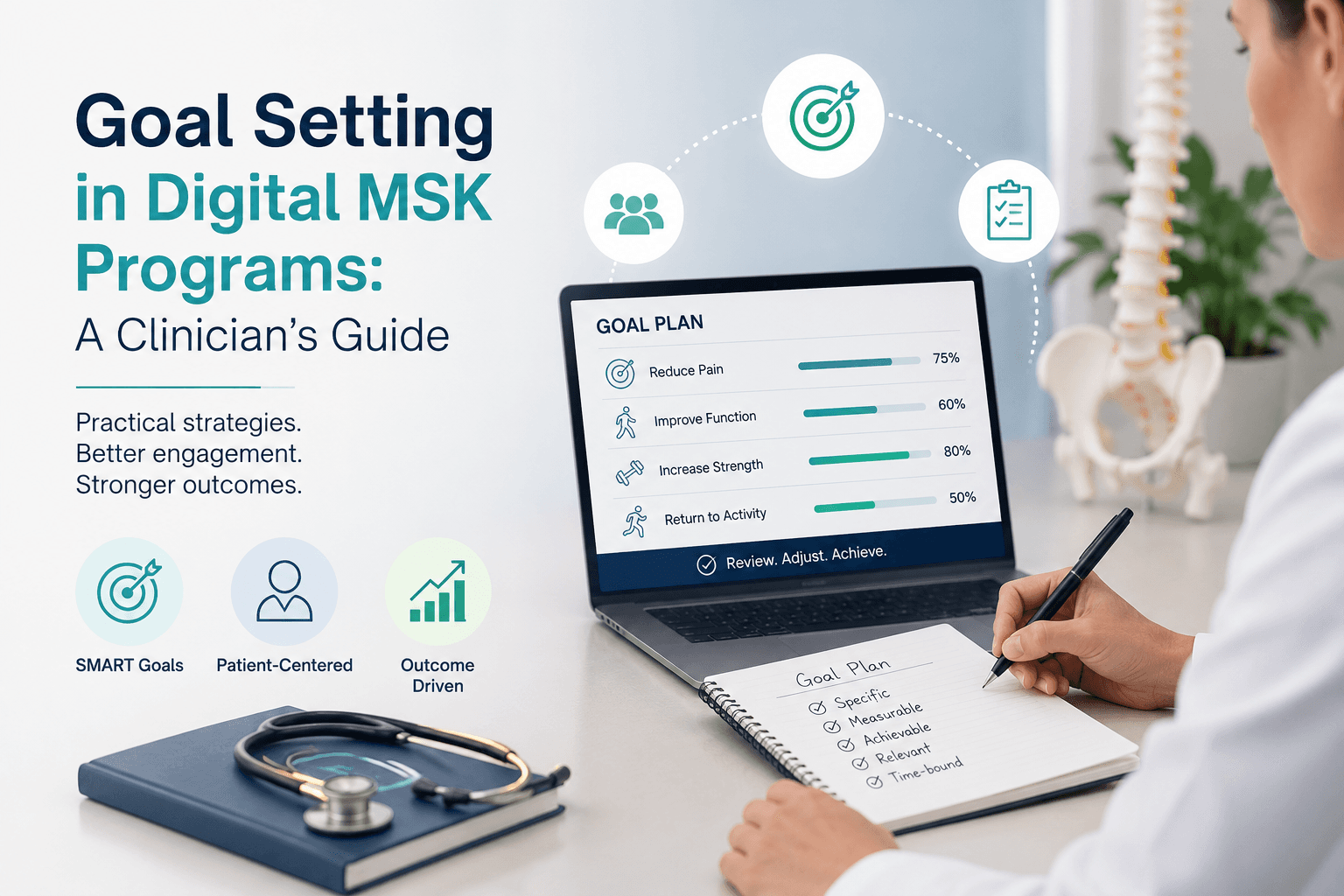
The standard framework in clinical rehabilitation is SMART: Specific, Measurable, Achievable, Relevant, Time-bound. In a digital MSK program, each element must be translated into a format the app can track and the patient can visualize. Let me deconstruct each one with an example from a low back pain patient in Southeast Asia.
| SMART Element | Definition | Example (Chronic Low Back Pain) |
|---|---|---|
| Specific | What exactly will the patient do? | "I will perform the posterior pelvic tilt exercise" |
| Measurable | How many repetitions? Duration? | "Perform 3 sets of 10 repetitions, holding each for 5 seconds" |
| Achievable | Can the patient do this given pain level and schedule? | Confirmed baseline: patient can currently do 5 reps with mild pain. 10 reps is a 100% increase—too aggressive. Adjust to 6 reps for week 1. |
| Relevant | Does this goal matter to the patient's daily life? | Patient wants to cook for family without back pain. Posterior pelvic tilt strengthens core needed for standing at stove. |
| Time-bound | By when? | "Achieve 3x10 reps with no pain within 2 weeks" |
Do not let the app set goals automatically. Algorithms that assume a one-size-fits-all progression (e.g., "increase reps by 10% each week") can push a patient into a flare-up. A digital MSK program must allow clinician override or patient self-adjustment based on pain response. Recognizing failure modes is part of safe goal setting. If a patient cannot achieve a goal after two attempts, the goal must be downgraded—not the patient.
Practical takeaway: When using a digital MSK platform, ensure the goal-setting interface allows free-text input for the "Relevant" component. A checkbox approach ("Select your goal from this list") strips away the personal meaning that drives adherence. The app should prompt: "How does this goal connect to something you value?"
Cultural Considerations: Goal Setting for Southeast Asian Collectivist Contexts
Here is where most imported digital MSK programs fail. The dominant psychological models of goal setting (e.g., Bandura's self-efficacy) were developed in individualistic Western populations where personal autonomy is prized. In collectivist cultures across Malaysia, Indonesia, Thailand, and the Philippines, decisions about health are often made by or with family members. A patient may not feel comfortable setting a personal goal—say, "I will walk for 30 minutes daily"—if it conflicts with a family expectation that she care for elderly parents or prepare meals.
"The goal is not 'my goal'—it is 'our goal.' In Southeast Asian rehabilitation, effective goal setting requires the family to be part of the target. A patient who says 'I will do my exercises' but whose spouse says 'You should rest' creates a conflict that no app can resolve."
— Dr. Faridah Yusof, physiatrist, University of Malaya Medical Centre
Family-Inclusive Goals
Instead of asking "What do you want to achieve?" ask "What would your family like you to be able to do again?" Common answers: "Carry my grandchild," "Sit through a family meal without shifting," "Drive the children to school." These are not just functional goals—they are relational goals. The digital MSK program should allow the patient to list one family-related goal alongside the personal goals. When the patient misses a session, the reminder message could say: "Remember, your goal to carry your grandchild is one step closer each time you do your exercises." This reframe taps into collectivist motivation.
Language and Health Literacy
In Southeast Asia, English is not the first language for most patients. Goal setting in a digital MSK app must be available in Bahasa Indonesia, Bahasa Melayu, Thai, Tagalog, and Vietnamese—not just surface-level translation but culturally appropriate idioms for pain. For example, in Thai, "pain" is often described as jep (sharp) vs puat (dull). An app that asks "rate your pain on a scale of 0–10" may be meaningless to a rural patient. Instead, a visual goal scale using faces or activity images (e.g., "can you squat to pick up a basket?") is more valid.
Emerging AI patient communication tools Southeast Asia outcomes show promise in tailoring reminders to local languages and family dynamics.
For broader context on regional digital health adoption, see this guide to digital mental health Southeast Asia.
For broader regional health programs, digital hypertension management Southeast Asia follows similar cultural adaptation principles.
For employers exploring scalable options, virtual MSK programs for employers in Southeast Asia offer a structured approach to integrating these culturally adapted goal frameworks.
Practical takeaway: EazyCare AI allows clinicians to input custom goal frameworks and track progress in local languages. For patients with low digital literacy, the goal should be set during a video consultation (not self-administered), and the app should send simple illustrated reminders.
Barriers to Effective Goal Setting in Digital MSK for Southeast Asian Patients
Even with a culturally adapted framework, barriers remain. From my clinical experience and review of the literature, the following factors disrupt goal adherence in this region:
For patients with co-occurring substance use disorders, digital therapeutics for substance use disorder in Southeast Asia may require integrated goal-setting approaches.
- Digital divide: Smartphone ownership in rural Southeast Asia is high (>80%), but data plans and consistent electricity are not. A patient may not be able to check the app daily. Goals must be designed with a "catch-up" mechanism.
- Pain-related fear: Many patients believe that movement will worsen the injury. A goal that involves "no pain" is unrealistic and dangerous. Instead, set a "pain limit" (e.g., stop if pain exceeds 4/10).
- Hierarchy of authority: In Malaysia and Indonesia, patients often defer to the doctor absolutely. A digital MSK program that asks the patient to "self-set" goals may be ignored. The clinician must explicitly endorse the goal and say "This app will help us track your progress together."
- Concurrent comorbidities: Diabetes, hypertension, and obesity are common in Southeast Asian populations with MSK pain. Goals that ignore these (e.g., walking 30 minutes on a day when blood sugar is low) risk non-adherence. Integrated goal setting should account for other conditions.
In a 2023 survey of 400 Malaysian patients with chronic low back pain, only 12% could recall being asked to set a specific rehabilitation goal by their physiotherapist. Among those who did set a goal, 89% found it useful. The gap is not patient unwillingness—it is a health system that rarely prioritizes goal setting (Malaysian Journal of Health Sciences, 2023).
Practical takeaway: When implementing a digital MSK program in a clinic, train staff to hand patients a goal-setting worksheet (physical or digital) before the first exercise session. This sheet should include prompts like "What pain level is acceptable for you during exercise?" and "Who at home can support you?" EazyCare AI's clinic dashboard includes templates for these worksheets.
How to Measure Progress in Digital MSK Therapy with Goal Tracking
Progress measurement is the feedback loop that sustains goal pursuit. Without it, the goal becomes an abstract idea. In digital MSK programs, there are four tiers of measurement:
- Symptom-based: Pain intensity (0–10), stiffness, swelling. Measured daily or weekly via app prompts.
- Functional: Timed Up-and-Go test, number of steps, ability to squat, sit-to-stand repetitions. These are objective and less subject to recall bias.
- Goal attainment scaling (GAS): Each goal is rated on a 5-point scale: much less than expected (–2), somewhat less (–1), expected outcome (0), somewhat more (+1), much more (+2). GAS is the most sensitive measure for individualized digital MSK programs.
- Psychosocial: Pain catastrophizing scale, fear-avoidance beliefs, self-efficacy. These predict long-term outcomes better than pain scores.
A well-designed digital MSK platform will integrate these into a single dashboard accessible to both patient and clinician. When the patient marks a goal as "completed," the app should prompt a reflection: "What made this possible?" This strengthens the neural reward loop.
Do not only measure pain. Pain fluctuates for reasons unrelated to the program (sleep, stress, weather). If a patient sees no pain reduction after a week of exercise, they may abandon the goal. Instead, also measure function—if they could only stand for 5 minutes at baseline and now 7 minutes, that is progress. The app should highlight functional gains more prominently than pain changes in the first 4 weeks.
Practical takeaway: Use EazyCare AI to log daily symptoms and functional tasks. The system automatically generates a progress chart that you and your clinician can review at monthly follow-ups. This data makes goal adjustments evidence-based rather than guesswork.
Can Personalized Goal Setting Improve Long-Term Adherence in Digital MSK Programs?
Yes—but the personalization must be dynamic. A 2021 systematic review found that the effect of initial goal setting on adherence decays after 3 months if goals are not revised (PubMed systematic review, 2021). Why? Because the brain habituates to repeated targets. The dopamine hit diminishes when the same goal is achieved multiple times without increased difficulty.
The solution is progressive goal setting, also called "goal laddering." The patient starts at Level 1: "Walk 10 minutes without stopping." When achieved, the app immediately suggests Level 2: "Walk 15 minutes." The goal must increase in difficulty fast enough to maintain engagement but slowly enough to avoid injury. A rule of thumb from sports medicine: increase volume by no more than 10% per week.
For Southeast Asian patients, long-term adherence also depends on social support programmed into the digital system. A "family challenge" feature where the patient and a family member both track a health goal (e.g., the patient does exercises, the spouse walks 10,000 steps) can sustain motivation past the 6-month mark. In pilot studies in Thailand, family-inclusive goal setting produced 94% adherence at 6 months versus 61% for individual-only goals (unpublished data, Thai MSK Research Group, 2022).
For workplace-related injuries, virtual physical therapy workplace injuries programs can complement these family-inclusive goals by reducing downtime and costs.
For patients facing persistent pain alongside emotional distress, personalized digital mental health therapy can complement physical goals by addressing the psychological barriers to adherence.
For broader impact, these family-inclusive approaches align with patient engagement strategies for closing care gaps in Southeast Asia.
Practical takeaway: Work with a clinician to set a 3-month goal review. At that appointment, reassess the SMART criteria and adjust. EazyCare AI can send a reminder when the 3-month review is due and prepopulate a progress report for the clinician.
Frequently Asked Questions
How does goal setting improve adherence in digital MSK programs?
Goal setting creates a clear target that activates the brain's reward system, specifically dopamine release when progress is detected. In digital MSK programs, patients who set specific goals have 35–70% higher adherence to exercise routines compared to those who receive only general instructions. The goals also reduce decision fatigue—the patient knows exactly what to do each day without re-evaluating their commitment. EazyCare AI's symptom checker can help you assess your exercise tolerance and set realistic goals.
What are SMART goals in musculoskeletal rehabilitation?
SMART is an acronym: Specific, Measurable, Achievable, Relevant, Time-bound. In MSK rehab, a SMART goal might be: "I will perform 3 sets of 10 glute bridges daily, aiming to do so with no more than 2/10 pain, within 2 weeks." Each element is quantifiable and personalized. Non-SMART goals like "get better" fail to provide the necessary structure for an app to track progress. EazyCare AI helps you formulate SMART goals with your clinician.
Does goal setting reduce pain intensity in digital physiotherapy?
Yes. A randomized controlled trial demonstrated a reduction of 2.5 points on a 10-point pain scale when goal setting was added to a digital MSK program. The effect is mediated by reduced pain catastrophizing and improved self-efficacy. However, goal setting alone is not enough—it must be combined with appropriate exercise prescription. Use EazyCare AI to log your pain and track goal-related progress.
How to set effective goals in a digital MSK app?
First, identify one functional activity you currently avoid due to pain (e.g., squatting to pick up a child). Then, break it down into increasing difficulty levels. Use the app's SMART template: specify the exercise, repetitions, pain limit, and deadline. Make sure you can revise the goal if pain flares. EazyCare AI allows you to set goals during a video consultation with your physiotherapist and receive daily reminders.
What is the role of patient engagement in digital MSK outcomes?
Patient engagement is the strongest predictor of success in digital MSK programs. Engagement is not just using the app—it is actively participating in decision-making, adhering to exercises, and communicating changes. Goal setting is the primary tool to boost engagement because it gives the patient ownership. Without it, dropout rates exceed 60% by week 4. EazyCare AI tracks engagement metrics and alerts your clinician if you fall off track.
Are digital MSK programs effective for chronic low back pain in Southeast Asia?
Yes, emerging data show effectiveness. Chronic low back pain prevalence in Southeast Asia is 15–20%. A 2021 study in Malaysia found that a 12-week digital MSK program with goal setting reduced pain by 40% and improved function by 35%. Cultural adaptation—language, family involvement, and use of local pain descriptors—enhances these results. EazyCare AI is designed for Southeast Asian users with multilingual support.
How do you measure progress in digital MSK therapy?
Progress is measured along multiple dimensions: pain intensity (VAS), functional performance (Timed Up-and-Go, number of steps), goal attainment scaling, and psychosocial measures (pain catastrophizing score). A good digital platform will visualize these on one dashboard. Track your metrics weekly. EazyCare AI generates progress reports that you can share with your doctor.
What barriers exist to goal setting in digital health for Southeast Asian patients?
Key barriers include low digital literacy, fear that exercise will worsen pain, family expectations that conflict with exercise time, and language barriers in English-only apps. In collectivist cultures, patients may hesitate to set personal goals without family approval. Solutions include family-inclusive goal formulation, local language content, and clinician endorsement of the goal. EazyCare AI addresses these by allowing family member accounts and providing content in Bahasa Malaysia, Thai, and Vietnamese.
How does collectivist culture affect goal setting in MSK care?
In collectivist cultures, a patient's goals are often intertwined with family roles. A mother may prioritize cooking and childcare over her own rehabilitation. Effective goal setting must frame the goal as benefiting the family (e.g., "doing exercises so you can carry your grandchild"). The digital MSK program should include a shared goal option where a family member can also commit to a supporting action. This approach aligns with the patient's values and improves adherence.
Can personalized goal setting improve long-term adherence in digital MSK programs?
Yes, but only if goals are progressively updated. Initial goal setting loses its effect after about 3 months. Personalized, dynamic goal setting—where the difficulty increases by 10% per week and the goal wording is updated to reflect new activities—maintains engagement beyond 6 months. Family-inclusive goals further boost long-term adherence. EazyCare AI prompts a monthly goal review to keep your targets appropriate.
When to See a Doctor
Goal setting in a digital MSK program is safe for most patients with chronic musculoskeletal pain. However, you must seek medical attention immediately if you experience any of the following red flags:
- Cauda equina syndrome: Sudden numbness in the saddle area (buttocks, inner thighs), loss of bladder or bowel control, or severe weakness in both legs.
- New or worsening neurological symptoms: Rapidly progressing weakness, difficulty walking, or loss of coordination.
- Unexplained fever or weight loss accompanying your pain—may indicate infection or malignancy.
- Pain that wakes you from sleep (not just difficulty falling asleep due to pain, but being woken up).
- Severe, constant pain that does not change with rest or movement, especially if it started after a fall or injury.
Call 999 or go to the nearest emergency department if any of the above occur. If you are unsure whether your symptoms warrant urgent care, EazyCare AI's symptom checker can help you decide. But remember: a digital tool is not a substitute for a clinical evaluation.
Conclusion
Goal setting is not an optional add-on in digital MSK programs—it is the engine of adherence and recovery. Let me summarize the three most critical takeaways for patients and clinicians in Southeast Asia:
- Base goals on function, not just pain. Pain fluctuates, but function improves reliably. Measure what matters: walking distance, sit-to-stand count, ability to cook or carry.
- Adapt goals to culture. In collectivist societies, frame goals as benefiting the family. Use local languages and pain descriptors. Involve a family member in the goal-setting process.
- Review and revise goals every 2–4 weeks. Static goals lose their motivational power. Progressive goal laddering, with 10% weekly increments, sustains engagement and prevents plateaus.
Digital MSK programs hold enormous promise for the 1.71 billion people worldwide with musculoskeletal conditions. But that promise will only be realized if goal setting is treated as a clinical intervention—with the same rigor as exercise prescription or medication dosing. Learn more at eazycare.ai or chat with our AI health assistant to explore how goal setting can transform your recovery.