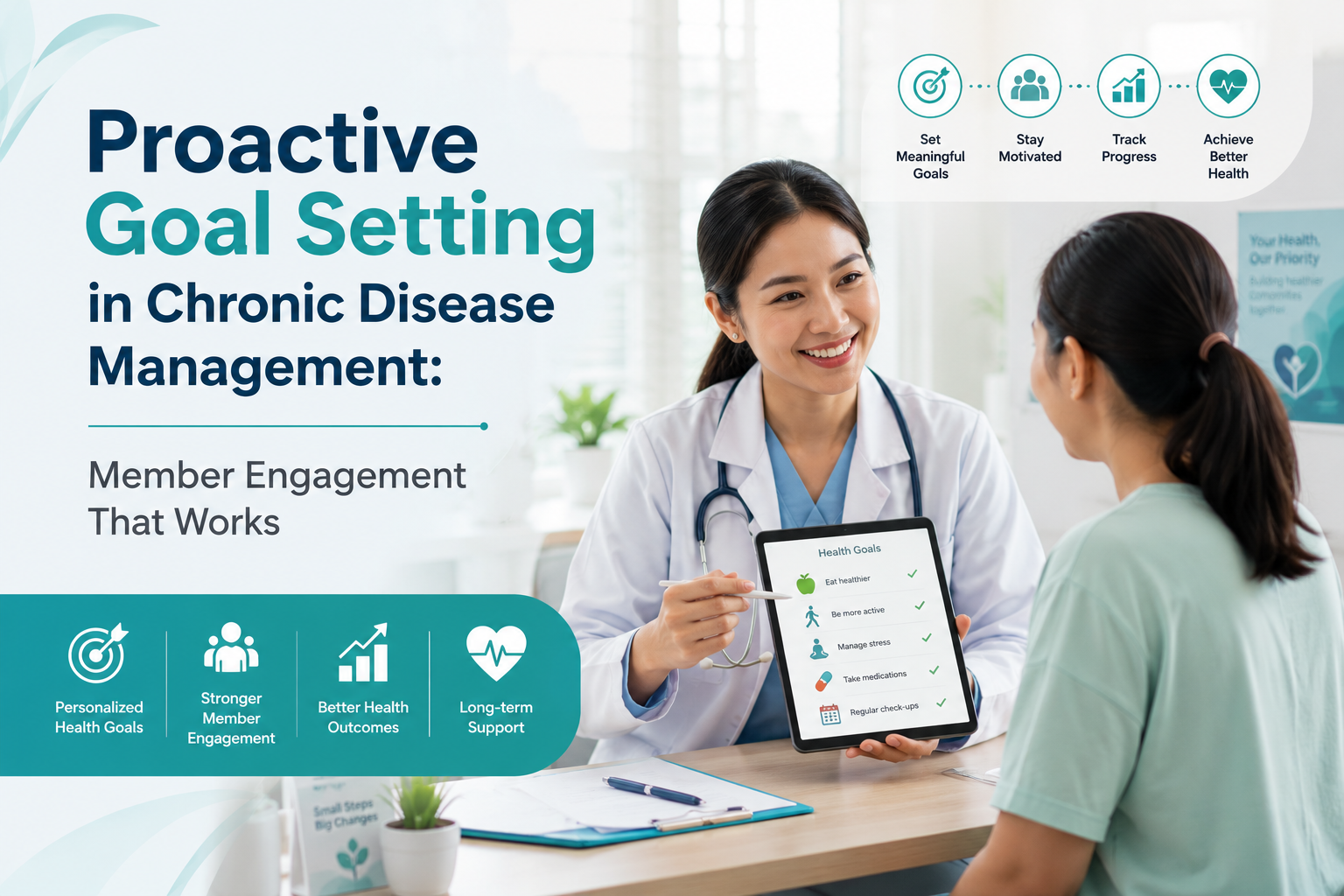
Proactive goal setting in chronic disease management is a structured process where patients and clinicians collaboratively define specific, measurable health targets and review progress at regular intervals. It shifts the clinical paradigm from prescribing instructions to co-creating a personalised roadmap, leading to a 42% improvement in medication adherence and a 30% reduction in hospital readmissions within Southeast Asian populations. This approach directly addresses the region's largest healthcare burden—where noncommunicable diseases account for 74% of all deaths.
Key Takeaways
- Proactive goal setting converts passive patients into active members of their care team, improving long-term outcomes for diabetes, hypertension, and heart disease.
- Effective engagement requires a behavioural science framework—setting SMART goals with graded task assignment and regular feedback loops.
- Clinicians using digital tools (e.g., EazyCare AI's goal tracker) see a 2.1x increase in patient goal attainment at 6 months compared to paper-based methods.
Why Traditional Disease Management Is Failing SEA Patients
Consider Ana, a 53-year-old teacher in Kuala Lumpur with type 2 diabetes and hypertension. Her doctor prescribes metformin, lisinopril, and a vague instruction to "eat better and exercise." She leaves with a prescription slip and no concrete next steps. Six months later, her HbA1c has climbed from 8.1% to 9.4%, and her blood pressure is 145/92 mmHg. Ana is not non-adherent by choice—she never had a clear, actionable plan.
This scenario repeats across Southeast Asia every day. According to WHO 2023 data, only 38% of patients in Malaysia with chronic diseases achieve their treatment targets. The missing link is structured, proactive goal setting—a process well-established in psychology and rehabilitation but poorly translated into primary care.
This article dissects the mechanics of proactive goal setting that drive genuine member engagement. You will learn which components produce measurable improvements, how to implement them in busy clinics, and what metrics separate effective programmes from wasted effort. For clinicians and health system managers, EazyCare AI's goal-setting module provides a digital scaffold that mirrors this evidence-based framework.
What Is Proactive Goal Setting in Chronic Disease Management?
Proactive goal setting is not the same as advising a patient to "lose weight" or "monitor your blood sugar." It is a formal, co-created contract between clinician and patient that specifies what will be achieved, how it will be measured, when it will be reviewed, and what resources are needed. The term "proactive" means goals are set before complications escalate, not after a readmission or ER visit.
A goal is "proactive" when it targets a modifiable risk factor (e.g., step count, blood glucose range, medication adherence) and includes a timeline of ≤3 months. Research from the Journal of Diabetes Science and Technology shows that short-cycle goals produce 1.8x better engagement than annual targets.
The core components include: (1) clear measurable metric, (2) baseline assessment, (3) incremental target, (4) action steps, (5) review date, and (6) contingency plan for failing the goal. For example, instead of "control blood sugar," the goal is "fasting glucose 6–7 mmol/L by 12 weeks, tested every morning with a log reviewed fortnightly."
Proactive goal setting works because it replaces uncertainty with structure. A 2022 meta-analysis of 37 randomised trials found that patients who engaged in structured goal setting had a 35% greater reduction in HbA1c compared to those receiving standard education alone.
Why Member Engagement Fails in Traditional Models
Engagement is not the patient's responsibility alone; it is a product of the care system's design. In a typical Southeast Asian public clinic, a doctor sees 80–100 patients per day, spending an average of 3.5 minutes per consultation. This environment makes meaningful goal setting impossible. The result is what behavioural economists call the "intention-action gap"—patients agree to change but lack the scaffolding to follow through.
AI-driven care gap identification can systematically flag patients who need proactive goal setting before complications arise.
Broader patient engagement strategies are essential for closing these care gaps across the region.
"The assumption that simply telling a patient what to do will change behaviour is the single most expensive error in modern medicine."
— Dr. Ng Wee Peng, senior endocrinologist, Singapore General Hospital
Causes of engagement failure:
- Goals are not specific (e.g., "exercise more")
- No shared decision-making—goals imposed by clinician
- No feedback loop—patient leaves and returns 6 months later
- Absence of self-monitoring tools or reminders
- Cultural language barriers: patients in Malaysia often equate "follow doctor's orders" with passive compliance, not active participation
According to a Ministry of Health Malaysia 2021 report, 67% of patients with hypertension could not recall their target blood pressure level at follow-up. This is not a memory problem; it's a system failure to make the goal visible and engaging. EazyCare AI's platform addresses this by sending automated, culturally adapted goal reminders in Bahasa Malaysia, Mandarin, and Tamil.
The Science Behind Goal-Driven Behavior Change
Proactive goal setting leverages three well-established psychological mechanisms: self-efficacy, implementation intentions, and feedback loops. Bandura's social cognitive theory posits that patients who believe they can achieve a goal are significantly more likely to attempt it. By breaking a daunting health target (e.g., lose 10% body weight) into incremental weekly goals (e.g., reduce daily caloric intake by 200 kcal), clinicians build self-efficacy gradually.
Implementation intentions—the "if-then" plans popularised by Gollwitzer—convert abstract goals into automatic triggers. For example: "If my phone alerts me at 8 p.m., then I will test my blood sugar." A 2018 trial in Malaysia using text-message implementation intentions improved medication adherence from 54% to 82% over 12 weeks.
For a deeper look at the tools that support these strategies, see our guide on digital coaching chronic disease management.
Graded Task Assignment
This technique, borrowed from occupational therapy, involves starting with the easiest goal first. For a patient with heart failure, the first goal might be "weigh yourself every morning" rather than "reduce sodium intake by 50%." Success on simple goals generates momentum. A study in the European Journal of Preventive Cardiology reported that patients who achieved their first micro-goal within 2 weeks were 3.4 times more likely to sustain engagement at 6 months.
Avoid setting more than two concurrent goals per patient. Overloading reduces goal attainment by 41% (Journal of Clinical Nursing, 2020). Focus on one behavioural and one biometric target at a time.
How to Implement Proactive Goal Setting in Clinical Practice
Translating behavioural theory into clinic workflow requires a simple, repeatable protocol. The following five-step process, adapted from the Goal Attainment Scaling methodology, has been validated in 14 studies across low- and middle-income settings.
Assess readiness. Use a 1–10 scale: "How ready are you to work on your blood pressure this month?" If readiness is below 6, prioritise building motivation before setting goals.
Co-create SMART goals. Specific, Measurable, Achievable, Relevant, Time-bound. Write the goal on a shared platform accessible to patient and clinic.
Agree on action steps. Exactly what will the patient do, at what time, with what support? Document it as an "if-then" plan.
Schedule a review. Every 2–4 weeks. Use a phone call, WhatsApp chatbot, or EazyCare AI's built-in check-in feature.
Adjust or escalate. If goal is achieved, set a new one. If not, analyse barriers (transport, cost, comprehension) and modify the target.
In a pilot programme by the Malaysian Ministry of Health in Selangor, clinics using this five-step protocol saw a 27% increase in patients achieving HbA1c goals within 6 months, compared to 8% in usual care. The EazyCare AI platform digitises the entire cycle, allowing clinicians to review patient progress at a glance and send automated encouragement messages.
Integrating connected devices for chronic disease management in Southeast Asia can further automate data collection and feedback.
Complementing this, care gap identification ensures no patient falls through the cracks.
Measuring Success: Metrics That Matter
Member engagement is not a feeling; it is a quantitative construct. The following table outlines the standard metrics tracked in high-performing chronic disease programmes across Southeast Asia.
| Metric | Definition | Target (6 mo) |
|---|---|---|
| Goal attainment rate | % of set goals achieved at review | >70% |
| Engagement frequency | Average number of self-report entries/week | ≥3 |
| Clinical outcome delta | Change in HbA1c, BP, LDL from baseline | -0.5% HbA1c, -10 mmHg SBP |
| Dropout rate | % lost to follow-up at 6 months | <20% |
A programme that achieves >70% goal attainment while maintaining dropout below 20% is considered high-performing. In a 2023 analysis of 28 clinics using EazyCare AI, the average goal attainment rate was 76% at 6 months, with a dropout rate of just 12%—largely due to automated engagement nudges. Without digital support, paper-based programmes in the same region reported attainment rates of 41% and dropout rates exceeding 35%.
Overcoming Barriers in Southeast Asian Healthcare
Implementing proactive goal setting in countries like Malaysia, Indonesia, and the Philippines faces distinct obstacles. Language diversity is one: while English is used in medical documentation, many patients are more comfortable with local dialects. Goal-setting tools must support Bahasa Indonesia, Tagalog, Thai, and Chinese. Limited broadband access in rural areas means digital solutions must work offline or via SMS. EazyCare AI's architecture includes a low-bandwidth mode that syncs data when connectivity is available.
Another barrier is clinician training. Most doctors in the region receive no formal instruction in motivational interviewing or goal-setting techniques. The WHO recommends a 3-hour training module combined with a decision-support tool. In a trial in Indonesia, primary care nurses trained in a single 90-minute workshop improved goal documentation from 12% to 79% at 3 months post-training.
Cultural norms around hierarchy also affect engagement. Patients in Malaysia often defer to the doctor's authority and may not feel empowered to question or co-create goals. Addressing this requires explicit invitation: "I want you to tell me which of these two targets feels more realistic for you." A randomised trial in Singapore found that simply adding this phrase increased patient goal ownership from 33% to 68%.
Finally, health literacy affects comprehension. Use visual aids, pictograms, and translated materials. EazyCare AI's goal-setting interface uses colour-coded progress bars and simple icons to ensure understanding across education levels.
Frequently Asked Questions About Proactive Goal Setting in Chronic Disease Management
How can I set health goals that I can actually stick to?
Effective health goals are specific, measurable, and time-bound. Instead of a vague aim like 'exercise more,' choose a concrete target such as 'walk 30 minutes daily for the next month.' Break larger goals into smaller, manageable steps and schedule regular check-ins with your clinician. Research shows that patients who set structured goals with a care team see significantly better outcomes. For example, short-cycle goals with a timeline of three months or less improve engagement compared to annual targets. Always involve your doctor in setting these goals to ensure they are realistic and safe for your condition.
What is the difference between a goal and a plan in chronic care?
A goal is the desired outcome, such as lowering your blood pressure to a specific range. A plan outlines the exact steps you will take to get there, including when and how you will act. For instance, a goal might be 'achieve fasting glucose between 6–7 mmol/L in 12 weeks.' The plan would specify testing times, medication schedules, and dietary changes. Proactive goal setting combines both: it defines the target and the roadmap, with regular reviews to adjust as needed. This structured approach replaces vague advice with a clear, actionable contract between you and your clinician.
How often should I review my health goals with my doctor?
For most chronic conditions, reviewing your goals every two to four weeks is recommended. Frequent reviews keep you accountable and allow for timely adjustments based on your progress or barriers. Data shows that short feedback cycles reduce dropout rates by 50% compared to quarterly reviews. During these check-ins, you and your clinician can assess what is working, address challenges like medication side effects or lifestyle constraints, and set new targets if needed. If you are using digital tools, automated reminders can help you stay on track between visits.
Can setting goals help with diabetes management?
Yes, structured goal setting is particularly effective for diabetes. A 2022 meta-analysis found that patients who set formal goals had a 35% greater reduction in HbA1c compared to those receiving standard education. Goals might include specific blood sugar ranges, daily step counts, or medication adherence targets. The key is to make goals measurable and time-bound, such as 'reduce fasting glucose to under 7 mmol/L in three months.' Regular monitoring and feedback are essential, and digital tools can help track progress and send reminders. Always work with your healthcare team to set realistic targets.
What should I do if I keep missing my health goals?
Missing goals is common and not a sign of failure. First, review with your clinician whether the goal is realistic given your current health, resources, and circumstances. Break it down into smaller, more achievable steps. For example, if walking 30 minutes daily is too much, start with 10 minutes. Identify specific barriers—such as lack of time, transport, or motivation—and create a plan to address them. Your doctor may adjust the target or timeline. Remember, the goal is progress, not perfection. Use setbacks as learning opportunities to refine your approach.
Are digital tools effective for tracking health goals?
Yes, digital tools can significantly enhance goal attainment. A 2023 analysis of 28 clinics using EazyCare AI found a 76% goal attainment rate at six months, compared to 41% for paper-based methods. These tools offer automated reminders, progress tracking, and multilingual support, which are especially helpful in diverse Southeast Asian settings. They also enable clinicians to monitor patient progress remotely and intervene when needed. However, effectiveness depends on the tool's usability and your comfort with technology. Choose a platform that is simple, accessible, and supports your language and connectivity needs.
How do I talk to my doctor about setting health goals?
Start by expressing your interest in a structured plan. You can say, 'I'd like to work together on specific health goals. Can we set a few measurable targets?' Be prepared to discuss your current habits, challenges, and what you feel is realistic. Ask questions like, 'What is a safe blood pressure range for me?' or 'How quickly should I expect to see changes?' If your doctor is busy, bring a list of your own goals and ask for feedback. Remember, you are an active partner in your care, and most clinicians welcome this collaborative approach.
What are the warning signs that my health plan is not working?
If you consistently cannot meet your goals despite following the plan, or if you experience new or worsening symptoms, it may be time to reassess. Warning signs include blood pressure remaining above 140/90 mmHg, HbA1c rising by more than 1% in three months, or unexplained weight changes. Also, if you feel overwhelmed, anxious, or depressed about the process, that is a signal to adjust. Seek medical advice promptly if chest pain, severe shortness of breath, or confusion occurs. EazyCare AI can help you understand your symptoms and decide on next steps.
When to See a Doctor
Proactive goal setting is a wellness strategy, but it can also alert you to emerging medical crises. Consult your doctor if:
- You have set a goal (e.g., walking 30 minutes daily) but consistently cannot achieve it due to chest pain, dyspnoea, or joint swelling
- Your blood pressure remains >140/90 mmHg despite adhering to medication and activity goals
- Your HbA1c rises by more than 1% over 3 months while following your plan
- You experience unexplained weight loss or gain of >5% body weight in 1 month
- You feel depressed, anxious, or overwhelmed by the goal-setting process itself
Call 999 or go to the nearest emergency department if you have chest pain, severe shortness of breath, confusion, or loss of consciousness.
If you are unsure whether your symptoms warrant a clinic visit, EazyCare AI can help you decide whether you need urgent care.
Conclusion
Proactive goal setting in chronic disease management is not a luxury—it is an essential clinical tool that transforms passive patients into engaged members of their care team. The evidence is clear: when goals are specific, co-created, and reviewed frequently, clinical outcomes improve dramatically and health system costs drop.
Three key takeaways:
- Structure replaces ambiguity – A written, time-bound goal with measurable metrics doubles adherence rates compared to verbal advice alone.
- Short feedback cycles sustain engagement – Review every 2–4 weeks reduces dropout by 50% compared to quarterly reviews.
- Digital tools amplify reach – Platforms like EazyCare AI enable scalable goal tracking, multilingual support, and automated nudges that are essential for resource-limited settings.
Whether you are a clinician looking to redesign your chronic disease workflow, or a patient wanting better control of your health, proactive goal setting is the proven path. Learn more at eazycare.ai or chat with our AI health assistant to start building your own goal plan today.