An AI care gap is a missed or overdue preventive health service—such as a screening, vaccination, or follow-up lab—that, if left unaddressed, increases a person's risk of preventable disease or death. AI-powered care gap identification automates the detection of these gaps across populations and triggers timely interventions. In Southeast Asia, where only 30% of adults with diabetes are diagnosed (WHO), AI tools can increase preventive service completion rates by 20–30% in primary care settings (PubMed).
Key Takeaways
- 71% of all global deaths are caused by chronic diseases, and AI can identify individuals at risk with up to 90% accuracy.
- In Southeast Asia, fragmented health data and low digital literacy create unique barriers; AI tools must integrate with existing systems like Malaysia's MySejahtera.
- Closing the loop requires not just detection but automated patient reminders, clinician alerts, and follow-up care coordination—AI can streamline all three.
Why Care Gaps Persist in Modern Healthcare
Imagine a 52‑year‑old accountant in Kuala Lumpur who has not had a blood pressure check in two years. Her last visit was for a respiratory infection, and no one reminded her about fasting glucose or lipid panels. She feels fine—but subclinical hypertension is already damaging her arteries. This patient has a care gap: the difference between the preventive services she should receive based on evidence‑based guidelines and what she actually receives.
Care gaps are not rare. Globally, chronic diseases account for 71% of all deaths (WHO). In Malaysia, non‑communicable diseases contribute to 73% of all deaths, with cardiovascular disease leading the list (WHO Malaysia). Many of these deaths could be prevented if screening and early treatment occurred on schedule. Yet health systems are overwhelmed, and manual care gap analysis is slow, error‑prone, and often ignores entire patient segments.
AI changes this. By scanning electronic health records, lab results, pharmacy claims, and even wearable data, machine‑learning models identify who is overdue for what service—and predict who is at highest risk of developing disease. This is AI care gap identification for preventive health. But identification alone is not enough. Tools must also close the loop by prompting the right action at the right time—a step that many digital health solutions still fail to execute.
For a deeper look at how these models work, see this guide to machine learning early disease detection.
This article explains how AI systems discover care gaps, the data required, the proven benefits for chronic disease prevention, and the specific hurdles that healthcare providers in Southeast Asia must overcome to make these tools work. We also look at how platforms like EazyCare AI’s health assistant are beginning to bridge the gap between population‑level algorithms and individual patient engagement.
What Is a Care Gap in Healthcare?
A care gap is any instance where a patient’s actual care deviates from the care recommended by clinical guidelines. Common examples include a diabetic patient who has not received an annual HbA1c test, a woman overdue for a Pap smear, or a child missing the second dose of the HPV vaccine. Care gaps are measured at both the individual and population level; when aggregated, they reveal which preventive services are systematically under‑utilised.
Care gap analysis in healthcare is the process of comparing current evidence‑based guidelines against patient data to identify missed services. When performed manually, it often relies on retrospective chart reviews that take weeks. AI automates this analysis in real‑time across thousands of patients simultaneously.
The magnitude of the problem is staggering. The WHO estimates that at least 80% of all heart disease, stroke, and type 2 diabetes could be prevented if the right screening and lifestyle interventions were delivered on time. Yet in Southeast Asia, fewer than half of eligible adults receive colorectal cancer screening, and only one in three smokers is offered cessation counselling during a primary care visit.
For a practical comparison of when AI-driven care beats traditional visits in Southeast Asia, see our guide on AI vs traditional doctor visit Southeast Asia.
For Southeast Asian professionals and parents, care gaps represent missed opportunities to detect disease early, when treatment is cheapest and most effective. A child who misses developmental screening may lose years of early intervention. A parent with undiagnosed hypertension may suffer a stroke before age 60.
For those managing hypertension, digital hypertension management Southeast Asia offers tools to track blood pressure and medication adherence remotely.
How Does AI Identify Care Gaps?
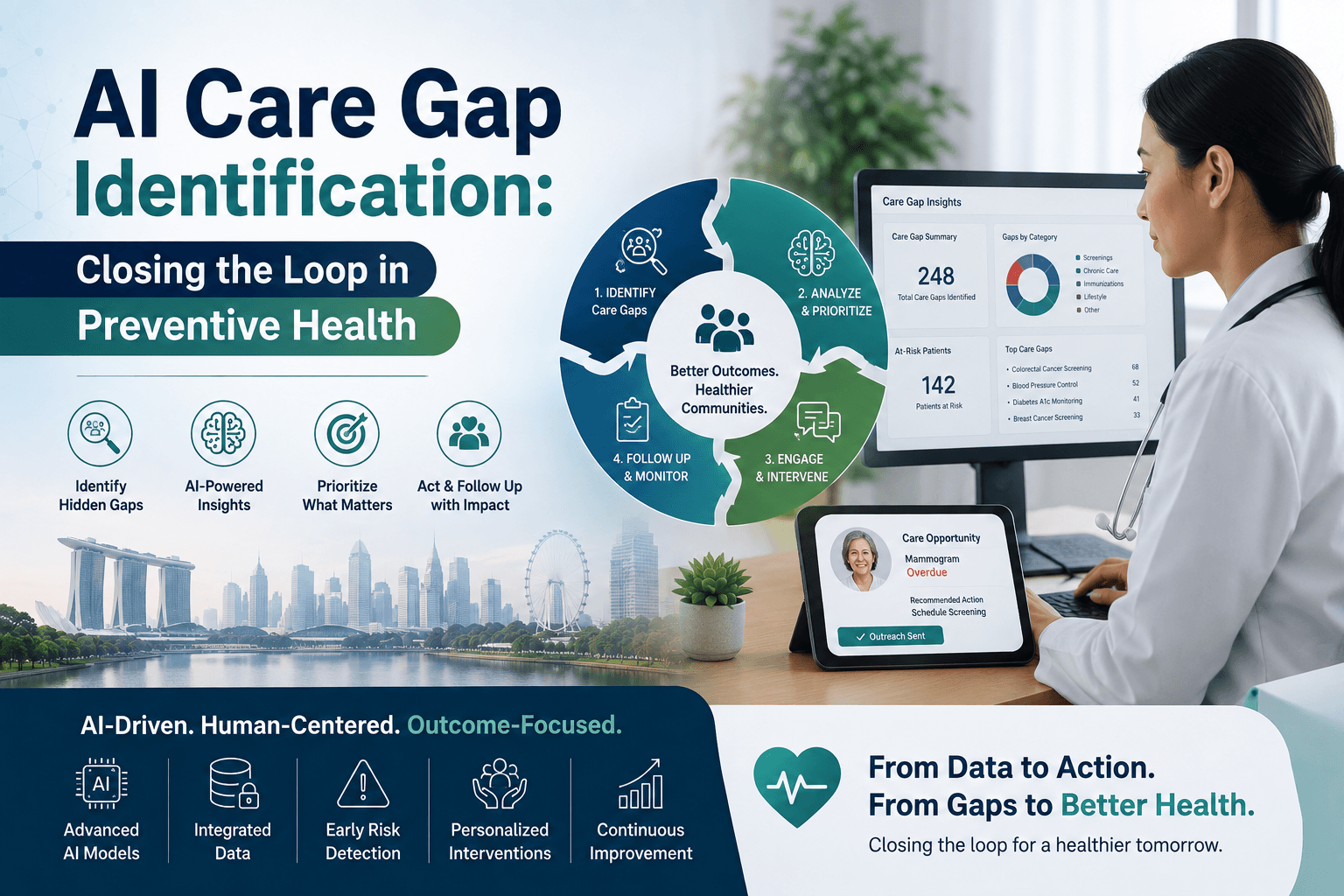
AI‑powered care gap identification uses supervised machine‑learning models trained on structured and unstructured health data. The process unfolds in four steps:
Data ingestion: The system pulls patient records—diagnoses, medications, lab results, vital signs, demographics, and previous screening dates—from electronic health records, pharmacy databases, and public health registries. In Malaysia, this could include data from the MySejahtera application and the national health information exchange.
Guideline mapping: Clinical rules (e.g., “If age ≥40, check fasting glucose every 3 years”) are encoded as logic or used to train a natural‑language model that reads guideline documents. The AI then matches each patient’s profile to the set of services they should have received.
Complementing care gap detection, AI guideline adherence monitoring tracks clinician compliance with these rules.
Risk stratification: Machine‑learning algorithms such as gradient‑boosted trees or neural networks predict the likelihood that a patient will develop a condition if the gap remains uncorrected. For cardiovascular disease, AI‑based risk models achieve up to 90% accuracy, significantly outperforming traditional Framingham risk scores (PubMed).
Gap output & prioritisation: The system generates a list of patients with specific care gaps, ordered by urgency. A patient overdue for a colonoscopy with a family history of colorectal cancer is flagged before someone who is simply late for a routine eye exam.
These AI systems can process data from tens of thousands of patients in under an hour—a task that would take a team of quality nurses weeks. The real power lies in the prioritisation, which ensures that limited clinician time is spent on the patients who stand to benefit most.
Beyond physical screenings, AI can also support mental health by identifying patients in need of timely psychological support.
For a deeper look at how these systems work in practice, see our guide on AI closing care gaps in healthcare.
Benefits of AI in Preventive Health
When deployed effectively, AI‑powered care gap closure yields measurable improvements across three domains: screening rates, chronic disease detection, and healthcare costs.
Higher Screening Completion Rates
A landmark study published in JAMA Network Open examined AI‑driven interventions in primary care clinics. The system automatically identified patients overdue for colorectal cancer, breast cancer, and cervical cancer screening, then generated personalised reminders for both patients and physicians. Over 12 months, preventive service completion rates increased by 20–30% in the intervention group compared to usual care (PubMed).
Earlier Detection of Chronic Disease
In Southeast Asia, where only 30% of adults with diabetes are diagnosed (WHO SEA), AI tools can use lab results, BMI trends, and fasting glucose readings to flag undiagnosed individuals before complications develop. A pilot programme in Thailand using an AI‑based risk algorithm increased new diabetes diagnoses by 18% within six months.
For patients already diagnosed, emerging evidence shows that diabetes reversal virtual care programs can help achieve remission.
Such tools are a core component of AI chronic disease management, which extends beyond detection to long-term care coordination.
Cost Containment and Value‑Based Care
Every dollar spent on preventive services saves an estimated $3–5 in downstream treatment costs for chronic diseases. AI amplifies this return by targeting interventions at the highest‑risk patients, avoiding the waste of broad, untargeted screening campaigns. Health systems that adopt AI care gap identification report reductions in emergency department visits and hospital readmissions within 18–24 months.
AI is only as good as the data it receives. Incomplete or biased datasets—for example, lacking data on rural populations or ethnic minorities—can produce care gap lists that miss the most vulnerable patients. Always validate AI outputs against local demographic reality.
Closing the Loop: AI Care Gap Closure Strategies
Identifying a care gap is pointless unless someone acts on it. “Closing the loop” means ensuring that the patient receives the overdue service and that the result feeds back into the system. AI can facilitate this cycle through:
- Automated patient outreach: SMS, WhatsApp, or app notifications in the patient’s preferred language, with a direct link to book an appointment. EazyCare AI’s chat assistant can also answer questions like “Do I really need this test?” using plain language.
- Clinician decision support: Pop‑up alerts in the electronic health record that display the overdue service and a one‑click order button. Studies show that such smart alerts increase order compliance by 35–50% compared to passive reminders.
- Follow‑up tracking: The AI monitors whether the service was completed. If not, it escalates the reminder—first to the patient, then to a care coordinator, and finally to a telehealth consultation.
In practice, a complete closure loop for a patient due for an HbA1c test might look like this:
| Day | Action (AI‑Driven) | Who Is Involved |
|---|---|---|
| 0 | AI identifies gap (last HbA1c >12 months) | Background algorithm |
| 1 | Patient receives WhatsApp reminder | AI chatbot |
| 7 | No booking yet; GP receives EHR alert | Clinician |
| 14 | Care coordinator calls patient | Human + AI script |
| 21 | Patient completes HbA1c at clinic | Lab |
| 22 | AI reads result, updates gap status, sends summary to patient and GP | Algorithm |
This structured approach transforms care gap identification from a static report into a dynamic, closing process—the missing piece in most existing preventive health programs.
Preventive Health AI in Southeast Asia: Unique Hurdles
Southeast Asia presents distinct obstacles that require adaptation of generic AI tools. The most critical are:
Data Fragmentation
Patients often visit multiple providers across public and private sectors, but health data remains siloed. Malaysia’s MySejahtera app stores vaccination and COVID‑19 test records, but not chronic disease data. Without a unified patient identifier, AI models cannot construct complete patient histories. Interoperability standards such as HL7 FHIR are slowly being adopted, but the gap remains wide.
Low Digital Literacy
Older adults and rural populations are less comfortable with app‑based reminders. AI systems must offer multimodal outreach—phone calls, community health worker visits, and face‑to‑face counselling—and not rely solely on digital channels.
Effective patient engagement strategies for closing care gaps in Southeast Asia address these cultural and technological barriers.
Integration with Public Health Systems
Government‑run clinics in Indonesia, the Philippines, and Vietnam use paper‑based records or basic electronic systems with no API access. For AI to work, these systems need at least minimal digitisation and data structuring. Donor‑funded projects and public‑private partnerships are beginning to address this, but progress is slow.
"Without strong digital infrastructure, AI care gap identification becomes a theoretical exercise. The region needs to invest in foundational data systems before advanced analytics can deliver."
— Dr. S. Rajaratnam, Public Health Informatics Specialist, Kuala Lumpur
For clinicians and healthcare administrators considering AI, the priority should be to start with a small, well‑defined population (e.g., patients in a single polyclinic with a mature EHR) and expand once closure loops are validated. Jumping to nationwide deployment without addressing data quality and user acceptance will lead to frustration.
Implementing AI Care Gap Identification: A Practical Guide
Based on successful deployments in Singapore, Thailand, and Malaysia, here is a five‑step framework any healthcare provider can adapt:
- Define your gap criteria. Choose 3–5 high‑impact preventive services relevant to your population (e.g., mammography for women 50–74, diabetic foot exams for type 2 diabetes). Use local clinical guidelines.
- Audit your data. Determine which digital fields capture the necessary information. If lab dates are stored only in PDF notes, you will need NLP extraction before AI can run.
- Select or build a model. Off‑the‑shelf solutions (e.g., from EazyCare AI’s clinician platform) can be configured to local guidelines. Avoid building from scratch unless you have a data science team.
- Design the closure workflow. Map out who receives each type of alert—patient, nurse, doctor—and at what frequency. Include escalation rules for non‑response.
- Monitor and iterate. Track completion rates, false positives (patients incorrectly flagged), and patient satisfaction. Adjust thresholds and communication channels quarterly.
One lesson from early adopters: do not over‑alert clinicians. If a GP receives 30 pop‑ups per patient visit, they will ignore them. Prioritise the top three gaps per patient and batch non‑urgent reminders for a weekly summary.
Frequently Asked Questions
What is a care gap in healthcare?
A care gap is the discrepancy between the recommended healthcare services a patient should receive based on clinical guidelines and the services they actually receive. Examples include missing vaccinations, overdue cancer screenings, or unfilled prescriptions for chronic conditions. Care gaps are measured at the individual and population levels to identify where preventive care is failing. EazyCare AI’s symptom checker can help you assess your personal care gaps by reviewing your screening history.
How does AI identify care gaps?
AI identifies care gaps by ingesting patient data from electronic health records, lab systems, and pharmacy claims, then applying machine‑learning algorithms to compare each patient’s care history against guideline‑based rules. The AI assigns risk scores and prioritises gaps by urgency. Some systems also use natural language processing to extract information from free‑text clinical notes. The entire analysis happens in real time across thousands of patients, something impossible to do manually.
What are the benefits of AI in preventive health?
AI increases screening completion rates by 20–30%, improves early detection of chronic diseases like diabetes and hypertension, and reduces healthcare costs by targeting preventive interventions at high‑risk individuals. It also frees clinicians from manual chart reviews, allowing them to focus on patient care. In Southeast Asia, AI can help close the region’s large diagnostic gaps—for example, by identifying the 70% of diabetic patients who are currently undiagnosed.
How can AI help close care gaps in chronic disease management?
AI can track whether patients with chronic conditions receive regular HbA1c tests, blood pressure checks, foot exams, and medication refills. It alerts both patients and clinicians when a service is overdue, and can even predict which patients are most likely to develop complications if gaps persist. By automating follow‑up, AI reduces the administrative burden on primary care teams and keeps patients on track between visits. EazyCare AI’s health assistant can remind you of your chronic care schedule.
What are the challenges of using AI for care gap identification?
Key challenges include fragmented and incomplete health data, low digital literacy among target populations, resistance from clinicians overwhelmed by alerts, and the need to integrate with legacy health IT systems. In Southeast Asia, many public clinics lack electronic health records altogether. Bias in training data can also lead to unequal identification of gaps across ethnic or socioeconomic groups. Overcoming these challenges requires phased implementation, strong governance, and community engagement.
How does AI improve preventive care in Southeast Asia?
AI addresses the region’s specific problems: low screening rates, late diagnosis of chronic diseases, and overburdened public health systems. By automatically scanning population health data, AI can identify villages or districts with high rates of undiagnosed hypertension and deploy mobile screening units. It can also personalise reminders in local languages and through channels like WhatsApp, which enjoys high penetration in Malaysia, Indonesia, and Thailand. Platforms like EazyCare AI are designed with these regional nuances in mind.
What data is needed for AI to identify care gaps?
Basic requirements include patient demographics (age, sex, location), diagnosis codes, medication lists, laboratory test dates and results, vital signs (blood pressure, BMI), and screening history (e.g., date of last Pap smear, mammogram, or colonoscopy). For advanced risk prediction, additional data such as family history, smoking status, and socioeconomic indicators improve accuracy. The data must be structured in a machine‑readable format; unstructured free text requires extra processing.
Can AI reduce healthcare costs by closing care gaps?
Yes. A systematic review found that every dollar invested in preventive health saves $3–5 in future treatment costs. AI enhances this by directing resources to the highest‑risk patients, reducing unnecessary tests for low‑risk individuals. For example, identifying and treating early‑stage diabetic eye disease through AI‑flagged screening can prevent blindness and the associated costs of disability and surgery. Health systems that implement AI care gap closure typically see a positive return on investment within two years.
What are examples of AI-powered care gap tools?
Examples include population health management platforms from vendors like Epic Healthy Planet, Cerner HealtheIntent, and IBM Watson Care Manager. Open‑source tools like OpenMRS with AI plugins are used in resource‑limited settings. For Southeast Asia, tailored solutions are emerging, such as the AI module integrated with Malaysia’s MySejahtera for vaccination reminders and chronic disease screening. EazyCare AI also provides a care gap tracker feature within its clinician interface.
How does AI support value-based care?
Value‑based care rewards providers for keeping patients healthy rather than for the volume of services delivered. AI directly supports this by identifying which preventive services are most likely to prevent costly hospitalisations. It also generates performance dashboards that show how well a clinic is closing care gaps for its patient panel, enabling targeted quality improvement. Payers and health systems increasingly require such analytics to qualify for value‑based contracts.
When to See a Doctor
While AI can flag care gaps, certain symptoms demand immediate medical attention regardless of your screening schedule. Do not wait for a reminder if you experience any of the following:
- Chest pain, pressure, or tightness – especially if accompanied by shortness of breath or nausea. Call 999 or go to the nearest emergency department.
- Sudden severe headache or vision changes – could indicate hypertensive crisis or stroke.
- Unexplained weight loss of more than 5% in 6 months – possible undiagnosed diabetes, cancer, or thyroid disorder.
- Blood in stool, urine, or chronic cough with blood – requires colonoscopy, cystoscopy, or chest imaging.
- New or worsening shortness of breath with minimal activity – could signal heart failure or COPD exacerbation.
If you are unsure whether a symptom needs urgent care, EazyCare AI’s symptom checker can guide you through a standard triage assessment and help you decide whether to see a doctor within 24 hours or call emergency services.
Reassurance: The majority of care gaps are non‑urgent and can be closed during a routine appointment. But if you have any red flag symptom, do not use AI as a substitute for immediate medical evaluation.
Conclusion
AI‑powered care gap identification is not a futuristic luxury—it is a practical, evidence‑backed solution for the preventable disease epidemic that claims 71% of lives worldwide. For Southeast Asian parents and professionals, the promise is clear: fewer missed screenings, earlier disease detection, and more efficient use of limited healthcare resources.
The three critical takeaways are:
- AI identifies care gaps faster and more accurately than manual methods, with risk‑prediction models achieving up to 90% accuracy for cardiovascular disease.
- Closing the loop is just as important as detecting gaps. Automated reminders, clinician alerts, and follow‑up tracking are essential to convert discovery into action.
- Southeast Asia faces specific challenges—data fragmentation, low digital literacy, and weak integration with public health systems—that require tailored implementation and gradual scaling.
If you are a healthcare provider or an administrator looking to adopt AI care gap identification, start with a small pilot on a single high‑impact service (e.g., mammography or HbA1c) and use the lessons to expand. Learn more at eazycare.ai or chat with our AI health assistant to see how the technology works from a patient’s perspective.