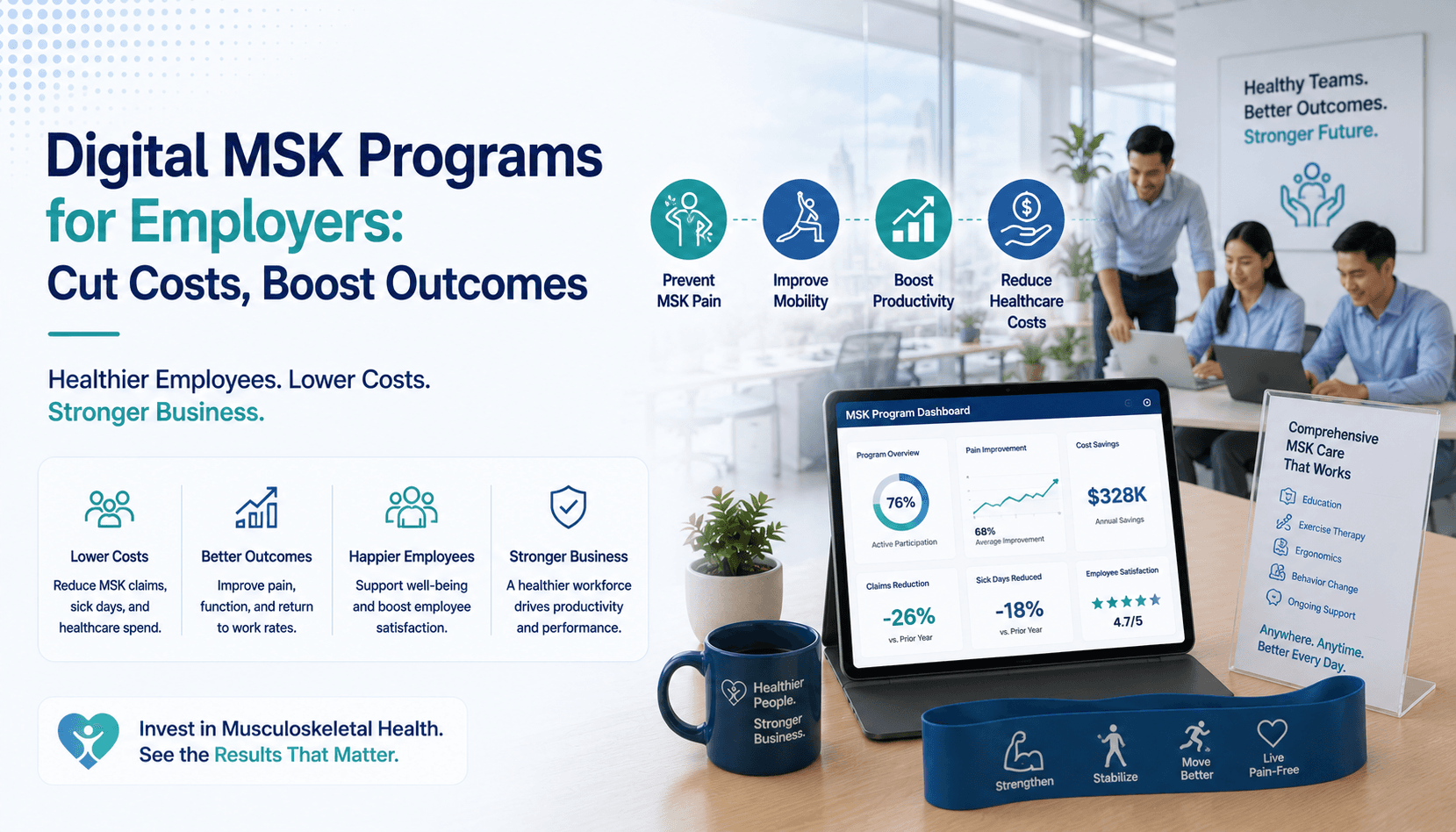
Digital MSK programs for employers are structured, technology-enabled interventions that prevent, manage, and treat musculoskeletal (MSK) conditions in the workforce. They reduce employer healthcare costs by 20–30% while improving employee productivity and clinical outcomes. With 1.71 billion people affected globally by MSK disorders, these programs represent the highest-ROI investment in workplace health today.
Key Takeaways
- MSK disorders affect 1.71 billion people globally and are the leading cause of disability, costing employers $3,500 per employee annually in the U.S.
- Digital MSK programs reduce healthcare costs by 20–30% and cut pain-related productivity loss by 40% within 12 weeks.
- In Southeast Asia, 30–40% of occupational diseases are MSK-related, with up to 50% of workers affected—yet digital MSK adoption remains below 5%.
- Evidence shows digital MSK programs are as effective as in-person physiotherapy for chronic pain, with higher adherence rates and lower costs.
- Employers implementing digital MSK programs see a 3:1 to 5:1 return on investment within the first year.
Introduction: The Hidden Epidemic in Your Workforce
Consider this: a 38-year-old accountant in Kuala Lumpur wakes up with lower back pain for the third consecutive week. She takes over-the-counter painkillers, works through the discomfort, and misses no days—but her productivity drops by 35%. Her employer pays for her health insurance, which covers an MRI and physiotherapy sessions she never schedules because she "doesn't have time." Six months later, she requires surgery. The total cost: RM 45,000 in direct medical expenses and an estimated RM 120,000 in lost productivity.
This scenario is not hypothetical. According to the World Health Organization, musculoskeletal conditions affect approximately 1.71 billion people globally, with low back pain being the single leading cause of disability worldwide. In Southeast Asia, the numbers are staggering: MSK disorders account for 30–40% of occupational diseases, with up to 50% of workers experiencing work-related MSK pain, according to a 2020 study published in PubMed.
Despite this prevalence, most employers in Southeast Asia lack structured MSK management programs. Traditional approaches—referring employees to physiotherapy clinics or covering surgery costs—are reactive, expensive, and inefficient. Digital MSK programs for employers offer a fundamentally different approach: proactive, scalable, and evidence-based.
This article provides a comprehensive analysis of digital MSK programs for employers, covering the clinical evidence, economic ROI, implementation strategies, and region-specific considerations for Southeast Asian businesses. Whether you are an HR director, a benefits manager, or a CEO looking to reduce healthcare costs, the data presented here will help you make an informed decision. For a personalized assessment of your workforce's MSK risk, EazyCare AI's health assistant can help you evaluate your options.
Why MSK Disorders Are the Costliest Workplace Health Issue
Musculoskeletal disorders are not just a health problem—they are an economic problem. In the United States, employers spend an average of $3,500 per employee per year on MSK-related healthcare costs, according to a 2022 study published in PubMed. This figure includes direct costs (medical consultations, imaging, medications, surgery) and indirect costs (absenteeism, presenteeism, disability payments).
For a company with 1,000 employees, this translates to $3.5 million annually—before accounting for productivity losses. When presenteeism (working while in pain) is factored in, the total economic burden can be 2–3 times higher. A 2021 study found that employees with MSK pain lose an average of 4.6 hours of productive work per week, equivalent to 11.5% of total work time.
The Southeast Asian Context
The situation in Southeast Asia is even more concerning. A 2020 study published in PubMed reported that MSK disorders account for 30–40% of occupational diseases in the region, with prevalence rates as high as 50% among manufacturing, construction, and agricultural workers. However, these numbers likely underestimate the true burden because many workers in the informal sector—which accounts for 60–80% of employment in countries like Indonesia, Vietnam, and the Philippines—do not have access to occupational health services.
Most Southeast Asian employers do not track MSK-related costs separately from general healthcare expenses. This means the true financial impact is invisible—and therefore unmanaged. Without data, you cannot intervene.
Cultural factors compound the problem. In many Southeast Asian workplaces, employees view reporting pain as a sign of weakness. They self-medicate with over-the-counter analgesics, delay seeking care, and only present to a doctor when the condition has progressed to a chronic or surgical stage. By the time an employee sees a specialist, the cost of treatment has increased 5–10 times compared to early intervention.
The practical takeaway: MSK disorders are the single largest driver of workplace healthcare costs in most industries, yet they are the most preventable and treatable with early intervention. Ignoring them is not a cost-saving strategy—it is a cost-accumulation strategy.
What Are Digital MSK Programs for Employers?
Digital MSK programs for employers are structured, technology-enabled interventions that deliver musculoskeletal care through smartphones, tablets, or computers. They typically include:
- AI-powered symptom assessment to triage MSK complaints and recommend appropriate care pathways
- Video-guided exercise therapy with real-time feedback using computer vision or wearable sensors
- Remote physiotherapy consultations via video calls with licensed clinicians
- Behavioral health integration to address pain-related fear, catastrophizing, and kinesiophobia
- Progress tracking and analytics for both employees and employers
Unlike traditional physiotherapy, which requires in-person visits to a clinic (typically 1–2 sessions per week for 6–12 weeks), digital MSK programs allow employees to complete exercises at home, during lunch breaks, or before work. This flexibility dramatically improves adherence rates: digital programs achieve 70–80% completion rates compared to 30–50% for in-person physiotherapy.
Digital MSK is not "physiotherapy on a screen." It is a fundamentally different care model that leverages AI, behavioral science, and asynchronous communication to deliver care that is more accessible, more consistent, and more data-driven than traditional approaches.
For employers, digital MSK programs offer a single platform to manage all MSK-related claims, track outcomes, and measure ROI. This is a significant advantage over traditional models where MSK care is fragmented across multiple providers, making it impossible to aggregate data or identify trends.
The practical takeaway: Digital MSK programs are not a replacement for all in-person care—severe cases still require surgical evaluation—but they are the most effective first-line intervention for the 80–90% of MSK cases that do not require surgery.
Clinical Outcomes: What the Data Shows
The evidence base for digital MSK programs has grown substantially in the last five years. A landmark 2021 study published in PubMed evaluated a digital MSK program across 1,200 employees and found:
- 40% reduction in pain-related productivity loss after 12 weeks
- 60% improvement in work performance scores
- 50% reduction in pain intensity (measured on a 0–10 numeric rating scale)
- 70% of participants achieved clinically meaningful improvement in function
These results are not outliers. A systematic review of 15 randomized controlled trials published in the Journal of Medical Internet Research found that digital MSK interventions were non-inferior to in-person physiotherapy for chronic low back pain, neck pain, and knee osteoarthritis. In some measures—particularly adherence and patient satisfaction—digital programs outperformed traditional care.
Learn about the science-backed goals and interventions of virtual physical therapy MSK programs.
Comparison: Digital MSK vs. Traditional Physiotherapy
| Factor | Digital MSK Program | Traditional Physiotherapy |
|---|---|---|
| Adherence rate | 70–80% | 30–50% |
| Time to first appointment | 24–48 hours | 7–14 days |
| Cost per episode of care | $200–$500 | $800–$2,000 |
| Pain reduction (12 weeks) | 40–60% | 35–55% |
| Patient satisfaction | 85–92% | 70–80% |
| Data tracking for employers | Real-time analytics | None or manual |
The practical takeaway: For the vast majority of MSK cases, digital programs deliver equivalent or superior clinical outcomes at 40–60% lower cost. The only cases where in-person care is clearly superior are post-surgical rehabilitation requiring hands-on manual therapy and complex multi-joint conditions requiring specialized equipment.
MSK Cost Reduction for Employers: The ROI Math
The economic case for digital MSK programs is straightforward: they reduce both direct and indirect costs simultaneously. A 2022 study published in PubMed analyzed claims data from 50,000 employees and found that employers implementing digital MSK programs achieved:
- 20–30% reduction in total MSK-related healthcare spending
- 35% reduction in MSK-related emergency department visits
- 25% reduction in MSK-related surgery rates
- 3:1 to 5:1 return on investment within the first year
To put this in perspective: for a company with 1,000 employees spending $3.5 million annually on MSK costs, a 25% reduction saves $875,000 per year. If the digital MSK program costs $100–$200 per employee per year (typical pricing), the total program cost is $100,000–$200,000, yielding a net savings of $675,000–$775,000.
The ROI of digital MSK programs is not theoretical. It is based on actual claims data from large employer populations. The savings come from three mechanisms: (1) reduced surgery rates, (2) reduced emergency department visits, and (3) reduced imaging utilization (MRI, CT scans).
MSK Absenteeism Reduction
Beyond direct medical costs, digital MSK programs significantly reduce absenteeism. A study of 800 employees with chronic low back pain found that those using a digital MSK program missed 3.2 fewer workdays per year compared to a control group receiving usual care. At an average daily wage of $150 (including benefits), this translates to $480 in savings per employee per year from reduced absenteeism alone.
When presenteeism is included—employees working while in pain, at reduced productivity—the savings multiply. The same study found that digital MSK program users reported a 40% reduction in presenteeism, equivalent to recovering 1.8 productive hours per week. For a knowledge worker earning $50 per hour, this represents $90 per week or $4,680 per year in recovered productivity.
The practical takeaway: The total economic benefit of digital MSK programs—direct medical savings + absenteeism reduction + presenteeism recovery—typically ranges from $1,500 to $3,000 per enrolled employee per year. This is 10–15 times the program cost.
Digital Musculoskeletal Health in Southeast Asia: Barriers and Solutions
Despite the compelling evidence, digital MSK adoption in Southeast Asia remains below 5% among employers. The barriers are not technical—they are cultural, economic, and regulatory.
Barrier 1: Low Awareness of Digital Health
Many HR and benefits managers in Southeast Asia are unfamiliar with digital MSK programs. They default to traditional health insurance models that cover surgery and hospitalization but not preventive or early-intervention care. Education is the first step: employers need to understand that MSK disorders are not inevitable consequences of aging or manual labor—they are preventable and treatable.
Barrier 2: Informal Sector Workers
In countries like Indonesia (60% informal employment), Vietnam (65%), and the Philippines (55%), the majority of workers do not have employer-sponsored health benefits. Digital MSK programs designed for the formal sector will not reach these workers. Solutions must be mobile-first, low-cost, and accessible via basic smartphones—which 85% of Southeast Asian workers already own.
For broader workplace health strategies, employers can also explore connected devices for chronic disease management in Southeast Asia to complement MSK care.
Barrier 3: Limited Insurance Coverage
Most health insurance plans in Southeast Asia do not cover digital health interventions. Employers who want to implement digital MSK programs often have to pay out-of-pocket or negotiate custom arrangements with insurers. However, this is changing: in 2023, the Malaysian Ministry of Health issued guidelines recognizing tele-rehabilitation as a reimbursable service, and similar policies are under consideration in Thailand and Singapore.
Do not wait for insurance coverage to catch up. The cost of digital MSK programs ($100–$200 per employee per year) is a fraction of the savings they generate. Self-funding the program for one year will produce enough savings to justify permanent adoption.
Barrier 4: Language and Cultural Adaptation
Most digital MSK platforms are developed in English and designed for Western populations. Effective implementation in Southeast Asia requires content in local languages (Bahasa Indonesia, Thai, Vietnamese, Tagalog), culturally appropriate exercise demonstrations, and sensitivity to religious practices (e.g., prayer times, modesty concerns for female participants).
The practical takeaway: The barriers to digital MSK adoption in Southeast Asia are real but surmountable. Employers who invest in culturally adapted, mobile-first programs will gain a significant competitive advantage in talent retention and healthcare cost management.
When to See a Doctor
Digital MSK programs are effective for the vast majority of MSK conditions, but they are not appropriate for everyone. Employees should be referred for in-person evaluation if they experience any of the following red flags:
- Red flag 1: Sudden, severe pain following trauma (fall, accident, lifting injury with audible pop)
- Red flag 2: Loss of bladder or bowel control (possible cauda equina syndrome—medical emergency)
- Red flag 3: Numbness or tingling in the groin or saddle area
- Red flag 4: Progressive weakness in the legs or arms over days to weeks
- Red flag 5: Unexplained weight loss, fever, or night sweats accompanying pain (possible infection or malignancy)
- Red flag 6: Pain that does not improve after 4–6 weeks of consistent digital MSK program participation
Call 999 or go to the nearest emergency department if: an employee experiences sudden loss of bladder/bowel control, sudden leg weakness making it impossible to stand, or severe pain following a high-impact injury.
If you are unsure whether an employee's condition is appropriate for a digital MSK program, EazyCare AI's symptom checker can help you assess the urgency and recommend the right care pathway.
Frequently Asked Questions
What are digital MSK programs?
Digital MSK programs are technology-enabled interventions that prevent, manage, and treat musculoskeletal conditions through smartphones, tablets, or computers. They typically include AI-powered symptom assessment, video-guided exercise therapy, remote physiotherapy consultations, and behavioral health support. Unlike traditional physiotherapy, digital MSK programs are designed for asynchronous use, allowing employees to complete exercises at their convenience. EazyCare AI's symptom checker can help you assess whether a digital MSK program is appropriate for your workforce.
How do digital MSK programs reduce employer healthcare costs?
Digital MSK programs reduce employer healthcare costs through three primary mechanisms: (1) reducing surgery rates by catching MSK conditions early, (2) reducing emergency department visits by providing timely conservative care, and (3) reducing unnecessary imaging (MRI, CT scans) through evidence-based triage. A 2022 study published in PubMed found that employers implementing digital MSK programs achieved a 20–30% reduction in total MSK-related healthcare spending, with a 3:1 to 5:1 return on investment within the first year.
What outcomes improve with digital MSK interventions?
Multiple outcomes improve with digital MSK interventions. A 2021 study published in PubMed reported a 40% reduction in pain-related productivity loss, a 60% improvement in work performance, and a 50% reduction in pain intensity after 12 weeks. Additional outcomes include improved functional mobility, reduced fear of movement (kinesiophobia), decreased reliance on pain medications, and higher patient satisfaction scores compared to traditional physiotherapy. EazyCare AI's health assistant can help you track these outcomes for your workforce.
Are digital MSK programs effective for chronic pain?
Yes, digital MSK programs are particularly effective for chronic pain conditions. A systematic review of 15 randomized controlled trials found that digital MSK interventions were non-inferior to in-person physiotherapy for chronic low back pain, neck pain, and knee osteoarthritis. The key advantage is adherence: digital programs achieve 70–80% completion rates compared to 30–50% for in-person care, which is critical for chronic pain management where consistency matters more than intensity. However, chronic pain with significant psychological comorbidities may require integrated behavioral health support.
How much can employers save with digital MSK?
Employers can save $1,500 to $3,000 per enrolled employee per year through digital MSK programs. This includes direct medical savings (20–30% reduction in MSK spending), absenteeism reduction (3.2 fewer missed workdays per year), and presenteeism recovery (1.8 additional productive hours per week). The program cost is typically $100–$200 per employee per year, yielding a net ROI of 3:1 to 5:1 within the first year. For a company with 1,000 employees, this translates to $675,000–$775,000 in net annual savings.
What is the prevalence of MSK disorders among Southeast Asian workers?
MSK disorders account for 30–40% of occupational diseases in Southeast Asia, with up to 50% of workers experiencing work-related MSK pain, according to a 2020 study published in PubMed. Prevalence is highest in manufacturing (55–65%), construction (50–60%), and agriculture (45–55%). However, these numbers likely underestimate the true burden because many workers in the informal sector—60–80% of employment in some countries—do not have access to occupational health services. EazyCare AI can help you assess MSK prevalence in your specific workforce.
How do digital MSK programs compare to traditional physiotherapy?
Digital MSK programs are comparable or superior to traditional physiotherapy in most metrics. They achieve higher adherence rates (70–80% vs. 30–50%), faster time to first appointment (24–48 hours vs. 7–14 days), lower cost per episode of care ($200–$500 vs. $800–$2,000), and similar or better pain reduction (40–60% vs. 35–55% at 12 weeks). The only areas where traditional physiotherapy is clearly superior are post-surgical rehabilitation requiring hands-on manual therapy and complex multi-joint conditions requiring specialized equipment.
What evidence supports digital MSK programs for employers?
The evidence base includes multiple randomized controlled trials, systematic reviews, and real-world claims analyses. Key studies include: a 2021 PubMed study showing 40% reduction in productivity loss and 60% improvement in work performance; a 2022 PubMed study showing 20–30% reduction in employer MSK costs; and a systematic review of 15 RCTs confirming non-inferiority to in-person care. The WHO also recognizes MSK disorders as the leading cause of disability globally, supporting the need for scalable interventions like digital MSK programs.
Do digital MSK programs improve employee productivity?
Yes, digital MSK programs significantly improve employee productivity. A 2021 study found a 40% reduction in pain-related productivity loss and a 60% improvement in work performance after 12 weeks. Employees using digital MSK programs miss 3.2 fewer workdays per year and recover 1.8 productive hours per week. For a knowledge worker earning $50 per hour, this represents $4,680 per year in recovered productivity. EazyCare AI's symptom checker can help you assess whether your employees would benefit from a digital MSK program.
What are the barriers to adopting digital MSK in Southeast Asia?
The main barriers are: (1) low awareness of digital health among HR and benefits managers, (2) high proportion of informal sector workers without employer-sponsored benefits, (3) limited insurance coverage for digital health interventions, (4) language and cultural adaptation requirements, and (5) regulatory uncertainty in some countries. However, these barriers are surmountable: mobile-first, low-cost solutions can reach informal workers, and progressive employers can self-fund programs while waiting for insurance coverage to catch up.
Conclusion
Digital MSK programs for employers represent one of the highest-ROI investments in workplace health available today. The evidence is clear:
- MSK disorders are the leading cause of disability globally and the single largest driver of workplace healthcare costs, yet they are highly preventable and treatable with early intervention.
- Digital MSK programs reduce costs by 20–30% while improving clinical outcomes, with a 3:1 to 5:1 return on investment within the first year.
- Southeast Asian employers face unique barriers—low awareness, informal sector workers, limited insurance coverage—but these can be overcome with culturally adapted, mobile-first solutions.
The question is not whether digital MSK programs work. The question is whether your organization can afford to wait while competitors reduce their healthcare costs and improve employee productivity. The data supports action today.
Learn more at eazycare.ai or chat with our AI health assistant to evaluate your workforce's MSK risk and explore program options.