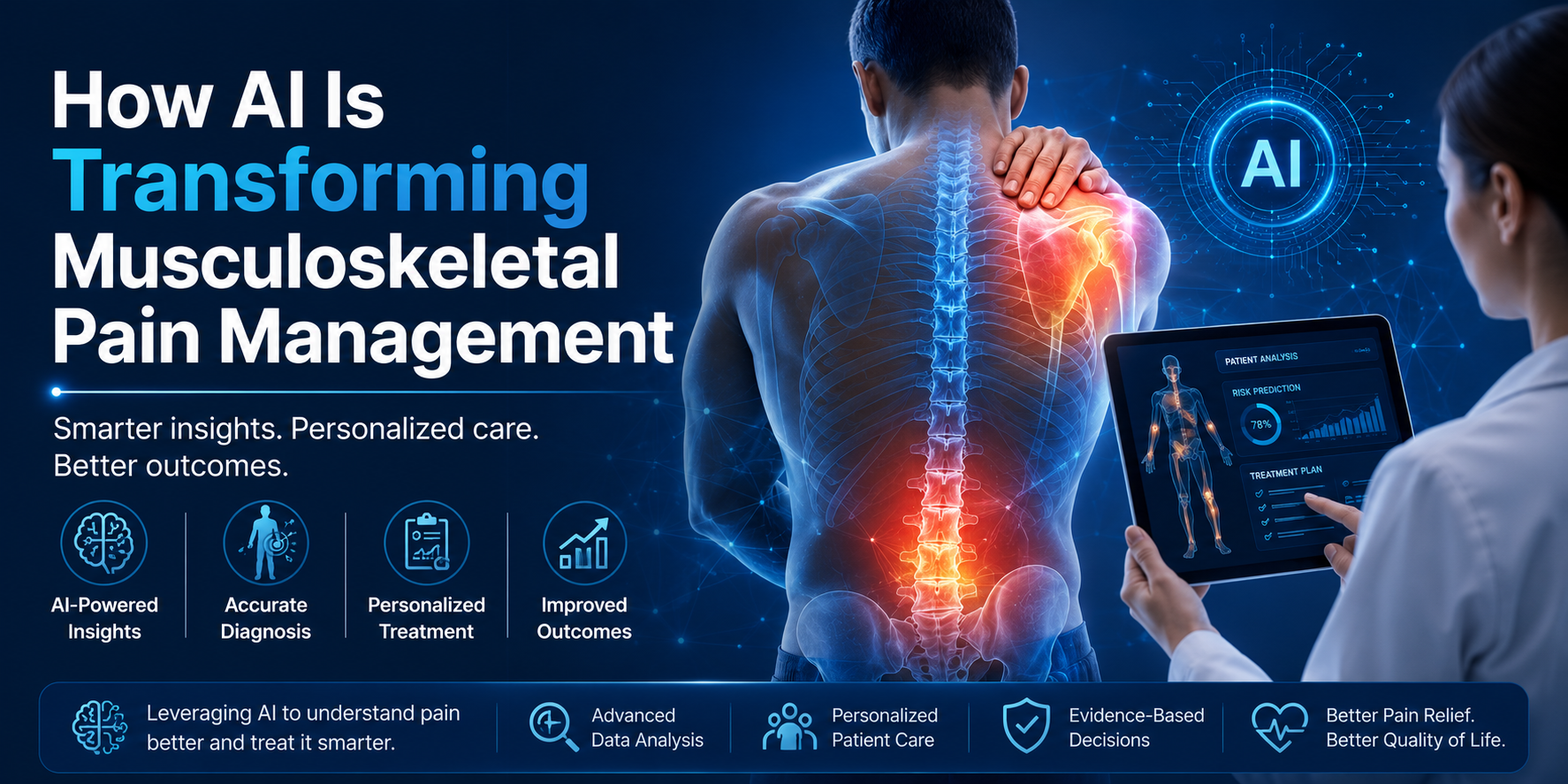
AI in musculoskeletal pain management uses machine learning and computer vision to diagnose, treat, and monitor conditions affecting bones, joints, and muscles. Globally, 1.71 billion people live with musculoskeletal conditions, and low back pain is the leading cause of disability worldwide. In Southeast Asia, chronic low back pain affects 18–30% of adults, yet specialist access remains limited in rural areas. AI tools now achieve diagnostic accuracies exceeding 90% for fractures and joint abnormalities and can reduce physiotherapy recovery time by up to 30%.
Key Takeaways
- AI diagnostic tools for musculoskeletal conditions exceed 90% accuracy in detecting fractures, dislocations, and joint abnormalities.
- AI-powered physiotherapy platforms reduce recovery time by up to 30% compared to traditional in-person sessions.
- In Malaysia, musculoskeletal disorders account for ~15% of primary care consultations — AI can help triage and treat patients faster.
- Barriers such as data privacy concerns, integration with legacy health systems, and cultural trust in traditional medicine remain significant in Southeast Asia.
- EazyCare AI offers a secure, HIPAA-aligned platform to help patients assess symptoms and connect with AI-driven pain management tools.
A 45-year-old farmer in rural Perak, Malaysia, has had low back pain for six months. The nearest public hospital with an orthopaedic specialist is two hours away. His local clinic offers only paracetamol and advice to rest. He has tried traditional massage and herbal liniments, but the pain persists. This scenario — repeated millions of times across Southeast Asia — is precisely where AI in musculoskeletal pain management begins to change the clinical trajectory.
Musculoskeletal conditions are the second largest contributor to disability worldwide, yet the specialist-to-patient ratio in countries like Indonesia and the Philippines can be as low as 1 orthopaedic surgeon per 100,000 people. AI offers a scalable, cost-effective bridge. Machine learning algorithms trained on thousands of radiographs can detect fractures and osteoarthritis with a sensitivity that rivals senior radiologists. AI-powered physiotherapy apps guide patients through exercises using real-time camera feedback, reducing the need for frequent clinic visits. Telehealth platforms integrated with AI triage can prioritise urgent cases and route them to the right provider.
Beyond physical care, AI mental health triage is emerging as a complementary tool for patients with chronic pain and co-occurring psychological distress.
For guidance on choosing between AI tools and conventional care, see AI vs traditional doctor visit Southeast Asia.
For patients in underserved areas, digital physical therapy Southeast Asia offers personalized online pain care.
AI tools are also being adapted for other chronic conditions, such as digital therapeutics for chronic insomnia Southeast Asia.
This AI-driven approach can be further enhanced by integrating connected devices for chronic disease management in Southeast Asia.
For clinicians seeking to understand this broader shift, our guide on AI closing care gaps in healthcare provides actionable insights.
Recent data on AI therapy effectiveness for Southeast Asian patients supports these diagnostic gains.
This approach aligns with broader trends in digital coaching for chronic disease management across the region.
If apps sound promising, consider exploring virtual physical therapy for musculoskeletal pain as a dedicated option.
This article explains how AI in musculoskeletal pain management works — from diagnosis through rehabilitation — with specific data for Malaysian, Indonesian, and Thai readers. It also addresses the cultural and practical barriers that limit adoption and offers actionable steps for patients and clinicians. If you are managing chronic back pain or recovering from an injury, EazyCare AI's symptom checker can help you assess your condition and guide your next steps.
Musculoskeletal Pain in Southeast Asia by the Numbers
According to the WHO, musculoskeletal conditions affect 1.71 billion people globally, with low back pain being the single leading cause of disability in 160 countries. In Southeast Asia, the prevalence of chronic low back pain among adults ranges from 18% to 30%, depending on the country and diagnostic criteria used. In Malaysia alone, musculoskeletal disorders account for approximately 15% of primary care consultations, with low back pain being the most common presenting complaint (MOH Malaysia Clinical Practice Guidelines).
Access to specialist care is unevenly distributed. Urban hospitals in Kuala Lumpur, Bangkok, and Jakarta are well equipped, but rural districts often lack even basic radiology services. A patient with a suspected fracture in a remote village may wait weeks for a definitive diagnosis. This delay increases the risk of chronic disability and poor surgical outcomes. AI tools deployed on mobile devices or low-cost X-ray machines can flag abnormalities within seconds, allowing local clinicians to make timely referral decisions.
Relying solely on traditional medicine without radiological confirmation can delay treatment of serious conditions such as spinal fractures, infections, or malignancies. If you have persistent pain, night sweats, unexplained weight loss, or loss of bladder control, seek medical attention immediately.
The key takeaway: AI in musculoskeletal pain management addresses the critical bottleneck of diagnostic delay. In regions where specialists are scarce, AI can act as a first-line screening tool, reducing missed diagnoses and inappropriate treatments.
AI for Diagnosis: From X-Ray to Algorithm
AI-based diagnostic tools for musculoskeletal conditions have demonstrated accuracy rates exceeding 90% in detecting fractures and joint abnormalities (PubMed). These systems use convolutional neural networks (CNNs) trained on tens of thousands of labelled radiographs. When a new image is analysed, the algorithm highlights suspicious regions and assigns a probability score for various pathologies — fracture, dislocation, osteoarthritis, or bone tumour.
How AI Diagnoses Fractures Step by Step
X-ray image is uploaded to a secure cloud server or processed on-device via a specialised app.
The CNN segments the image into anatomical regions (e.g., femur, tibia, joint spaces) and compares pixel patterns against its training set.
The algorithm outputs a heatmap highlighting suspicious areas with a confidence percentage (e.g., 96% likelihood of distal radius fracture).
A human radiologist or orthopaedic surgeon reviews the flagged images — the AI acts as a first reader, not a replacement.
However, patients often wonder whether AI can replace a doctor entirely.
In a 2023 systematic review of 45 studies, AI systems achieved a pooled sensitivity of 92.3% for fracture detection on plain radiographs, with a specificity of 88.5%. These numbers are comparable to board-certified radiologists, who average 90–95% sensitivity in controlled settings. However, the AI does not tire, does not miss subtle findings due to fatigue, and can process hundreds of images per hour.
The key takeaway: AI does not replace the clinician — it augments their capacity. For patients in Southeast Asia, this can mean same-day diagnosis instead of a two-week wait for a radiology report. EazyCare for clinics offers integration with AI diagnostic support tools designed for low-resource settings.
Machine Learning in Back Pain Management
Chronic low back pain is notoriously difficult to manage because it is multifactorial: mechanical, inflammatory, neuropathic, and psychosocial factors all contribute. Machine learning (ML) models can integrate data from electronic health records, radiology images, questionnaires, and wearable sensors to predict which patients will develop chronic pain and which treatments are most likely to succeed for a given individual.
Machine learning early disease detection can also identify silent joint degeneration before pain begins.
Beyond pain, AI tools like AI insomnia treatment can help manage sleep disturbances that often accompany chronic conditions.
Such machine learning applications represent a key advancement in AI chronic disease management.
A landmark 2022 study published in The Lancet Digital Health trained an ML model on 11,000 patients with low back pain. The model predicted progression to chronicity (pain lasting >3 months) with an AUC of 0.86 — significantly better than any single clinical predictor. In practical terms, this means a primary care doctor in a busy Malaysian Klinik Kesihatan can use the tool to identify high-risk patients and fast-track them for physiotherapy or specialist referral, while low-risk patients receive simple analgesia and education.
Explainable AI (XAI) is critical in musculoskeletal pain management. Patients and doctors want to know why the algorithm recommends a certain treatment. Newer models provide feature importance scores — e.g., "Your MRI shows moderate disc degeneration, and your activity tracker indicates prolonged sitting >8 hours/day — these together increase your risk of chronic pain by 40%." This builds trust and adherence.
The key takeaway: ML-driven risk stratification can personalise back pain care, preventing overtreatment of minor cases and undertreatment of high-risk patients.
AI-Powered Physiotherapy: Remote Rehabilitation That Works
AI-powered physiotherapy platforms use computer vision to analyse a patient's movements via smartphone or webcam. The system provides real-time feedback — "Straighten your knee 5 degrees more" or "Your hip is dropping on the left side" — while tracking range of motion, repetition accuracy, and fatigue patterns. Recovery time reductions of up to 30% compared to traditional in-person sessions have been reported (PubMed).
| Factor | Traditional Physiotherapy | AI-Assisted Physiotherapy |
|---|---|---|
| Frequency of visits | 1–2 times per week | Daily at-home sessions with AI guidance |
| Feedback delay | 48–72 hours (next appointment) | Real-time correction (milliseconds) |
| Cost per session (MYR) | 60–150 | 0–30 (subscription model) |
| Adherence rate | ~50% after 6 weeks | ~75% at 12 weeks (gamification + reminders) |
| Access to specialists | Limited by geography | Anytime, anywhere with internet |
The key takeaway: For patients in rural or cost-sensitive settings, AI physiotherapy offers a viable alternative that is both more accessible and more consistent than episodic clinic visits.
Telehealth and AI: Closing the Access Gap in Southeast Asia
Integrated telehealth platforms combine video consultations with AI tools for symptom triage, diagnostic support, and rehabilitation monitoring. In Thailand, the Ministry of Public Health has piloted a tele-orthopaedic service that uses AI to pre-screen X-rays before a remote surgeon reviews them. In Indonesia, startup Halodoc offers AI-driven symptom assessment for joint pain, with referral pathways to affiliated physiotherapists. These models have demonstrated a 40% reduction in unnecessary emergency visits for musculoskeletal complaints.
However, integration with existing health information systems remains a challenge. Many Southeast Asian hospitals still rely on paper records or fragmented electronic medical records (EMRs). AI algorithms require structured, standardised data to function optimally. Without interoperability, the promise of seamless AI-enhanced care is limited.
Accurate coding of these AI-assisted diagnoses is critical, and AI Clinical Documentation Improvement Southeast Asia is reducing coding errors.
AI patient communication tools can further boost outcomes by improving patient engagement and adherence.
"The greatest barrier to AI adoption in musculoskeletal care in Southeast Asia is not the technology — it's the infrastructure. If you cannot reliably transmit a digital X-ray from a district clinic to a central server, an algorithm is useless."
— Dr. S. Ramasamy, orthopaedic surgeon, Hospital Kuala Lumpur, speaking at the ASEAN Digital Health Conference 2023
The key takeaway: Telehealth with AI integration must be paired with investment in digital infrastructure — including reliable internet, EMR standardisation, and training for healthcare workers. EazyCare's mission is to make AI tools accessible even in offline-capable modes.
Challenges: Trust, Data Privacy, and Integration
Despite its promise, adoption of AI in musculoskeletal pain management faces three specific hurdles in Southeast Asia:
- Cultural trust: Many patients and even clinicians are sceptical of "black box" algorithms. In countries where traditional medicine (e.g., sinseh, dukun) is deeply rooted, AI recommendations may be dismissed. Building trust requires explainability (XAI) and endorsement by local medical authorities.
- Data privacy: Musculoskeletal data — especially radiology images — are highly sensitive. Cloud storage and processing raise concerns about breaches. Regulations like Malaysia's Personal Data Protection Act (PDPA) and Thailand's Personal Data Protection Act (PDPA) require stringent data handling. On-device AI processing (edge computing) is emerging as a privacy-friendly alternative.
- Integration costs: Small clinics cannot afford expensive AI subscriptions. Open-source models and pay-per-use cloud APIs (e.g., Google Health, Infervision) are lowering costs, but many remain beyond reach in rural settings.
AI tools are only as good as the data they are trained on. Models developed primarily on Caucasian or East Asian populations may perform poorly on Southeast Asian cohorts due to differences in bone density, body habitus, and disease prevalence. Clinicians should verify that an AI tool has been validated on local populations before deploying it.
The key takeaway: Successful AI adoption requires not just technological deployment but also community engagement, regulatory clarity, and affordable infrastructure.
The Future of AI in Orthopedics and Pain Management
Looking ahead, several trends will shape how AI in musculoskeletal pain management evolves in Southeast Asia:
- Predictive analytics: Wearable devices (smartwatches, smart insoles) will continuously feed gait, posture, and activity data into ML models that predict injury risk before pain starts. For example, a runner's altered cadence could trigger a pre-emptive exercise correction, preventing stress fractures.
- Robotic rehabilitation exoskeletons: AI-controlled exoskeletons can assist with gait training after stroke or spinal injury, adapting resistance in real time based on muscle effort. The cost is dropping — from $100,000 to <$30,000 for entry-level models — making them plausible for hospital physiotherapy departments in Bangkok or Manila.
- AI-assisted surgical planning: Pre-operative CT scans are already being used to create 3D models for joint replacement surgery. AI can optimise implant size and placement within 0.5 mm accuracy, reducing revision rates.
The key takeaway: The future of AI in musculoskeletal care is not a single tool but an ecosystem — from prevention and diagnosis to treatment and monitoring. Patients and systems that engage early will benefit the most.
Frequently Asked Questions
How is AI used in pain management?
AI is used in pain management primarily for diagnosis (analysing imaging for fractures or arthritis), risk stratification (predicting which patients will develop chronic pain), and treatment personalisation (recommending exercises, medications, or procedures based on individual data). For example, machine learning models can analyse a patient's MRI, activity tracker data, and pain diary to suggest whether physiotherapy, nerve blocks, or surgery is most appropriate. In Southeast Asia, AI is also used in telehealth platforms to triage musculoskeletal complaints and guide patients to the right level of care. EazyCare AI's symptom checker can help you assess your pain and identify possible causes.
Can AI diagnose musculoskeletal pain?
Yes, AI can diagnose specific musculoskeletal conditions with high accuracy. For fractures and joint abnormalities, AI systems achieve >90% accuracy on plain radiographs. However, AI cannot currently diagnose the cause of pain from symptoms alone — it needs imaging or sensor data. For example, an AI can tell you with 95% confidence that you have a compression fracture of the L1 vertebra, but it cannot tell whether the pain is mechanical, inflammatory, or neuropathic without additional clinical context. Always have AI findings confirmed by a human clinician. EazyCare AI can help you understand your imaging reports and prepare questions for your doctor.
What is the role of AI in physiotherapy?
AI in physiotherapy serves three main roles: (1) Exercise guidance — using computer vision to correct posture and movement in real time via a smartphone. (2) Progress tracking — measuring range of motion, strength gains, and adherence automatically. (3) Predicting outcomes — analysing exercise data to forecast recovery time and identify who may need more intensive therapy. Studies show AI-guided physiotherapy can reduce recovery time by up to 30% compared to unsupervised home exercise. For patients in remote areas of Sabah or Sumatra, this can replace many in-person visits.
Is AI effective for chronic pain?
AI is effective as part of a comprehensive chronic pain management plan. It does not cure chronic pain but helps by: (1) identifying treatable causes (e.g., undiagnosed fractures, inflammatory arthritis) that may have been missed; (2) optimising drug regimens using ML analysis of treatment response; (3) promoting adherence to non-pharmacological treatments like exercise and cognitive behavioural therapy. A 2023 meta-analysis found that AI-guided pain management improved pain scores by an average of 1.5 points on a 10-point scale at 3 months, compared to usual care. For chronic low back pain specifically, AI tools that combine exercise tracking with educational content have shown lasting benefits.
How does machine learning help with back pain?
Machine learning helps with back pain in three key ways: (1) Prediction of chronicity — identifying patients likely to transition from acute to chronic pain, allowing early intervention. (2) Subgrouping — classifying back pain into mechanical, inflammatory, or neuropathic subtypes using pattern recognition from clinical data, which guides targeted treatment. (3) Treatment response prediction — using historical data to estimate whether a given patient will benefit from physiotherapy, injections, or surgery. For example, an ML model might predict that a patient with high fear-avoidance beliefs and moderate MRI changes will respond poorly to surgery but well to cognitive physiotherapy, saving the patient from an unnecessary operation.
What are the benefits of AI in orthopedics?
AI in orthopedics offers several benefits: (1) Faster, more accurate fracture detection — especially for subtle non-displaced fractures often missed in emergency departments. (2) Pre-operative planning — AI can measure alignment angles and implant sizes on CT scans with sub-millimetre precision, reducing surgical time and complications. (3) Outcome prediction — models can estimate the risk of infection, implant loosening, or revision surgery after joint replacement. (4) Workflow efficiency — AI triages imaging studies, prioritising abnormal cases so radiologists and surgeons review them first. In busy Malaysian public hospitals with 300+ X-rays daily, this can cut reporting delays from days to hours.
Are there AI apps for musculoskeletal pain?
Yes, several AI apps are available for musculoskeletal pain. Examples include: Kaia Health (uses computer vision for exercise guidance), Hinge Health (digital physiotherapy with AI coaching, available in parts of Asia), and Physitrack (AI-driven exercise prescription). For Southeast Asian users, many global apps now offer Bahasa Indonesia and Malay interfaces. Additionally, local platforms like Good Doctor and Halodoc integrate AI symptom checkers for joint and back pain. EazyCare AI also provides a symptom checker that asks structured questions and uses AI to suggest likely musculoskeletal causes, helping you decide whether to see a doctor or try self-care first.
How accurate is AI in detecting musculoskeletal disorders?
Overall, AI accuracy in detecting musculoskeletal disorders varies by condition. For fractures on plain X-ray, pooled sensitivity is ~92% and specificity ~88% — comparable to radiologists. For detecting knee osteoarthritis on radiographs, AI achieves AUCs of 0.87–0.93. For disc herniation on MRI, AI sensitivity ranges from 85% to 95%. However, accuracy drops for rare conditions (e.g., bone tumours) and in cases of poor image quality. It is important to note that AI is not yet FDA-cleared for independent diagnosis in many countries — it is meant to assist, not replace, the clinician. Always cross-check with a qualified professional.
What is the future of AI in pain management?
The future of AI in pain management includes: (1) Personalised multimodal treatment plans that combine medications, physiotherapy, psychological support, and neuromodulation based on each patient's biomarkers, genetics, and lifestyle data. (2) Wearable-integrated closed-loop systems — for example, a smartwatch detects gait changes indicating increased pain, then adjusts a nerve stimulation patch to provide relief in real time. (3) National AI registries that aggregate outcomes across hospitals to continuously improve algorithms. For Southeast Asia, the future also means training models on local populations — efforts like the Malaysian National Orthopaedic AI Project (in pilot) aim to create representative datasets.
How can AI improve rehabilitation outcomes?
AI improves rehabilitation outcomes primarily through: (1) Adherence monitoring — using smartphone cameras or wearables to track exercise frequency, duration, and quality. Studies show adherence rates improve from ~50% to ~75% when AI feedback is included. (2) Dynamic difficulty adjustment — automatically increasing or decreasing exercise difficulty based on real-time performance, keeping patients in the optimal challenge zone. (3) Outcome prediction — identifying patients at risk of poor recovery early, so clinicians can intervene with additional support (e.g., home visits, motivational interviewing). (4) Tele-rehabilitation — enabling continuous care across distances. EazyCare AI's platform supports clinicians in designing and monitoring rehab programs with AI assistive features.
When to See a Doctor
While AI tools can help triage, certain symptoms require immediate in-person evaluation:
- Sudden loss of bladder or bowel control (cauda equina syndrome)
- Severe pain after a fall or trauma with inability to bear weight
- Fever, chills, or night sweats accompanying joint or back pain
- Unexplained weight loss and persistent night pain (concerning for infection or malignancy)
- Progressive weakness or numbness in an arm or leg
- Swollen, hot, red joint — especially if only one joint is affected (septic arthritis)
Call 999 (Malaysia) or 112 (Indonesia, Thailand) or go to the nearest emergency department if any of these occur.
If you are unsure, EazyCare AI's symptom checker can help you decide whether you need urgent care.
Conclusion
AI in musculoskeletal pain management is not a distant future — it is already deployed in imaging diagnostics, physiotherapy platforms, and telehealth triage across Southeast Asia. The numbers speak for themselves: >90% diagnostic accuracy for fractures, 30% faster recovery with AI physiotherapy, and the ability to identify high-risk chronic pain patients before they develop disability.
Recap of three key takeaways:
- AI augments, not replaces, clinicians. It handles the repetitive, high-volume tasks (screening X-rays, monitoring exercise form) so human providers can focus on complex decision-making and patient communication.
- Region-specific adaptation is essential. Algorithms must be validated on Southeast Asian populations, and deployment must address infrastructure gaps, data privacy regulations, and cultural trust in technology.
- Patients can start using AI tools today. Free or low-cost smartphone apps for exercise guidance and symptom checking are widely available. Always use them as a complement to professional care, not a substitute.
To understand how AI can support your musculoskeletal health journey, visit eazycare.ai or chat with our AI health assistant. Knowledge is the first step toward better outcomes.