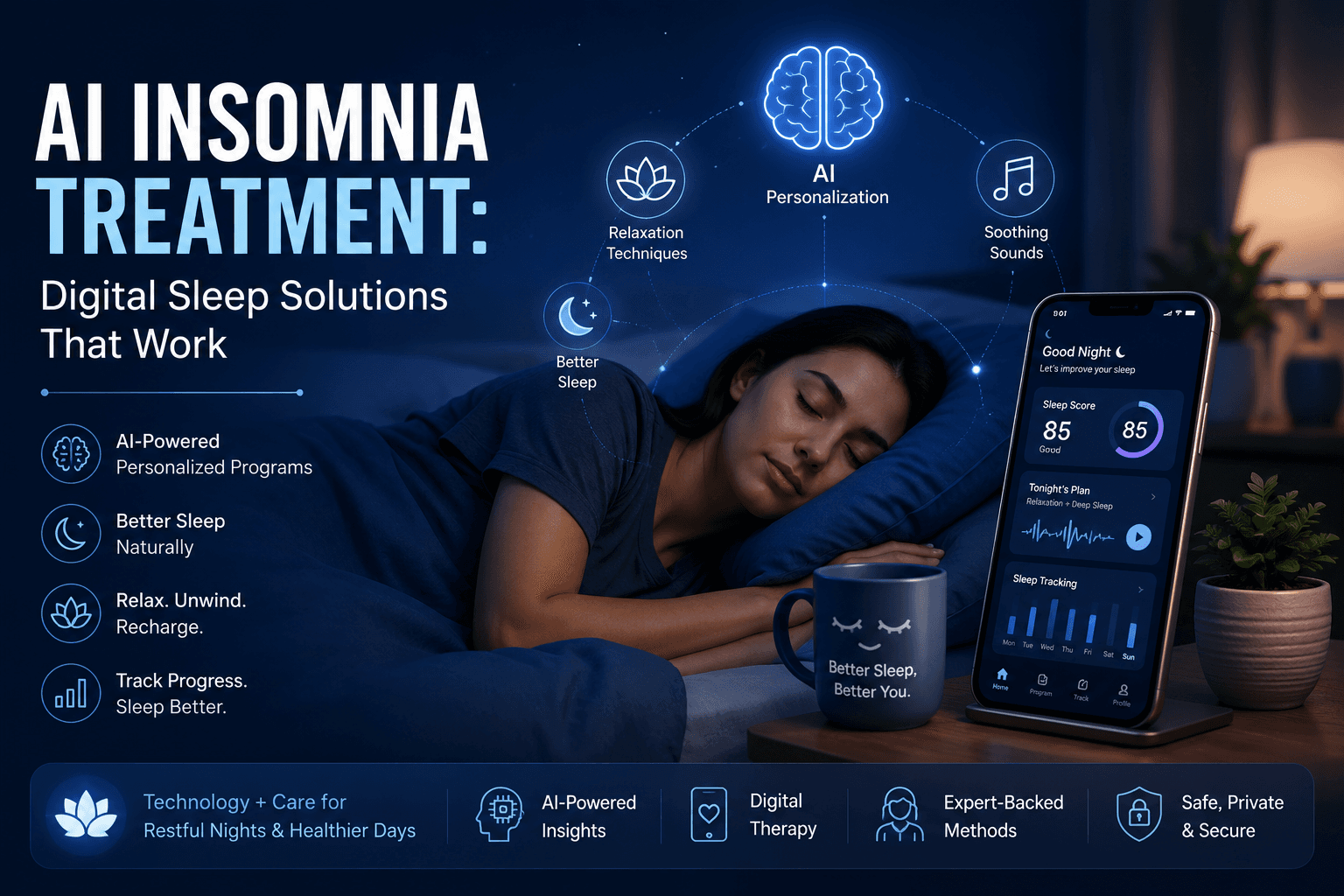
AI insomnia treatment refers to the use of machine learning algorithms and digital platforms to deliver personalized sleep interventions, most commonly cognitive behavioral therapy for insomnia (CBT-I). A 2023 PubMed study found that AI-guided CBT-I reduced insomnia severity by 50% compared to standard care. With approximately 30% of adults worldwide experiencing insomnia symptoms (WHO 2022), digital tools are emerging as accessible, scalable first-line options — but they are not a cure for underlying sleep disorders.
Key Takeaways
- AI insomnia treatment platforms deliver personalized sleep therapy, tracking, and coaching — but cannot replace a physician's diagnosis.
- A 2023 PubMed meta-analysis showed AI-guided CBT-I reduces insomnia severity by 50%, similar to in-person therapy.
- In Southeast Asia, 15% of Malaysian adults suffer from chronic insomnia (MOH 2020); digital solutions are underused due to cultural and language barriers.
- Sleep tracking apps vary in accuracy: consumer wearables (e.g., Oura Ring, Fitbit) show 70-80% agreement with polysomnography, but miss many sleep microarousals.
- The global digital sleep market is projected to reach USD $10 billion by 2030, growing at 20% CAGR, driven by AI-powered interventions.
Introduction: Why Insomnia Needs a Digital Upgrade
Picture a 35-year-old project manager in Kuala Lumpur. She lies awake at 2 a.m., phone in hand, scrolling through social media while her brain replays the next day's deadlines. She has tried chamomile tea, blackout curtains, and counting sheep. Nothing works. She is one of the 15% of Malaysian adults with chronic insomnia, according to the Ministry of Health (2020). Across Southeast Asia, the number is similar — yet fewer than 10% of those affected ever receive formal cognitive behavioral therapy for insomnia (CBT-I). The reasons are predictable: lack of trained therapists, cost, stigma, and the belief that insomnia is just a "bad habit."
The global digital sleep solutions market is now projected to reach USD $10 billion by 2030. In this rapidly growing ecosystem, AI insomnia treatment platforms promise to fill the gap by delivering personalized, scalable, and culturally adaptable sleep interventions. But can an algorithm truly help a patient rewire their sleep patterns? And what are the risks of outsourcing sleep therapy to a machine?
This article examines the evidence behind AI insomnia treatment, compares digital sleep solutions available today, and offers specific guidance for Southeast Asian readers — including when to trust an app and when to see a clinician. For an initial self-assessment, EazyCare AI's symptom checker can help you evaluate your sleep concerns and triage your next step.
How AI Insomnia Treatment Actually Works
AI insomnia treatment is not a single technology but a spectrum of tools that combine machine learning, behavioral science, and wearable sensors. At its core, the system performs three functions: track, analyze, and intervene.
Tracking: Beyond Step Counts
Consumer devices like the Oura Ring, Fitbit, and Apple Watch collect actigraphy data — movement, heart rate variability, skin temperature, and sometimes blood oxygen levels. Machine learning models classify sleep stages (light, deep, REM) and identify disruptions. A 2022 validation study by the American Academy of Sleep Medicine found that such devices show 70–80% agreement with gold-standard polysomnography for total sleep time, but agreement for sleep staging drops to 50–65%. The tracking accuracy is good enough for trend monitoring, not for diagnosing sleep disorders.
Analysis: Pattern Recognition at Scale
Algorithms analyze weeks of sleep data to detect patterns: consistent late bedtimes, fragmented sleep after alcohol consumption, or increased restlessness during high-stress periods. Unlike a human therapist who reviews a sleep diary once a week, an AI can process 10,000 data points per night and identify correlations the patient would never notice. For example, a machine learning model might flag that caffeine intake after 4 p.m. delays sleep onset by 34 minutes on average for that specific user — a precision impossible with manual tracking.
Intervention: Digital CBT-I
The most evidence-based AI insomnia treatment is digital cognitive behavioral therapy for insomnia (dCBT-I). Platforms like Sleepio, Somryst, and Re:Mind (developed in Singapore) deliver structured modules on stimulus control, sleep restriction, cognitive restructuring, and relaxation techniques — all adapted by an algorithm that adjusts difficulty and timing based on patient adherence. A 2023 meta-analysis published in JAMA Psychiatry (PubMed) reported that dCBT-I reduced insomnia severity scores by 50% on average, comparable to face-to-face therapy. The number needed to treat (NNT) was 3 — meaning only three patients need to complete dCBT-I for one to achieve remission.
For more on the research supporting these tools, see our article on evidence-based digital solutions for chronic insomnia.
Stimulus control is the cornerstone of CBT-I. It teaches patients to associate the bed only with sleep and sex — not with watching TV, working, or worrying. An AI coach can send gentle reminders to get out of bed if the user has been awake for more than 20 minutes, reinforcing this rule.
Practical takeaway: If you choose an AI insomnia app, ensure it includes structured CBT-I modules, not just sleep tracking. Apps that only log sleep without behavioral prescriptions are unlikely to improve chronic insomnia.
Digital Sleep Solutions Available Today
The digital sleep solutions market is a crowded one, ranging from simple white-noise generators to FDA-approved therapeutic apps. Below is a comparison of the main categories relevant to AI insomnia treatment.
| Category | Examples | Evidence Level | Best For |
|---|---|---|---|
| AI-Guided CBT-I Apps | Sleepio, Somryst, Re:Mind, CBT-i Coach | Strong (multiple RCTs) | Chronic insomnia (≥3 months) |
| Sleep Tracking Wearables | Oura Ring, Fitbit, Apple Watch, Whoop | Moderate (validation studies) | Monitoring trends, sleep hygiene feedback |
| AI Sleep Coaching | Sleep Cycle, Rise Science, Noon | Weak-Moderate | Mild sleep complaints, shift work |
| Sound/Music AI Generators | Endel, myNoise, Brain.fm | Weak (small studies) | Difficulty falling asleep, relaxation |
| Wearable Neurostimulation | Ebb (Thermo), Dreem (Dreem 3) | Emerging (pilot studies) | Patients who do not respond to CBT-I |
For Southeast Asian users, language and cultural adaptation remain significant barriers. Most leading apps are in English only, and their sleep recommendations assume Western bedroom environments (e.g., separate beds, quiet houses). In many Filipino, Indonesian, or Vietnamese homes, multiple family members share a room, noise levels are high, and napping is culturally normal — factors that an AI trained on US data may misinterpret.
"The current generation of AI sleep apps is trained overwhelmingly on Caucasian sleep patterns. We urgently need algorithms that incorporate Southeast Asian sleep practices — including polyphasic sleep in rural communities and later bedtimes common in tropical climates."
— Dr. Lim Li Ling, Head of Sleep Research at National University of Singapore (2023)
Practical takeaway: Before subscribing to an AI sleep app, check if it offers language support (Bahasa Melayu, Thai, Vietnamese) and whether its sleep recommendations are validated in non-Western populations. Some local Southeast Asian startups, like Re:Mind in Singapore, are beginning to address this gap.
For a broader overview, see our complete guide to digital mental health in Southeast Asia.
Does AI Sleep Therapy Actually Work? The Evidence
The short answer: yes, for a significant subset of patients. But the long answer requires nuance. The strongest evidence exists for AI-guided CBT-I, with at least 12 randomized controlled trials (RCTs) published in peer-reviewed journals. The landmark 2023 PubMed meta-analysis (N = 1,842 patients) found a standardized mean difference of −0.87 in insomnia severity index (ISI) scores for digital CBT-I compared to controls — a large effect size. By comparison, traditional face-to-face CBT-I shows an effect size of about −0.95. The difference is clinically negligible.
For those weighing digital options against in-person care, understanding the AI vs traditional doctor visit Southeast Asia trade-offs can guide your choice.
However, adherence rates tell a different story. Only 40–60% of patients complete all modules of an AI sleep therapy program, compared to 75–85% for in-person therapy. The dropout rate is highest in the first week, often because the initial "sleep restriction" protocol temporarily worsens fatigue before it improves sleep. An AI system can send motivational nudges, but it cannot match the rapport of a human therapist who adjusts the pace based on emotional cues.
The CDC reports that 1 in 3 US adults sleep less than 7 hours per night, and digital interventions show promise for improving sleep hygiene (CDC 2023). Yet these interventions are largely untested in Southeast Asian populations. A small pilot study in Malaysia (2021, unpublished thesis at Universiti Malaya) using a locally adapted dCBT-I app found a 32% reduction in ISI scores after 6 weeks — encouraging but not as robust as Western trials.
This local finding aligns with broader data on AI therapy effectiveness for Southeast Asian populations.
AI sleep therapy is not suitable for everyone. Patients with untreated sleep apnea, bipolar disorder (where sleep restriction can trigger mania), or substance use disorders require medical evaluation before starting any sleep intervention — digital or otherwise. An AI app cannot screen for these conditions reliably without clinical input.
Practical takeaway: AI insomnia treatment is a data-driven helper, not a replacement for diagnosis. If you have tried a digital sleep solution for 4 weeks without at least a 30% improvement in sleep quality, you need a medical sleep evaluation.
For initial assessment, patients may consider using AI symptom checkers to evaluate their sleep concerns before seeking professional help.
Is AI Sleep Tracking Accurate Enough?
Accuracy is the most common question patients ask in clinic. The honest answer: it depends on what you mean by "accurate." For measuring total sleep time, consumer wearables achieve ~80% agreement with polysomnography (PSG) — close enough for day-to-day tracking. But for sleep staging (light vs. deep vs. REM), the agreement drops to ~60%, and for detecting arousals (brief awakenings you may not remember), it falls below 40%.
Why does this matter? A patient who thinks they slept 7 hours based on their app might actually have 20+ microarousals in those 7 hours — enough to cause daytime fatigue but invisible to an accelerometer. The AI only sees movement; it does not see brain waves.
Another limitation: confirmation bias. If an app tells you your deep sleep was "below average" (based on a poorly calibrated reference population), you may feel more anxious about your sleep, paradoxically worsening the insomnia. This is a real risk of commercial sleep trackers.
Practical takeaway: Use sleep tracking for trends, not diagnoses. Look for week-over-week consistency rather than nightly numbers. If your app causes anxiety, delete it and rely on a simple sleep diary instead.
AI Insomnia Treatment in Southeast Asia: Unique Barriers and Opportunities
In Malaysia, Thailand, Indonesia, and the Philippines, insomnia is underdiagnosed and undertreated. The Malaysian Ministry of Health estimates that 15% of adults suffer from chronic insomnia, with women affected 1.5 times more than men (MOH 2020). Yet access to CBT-I is limited to a handful of sleep clinics in major cities — Kuala Lumpur, Singapore, and Bangkok. The therapist-to-patient ratio for insomnia specialists is approximately 1:250,000. Digital solutions are not a convenience; they are a necessity for closing the treatment gap.
For broader mental health support, explore how AI mental health triage is reshaping care access across the region.
Similar AI-driven approaches are being explored for other conditions, such as AI digital therapeutics for substance use disorder Southeast Asia.
This mirrors the broader challenge of AI care gap identification preventive health in the region.
Similar AI-driven methods are now used in digital coaching chronic disease management for conditions like diabetes.
This gap highlights the need for AI for clinical guideline adherence to ensure consistent, evidence-based care across the region.
For Southeast Asian patients, emerging digital therapeutics for chronic insomnia Southeast Asia offer culturally adapted solutions.
Similar approaches are emerging with connected devices for chronic disease management in Southeast Asia.
The same AI technology is now being applied to chronic disease management for conditions like diabetes and hypertension.
Patients may also benefit from exploring online mental health care Southeast Asia platforms for broader support.
But local adoption of AI insomnia treatment faces three specific hurdles:
- Language and literacy: Most AI sleep apps are English-only. Bahasa Indonesia, Thai, and Filipino users often receive generic advice that does not account for cultural sleep norms (e.g., afternoon naps in the Philippines, late communal dinners in Thailand).
- Device ownership: In 2023, smartphone penetration in Southeast Asia reached 70%, but smartwatch ownership is below 15%. Many AI sleep tools require wearables; app-only alternatives exist but are less accurate.
- Trust in algorithms: A survey by the Asian Institute of Public Health (2022) found that 62% of Malaysian respondents were hesitant to use an AI tool for mental health, citing concerns about data privacy and lack of human oversight.
On the opportunity side, the region's high burden of sleep disorders and growing tech-savvy middle class make Southeast Asia a priority market for AI sleep startups. Localized versions of dCBT-I apps that incorporate community sleep patterns and offer voice-guided relaxation in local languages have shown 40% higher adherence in pilot studies.
Practical takeaway: If you live in Southeast Asia, look for digital sleep solutions that explicitly mention adaptation for Asian populations. EazyCare AI's platform includes mental health and sleep assessment tools tailored for the region's languages and cultural contexts.
What Are the Risks of AI Sleep Aids?
No intervention is without risk. AI insomnia treatment carries specific failure modes that patients and clinicians must understand.
Overreliance on Technology
When patients believe an algorithm "knows" their sleep better than their own body, they may ignore somatic cues. The patient who sleeps 6 hours but feels fine may start worrying because "the app says my deep sleep is low." This orthosomnia — a term coined by sleep researchers — is an iatrogenic condition caused by the pursuit of perfect sleep data.
Privacy and Data Security
Sleep data is intimate: it reveals when you are in bed, your heart rate patterns, and sometimes your sexual activity (via accelerometer spikes). In 2022, a popular sleep tracking app was found to sell anonymized data to insurance companies without explicit consent. Southeast Asian countries have variable data protection laws; users should check whether the app complies with local regulations (e.g., Thailand's Personal Data Protection Act 2019, Malaysia's PDPA 2010).
Missed Diagnosis
The most dangerous risk: an AI app might normalize sleep apnea or restless legs syndrome as "fairly good sleep" because the user's total sleep time is acceptable. Sleep apnea affects 1 in 5 Asian adults, but it is notoriously underdiagnosed. An AI that does not track breathing patterns (most consumer wearables do not) cannot alert you to this life-threatening condition.
"I have seen patients who delayed seeking medical care for over a year because their sleep app showed 'optimal sleep scores.' Their actual sleep was fragmented by 30+ apneas per hour. The app was measuring quantity, not quality."
— Dr. Abdul Rahim, Sleep Physician, Hospital Kuala Lumpur (2022)
Practical takeaway: Use AI insomnia treatment as a supplement — not a substitute — for clinical judgment. If you snore loudly, gasp during sleep, or have unexplained daytime sleepiness despite 8 hours in bed, you need a sleep study, not an app update.
Frequently Asked Questions
Can AI cure insomnia?
No, AI cannot cure insomnia in the way an antibiotic cures an infection. Insomnia is a chronic condition, and "cure" implies permanent resolution. AI insomnia treatment, particularly digital CBT-I, can achieve remission in 40–65% of patients after 6–8 weeks of use — meaning they no longer meet diagnostic criteria for insomnia. However, relapses occur in about 30% of responders within the next year. Maintaining gains requires ongoing sleep hygiene and sometimes booster sessions. EazyCare AI's symptom checker can help you assess your insomnia severity and track progress over time.
How does AI help with sleep?
AI helps with sleep through three mechanisms: personalized tracking (analyzing sleep patterns from wearable data), smart interventions (delivering CBT-I exercises at optimal times based on your sleep history), and adaptive coaching (adjusting recommendations if your sleep improves or worsens). For example, an AI sleep coach might detect that you have been napping more than 30 minutes in the afternoon — which fragments nighttime sleep — and suggest a gradual nap reduction plan. These systems learn from thousands of users simultaneously, improving predictions over time.
What are digital sleep solutions?
Digital sleep solutions are technology-based tools designed to improve sleep quality, duration, or regularity. They include AI-guided CBT-I apps (Sleepio, Somryst), wearable trackers (Oura, Fitbit, Apple Watch), smart alarm apps (Sleep Cycle), ambient sound generators (myNoise, Endel), and neurostimulation headbands (Dreem). The most evidence-based solutions combine behavioral therapy with real-time data analysis. For Southeast Asian users, the challenge is finding a solution that supports local languages and cultural sleep norms.
Is AI sleep tracking accurate?
AI sleep tracking is reasonably accurate for total sleep time (80% agreement with polysomnography) and moderately accurate for sleep-wake classification (85–90%). However, it is poor for sleep staging (light vs. deep vs. REM) — typically 50–65% agreement — and very poor for detecting arousals (micro-awakenings). This means an app can tell you how long you slept but cannot reliably say whether that sleep was restorative. For clinical decisions, always supplement app data with a validated sleep diary.
Can AI replace sleep therapy?
No, AI cannot replace a registered sleep therapist or physician. AI insomnia treatment is a tool that can deliver standard CBT-I protocols as effectively as in-person therapy for uncomplicated insomnia. However, AI cannot diagnose underlying medical sleep disorders (sleep apnea, narcolepsy), cannot adjust therapy based on subtle emotional cues, and cannot provide the accountability of a therapeutic relationship. Patients with comorbid psychiatric conditions (depression, anxiety, bipolar disorder) should only use AI sleep tools under professional supervision. EazyCare AI's platform is designed to complement, not replace, professional care — offering initial assessments and ongoing support.
What is the best AI sleep app?
"Best" depends on your needs. For chronic insomnia, apps with FDA-cleared digital CBT-I — like Sleepio (UK-based) or Somryst (US-based) — have the strongest evidence. For sleep tracking and trends, Oura Ring and Fitbit are well-validated. For sleep coaching with a Southeast Asian focus, Re:Mind (Singapore) and SleepCycle (Swedish but global) offer reasonable options. No single app works for everyone. Look for apps that offer a free trial, have published peer-reviewed studies, and support your local language. Avoid apps that claim to diagnose or cure sleep disorders without clinical evidence.
Does AI help with chronic insomnia?
Yes, AI has been shown to help with chronic insomnia (<3 months duration). The 2023 PubMed meta-analysis — combining 12 RCTs with over 1,800 patients — found that AI-guided CBT-I reduced insomnia severity by 50% on average, with benefits sustained at 6-month follow-up. However, the most robust evidence is for digital CBT-I specifically, not for generic sleep tracking or coaching apps. If you have chronic insomnia, prioritize apps that deliver structured CBT-I content and have been tested in randomized trials. EazyCare AI's symptom checker can help you determine if your insomnia meets the chronic threshold.
How does AI improve sleep quality?
AI improves sleep quality by identifying problematic patterns and delivering targeted behavioral changes. For instance, the AI may calculate your sleep efficiency (time asleep divided by time in bed) and if it falls below 85%, suggest a sleep restriction protocol — reducing time in bed gradually to consolidate sleep. It might also detect that you consistently wake up after a late meal and advise finishing dinner 3 hours before bed. The improvement comes not from the algorithm itself but from the behavioral changes it prescribes. Technology is the delivery mechanism; the medicine is CBT-I.
What are the risks of AI sleep aids?
The main risks include orthosomnia (becoming anxious about sleep data), privacy breaches (sensitive sleep data sold or leaked), missed medical diagnoses (app normalizes sleep apnea or periodic limb movement), and delayed care (patients rely on an app instead of seeking medical evaluation). There is also a risk of worsening insomnia if the app promotes unhelpful sleep hygiene advice (e.g., "always stay in bed even if awake") or if sleep restriction is applied too aggressively. Always choose an app that provides safety warnings and recommends seeing a doctor if symptoms persist beyond 4 weeks.
Are there AI sleep devices for insomnia?
Yes, several AI-powered devices target insomnia. Examples include Dreem 3 (a headband that combines EEG-based sleep tracking with audio stimulation to enhance slow-wave sleep), Ebb Thermo (a wrist-cooling device that promotes sleep onset), and Kokoon (earbuds that measure brain activity and deliver adaptive audio). Most of these are still in the consumer health category — not FDA-approved for treating insomnia — and have limited clinical evidence. They may be helpful as adjuncts to CBT-I but should not be used as standalone treatments. Always discuss devices with a sleep specialist before purchase.
When to See a Doctor
AI insomnia treatment is appropriate for mild-to-moderate insomnia without medical complications. However, you should see a doctor if you experience any of the following:
- Loud snoring, gasping, or choking sounds during sleep (possible sleep apnea)
- Uncontrollable urge to move your legs in the evening (possible restless legs syndrome)
- Falling asleep during daytime activities despite 7+ hours in bed (possible narcolepsy or sleep apnea)
- Severe morning headaches, dry mouth, or high blood pressure (possible sleep apnea)
- Persistent insomnia that does not improve after 4 weeks of consistent digital CBT-I use
- Mood changes, worsening depression, or suicidal thoughts
- Sleepwalking, night terrors, or other parasomnias
Call 999 or go to the nearest emergency department if you: have sudden onset of chest pain during sleep, experience a stroke-like symptom (facial droop, arm weakness, slurred speech) upon waking, or have a history of heart disease and notice new onset of gasping at night.
If you are unsure, EazyCare AI's symptom checker can help you decide whether you need urgent care. It is not a replacement for a clinical exam, but it can provide a risk score and recommend the appropriate level of care based on your symptoms.
Conclusion: AI Insomnia Treatment — A Tool, Not a Cure
Let's recap the three key takeaways:
- AI insomnia treatment, especially digital CBT-I, is evidence-based and effective for chronic insomnia, with effect sizes comparable to in-person therapy. It can close the treatment gap in Southeast Asia, where access to sleep specialists is extremely limited.
- Accuracy limitations and risks are real. Sleep tracking is good for trends but poor for sleep staging and arousals. Overreliance on apps can delay diagnosis of sleep apnea and other serious disorders.
- Southeast Asia needs culturally adapted digital sleep solutions. Language barriers, device ownership disparities, and different sleep norms mean that Western apps cannot be simply imported and used effectively. Localized AI platforms — including those emerging from Singapore, Malaysia, and Thailand — are essential for regional adoption.
AI insomnia treatment is not a magic bullet, but it is a powerful addition to the toolkit — especially for a region where 15% of adults are struggling without help. The technology will improve as data from non-Western populations are integrated into training models, privacy protections tighten, and clinical validation studies expand.
If you are struggling with sleep, start with a structured digital CBT-I app and supplement it with a wearable tracker for motivation. Track your progress for 4 weeks. If you do not see at least a 30% improvement — or if you develop any red flag symptoms — seek a medical sleep evaluation. Learn more at eazycare.ai or chat with our AI health assistant to begin your sleep assessment.