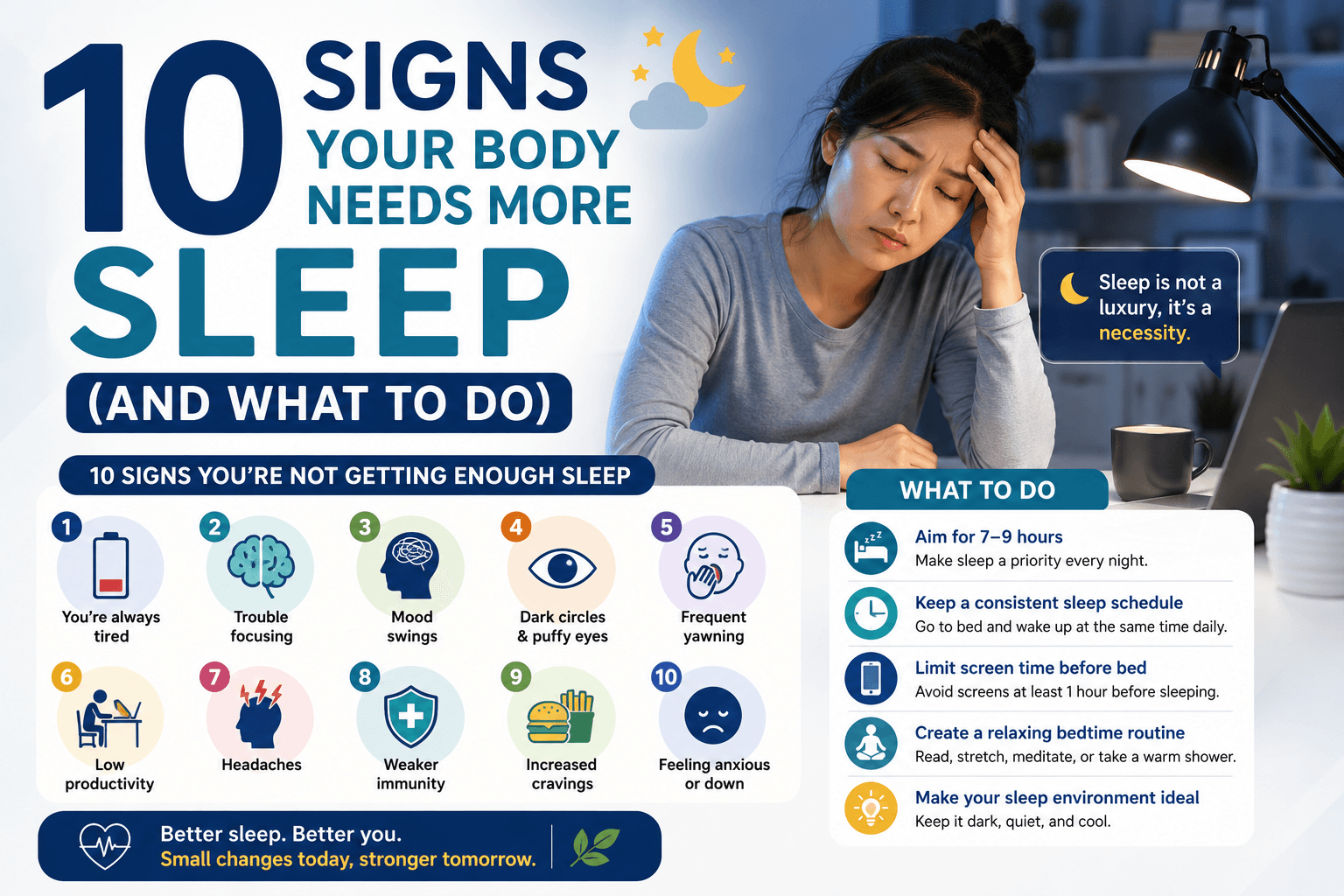
Sleep deprivation is a physiological debt your body records with precision. The signs your body needs more sleep are not subjective complaints—they are measurable biological signals ranging from microsleep episodes to altered glucose metabolism. In Malaysia, 33.6% of adults report poor sleep quality, according to the 2019 National Health and Morbidity Survey, and rates across Southeast Asia are similar or higher. This article identifies 10 specific signs of insufficient sleep and gives you actionable, culturally-adapted solutions.
Key Takeaways
- Chronic sleep deprivation raises mortality risk by 12% in adults sleeping under 7 hours per night (CDC, 2021).
- Microsleeps lasting 0.5–15 seconds are a leading cause of road accidents in tropical regions where heat worsens daytime sleepiness.
- Southeast Asian factors—late-night supper culture, humidity disrupting deep sleep, and air-conditioning overuse—require tailored sleep hygiene strategies.
Why Your Sleep Debt Matters More Than You Think
You can survive on 5 hours of sleep for weeks. Your brain will adapt—poorly. Every night of inadequate rest accumulates into a sleep debt that doesn't clear after one good weekend. Think of it like a bank overdraft: your body charges compound interest in the form of inflammation, hormonal imbalance, and reduced cognitive reserves.
Clinically, sleep deprivation is defined as consistently getting less than the recommended 7–9 hours per night for adults. But quantity alone doesn't tell the full story. The quality of sleep matters equally, and in Southeast Asia, that quality is under constant assault from heat, humidity, noise, and irregular meal timing. The 10 signs listed below are not random—they follow a predictable pattern of escalating biological failure. Recognising them early gives you a chance to intervene before chronic disease sets in.
For those managing chronic conditions, connected devices for chronic disease management in Southeast Asia can help track sleep's impact on health.
For those with existing health conditions, AI chronic disease management can help track sleep-related risks.
For context, 30% of Malaysian adults are prediabetic (NHMS 2019). Sleep debt is a direct contributor to insulin resistance. This is not a trivial issue—it is a population health crisis. By the end of this article, you will have a personalised checklist and a set of region-specific interventions.
1. Your Brain Feels Foggy and Forgetful
The first sign your body needs more sleep is a decline in what clinicians call "executive function." You forget appointments, lose your train of thought mid-sentence, and struggle to make decisions that previously came naturally. This happens because sleep consolidates memory—during slow-wave sleep, your brain transfers information from short-term to long-term storage. When you short-change that window, the transfer fails.
A 2023 meta-analysis in Sleep Medicine Reviews found that after one night of 5 hours of sleep, cognitive performance drops by the equivalent of a blood alcohol concentration of 0.05%. After two nights, that climbs to 0.08%—the legal limit for driving in many countries. If you feel mentally sluggish by 3 PM daily, that is a red flag.
If this happens regularly, it's worth investigating why you're always tired to rule out medical causes.
In tropical climates, afternoon mental fog is exacerbated by heat-related dehydration. Drinking water alone won't fix the root cause—your brain needs sleep to complete its daily maintenance cycle.
Prolonged sitting also impairs circulation and cognitive function, similar to sleep deprivation.
"Sleep is the brain's janitor. Without it, the cognitive debris accumulates until you can't think straight."
— Dr. Meena Devi, sleep neurologist, University Malaya Medical Centre
2. You Are Irritable or Emotionally Unstable
Sleep deprivation shrinks the prefrontal cortex's ability to regulate the amygdala—the emotional control centre. The result: you snap at your spouse, cry over minor frustrations, or feel a persistent low-grade anger that wasn't there before. This is not a personality flaw. It is a biological consequence of insufficient rest.
Longitudinal data from the CDC shows that adults sleeping less than 7 hours per night have a 27% higher risk of developing depressive symptoms over a 5-year period. The relationship is bidirectional—depression causes insomnia, and insomnia worsens depression. But in clinical practice, the most common trigger is not a mood disorder; it is accumulated sleep debt from late-night work and social habits. If your temper has shortened, track your sleep—not your moods.
If poor sleep is affecting your mood, exploring online mental health care in Southeast Asia may help you address the root cause.
For persistent mood issues, emerging data on AI therapy effectiveness shows promise for Southeast Asian patients.
Southeast Asian cultural patterns compound this. Supper—eating heavy fried noodles or rice at 11 PM—stimulates digestion and elevates core temperature, making it harder to reach the deep sleep stage that resets emotional stability. Try moving your last meal to at least 3 hours before bedtime.
3. You Experience Microsleeps—Even Briefly
A microsleep is an involuntary episode of sleep lasting from 0.5 to 15 seconds. You may not even notice it happening. One moment you are driving on the PLUS highway; the next, two seconds have vanished. Your eyes are open, but your brain is asleep. According to a 2023 PubMed review, microsleeps are a leading cause of road accidents in Asia, especially during the afternoon heat (2–4 PM) when circadian alertness dips.
Microsleeps occur most frequently in people who have accumulated 10 hours or more of sleep debt. They are not a sign of laziness—they are a sign your brain is forcing shut-down. If you ever catch yourself nodding off at a red light or during a meeting, that is a medical warning.
But not all warnings are sleep-related; learn which symptoms you should never ignore.
Microsleeps while driving cause an estimated 20% of road accidents in Malaysia (MIROS, 2022). Do not "push through" sleepiness. Pull over and take a 20-minute nap—ideally in an air-conditioned rest stop to lower your core body temperature.
4. Frequent Illness or Slow Recovery
Sleep and immune function share a direct, quantifiable relationship. After just one night of 4 hours of sleep, natural killer cell activity—your first defence against viruses—decreases by 50%, according to CDC data. This means you are more likely to catch the cold going around your office, and when you do get sick, recovery takes longer.
Recognising how sleep deprivation alters your immune response can help you differentiate flu vs COVID-19 symptoms more accurately.
If your child develops a fever, our fever in children guide can help you decide when to seek medical care.
In Singapore and Malaysia, where air-conditioning is used aggressively, the combination of sleep deprivation and dry, recirculated air further impairs mucosal immunity. The dry air dries out your nasal passages, reducing the protective mucus layer. Getting 7–8 hours of sleep is more effective than most over-the-counter immunity supplements.
5. Uncontrollable Cravings for Carbs and Sugar
This sign is particularly common in Southeast Asia, where high-carb comfort foods like nasi lemak, roti canai, and fried banana are available 24/7. When you are sleep-deprived, two hormones shift: ghrelin (hunger hormone) increases by 20%, while leptin (satiety hormone) drops by 15%. The result is an intense craving for quick-energy carbohydrates and sugars.
A WHO analysis found that chronic sleep deprivation increases obesity risk by 55% in adults. But the mechanism goes beyond calories. Lack of sleep also impairs insulin sensitivity—meaning your body stores more of those carbs as fat rather than using them for energy. If you find yourself craving teh tarik and roti canai at 10 PM, your sleep—not your willpower—needs attention.
For persistent sleep issues, consider exploring AI insomnia treatment options that provide personalized digital sleep solutions.
| Factor | Well-Rested (7–9 hrs) | Sleep-Deprived (≤5 hrs) |
|---|---|---|
| Ghrelin levels | Baseline | ↑ 20% |
| Leptin levels | Baseline | ↓ 15% |
| Calories consumed in next meal | Normal | ↑ 30–40% (snacking) |
| Insulin sensitivity | Normal | ↓ 33% after 4 nights of 4.5 hrs sleep |
Source: Sleep and Metabolism – Spiegel et al., Annals of Internal Medicine, 2004; WHO 2020.
6. Morning Headaches or Elevated Blood Pressure
Waking up with a headache is not always about dehydration or caffeine withdrawal. Sleep deprivation causes blood vessels in the brain to dilate abnormally, triggering tension-type headaches and migraines. Additionally, lack of sleep elevates nocturnal blood pressure because the normal "dipping" that occurs during deep sleep is absent. Over months, this raises resting daytime blood pressure.
To identify other triggers, learn about headache causes beyond stress in our detailed guide.
To interpret these changes, focus on understanding blood pressure numbers.
A 2021 CDC report linked insufficient sleep to a 12% higher risk of mortality, with cardiovascular disease being the primary contributor. In Southeast Asian populations, where hypertension prevalence is already high (30% in Malaysia, NHMS 2019), sleep loss compounds the risk. If you have a family history of hypertension and you sleep less than 6 hours, get a home blood pressure monitor—and a sleep intervention.
Understanding chest pain causes can help you identify when sleep deprivation affects your heart.
Nocturnal blood pressure dipping: Normally, blood pressure drops by 10–20% during deep sleep. Without this dip, the cardiovascular system stays on high alert all night. Sleep deprivation eliminates the dip, pushing your average 24-hour blood pressure higher. EazyCare AI's symptom checker can help you assess your sleep quality and cardiovascular risk factors.
7. Dark Circles, Puffiness, and Pale Skin
Beauty sleep is not a myth. Lack of sleep increases cortisol, which breaks down collagen—the protein that keeps skin firm and elastic. At the same time, fluid redistribution caused by gravity and poor lymphatic drainage leads to under-eye puffiness. The result: darkened circles, sallow skin, and more visible fine lines.
Clinically, this is one of the most obvious signs your body needs more sleep. In a 2019 study published in Sleep, participants rated photos of sleep-deprived individuals as less healthy and less attractive. The biological explanation is straightforward: sleep is when skin repairs itself from UV damage and oxidative stress. Skipping sleep is equivalent to accelerating skin aging by about 2–3 years per decade.
8. Poor Reaction Time and Coordination
Reaction time slows by about 15–20% after two nights of restricted sleep. This affects everything from driving to sports to typing emails. The mechanism involves reduced connectivity between the motor cortex and the cerebellum. In practical terms, you become clumsier—bumping into door frames, dropping objects, and misjudging distances.
Among night-shift workers in Singapore—a population frequently seen in clinical practice—this manifests as increased workplace accidents. A 2022 study in Occupational Medicine reported a 30% higher injury rate among workers who slept fewer than 5 hours between shifts. If your coordination feels "off" for no apparent reason, do not ignore it.
Step 1: Stop driving or operating machinery immediately if you notice coordination lapses. Pull over and take a 20-minute power nap.
Step 2: Assess your sleep debt using a free online calculator or EazyCare AI's sleep assessment tool.
Step 3: Prioritize sleep consistency. Go to bed at the same time every night, even on weekends.
9. Heightened Anxiety or Racing Thoughts at Night
Paradoxically, the more sleep-deprived you are, the harder it becomes to fall asleep. This creates a vicious cycle. Sleep loss sensitises the brain's fear circuitry—the amygdala becomes hyperresponsive to negative stimuli while the prefrontal cortex's ability to quiet that response is impaired. The result: racing thoughts, rumination, and difficulty "switching off" at bedtime.
This sign is especially common among professionals in high-pressure environments like Kuala Lumpur's financial district or Singapore's tech hub. They work late, sleep 5 hours, and then lie awake at 3 AM worrying. If you find your mind racing when your head hits the pillow, you likely have sleep debt that needs active repayment.
10. You Need an Alarm to Wake Up (and You Hit Snooze)
Waking up naturally without an alarm is the simplest, most reliable indicator that your body has had enough sleep. If you rely on an alarm—especially if you hit snooze multiple times—you are waking up in the middle of a sleep cycle, which means you are still in sleep debt. Hitting snooze fragments your sleep further, leaving you groggier.
A study from the American Academy of Sleep Medicine found that people who never use an alarm average 8.1 hours of sleep, while those who use an alarm every day average 6.5 hours. If you cannot wake up before your alarm at least 4 days per week, your sleep duration is almost certainly insufficient.
Frequently Asked Questions
What are the 10 signs of sleep deprivation?
The 10 signs are: brain fog and forgetfulness, irritability and emotional instability, microsleeps, frequent illness, carb cravings, morning headaches/blood pressure changes, dark circles and puffiness, poor reaction time and coordination, heightened anxiety at night, and needing an alarm to wake up. Each reflects a distinct biological pathway—from impaired memory consolidation to disrupted hormone regulation. If you experience three or more, you likely have significant sleep debt. EazyCare AI's symptom checker can help you assess your sleep quality.
How many hours of sleep do adults really need?
The American Academy of Sleep Medicine recommends 7–9 hours per night for adults aged 18–64, and 7–8 hours for adults aged 65 and older. This consensus is based on hundreds of studies linking shorter or longer sleep to adverse health outcomes. Individual variation exists—some people function well on 7 hours, others need 9. But sleeping 5 hours or less night after night is insufficient for the vast majority and raises mortality risk by 12% (CDC).
Can lack of sleep cause high blood pressure?
Yes. Lack of sleep prevents the normal 10–20% drop in blood pressure that occurs during deep sleep (nocturnal dipping). Over weeks and months, this leads to sustained higher daytime blood pressure. A 2021 meta-analysis in Hypertension found that chronic sleep deprivation (less than 6 hours) increases the risk of developing hypertension by 32%. In Southeast Asia, where hypertension is already common, sleep loss compounds the problem significantly.
What happens to your body when you don't get enough sleep?
Within 24 hours of insufficient sleep, your immune function drops by 50% (CDC), your reaction time slows by 15–20%, and your hunger hormones shift to increase calorie intake. By day three, cognitive performance drops to the level of intoxication. Long-term effects include a 55% higher obesity risk (WHO), impaired insulin sensitivity, elevated cortisol, increased inflammation markers, and reduced cardiac repair. Every organ system is affected—from the brain to the gut to the skin.
Is sleeping 5 hours a night enough?
For almost all adults, no. The AASM consensus states that 5 hours is below the recommended minimum. While a small percentage of the population carries a genetic mutation allowing them to function on 5 hours, this is rare (<1%). For the typical Southeast Asian professional, 5 hours leads to accumulated sleep debt, increased accident risk, and long-term metabolic diseases. If you are sleeping 5 hours nightly, you are in the highest-risk group for sleep-related health problems.
How does sleep deprivation affect mental health?
Sleep deprivation amplifies negative emotions by 60% and reduces positive emotions by 40% in controlled studies. It impairs emotional regulation by weakening the prefrontal cortex's control over the amygdala. Long-term, it increases the risk of developing depression by 27% and doubles the risk of anxiety disorders. In Malaysia, where mental health stigma remains, sleep deprivation is often mistaken for a personality flaw—it is a biological condition requiring treatment.
What are the long-term effects of chronic sleep loss?
Chronic sleep loss (under 6 hours for months or years) is linked to: type 2 diabetes (30% increased risk per hour of sleep lost), hypertension, cardiovascular disease, stroke, obesity, weakened immune function, cognitive decline, dementia (due to reduced amyloid-beta clearance during sleep), depression, and earlier mortality. The CDC's 2021 report found a 12% higher all-cause mortality in adults sleeping less than 7 hours. The damage is cumulative and often irreversible without intervention.
Does sleeping too much have side effects?
Yes, regularly sleeping more than 9–10 hours per night is linked to adverse outcomes including increased inflammation, higher depression risk, and a 30% higher risk of cardiovascular events (NIH, 2023). However, oversleeping is often a symptom of an underlying problem—sleep apnea, depression, or hypersomnia—rather than a cause itself. If you consistently need more than 9 hours to feel rested, see a sleep specialist rather than assuming it is normal.
How can I tell if I have sleep debt?
The simplest test: if you fall asleep within 5 minutes of lying down during the day, you likely have sleep debt. A more precise method is to track your sleep for two weeks and compare it to the 7–9 hour target. If you average less than 7 hours, you are accumulating debt. Symptoms like microsleeps, needing an alarm, and craving carbs are strong indicators. EazyCare AI's sleep assessment tool can help you quantify your debt and track improvement.
Why do I wake up tired even after 8 hours of sleep?
This is common and points to poor sleep quality rather than insufficient quantity. Possible causes include: sleep apnea (common in overweight individuals and those who snore), restless leg syndrome, frequent arousal from heat or humidity, late-night alcohol consumption (which fragments sleep), or an undiagnosed medical condition. You may be spending 8 hours in bed but only 5 hours in deep or REM sleep. A sleep study can identify the root cause.
When to See a Doctor
- You experience microsleeps while driving or operating machinery
- You have been sleeping 5 hours or less for more than a month
- You wake up gasping for air or with a choking sensation (possible sleep apnea)
- Your daytime sleepiness is so severe that you fall asleep mid-conversation
- You have chest pain or palpitations on waking
Call 999 or go to the nearest emergency department if you experience sudden collapse or if someone witnesses you stop breathing during sleep. If you are unsure whether your symptoms warrant a visit, EazyCare AI can help you decide whether you need urgent care.
Conclusion
The signs your body needs more sleep are not subtle—they are your biology calling for recovery. To recap:
- Track quantity and quality: Aim for 7–9 hours, but also ensure you get deep sleep—avoid late heavy meals, alcohol, and excessive AC that dries out your airways.
- Act on microsleeps immediately: They are a medical warning, not a personal failing. Pull over if driving, then address your sleep debt over the next week.
- Use region-specific solutions: Use a fan to cool down without drying the air, schedule afternoon naps (20 minutes max, before 3 PM), and avoid carbo-heavy suppers.
Sleep is non-negotiable for health. Start tonight. Learn more at eazycare.ai or chat with our AI health assistant to personalise your sleep plan.