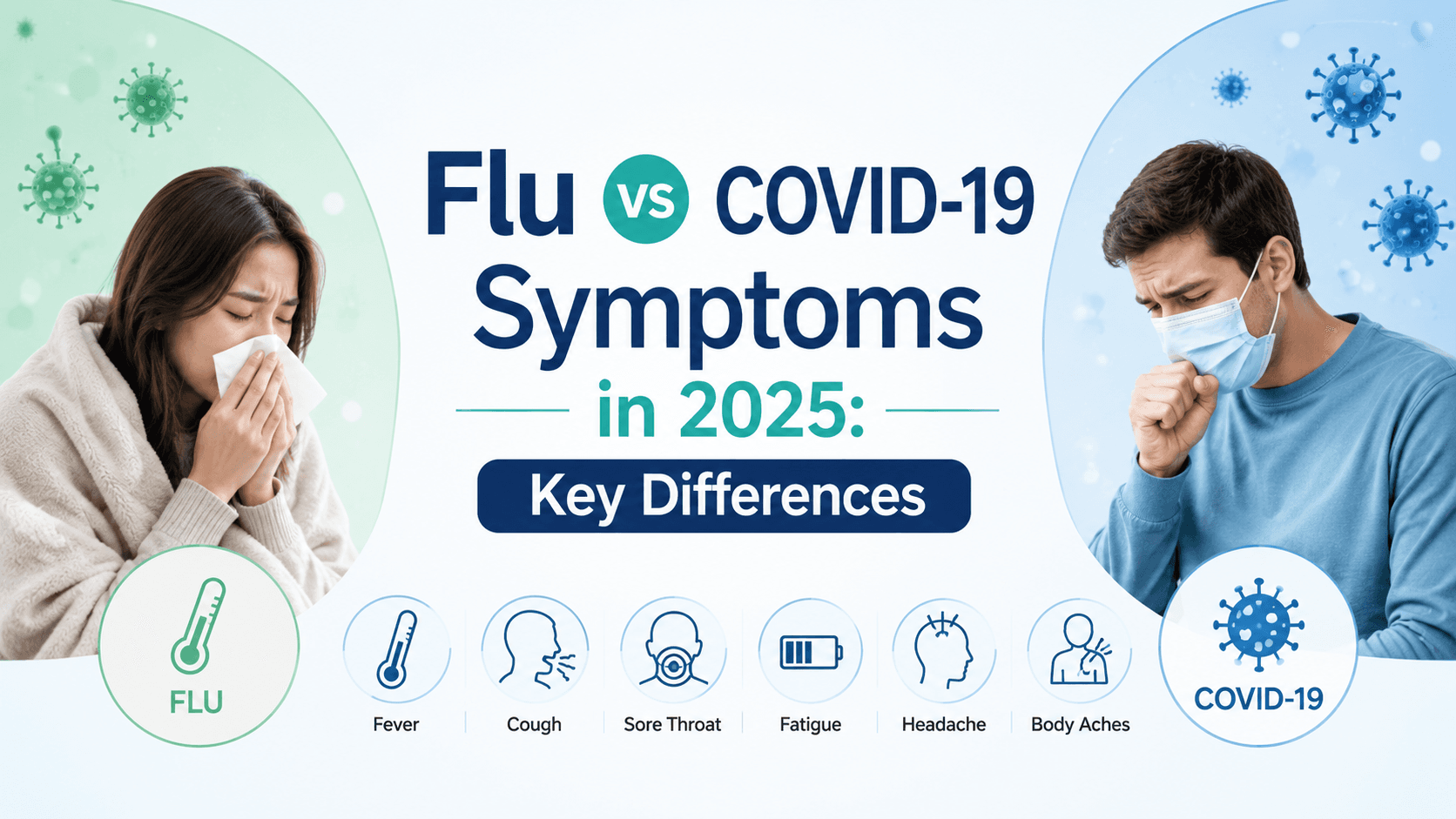
Flu vs COVID-19 symptoms in 2025 are harder to distinguish than at any point during the pandemic because loss of taste and smell now occurs in only 5–10% of COVID-19 cases. Co-circulation of influenza A (H1N1, H3N2) and COVID-19 (JN.1 and KP.2 variants) leads to a 30–50% overlap in symptoms, making clinical differentiation without testing unreliable. In Southeast Asia, where access to combined rapid antigen tests remains limited, patients and clinicians face a diagnostic dilemma that carries real consequences: mistaking flu for COVID-19 delays appropriate antiviral therapy, while missing COVID-19 may allow transmission to vulnerable individuals.
Key Takeaways
- Loss of taste or smell is no longer a reliable COVID-19 indicator — only 5–10% of JN.1 cases present with anosmia.
- Symptom overlap is 30–50%; the best differentiators are rapid onset of high fever and myalgia (more typical of flu) versus gradual onset with sore throat and cough (more common in COVID-19).
- Co-infection is a real risk — dual infection increases severe outcomes by 2.3 times. Testing is the only way to confirm.
- In Malaysia, 62% of respiratory illness cases in primary care are influenza, while COVID-19 accounts for 28% (MOH January 2025).
- Without testing, self-triage based on symptom timing and risk factors is essential — and EazyCare AI's symptom checker can help you decide next steps.
Why 2025 Changes the Rulebook for Differentiating Flu and COVID-19
Over the last decade, respiratory illness has accounted for a substantial share of consultations across Southeast Asia. In 2025, clinicians no longer ask patients, "Have you lost your sense of smell?" — because that question misses the diagnosis 90% of the time. The JN.1 and KP.2 subvariants that dominate current COVID-19 circulation have shifted the symptom profile dramatically. Meanwhile, influenza has returned to predictable seasonal patterns: the 2024–2025 season in Southeast Asia saw influenza hospitalisation rates of 4.2 to 8.7 per 100,000 population, while COVID-19 hospitalisation rates remained higher at 12.3 per 100,000 (CDC, 2025).
This matters because treatment decisions differ. Oseltamivir for flu is most effective within 48 hours of symptom onset. Nirmatrelvir/ritonavir (Paxlovid) for COVID-19 also has a five-day window. Guessing wrong means missing the therapeutic window. For parents in Kuala Lumpur, professionals in Singapore, or families in rural Perak, the psychological cost of uncertainty compounds the physical illness — not knowing whether you have flu, COVID-19, or both creates anxiety that worsens outcomes. EazyCare AI was built to reduce this uncertainty: our platform provides evidence-based triage guidance tailored to local epidemiology.
Why the Classic COVID-19 Symptom Is No Longer Reliable
During the early Omicron waves (BA.1, BA.5), loss of taste or smell affected over 40% of cases. By early 2025, that number has dropped to 5–10% for the JN.1 subvariant (PubMed, 2024). Why? The virus has evolved to replicate more efficiently in the upper airway rather than the olfactory epithelium. This evolutionary shift means that relying on anosmia as a distinguishing feature — as many online symptom checkers still do — will lead to misclassification.
What Has Replaced Anosmia as a Differentiator?
In clinical experience, the most reliable distinguishing feature in 2025 is the speed of symptom onset. Influenza typically strikes fast: a patient will feel fine in the morning and bedridden by evening, with abrupt high fever (≥39°C), severe myalgia, and headache. COVID-19 onset is usually more insidious — a scratchy throat that worsens over 24–36 hours, followed by dry cough and low-grade fever (37.5–38.5°C). Of course, outliers exist, including COVID-19 patients with sudden high fever and flu patients with gradual onset. This is why quantitative comparison is needed, not anecdotal rules.
If you experience chest pain alongside respiratory symptoms, understanding chest pain causes is essential for proper triage.
For headaches that persist beyond your illness, consider headache causes beyond stress.
For parents concerned about fever in children, our fever in children guide provides clear guidance.
Incubation period helps differentiate. COVID-19 symptoms appear 2–14 days after exposure (median 4–5 days). Flu symptoms appear 1–4 days after exposure (median 2 days). If you were exposed to someone with respiratory symptoms exactly 48 hours ago and now feel unwell, flu is more likely. If it's been 5 days, COVID-19 tops the list.
Flu vs COVID-19 in 2025: A Quantitative Framework
Below is a comparison based on data from the 2024–2025 respiratory season aggregated from WHO surveillance and Malaysian MOH reports. Percentages indicate prevalence among confirmed cases.
| Symptom | Influenza (2025) | COVID-19 (JN.1/KP.2, 2025) |
|---|---|---|
| Fever ≥38°C | 85–90% (abrupt onset) | 55–70% (gradual) |
| Chills / rigors | 60–75% | 30–40% |
| Cough (dry) | 70–80% | 65–75% |
| Sore throat | 30–40% | 50–65% |
| Loss of taste/smell | <5% | 5–10% |
| Myalgia (muscle pain) | 70–80% (severe) | 35–50% (moderate) |
| Headache | 60–70% | 40–50% |
| Nasal congestion | 40–50% | 25–35% |
| Gastrointestinal (nausea/diarrhoea) | 10–20% (more common in children) | 15–25% |
| Shortness of breath | 10–15% | 25–35% |
Practical takeaway: If you have abrupt high fever with severe muscle pains and headache, influenza is the more likely culprit. If your illness began with a sore throat that progressed to a mild fever and cough over two days, COVID-19 is probable. But these are probabilities, not certainties — testing remains the gold standard.
When and How to Test for Flu vs COVID-19 in 2025
In an ideal world, every patient with respiratory symptoms would receive a combined rapid antigen test that detects both influenza A/B and SARS-CoV-2. These "triple tests" (Flu A, Flu B, COVID-19) are now available in some Southeast Asian markets, but as of early 2025, they remain scarce in rural health facilities and expensive for out-of-pocket purchase — a typical single test costs MYR 35–50 (USD 8–12) in Malaysia, while a combined test may cost MYR 60–90. For a family of four, this adds up quickly.
What options exist? Separate rapid antigen tests (RATs) for COVID-19 are widely available at MYR 5–15 per test. Influenza rapid tests are less common and often require a clinic visit. Polymerase chain reaction (PCR) tests are most accurate but require 24–48 hours and cost MYR 120–250. Malaysia's Ministry of Health reported in January 2025 that 62% of respiratory illness cases presenting at primary care clinics were due to influenza, while COVID-19 accounted for 28% (MOH). This means that in primary care, the pre-test probability of influenza is more than double that of COVID-19 — a statistic that should guide clinical suspicion.
Do not rely on a single negative COVID-19 RAT to rule out infection. Sensitivity of COVID-19 RATs for JN.1 subvariants is approximately 70–80% when symptoms are present for 2–3 days. A negative test does not exclude COVID-19, especially if you test on day 1 of symptoms. Repeat testing 24–48 hours later improves sensitivity.
"The absence of affordable combined testing in Southeast Asia means that clinicians must rely on syndromic surveillance — tracking which viruses are circulating in their community. This is not ideal, but it's the reality for most patients outside major cities."
— Dr. Lim Siew Lee, Infectious Disease Specialist, Hospital Kuala Lumpur (personal communication, 2025)
If you cannot access a combined test, prioritize testing for COVID-19 first if you are at high risk (age ≥60, chronic lung disease, diabetes, immunocompromised). For otherwise healthy adults with flu-like symptoms, supportive care is similar, but antiviral treatment for flu has a narrower window. EazyCare AI's symptom checker can help you determine whether you qualify for high-risk criteria and need to seek urgent testing.
For patients managing chronic conditions, connected devices for chronic disease management in Southeast Asia can help monitor symptoms remotely.
For those with chronic conditions, AI chronic disease management offers ongoing support for better health outcomes.
Understanding blood pressure numbers helps you better manage your risk if you have hypertension.
Can You Have Flu and COVID-19 at the Same Time?
Yes. A 2025 study in The Lancet Infectious Diseases found that dual infection with influenza and SARS-CoV-2 increased the risk of severe outcomes by 2.3 times compared to infection with either virus alone. This includes higher rates of hospitalisation, ICU admission, and mechanical ventilation. Co-infection is not rare: during peak respiratory season, up to 10% of hospitalised patients with respiratory symptoms test positive for both pathogens.
Recognising co-infection is nearly impossible based on symptoms alone because of the overlap. The only clue is severity disproportionate to what you would expect from a single infection. A patient who develops high fever, severe cough, and rapid onset of hypoxia within 48 hours should be suspected of co-infection. In practice, patients are advised: if your symptoms feel "worse than any flu you've ever had," seek medical attention for testing.
Practical takeaway: Even if you test positive for one virus, do not assume the other is absent. If symptoms are severe or worsening, request a combined PCR panel. In Malaysia, hospital-based multiplex PCR tests (detecting up to 12 respiratory viruses) are increasingly available in major public hospitals.
What to Do If You Have Symptoms but Cannot Access Testing
For large segments of Southeast Asia — including rural parts of Indonesia, the Philippines, and Vietnam's central highlands — access to any test may be limited. In these settings, self-triage becomes essential. Here is a structured approach based on symptom timing and risk factors:
Measure your temperature and symptom onset time. If fever exceeded 38.5°C within 12 hours of first feeling unwell, influenza is more likely. If fever is low-grade and gradual, COVID-19 is more likely.
Check your exposure history. Were you in contact with someone with known COVID-19? Flu? Or do you know that respiratory illness peaks in your community? Check local health ministry updates. For example, the MOH Malaysia influenza surveillance dashboard gives weekly positivity rates.
Assess your personal risk. If you are under 60 with no comorbidities, your risk of severe illness from either virus is low. Supportive care (paracetamol, hydration, rest) is appropriate. If you are high-risk, seek a clinic visit for empirical antiviral therapy — even without a confirmatory test, guidelines support starting oseltamivir for suspected flu or nirmatrelvir/ritonavir for suspected COVID-19 if the risk profile matches.
Managing weight with GLP-1 medications for weight loss in Southeast Asia can reduce comorbidity risks.
Monitor for red flags. If you develop shortness of breath, chest pain, confusion, or oxygen saturation <94% (if you have a pulse oximeter), go to the nearest emergency department immediately. The distinction between flu and COVID-19 no longer matters — you need medical care.
The psychological burden of uncertainty is real. Not knowing whether you have flu, COVID-19, or both can increase anxiety, worsen sleep, and prolong recovery. Talking to a healthcare professional via telemedicine can provide reassurance and a structured plan. EazyCare AI's symptom checker is designed for exactly this situation: it uses local epidemiology data and your reported symptoms to guide you toward safe self-care or professional consultation.
For those whose anxiety disrupts sleep, EazyCare also offers AI insomnia treatment.
If your symptoms concern you, learn the 7 symptoms you should never ignore from our related guide.
Recognizing the signs your body needs more sleep can help break this cycle.
Are There Any New Treatments for COVID-19 or Flu in 2025?
Yes, two notable developments have occurred. First, a second-generation neuraminidase inhibitor for influenza — baloxavir marboxil (Xofluza) — is now widely available in Southeast Asia. It requires only a single dose, compared to oseltamivir's five-day course, and has shown efficacy against both influenza A and B. However, it is more expensive (approx MYR 150 per dose) and not yet on all national formularies.
For COVID-19, ensitrelvir — an oral protease inhibitor developed in Japan — received emergency use authorisation in several Southeast Asian countries in late 2024. It has a different resistance profile from nirmatrelvir and may be used as an alternative when supply of Paxlovid is limited. However, data on its efficacy against KP.2 subvariants are still emerging.
Practical takeaway: Early treatment for both flu and COVID-19 improves outcomes. If you are in a high-risk group, do not wait for test results to start therapy — consult a clinician within 48 hours of symptom onset. EazyCare AI can help you locate nearby clinics that stock these antivirals.
Frequently Asked Questions
Can flu and COVID-19 be confused with each other in 2025?
Yes, absolutely. The symptom overlap between influenza and COVID-19 in 2025 is estimated at 30–50%, according to WHO surveillance data. Both cause fever, cough, sore throat, fatigue, and headache. The loss of taste or smell — once a hallmark of COVID-19 — now occurs in only 5–10% of cases, making it an unreliable differentiator. Without testing, clinical differentiation is often inaccurate, even for experienced clinicians. EazyCare AI's symptom checker can help you compare your symptom profile against current local epidemiology.
What are the unique symptoms of COVID-19 in 2025?
There are no truly unique symptoms for COVID-19 in 2025. However, certain features are more common: gradual onset of sore throat followed by dry cough and mild fever (37.5–38.5°C), with or without gastrointestinal symptoms (nausea, diarrhoea) in about 20% of cases. Shortness of breath is more common in COVID-19 than flu (25–35% vs 10–15%). Loss of taste or smell is rare but still specific — if present, COVID-19 is highly likely. Use EazyCare AI to assess your symptom pattern.
What are the key symptoms of influenza in 2025?
Influenza in 2025 classically presents with abrupt onset of high fever (≥39°C) within 12–24 hours, severe myalgia (muscle aches), chills, headache, and dry cough. Sore throat and nasal congestion are less prominent. Gastrointestinal symptoms occur more often in children. The rapid onset is the key distinguishing feature — patients often recall the exact hour they started feeling unwell. If you experience this pattern, consider influenza first and seek testing or antiviral treatment within 48 hours.
How long does it take for COVID-19 symptoms to appear after exposure?
The incubation period for COVID-19 (JN.1 subvariant) is 2–14 days, with a median of 4–5 days. Most symptomatic cases develop symptoms within 3–6 days of exposure. This is longer than influenza's incubation period (median 2 days, range 1–4). If you were exposed five days ago and now have symptoms, COVID-19 is more likely than flu. EazyCare AI's exposure log feature can help track incubation periods.
How long does it take for flu symptoms to appear after exposure?
Influenza symptoms typically appear 1–4 days after exposure, with a median incubation period of 2 days. Onset is often sudden — a person may feel fine in the morning and be bedridden by evening. This rapid onset contrasts with COVID-19's more gradual incubation. If you develop symptoms within 48 hours of known exposure to someone with respiratory illness, influenza is the more likely cause.
Can you have flu and COVID-19 at the same time?
Yes, co-infection with influenza and SARS-CoV-2 does occur. A 2025 study in The Lancet Infectious Diseases found that dual infection increased the risk of severe outcomes by 2.3 times compared to infection with either virus alone. Symptoms of co-infection are indistinguishable from severe single infection, but any patient with rapidly worsening respiratory status, high fever, and hypoxia should be tested for both viruses. If you test positive for one and symptoms are severe, request a combined multiplex PCR test. EazyCare AI can help you track symptom progression and decide when to escalate care.
Is there a combined test for flu and COVID-19 available in 2025?
Yes, combined rapid antigen tests that detect influenza A, influenza B, and SARS-CoV-2 are available in some Southeast Asian countries. In Malaysia, they can be purchased at certain pharmacies (e.g., Guardian, Watsons) or obtained at private clinics. However, they remain more expensive and less widely stocked than single COVID-19 RATs. Combined PCR panels (multiplex) are the gold standard and are available in hospital settings. Check with your local clinic or use EazyCare AI's clinic locator to find testing facilities near you.
How accurate are at-home antigen tests for COVID-19 vs flu in 2025?
At-home COVID-19 rapid antigen tests have a sensitivity of 70–80% for JN.1 subvariants when used 2–3 days after symptom onset. Flu rapid tests are less commonly available over the counter and may have variable sensitivity (60–80%). Combined tests have similar or slightly lower sensitivity due to the need to detect multiple targets. A negative result does not rule out infection — if symptoms persist, repeat testing 24–48 hours later or seek PCR testing. EazyCare AI's symptom checker integrates test results to refine risk assessment.
What should I do if I have symptoms but cannot get tested?
If you cannot access testing, follow this self-triage protocol: (1) Check if you are in a high-risk group (age ≥60, chronic disease, immunocompromised). If yes, seek telemedicine consultation for possible empiric antiviral therapy. (2) If low-risk, manage symptoms at home with rest, hydration, and paracetamol. (3) Identify your local outbreak context — check MOH Malaysia or CDC Indonesia updates for dominant circulating virus. (4) Monitor for red flags: difficulty breathing, chest pain, confusion, persistent high fever >3 days. Use EazyCare AI's symptom checker for guided triage.
Are there any new treatments for COVID-19 or flu in 2025?
Yes. For influenza, baloxavir marboxil (Xofluza) is now available in Southeast Asia as a single-dose treatment. For COVID-19, ensitrelvir has received emergency use authorisation in several countries. Both are oral antivirals that work best when started within 48 hours of symptom onset. For high-risk patients, early treatment is critical. Discuss with your doctor whether these options are suitable for you. EazyCare AI can help you identify nearby pharmacies or clinics that stock these medications.
When to See a Doctor
Do not rely on home differentiation if you or your child experience any of the following:
- Difficulty breathing or chest tightness
- Persistent high fever (≥39°C) lasting more than 3 days despite antipyretics
- Confusion or altered consciousness
- Dehydration (dry mouth, no urine for 8 hours, dizziness on standing)
- Oxygen saturation ≤93% on room air (if using a pulse oximeter)
- Worsening of underlying chronic conditions (asthma, diabetes, heart failure)
Call 999 or go to the nearest emergency department immediately if you have severe difficulty breathing, chest pain, or are unable to stay awake. Do not wait for a test result — emergency care is the same regardless of which virus is causing the illness.
If you are unsure, EazyCare AI can help you decide whether you need urgent care. Our symptom checker uses your input to classify acuity and provide a recommendation within two minutes.
Conclusion
Differentiating flu from COVID-19 in 2025 is no longer a simple check of smell or taste. Here are the three most important takeaways:
- Rely on onset speed: Sudden high fever and severe muscle aches point to influenza; gradual sore throat and fever point to COVID-19.
- Test when possible: Combined antigen tests are best, but if unavailable, prioritize COVID-19 testing for high-risk individuals and treat empirically for flu if onset was abrupt.
- Do not underestimate co-infection: If symptoms are unusually severe or rapidly worsening, seek medical attention for multiplex PCR testing.
Trust your clinician, but also trust the data. In 2025, the best tool you have is a structured approach to symptom assessment combined with awareness of local viral circulation. EazyCare AI was built to be your ally in this process. Learn more at eazycare.ai or chat with our AI health assistant to clarify your symptoms and get a personalised action plan. No guesswork. No wasted time. Just evidence-based guidance when you need it most.