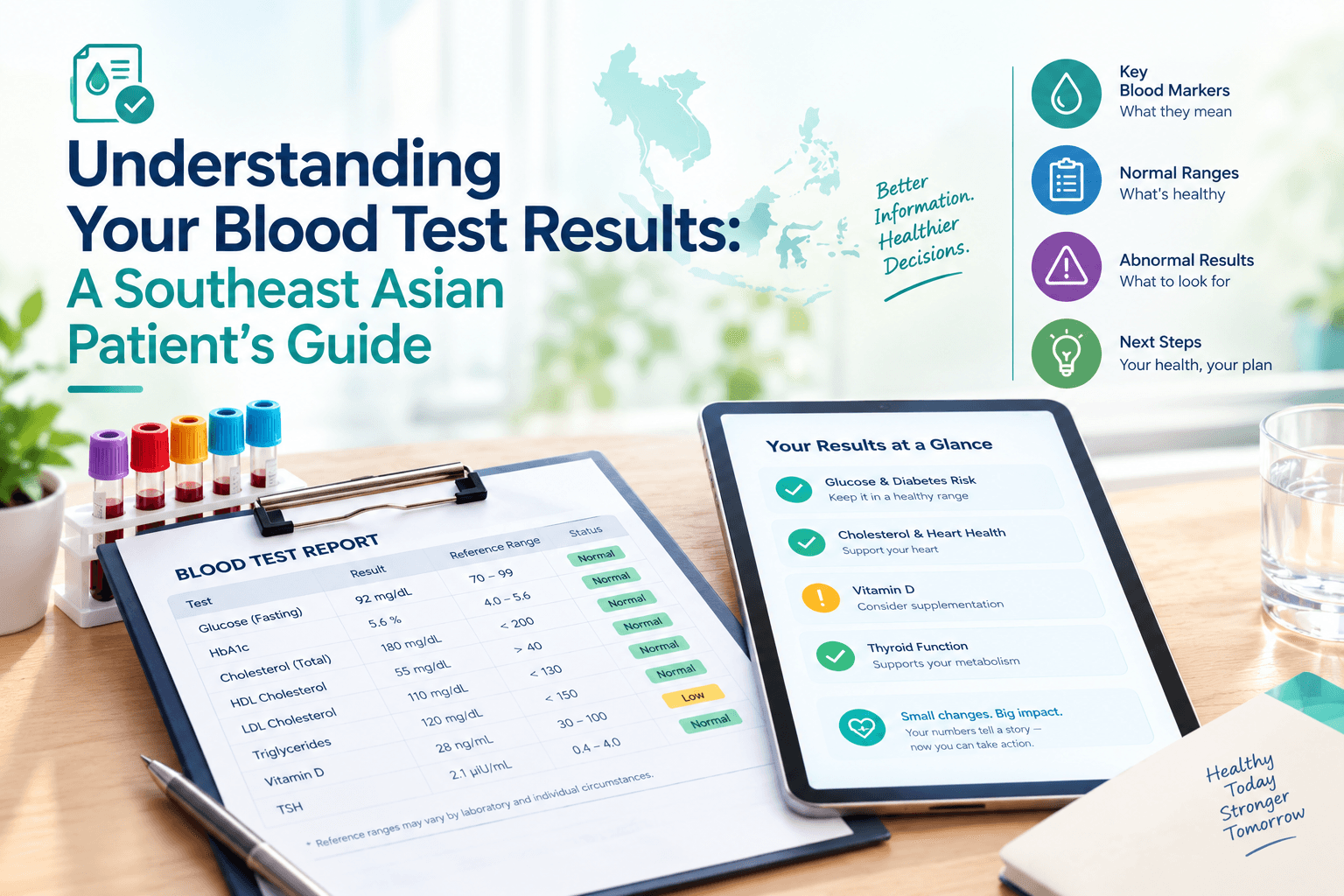
A blood test results guide for Southeast Asia must account for the fact that standard reference ranges are often derived from Western populations, which can mislead patients in Malaysia, Singapore, Thailand, and beyond. Your lab report is a quantitative snapshot of your physiology, but interpreting it correctly requires understanding ethnic-specific norms, local disease prevalence, and the limitations of each marker. This guide explains the most common blood tests, what your numbers mean in a Southeast Asian context, and how to have a productive conversation with your doctor.
Key Takeaways
- Standard reference ranges are often based on Western populations and may not reflect healthy values for Southeast Asians — differences in hemoglobin, creatinine, and lipid profiles are well-documented.
- Chronic kidney disease affects approximately 15% of adults in Southeast Asia, making eGFR and creatinine critical numbers to understand on your report.
- Hepatitis B is endemic in the region, so liver function tests (ALT, AST) deserve special attention even if you feel healthy.
- Your blood test results are a conversation starter, not a verdict — always discuss findings with a qualified clinician who understands your ethnic background.
Why Your Blood Test Report Deserves a Second Look
You've just picked up your lab report from the clinic in Kuala Lumpur or Singapore. The numbers are a mix of abbreviations, decimals, and arrows pointing up or down. Your doctor said "all normal" in under three minutes, but you're not so sure. That slightly elevated ALT or borderline hemoglobin keeps nagging at you. This scenario plays out thousands of times daily across Southeast Asia, where patients receive results without context and clinicians often lack the time to explain every marker.
The problem is compounded by a critical flaw in how reference ranges are established. Most laboratories in the region adopt reference intervals from Western populations — typically European or North American cohorts. Yet research published in PubMed demonstrates that ethnic differences significantly affect blood test reference ranges, with variations in hemoglobin, creatinine, and lipid profiles between Asian and Caucasian populations. For Southeast Asians, this means a "normal" result on your report might actually indicate a problem, or conversely, a "borderline" value might be perfectly healthy for your body type.
This guide serves as your interpretive companion. It covers the complete blood count, lipid profile, blood glucose, liver and kidney function tests, and thyroid markers — all contextualised for Southeast Asian patients. You'll learn what each marker measures, why the numbers matter, and how to prepare for your next doctor's visit. For a quick pre-consultation assessment, EazyCare AI's symptom checker can help you organise your concerns before you walk into the clinic.
Blood Test Reference Ranges for Asians: Why Ethnicity Matters
When you receive a blood test report, every result is compared against a reference range — the values expected in 95% of a healthy population. The critical question is: which population? Most laboratories in Southeast Asia use reference intervals derived from Western cohorts, which creates a systematic bias. A 2017 study in the American Journal of Clinical Pathology examined this issue and found that ethnic-specific reference ranges are essential for accurate interpretation, particularly for markers like hemoglobin, ferritin, and creatinine.
Consider hemoglobin, the oxygen-carrying protein in red blood cells. The typical Western reference range is 13.5–17.5 g/dL for men and 12.0–15.5 g/dL for women. However, healthy Southeast Asian populations often have baseline hemoglobin levels that are 0.5–1.0 g/dL lower, partly due to differences in body composition and altitude adaptation in certain regions. A Malaysian Chinese man with a hemoglobin of 13.0 g/dL might be flagged as "low" by Western standards, yet this could be entirely normal for his ethnic background. Conversely, a value that falls within the "normal" range might still represent a significant drop from a patient's baseline — a key reason why trend analysis matters more than a single reading.
This isn't just an academic concern. Misinterpretation leads to unnecessary anxiety, repeat testing, and sometimes inappropriate treatment. A 2020 analysis of chronic kidney disease in Southeast Asia, published in the American Journal of Kidney Diseases, highlighted that creatinine-based eGFR equations may overestimate or underestimate kidney function in Asian populations, affecting roughly 15% of adults with undiagnosed CKD in the region. The takeaway is clear: your blood test results must be interpreted in the context of your ethnicity, age, sex, and medical history — not just compared against a generic reference range.
A reference range tells you what's statistically common in a population, not what's optimal for your health. For example, a fasting blood glucose of 5.9 mmol/L might be "within normal limits" but is already approaching pre-diabetic territory. Similarly, LDL cholesterol of 3.5 mmol/L might be "normal" for a general population but too high for someone with diabetes or a family history of heart disease. Always ask your doctor: "What is the optimal target for me, given my risk factors?"
So what should you do? First, always request a copy of your blood test results and keep a personal record. Second, ask your doctor to explain any result that falls outside the reference range — and ask whether the range used is appropriate for your ethnic background. Third, if you're comparing results over time, ensure you're using the same laboratory, as different labs may use different assays and reference intervals. The most clinically useful conversation you can have with your doctor is about trends, not isolated numbers.
Understanding CBC Results: Hemoglobin, Platelets, and Infection Markers
The complete blood count (CBC) is the most commonly ordered blood test, and for good reason — it provides a snapshot of your blood cells and can reveal anaemia, infection, and even blood cancers. For Southeast Asian patients, three components deserve particular attention: hemoglobin, white blood cells, and platelets.
Hemoglobin and Anaemia Risk
Low hemoglobin is the defining feature of anaemia, a condition affecting an estimated 30% of women of reproductive age in Southeast Asia. The region also has a high prevalence of thalassemia — a genetic blood disorder that causes mild to severe anaemia. If you have thalassemia trait (carrier status), your hemoglobin might be slightly lower than average, and your red blood cells will be smaller than normal (low MCV). This is not a disease, but it can be confused with iron deficiency anaemia. A simple serum ferritin test can differentiate the two: if ferritin is normal, your low hemoglobin is likely due to thalassemia trait, not iron deficiency.
Platelets and Dengue
Platelets are your body's first responders to bleeding. In Southeast Asia, a sudden drop in platelet count is a hallmark of dengue fever, a mosquito-borne viral infection that causes hundreds of thousands of hospitalisations annually in the region. A normal platelet count is 150,000–400,000 per microliter. During the critical phase of dengue (typically days 3–7 of fever), platelet counts can drop below 50,000, requiring hospital monitoring. If you have a fever and your CBC shows a falling platelet trend, this is a medical emergency — do not wait for symptoms to worsen before seeking care.
| Marker | Typical Range (Western) | Consideration for Southeast Asians |
|---|---|---|
| Hemoglobin (men) | 13.5–17.5 g/dL | May be 0.5–1.0 g/dL lower in healthy Asian men |
| Hemoglobin (women) | 12.0–15.5 g/dL | Iron deficiency common; thalassemia trait affects 5–10% |
| Platelets | 150,000–400,000/µL | Dengue causes rapid drops; monitor trends during fever |
| White blood cells | 4,000–11,000/µL | Elevated in infection; low counts may indicate viral illness |
Your CBC also includes white blood cell (WBC) count and differential. A high WBC count typically indicates bacterial infection, while a low count can be seen in viral infections like dengue. The key is the trend: a single low platelet count might be incidental, but a progressive decline over 48 hours is concerning. If you're recovering from a viral illness and your CBC shows improving trends, that's reassuring — but always confirm with your doctor.
Lipid Profile Normal Values: LDL, HDL, and Triglycerides in Asian Populations
Cardiovascular disease is the leading cause of death globally, and Southeast Asia is no exception. The lipid profile measures your cholesterol levels and is a cornerstone of cardiovascular risk assessment. However, the optimal targets for Southeast Asians may differ from Western guidelines due to differences in body composition and lipid metabolism.
For a fuller picture of your heart health, understanding blood pressure numbers is just as important as your cholesterol levels.
Total cholesterol is less important than the breakdown of its components. LDL cholesterol ("bad" cholesterol) is the primary driver of plaque buildup in arteries. For a healthy person, an LDL below 3.4 mmol/L is generally desirable. However, if you have diabetes, kidney disease, or a history of heart attack, your target should be much lower — often below 1.8 mmol/L. HDL cholesterol ("good" cholesterol) should ideally be above 1.0 mmol/L for men and 1.3 mmol/L for women. Triglycerides, which rise after eating, should be below 1.7 mmol/L.
Research indicates that Southeast Asian populations may have different lipid profiles compared to Western populations, with some studies showing lower average HDL levels and higher triglyceride levels. This is partly due to genetic factors and partly due to dietary patterns — a diet high in refined carbohydrates and saturated fats from coconut oil, common in parts of Malaysia and Indonesia, can elevate triglycerides. A 2020 WHO report on cardiovascular disease in the Western Pacific region noted that dyslipidemia is a major modifiable risk factor, yet many patients in the region remain undiagnosed and untreated.
Many patients are told to fast for 8–12 hours before a lipid test, but non-fasting lipid panels are increasingly common and acceptable for screening purposes. The key difference is that triglycerides will be higher after a meal. If your triglycerides are elevated on a non-fasting sample, your doctor may recommend a repeat fasting test to confirm. Do not skip your medication or drastically change your diet before a lipid test — this only masks your true baseline.
What should you do with your lipid results? First, know your numbers. Second, understand your risk: use a cardiovascular risk calculator (like the WHO/ISH risk prediction charts) to estimate your 10-year risk of a heart attack or stroke. Third, if your LDL is elevated, lifestyle changes — reducing saturated fat, increasing soluble fibre, and exercising regularly — can lower LDL by 10–20%. If lifestyle changes are insufficient after 3–6 months, your doctor may recommend statin therapy, which has been shown to reduce cardiovascular events by 25–30% in high-risk patients.
Blood Glucose Levels Normal Range: Fasting, Post-Meal, and HbA1c
Diabetes is a growing epidemic in Southeast Asia, with an estimated 90 million adults living with the condition in the region. The good news is that early detection through blood tests can prevent or delay complications. The two main tests are fasting blood glucose and HbA1c.
A normal fasting blood glucose is below 5.6 mmol/L. If your fasting glucose is between 5.6 and 6.9 mmol/L, this indicates impaired fasting glucose (pre-diabetes). A fasting glucose of 7.0 mmol/L or higher on two separate occasions confirms diabetes. HbA1c, which reflects your average blood sugar over the past 2–3 months, is a more stable marker. A normal HbA1c is below 5.7%. Pre-diabetes is diagnosed at 5.7–6.4%, and diabetes at 6.5% or higher.
For Southeast Asians, there's an additional consideration: post-meal glucose spikes may be more pronounced due to the high glycemic index of white rice, a staple across the region. A study published in the Journal of Diabetes Investigation found that Asian populations tend to have higher post-meal glucose excursions compared to Western populations, even with similar fasting glucose levels. This means that relying solely on fasting glucose may miss early diabetes in some patients. If you have risk factors — a family history of diabetes, a body mass index above 23 kg/m², or a history of gestational diabetes — ask your doctor about an oral glucose tolerance test.
"A fasting blood glucose of 5.8 mmol/L might be 'normal' on your report, but it's already 20% of the way to diabetes. The question is not whether you're diabetic — it's whether you're willing to act before you are."
— Dr. Lim Wei Jen, Endocrinologist, Singapore General Hospital
If you're diagnosed with pre-diabetes, the evidence is clear: lifestyle intervention can reduce your risk of progressing to diabetes by 40–58%. This includes losing 5–7% of your body weight, increasing physical activity to at least 150 minutes per week, and reducing your intake of refined carbohydrates. Your blood glucose numbers are not a life sentence — they're a warning sign that you have the power to act on.
Liver Function Test Interpretation: ALT, AST, and Hepatitis B in Southeast Asia
The liver is your body's chemical factory, and liver function tests (LFTs) measure enzymes and proteins that indicate how well it's working. The most common markers are ALT (alanine aminotransferase) and AST (aspartate aminotransferase), which are released into the bloodstream when liver cells are damaged.
Normal ALT levels are typically below 40 U/L, though this varies by laboratory. ALT levels above 40 U/L may indicate liver stress, and in Southeast Asia, the most common cause is non-alcoholic fatty liver disease (NAFLD), which affects an estimated 30% of adults in the region. However, the second most important cause is chronic hepatitis B, which is endemic in Southeast Asia. According to the WHO, an estimated 350 million people worldwide live with chronic hepatitis B, with the highest prevalence in the Western Pacific and African regions. In Malaysia, the prevalence of hepatitis B surface antigen positivity is approximately 0.5–1%, while in some parts of Indonesia and Vietnam, it exceeds 5%.
If your ALT is elevated, your doctor will typically repeat the test to confirm. If it remains elevated, additional tests — including hepatitis B and C serology, a lipid panel, and an abdominal ultrasound — may be ordered to determine the cause. The key point is that mildly elevated ALT (40–80 U/L) is often asymptomatic but can progress to cirrhosis and liver cancer if left untreated. Early detection and treatment of hepatitis B can reduce the risk of liver cancer by 50–60%.
The ratio of AST to ALT can provide diagnostic clues. In NAFLD, the ALT is usually higher than AST. In alcohol-related liver disease, the AST is typically higher (ratio > 1.5). However, this ratio is not definitive — it's just one piece of the puzzle. Your doctor will interpret these values in the context of your symptoms, medical history, and other test results.
What can you do? First, know your hepatitis B status. The WHO recommends that all adults in endemic regions be tested at least once. If you're not immune, get vaccinated — the hepatitis B vaccine is 95% effective and is a key strategy for preventing liver cancer. Second, limit alcohol consumption and avoid traditional herbal remedies that may be hepatotoxic. Some Southeast Asian herbal supplements have been linked to liver injury, so always inform your doctor about any supplements you're taking. Your liver is remarkably resilient, but it has its limits — respect them.
Kidney Function Test Results: Creatinine, eGFR, and Chronic Kidney Disease
Your kidneys filter waste products from your blood, and the two most important markers of kidney function are creatinine and estimated glomerular filtration rate (eGFR). Creatinine is a waste product from muscle breakdown, and eGFR is calculated from your creatinine level, age, sex, and ethnicity.
A normal creatinine level is approximately 0.6–1.2 mg/dL (53–106 µmol/L) for men and 0.5–1.1 mg/dL (44–97 µmol/L) for women. However, creatinine levels vary with muscle mass, and Southeast Asians generally have lower muscle mass than Western populations. This means that a creatinine level at the upper end of the "normal" range might actually indicate reduced kidney function in a smaller-framed individual. This is why eGFR is a more reliable indicator.
eGFR is reported in mL/min/1.73m², with a normal value above 90. Chronic kidney disease (CKD) is staged based on eGFR: Stage 1 (eGFR ≥ 90), Stage 2 (60–89), Stage 3 (30–59), Stage 4 (15–29), and Stage 5 (< 15, kidney failure). Chronic kidney disease affects about 15% of adults in Southeast Asia, according to a 2020 study in the American Journal of Kidney Diseases, with diabetes and hypertension being the leading causes.
There's a critical caveat: standard eGFR equations may not be accurate for Asian populations. The most commonly used equation (CKD-EPI) includes a coefficient for African American ethnicity but not for Asian ethnicities. Some studies suggest that eGFR may be overestimated in Southeast Asians, meaning that kidney disease could be underdiagnosed. If you have diabetes, hypertension, or a family history of kidney disease, ask your doctor about a urine albumin-to-creatinine ratio (UACR) test, which detects protein in the urine — an early sign of kidney damage that can occur before eGFR drops.
What can you do to protect your kidneys? Control your blood pressure (target below 130/80 mmHg), manage your blood sugar if you have diabetes, stay hydrated, and avoid non-steroidal anti-inflammatory drugs (NSAIDs) like ibuprofen, which can damage the kidneys with prolonged use. If your eGFR is below 60, you should be under the care of a nephrologist — early intervention can slow the progression of CKD by 30–50%.
Thyroid Function Test Normal Values: TSH, T3, and T4
The thyroid gland regulates your metabolism, and thyroid dysfunction is common — affecting an estimated 5–10% of the global population, with a higher prevalence in women. The primary screening test is thyroid-stimulating hormone (TSH), which is produced by the pituitary gland to stimulate the thyroid. If your thyroid is underactive (hypothyroidism), TSH will be elevated; if overactive (hyperthyroidism), TSH will be suppressed.
The normal TSH range is typically 0.4–4.0 mIU/L, though some experts advocate for a narrower range of 0.5–2.5 mIU/L in adults over 50. If TSH is abnormal, your doctor will measure free T4 and sometimes free T3 to confirm the diagnosis. Free T4 normal range is approximately 9–19 pmol/L, and free T3 is 2.6–5.7 pmol/L.
For Southeast Asian patients, there's an important consideration: iodine deficiency, once common in the region, has been largely addressed through salt iodisation programmes. However, excessive iodine intake — from seaweed consumption or supplements — can also cause thyroid dysfunction. Additionally, autoimmune thyroiditis (Hashimoto's disease) is the most common cause of hypothyroidism in the region, and it has a genetic component.
Symptoms of thyroid dysfunction are often subtle and can be mistaken for stress or ageing. Hypothyroidism causes fatigue, weight gain, cold intolerance, and depression. Hyperthyroidism causes weight loss, palpitations, heat intolerance, and anxiety. If you have these symptoms and a family history of thyroid disease, ask for a TSH test. Thyroid conditions are highly treatable, but they require lifelong monitoring — don't ignore persistent symptoms.
Frequently Asked Questions
What are the normal blood test ranges for Southeast Asians?
There is no single "normal" range for all Southeast Asians, as values vary by ethnicity, age, sex, and laboratory. However, some general guidelines apply. For hemoglobin, healthy Southeast Asian men typically have levels of 13.0–17.0 g/dL, while women range from 11.5–15.0 g/dL. Fasting blood glucose should be below 5.6 mmol/L, and HbA1c below 5.7%. LDL cholesterol should be below 3.4 mmol/L for most people, and eGFR above 90 mL/min/1.73m². The most important point is that your results should be interpreted in the context of your personal health history, not just compared to a generic reference range. EazyCare AI's symptom checker can help you assess your risk factors before your next appointment.
How do I read my blood test results?
Start by identifying the test name, your result, the reference range, and the unit of measurement. Focus on markers that fall outside the reference range, but remember that "outside" doesn't automatically mean "abnormal" — it depends on your clinical context. Look for trends: a single elevated ALT might be transient, but a progressive rise over several tests is more concerning. Always bring your results to your doctor and ask three questions: What does this result mean? Is it clinically significant? Do I need follow-up testing? For a more structured approach, use EazyCare AI's symptom checker to organise your concerns before your consultation.
What does high ALT mean in a blood test?
High ALT (above 40 U/L) indicates liver cell injury, but it doesn't tell you the cause. In Southeast Asia, the most common causes are non-alcoholic fatty liver disease, chronic hepatitis B, and alcohol-related liver disease. Mild elevations (40–80 U/L) are often asymptomatic and may be transient. Your doctor will likely repeat the test and may order additional tests, including hepatitis serology, a lipid panel, and an abdominal ultrasound. If your ALT remains elevated, you may need a referral to a hepatologist. EazyCare AI's symptom checker can help you assess your risk factors for liver disease.
What is a normal fasting blood sugar level?
A normal fasting blood glucose is below 5.6 mmol/L. Levels between 5.6 and 6.9 mmol/L indicate impaired fasting glucose (pre-diabetes), and levels of 7.0 mmol/L or higher on two separate occasions confirm diabetes. If you have risk factors for diabetes — such as a family history, a BMI above 23 kg/m², or a history of gestational diabetes — your doctor may recommend an oral glucose tolerance test, which is more sensitive for detecting early diabetes. EazyCare AI's symptom checker can help you assess your risk of type 2 diabetes.
What does low hemoglobin indicate?
Low hemoglobin indicates anaemia, which means your blood has a reduced capacity to carry oxygen. The most common cause is iron deficiency, which affects an estimated 30% of women of reproductive age in Southeast Asia. Other causes include thalassemia trait, vitamin B12 or folate deficiency, chronic disease, and blood loss. If your hemoglobin is low, your doctor will likely order a ferritin test to check your iron stores. If ferritin is normal, you may need a hemoglobin electrophoresis to rule out thalassemia. EazyCare AI's symptom checker can help you assess your symptoms of anaemia, such as fatigue and shortness of breath.
What is a normal cholesterol level for Asians?
For most Southeast Asians, a desirable total cholesterol is below 5.2 mmol/L, with LDL below 3.4 mmol/L, HDL above 1.0 mmol/L for men and 1.3 mmol/L for women, and triglycerides below 1.7 mmol/L. However, optimal targets depend on your individual cardiovascular risk. If you have diabetes, kidney disease, or a history of heart attack, your LDL target is much lower — often below 1.8 mmol/L. Some studies suggest that Asian populations may have different lipid profiles, with lower HDL and higher triglycerides, partly due to genetic factors and dietary patterns. EazyCare AI's symptom checker can help you assess your cardiovascular risk.
How often should I get a blood test?
For healthy adults under 40, a comprehensive blood test every 2–3 years is reasonable. For adults over 40, or those with risk factors like diabetes, hypertension, or a family history of heart disease, annual testing is recommended. If you have a chronic condition, your doctor will determine the frequency based on your treatment plan. The key is not to wait for symptoms — many conditions like diabetes and kidney disease are silent in their early stages. EazyCare AI's symptom checker can help you determine if you're due for a blood test based on your risk factors.
What does high creatinine mean?
High creatinine indicates that your kidneys may not be filtering waste products effectively. However, creatinine levels can be temporarily elevated by intense exercise, a high-protein diet, or certain medications. A single high reading doesn't confirm kidney disease — your doctor will check your eGFR, which accounts for age, sex, and ethnicity. If your eGFR is below 60 mL/min/1.73m², you may have chronic kidney disease, which affects about 15% of adults in Southeast Asia. EazyCare AI's symptom checker can help you assess your risk factors for kidney disease.
What is the difference between LDL and HDL cholesterol?
LDL (low-density lipoprotein) is often called "bad" cholesterol because it deposits cholesterol in your arteries, leading to plaque buildup and increasing your risk of heart attack and stroke. HDL (high-density lipoprotein) is "good" cholesterol because it helps remove cholesterol from your arteries and transports it back to the liver for excretion. The goal is to keep LDL low and HDL high. For most people, an LDL below 3.4 mmol/L and an HDL above 1.0 mmol/L (men) or 1.3 mmol/L (women) is desirable. EazyCare AI's symptom checker can help you assess your cardiovascular risk.
Can blood test results vary by ethnicity?
Yes, blood test results can vary significantly by ethnicity. Research published in PubMed demonstrates that ethnic differences affect reference ranges for blood tests, including hemoglobin, creatinine, and lipid profiles. For example, healthy Southeast Asian populations often have lower baseline hemoglobin levels than Western populations. Similarly, standard eGFR equations may not be accurate for Asian populations, potentially leading to underdiagnosis of kidney disease. This is why it's essential to have your results interpreted by a clinician who understands your ethnic background and personal health history. EazyCare AI's symptom checker can help you prepare for that conversation.
When to See a Doctor
While most blood test abnormalities are subtle and require clinical correlation, certain findings demand immediate attention. Seek urgent medical care if you experience any of the following symptoms, especially if you have abnormal blood test results:
- Shortness of breath, chest pain, or palpitations — may indicate anaemia, heart disease, or thyroid storm.
- Sudden, severe abdominal pain with nausea and vomiting — could indicate acute pancreatitis or liver disease.
- Easy bruising, bleeding gums, or blood in your stool — may indicate a platelet disorder or liver disease.
- Confusion, drowsiness, or seizures — could indicate severe electrolyte imbalance or liver failure.
- Fever with a rapidly dropping platelet count — a hallmark of severe dengue, which requires hospitalisation.
- Swelling in your face, hands, or feet with frothy urine — may indicate nephrotic syndrome or advanced kidney disease.
- Persistent fatigue, unintentional weight loss, or night sweats — could indicate chronic infection or malignancy.
Call 999 or go to the nearest emergency department if you experience chest pain, severe difficulty breathing, or a sudden, severe headache with vision changes. These could be signs of a heart attack, pulmonary embolism, or stroke — conditions where every minute counts.
If you are unsure whether your symptoms warrant a visit to the doctor, EazyCare AI can help you decide whether you need urgent care. Our AI health assistant can help you assess your symptoms and provide guidance on the most appropriate level of care.
Conclusion
Your blood test results are a powerful tool for understanding your health, but only if you know how to interpret them. Here are the three most important takeaways from this guide:
- Context matters more than the reference range. Standard reference ranges are often based on Western populations and may not reflect healthy values for Southeast Asians. Always ask your doctor whether the range used is appropriate for your ethnic background and personal health history.
- Trends are more informative than single readings. A single elevated ALT or borderline glucose might be transient, but a progressive rise over several tests is more concerning. Keep a personal record of your results and share them with your doctor at each visit.
- Knowledge is the first step toward action. Understanding what each marker measures — and what it means for your risk of conditions like diabetes, kidney disease, and liver disease — empowers you to have more productive conversations with your healthcare provider and make informed decisions about your health.
Your blood test results are not a verdict — they're a starting point for a conversation. Learn more at eazycare.ai or chat with our AI health assistant to better understand your health and prepare for your next doctor's visit.