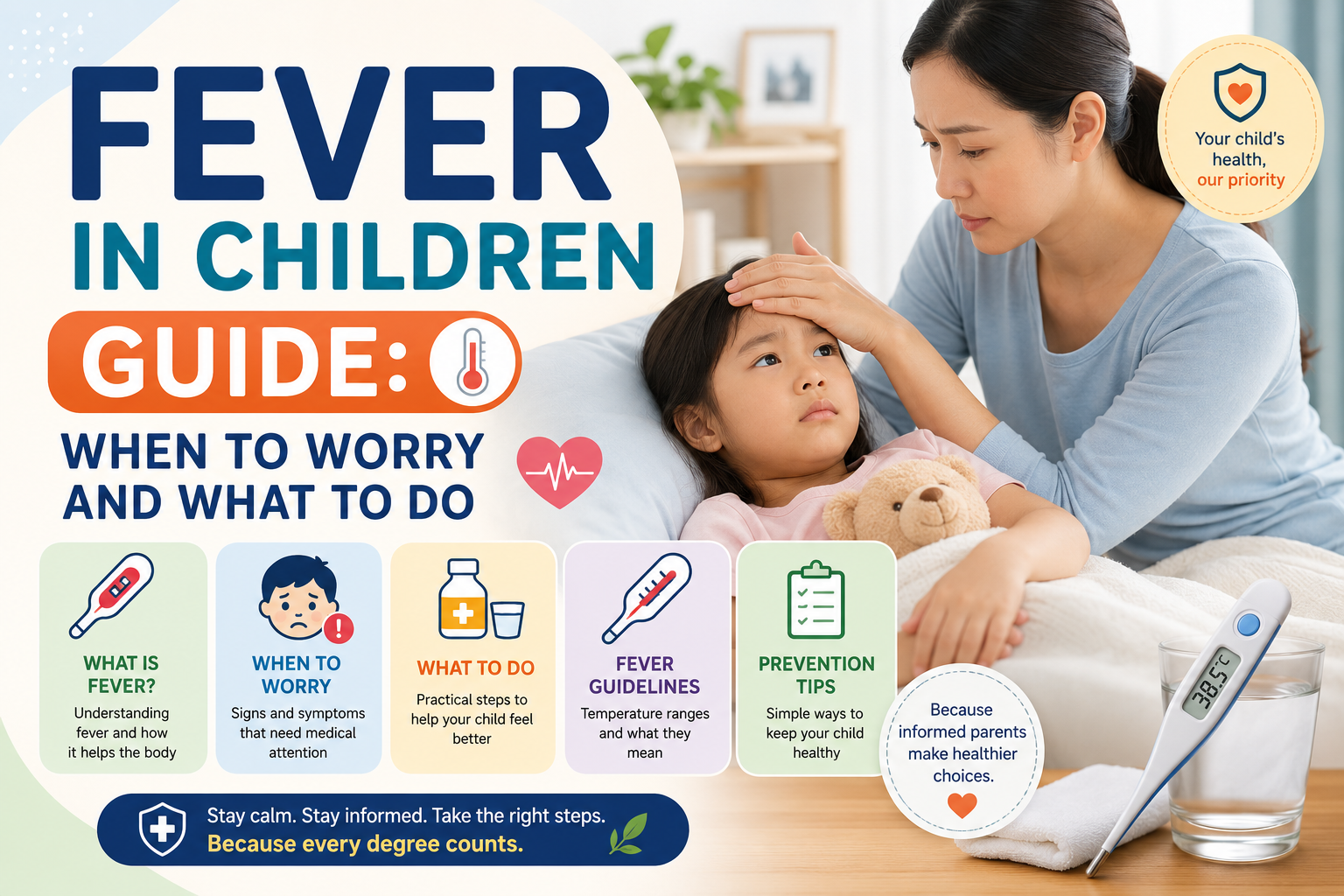
Fever in children is defined as a body temperature of 38°C or higher. It is the body's natural defense mechanism against infection, but knowing when to intervene and when to observe is critical. Fever accounts for 20–30% of all pediatric primary care visits in Southeast Asia, yet most cases resolve without medical treatment. This guide gives you evidence-based thresholds, home care steps, and clear danger signs specific to our region.
Key Takeaways
- Normal temperature range for children is 36.5–37.5°C. Fever starts at 38°C (rectal or ear reading).
- Febrile seizures occur in 2–5% of children aged 6 months to 5 years and rarely cause brain damage.
- Infants under 3 months with any fever must be seen by a doctor immediately due to a 10–15% risk of serious bacterial infection.
- Do not use tepid sponging – WHO and AAP advise against it. Paracetamol or ibuprofen are safer.
- Dengue fever is a leading cause of hospitalization among children in Malaysia; know the warning signs (bleeding, severe abdominal pain, persistent vomiting).
Why This Guide Exists
Your child feels warm. The thermometer reads 38.2°C. Your heart rate rises faster than the mercury. As a parent in Southeast Asia, you face additional layers of anxiety: Is it dengue? Hand-foot-mouth disease? A simple viral fever? Or something more serious?
Over 15 years of clinical practice across Malaysia and Singapore, fever consultations have numbered in the thousands. At least 70% could have been managed at home with proper guidance. Yet over 60% of parents in the region still reach for traditional remedies like tepid sponging – a practice the World Health Organization (WHO) has explicitly advised against since 2013. The gap between evidence and action is wide, and it is dangerous.
Caring for a sick child can leave you exhausted; recognize the signs your body needs more sleep.
This fever in children guide is designed for Southeast Asian parents. It addresses local disease patterns (dengue, hand-foot-mouth disease, vaccine reactions), cultural practices, and the practical realities of accessing healthcare in both urban and rural settings. It is not a substitute for professional medical advice, but it will give you the knowledge to make better decisions – and the confidence to stay calm.
Throughout this guide, we will reference the EazyCare AI symptom checker as a complementary tool to help you assess symptoms in real time. Use it alongside your clinical judgment, not instead of it.
What Is a Normal Temperature? Fever Temperature Children Normal Range Explained
The normal body temperature of a child is not a fixed number. It fluctuates with age, time of day, activity level, and even the room temperature. The normal range is 36.5°C to 37.5°C when measured rectally or via an ear thermometer. Axillary (armpit) readings are typically about 0.5°C lower.
"Fever itself is not an illness – it is a symptom. The body raises its temperature to make it harder for bacteria and viruses to survive."
— American Academy of Pediatrics, Fever Without Source guidelines (2021)
How to Check a Child's Temperature Accurately
| Method | Best for | Accuracy | Normal range |
|---|---|---|---|
| Rectal (digital thermometer) | Infants <3 months | Gold standard | 36.6–38.0°C |
| Ear (tympanic) | Children >6 months | Very good | 35.8–37.8°C |
| Axillary (armpit) | All ages (screening) | Good (0.5°C lower) | 34.7–37.3°C |
| Forehead (temporal artery) | Non-invasive, quick | Moderate | 35.8–37.5°C |
| Pacifier thermometer | Cooperative toddlers | Fair | Similar to axillary |
Key point: Fever temperature children normal range is not a single number. The CDC defines fever as a rectal/ear reading of 38°C or higher. For axillary measurements, add 0.5°C to decide if fever is present.
For children under 3 months, always use a rectal digital thermometer. It is the most accurate and the only method that should guide clinical decisions in this age group. Ear thermometers can be used from 6 months onward if the ear canal is clear.
Never use an old-school glass mercury thermometer – these are banned in many countries because of the risk of breakage and mercury poisoning.
Common Causes of Fever in Children in Southeast Asia
In our region, the differential diagnosis for fever is broader than in temperate climates. Viral upper respiratory infections account for the majority, but we must also consider dengue, hand-foot-mouth disease (HFMD), typhoid, and leptospirosis, especially during monsoon seasons.
If your child also reports chest pain, learn more about chest pain causes and meaning to identify potential concerns.
If your child also reports discomfort in the chest, understanding chest pain causes can help you assess the situation.
To help distinguish between these infections, refer to our guide on flu vs COVID-19 symptoms in 2025.
Dengue Fever: A Regional Threat
In Malaysia alone, over 100,000 dengue cases are reported annually, with children making up a significant proportion of hospitalizations. Dengue starts with high fever (often 39–40°C), severe headache, retro-orbital pain, and joint aches. The critical phase occurs at days 3–7 when fever drops – this is when warning signs appear: persistent vomiting, abdominal pain, bleeding gums, or restlessness.
If your child has fever for more than 2 days and develops any of the following, take them to the emergency department immediately: severe abdominal pain, persistent vomiting, bleeding from nose/gums, black stools, difficulty breathing, or irritability.
Hand-Foot-Mouth Disease (HFMD)
HFMD is highly prevalent in Southeast Asia, especially among children under 5. Fever is usually the first symptom, followed by mouth ulcers and a rash on palms, soles, and buttocks. The fever typically lasts 2–3 days. Complications (meningitis, encephalitis) are rare but possible. Watch for poor feeding due to mouth pain – dehydration is the main risk.
Febrile Seizures: What Every Parent Should Know
Febrile seizures occur in 2–5% of children aged 6 months to 5 years (WHO data). Most are simple febrile seizures: generalized tonic-clonic movements lasting less than 15 minutes, with no recurrence within 24 hours. They look terrifying but do not cause brain damage.
What to do during a seizure: lay the child on their side, clear nearby objects, time the seizure, and do not put anything in their mouth. If the seizure lasts more than 5 minutes, call an ambulance. After the seizure, consult a doctor to rule out meningitis or other causes.
Other Causes
- Vaccine reactions (discussed in Section 05)
- Urinary tract infections – especially in girls under 2, often with no other symptoms
- Bacterial infections – pneumonia, otitis media, sinusitis
- Kawasaki disease – persistent high fever >5 days with red eyes, cracked lips, rash, and swollen hands/feet
If your child has fever without any other obvious symptoms (no cough, runny nose, diarrhea, or rash), you need to consider a "fever without source." The EazyCare AI platform can help clinicians triage such cases using evidence-based algorithms.
Child Fever Home Care Tips: What Works and What Doesn't
Over the years, parents have been observed using everything from onion slices on the feet to urine-soaked cloths on the forehead. Most are harmless but ineffective. Some are outright dangerous. Here is what evidence supports.
Do This
Hydrate aggressively. Offer breastmilk, formula, or oral rehydration solutions frequently. For older children, popsicles and gelatin are good alternatives. Fever increases fluid loss by 10–15% per degree Celsius above 38°C.
Dress lightly. Remove extra layers of clothing and blankets. Use a single sheet. Overwrapping traps heat and can push the temperature higher.
Give antipyretics only if the child is uncomfortable. The goal is not to normalize temperature but to relieve discomfort. Use paracetamol (15 mg/kg every 4–6 hours) or ibuprofen (10 mg/kg every 6–8 hours). Do not alternate unless advised by a doctor – it increases the risk of dosing errors.
Monitor urine output. A child should urinate at least every 6–8 hours. Dark urine, dry mouth, and sunken eyes signal dehydration.
Don't Do This
- Tepid sponging – A 2018 Cochrane review found it does not reduce fever duration and can cause shivering (which actually raises core temperature). The WHO explicitly advises against it, yet over 60% of parents in Southeast Asia still use it.
- Alcohol or vinegar baths – Can be absorbed through the skin, causing toxicity or burns.
- Combining paracetamol and ibuprofen – Unless specifically told to by a doctor. Overlapping doses can lead to liver or kidney injury.
- Waking a sleeping child to give medicine – Sleep is restorative. If the child is sleeping comfortably, let them rest.
Give medicine if the temperature is ≥38.5°C AND the child is miserable (crying, refusing to eat, lethargic). If they are playing and hydrated despite a fever of 39°C, you can wait. Fever itself is not dangerous until it reaches 41°C (rare in children) – and that is usually due to overheating, not infection.
For the latest evidence-based guidance on home management, you can chat with the EazyCare AI health assistant – available 24/7 and calibrated for Southeast Asian contexts.
When to Worry About Child Fever: Danger Signs You Must Not Miss
Most fevers are harmless. But certain presentations require urgent medical attention. This is the most critical section of this fever in children guide.
For a broader list of symptoms you should never ignore, read our companion guide.
Immediate Red Flags – Go to the Emergency Department
- Age < 3 months with any fever (≥38°C) – risk of serious bacterial infection is 10–15%
- Temperature > 40.5°C (105°F) – especially if no obvious source
- Non-blanching rash – press a glass against the rash; if it does not fade, it could be meningococcal infection
- Stiff neck, photophobia, or bulging fontanelle – signs of meningitis
- Persistent vomiting – unable to keep any fluids down for 6+ hours
- Seizure lasting > 5 minutes, or multiple seizures
- Lethargy or extreme irritability – child is not interactive, difficult to wake, or inconsolable
- Labored breathing – grunting, retractions, or blue lips
- Signs of dehydration – no urine for 8 hours, dry mouth, sunken eyes, skin tenting
Fever Without Source for 3+ Days
If fever persists beyond 72 hours with no clear cause (no cough, cold, ear pain, or rash), see a doctor. This could indicate a urinary tract infection, occult bacteremia, or Kawasaki disease. In dengue-endemic areas, persistent fever with falling platelet count is a classic pattern.
Fever in Babies Under 3 Months – A Special Case
This age group deserves its own alert. Their immune systems are immature, and they cannot mount a localized response. A fever here might be the only sign of a serious bacterial infection (pneumonia, meningitis, UTI, or sepsis). The rate of serious bacterial infection in febrile infants under 3 months is 10–15% per WHO data. These infants require full sepsis workup – blood tests, urine culture, lumbar puncture, and intravenous antibiotics. Do not wait. Do not give paracetamol and hope it passes. Take them to the nearest hospital immediately.
Fever After Vaccination Baby: What’s Normal and What’s Not
Vaccinations are a common cause of fever in the first two years of life. The MMR (measles, mumps, rubella) vaccine can cause fever 7–12 days post-vaccination – often accompanied by a mild rash. The DTaP (diphtheria, tetanus, pertussis) vaccine can cause fever within 24 hours, sometimes with irritability or crying.
Normal vaccine fever: 38–39°C, lasts 1–2 days, child is generally active between spikes. It indicates the immune system is responding appropriately.
When to worry: If fever is >39.5°C, lasts >3 days, or is accompanied by a high-pitched cry, stiff neck, or seizure. In rare cases, vaccines can trigger febrile seizures – but these have the same good prognosis as other febrile seizures.
Doctors recommend giving paracetamol after DTaP (not before) if fever develops. Ibuprofen can be used for children over 6 months. For MMR fever, paracetamol is safe but avoid ibuprofen if there is a rash (rarely, ibuprofen can worsen inflammation).
Track your child’s post-vaccination symptoms using the EazyCare AI symptom tracker – it helps distinguish normal from abnormal patterns.
Fever vs Heatstroke Children: Critical Distinction in the Tropics
In Southeast Asia, heatstroke can easily be mistaken for infectious fever. Heatstroke occurs when the body’s temperature regulation fails due to prolonged exposure to high ambient temperatures. Unlike infectious fever, heatstroke does not respond to antipyretics.
| Feature | Infectious Fever | Heatstroke |
|---|---|---|
| Core temperature | Usually 38–40°C | Can exceed 40.5°C rapidly |
| Skin | Warm, often sweaty | Hot, red, and dry (no sweating) |
| Mental state | Irritable but conscious | Confusion, delirium, loss of consciousness |
| Response to antipyretics | Temperature drops 1–2°C | No response |
| Cause | Infection, vaccination, inflammation | Heat exposure, lack of hydration, enclosed spaces |
If you suspect heatstroke: Move the child to shade, remove clothing, apply cool (not ice-cold) water to the skin, fan them, and call for emergency transport. Do not give paracetamol or ibuprofen – they will not work and may worsen liver or kidney damage.
Prevention is straightforward: never leave a child in a parked car; ensure they drink water every 20 minutes during outdoor play; and use air-conditioned spaces between 11am and 3pm (hottest hours).
Frequently Asked Questions
What temperature is considered a fever in children?
A fever is a body temperature of 38°C (100.4°F) or higher measured rectally or via an ear thermometer. For axillary (armpit) readings, a fever is 37.5°C or higher (since armpit readings are about 0.5°C lower). The normal range is 36.5–37.5°C. Use the same method consistently to track trends. If you are unsure about the reading, repeat it after 15 minutes. EazyCare AI's symptom checker can help you interpret temperature readings based on your child's age.
When should I take my child to the hospital for a fever?
Take your child to the hospital immediately if they are under 3 months old with any fever; have a temperature >40.5°C; show signs of meningitis (stiff neck, severe headache, light sensitivity); have a non-blanching rash; have a seizure lasting more than 5 minutes; are lethargic or difficult to wake; have labored breathing; or show signs of dehydration (no urine for 8 hours, dry mouth, sunken eyes). For older children with a fever <39°C who are otherwise well, a clinic visit within 24 hours is usually sufficient.
Can a fever cause brain damage in children?
No. Fever caused by infection does not cause brain damage. The body's temperature regulation mechanism prevents fever from reaching dangerous levels (above 41.5°C) during infections. Brain damage from high temperature occurs only in rare cases of heatstroke or malignant hyperthermia, where the body loses the ability to cool itself. Febrile seizures, though frightening, also do not cause brain damage. The myth persists because historically, prolonged febrile status epilepticus (seizure lasting >30 minutes) could be harmful, but this is extremely rare and treatable.
How long does a fever last in kids?
Most viral fevers last 3 to 5 days. Fever patterns vary: with influenza, temperature spikes may last 3–4 days; with dengue, high fever typically lasts 2–7 days followed by a defervescence (critical phase). If fever persists beyond 5 days, see a doctor to rule out bacterial infection or Kawasaki disease. Fevers that come and go over several weeks (e.g., cyclical fevers) require thorough investigation. EazyCare AI's symptom tracker can record fever duration and help spot abnormal patterns.
Is it safe to give paracetamol and ibuprofen together for fever?
No, routine alternating of paracetamol and ibuprofen is not recommended because it increases the risk of dosing errors and side effects (liver or kidney injury). Give one medication at a time, as needed for discomfort. If the child does not respond to paracetamol after 1–2 hours and is still miserable, you may switch to ibuprofen (if >6 months old). But do not give both within the same 4-hour window. Unless a doctor specifically instructs you (e.g., for very high fever in hospital settings), stick to a single drug.
What are the signs of febrile seizure in children?
Febrile seizures typically occur between 6 months and 5 years of age during a rapid rise in temperature. Signs include: loss of consciousness, stiffening of the body, jerking of arms and legs, rolling of the eyes, and sometimes foaming at the mouth or turning blue. Most last less than 2 minutes. After the seizure, the child may be sleepy or confused for up to 30 minutes (postictal state). Simple febrile seizures do not cause brain damage. If febrile seizures occur, seek medical evaluation to rule out meningitis or epilepsy.
How to check a child's temperature accurately?
For children under 3 months, use a rectal digital thermometer – insert 1–2 cm into the rectum with lubricant. For children 6 months and older, an ear (tympanic) thermometer is accurate and easy. For screening, axillary (armpit) readings are acceptable but add 0.5°C to estimate core temp. Forehead (temporal artery) thermometers are convenient but less accurate – confirm with a rectal or ear reading if fever is suspected. Do not use oral thermometers until a child can reliably hold it under the tongue (usually >5 years). Pacifier thermometers give rough estimates only.
Should I wake my child to give fever medicine?
No. If your child is sleeping comfortably, let them sleep. Sleep is essential for immune recovery. Wake them only if they are uncomfortable (tossing, crying in sleep) or if you are concerned about very high fever (>40°C). You can gently check their temperature without waking them fully. If the fever is high but the child is resting peacefully, antipyretics can wait until they wake naturally. If you are unsure, use the EazyCare AI symptom checker to guide your decision.
What causes fever in children without other symptoms?
Fever without source (no cough, coryza, ear pain, rash, or diarrhea) can be caused by: urinary tract infection (most common in girls <2 years), occult bacteremia (bacteria in the blood without localized signs), Kawasaki disease (prolonged fever >5 days with red eyes, cracked lips, strawberry tongue), typhoid fever in endemic areas, dengue fever before the classic rash appears, or roseola (herpesvirus 6) which declares itself only after fever drops. If isolated fever lasts >3 days, a doctor should evaluate with blood and urine tests.
Is fever after vaccination normal in babies?
Yes, fever after vaccination is a normal and expected immune response. It occurs most often after DTaP (within 24 hours) and MMR (7–12 days later). Temperatures usually range 38–39°C and last 1–2 days. Treat with paracetamol if the baby is uncomfortable. Do not give prophylactic antipyretics before vaccination – they may blunt the immune response. Seek medical advice if fever exceeds 39.5°C, lasts >3 days, or is accompanied by a high-pitched cry, seizure, or inconsolable crying for >3 hours.
When to See a Doctor
Emergency signs – go to hospital now:
- Infant <3 months with fever ≥38°C
- Temperature >40.5°C (105°F)
- Non-blanching rash (glass test positive)
- Stiff neck, bulging fontanelle, or severe headache
- Seizure lasting >5 minutes or multiple seizures
- Lethargic, unresponsive, or extremely irritable
- Labored breathing (grunting, retractions, flaring nostrils)
- Signs of severe dehydration: no urine for 8 hours, dry mouth, sunken eyes, skin tenting
Urgent clinic visit within 24 hours:
- Fever >5 days
- Fever >3 days with no source
- Child with chronic illness (heart disease, immunodeficiency)
- Recurrent fevers over several weeks
- History of febrile seizures multiple times
If you are unsure whether your child needs urgent care, EazyCare AI's triage tool can help you decide based on evidence-based guidelines.
Conclusion
Fever in children is one of the most common – and most frightening – experiences for parents. This fever in children guide has given you the tools to differentiate benign viral illnesses from serious conditions, using evidence-based thresholds and Southeast Asia-specific warnings.
Three key takeaways:
- Trust the numbers but not blindly. Fever starts at 38°C (rectal). Normal is 36.5–37.5°C. Use the correct thermometer for your child's age.
- Treat the child, not the number. Give antipyretics only if the child is uncomfortable. Prioritize hydration, light clothing, and rest.
- Know your local risks. In dengue season, watch for warning signs. For infants under 3 months, any fever is a medical emergency.
For personalized guidance, you can always chat with our AI health companion at eazycare.ai/chat. It is designed to help Southeast Asian parents make informed, confident decisions – day or night. When in doubt, see a doctor. Your child's safety comes first.