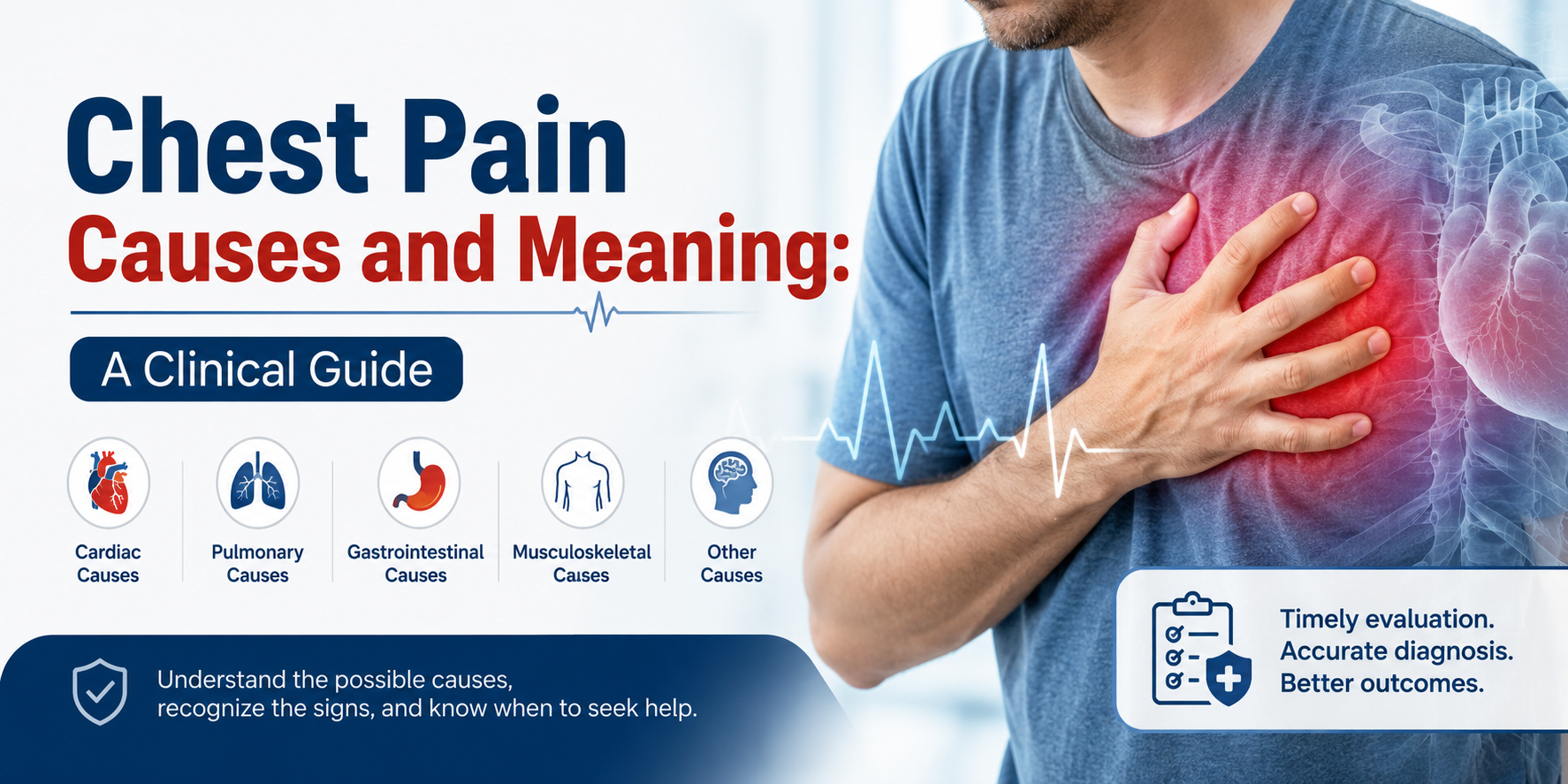
Chest pain is a symptom that sends millions of people to emergency departments every year, yet only 15–25% of cases turn out to be cardiac in origin. The challenge is that the remaining 75–85%—caused by anxiety, indigestion, musculoskeletal strain, or respiratory infections—can feel indistinguishable from a heart attack in the moment. Understanding chest pain causes and meaning is the difference between receiving life-saving treatment within the golden hour and spending hours in a crowded emergency room for a condition that could have been managed at home.
Key Takeaways
- Chest pain is cardiac in only 15–25% of emergency visits; the majority stems from gastrointestinal, musculoskeletal, pulmonary, or psychological causes.
- Cardiac chest pain typically presents as pressure, tightness, or squeezing—not sharp or stabbing pain—and may radiate to the jaw, left arm, or back.
- Atypical presentations are common in women, the elderly, and people with diabetes, who may report fatigue, shortness of breath, or nausea instead of classic chest pain.
- In Southeast Asia, infectious causes such as tuberculous pericarditis and rheumatic heart disease are more prevalent than in Western populations and must be considered in the differential diagnosis.
- If chest pain is accompanied by shortness of breath, cold sweats, nausea, or pain radiating to the arm or jaw, seek emergency care immediately—do not wait.
Why Chest Pain Demands a Systematic Approach
A 52-year-old man in Kuala Lumpur wakes at 3 a.m. with a dull pressure in his chest. He has a history of hypertension and eats a diet high in coconut milk and fried foods. He waits until morning, takes a traditional herbal tonic, and only visits the clinic when the sensation spreads to his jaw. By then, he has lost four hours of precious time—time that could have saved more heart muscle if he had presented earlier.
For those with hypertension, understanding your blood pressure numbers is key to preventing heart complications.
This scenario plays out daily across Southeast Asia. According to the World Health Organization, cardiovascular disease claims 17.9 million lives globally each year. In Malaysia, non-communicable diseases account for 73% of all deaths, with cardiovascular disease alone responsible for 25% of that burden, as reported by the Ministry of Health Malaysia. Yet chest pain is not always cardiac. A 2019 review published in PubMed found that anxiety and panic disorders account for up to 20% of chest pain presentations to cardiology clinics, with non-cardiac chest pain being a frequent final diagnosis.
The problem is that generic advice written for Western populations often overlooks key realities in Southeast Asia: the higher prevalence of infectious causes such as tuberculous pericarditis and rheumatic heart disease, the cultural tendency to delay care due to cost concerns or reliance on traditional remedies, and the fact that public hospitals in the region may not have immediate access to advanced imaging. This article provides a practical, evidence-based framework for understanding chest pain causes and meaning—what to look for, when to act, and how to navigate the decision with confidence. For personalised triage, EazyCare AI's symptom checker can help you assess your specific situation in real time.
Cardiac Chest Pain: Heart Attack vs Angina vs Other Cardiac Conditions
When patients ask what cardiac chest pain feels like, the answer is rarely the "crushing, elephant-on-the-chest" sensation portrayed in television dramas. In clinical practice, cardiac chest pain—also called anginal pain—is more often described as pressure, tightness, squeezing, or a heavy weight. It is diffuse, not localised to a single spot the size of a coin. Patients often place a flat hand over their sternum, not a pointed finger, when describing the location.
Angina vs Heart Attack: The Stability Spectrum
Stable angina occurs when coronary arteries are narrowed but not completely blocked. It is predictable: it comes on during exertion—walking uphill, carrying groceries, climbing stairs—and resolves within 2–5 minutes of rest or nitroglycerin. The pain is reproducible and follows a pattern the patient can recognise. Unstable angina breaks that pattern. It occurs at rest, lasts longer than 15–20 minutes, or becomes more frequent or severe. Unstable angina is a medical emergency because it signals that a plaque has ruptured and a heart attack may be imminent.
Acute myocardial infarction (heart attack) happens when a coronary artery is completely occluded. The pain is prolonged—typically longer than 20 minutes—and does not resolve with rest or nitroglycerin. The American Heart Association emphasises that additional symptoms—shortness of breath, cold sweats, nausea, lightheadedness, or pain radiating to the left arm, jaw, back, or shoulder—increase the likelihood of a heart attack significantly.
Approximately 50% of patients experiencing a heart attack report chest pain as the primary symptom, according to a 2017 study in PubMed. The other half—particularly women, the elderly, and people with diabetes—may present with atypical symptoms such as extreme fatigue, indigestion, or simply "feeling unwell." Never dismiss chest pain just because it does not match the textbook description.
Other Cardiac Causes: Pericarditis and Myocarditis
Not all cardiac chest pain is caused by coronary artery disease. Pericarditis—inflammation of the sac surrounding the heart—produces sharp, pleuritic pain that worsens with deep breathing, lying flat, or coughing. It often improves when the patient sits up and leans forward. Myocarditis, inflammation of the heart muscle itself, can mimic a heart attack with chest pain, elevated troponin levels, and ECG changes, but it is usually preceded by a viral illness. In Southeast Asia, tuberculous pericarditis remains an important cause of pericardial effusion and constrictive pericarditis, particularly in immunocompromised patients and those with a history of tuberculosis exposure.
Practical takeaway: If your chest pain is sharp, positional, and worsens when you breathe in, the cause may be pericarditis rather than a heart attack. However, given the overlap in presentation, any new chest pain warrants an ECG and a clinical evaluation before self-diagnosing.
| Feature | Stable Angina | Unstable Angina / Heart Attack | Pericarditis |
|---|---|---|---|
| Quality | Pressure, tightness, squeezing | Pressure, tightness, often severe | Sharp, stabbing, pleuritic |
| Duration | 2–5 minutes | >15–20 minutes | Hours to days, waxing and waning |
| Triggers | Exertion, stress, cold | Occurs at rest or with minimal exertion | Deep breathing, lying flat |
| Relief | Rest, nitroglycerin | Not relieved by rest or nitroglycerin | Sitting up, leaning forward |
| Radiation | Jaw, left arm, back | Jaw, left arm, back, shoulder | Rarely radiates; may involve shoulders |
Non-Cardiac Chest Pain Causes: Anxiety, Indigestion, and Musculoskeletal Issues
The majority of chest pain cases seen in emergency departments and primary care clinics are not cardiac. A systematic approach to chest pain causes and meaning must include the gastrointestinal, musculoskeletal, pulmonary, and psychological differentials that account for 75–85% of presentations. In Southeast Asia, where infectious diseases remain prevalent, the list expands to include conditions such as tuberculous pericarditis, rheumatic heart disease, and even dengue-related myocarditis.
Gastrointestinal Causes: Gastroesophageal Reflux and Gastritis
Gastroesophageal reflux disease (GERD) is one of the most common mimics of cardiac chest pain. The pain is typically burning, retrosternal, and may be accompanied by a sour taste or regurgitation. It often occurs after meals, when lying down, or at night. Importantly, GERD can be triggered or worsened by spicy foods, caffeine, alcohol, and large meals—all common dietary patterns in Southeast Asia. Indigestion chest pain symptoms can be distinguished from cardiac pain by their relationship to food and posture: antacids provide relief, and the pain does not radiate to the arm or jaw.
However, clinicians must be cautious. A 2017 study found that up to 22% of patients diagnosed with gastroesophageal reflux in the emergency department were later found to have acute coronary syndrome. The overlap is significant enough that the NHS advises against assuming chest pain is "just indigestion" without a proper evaluation.
The "indigestion trap": Many patients with heart attacks report symptoms they mistake for indigestion—a burning sensation, nausea, or upper abdominal discomfort. If you have taken antacids and your symptoms persist for more than 15 minutes, or if they are accompanied by shortness of breath or sweating, seek emergency care.
Anxiety and Panic Attacks: When the Mind Mimics the Heart
Anxiety-related chest pain is real, but it is not dangerous. A panic attack can produce chest tightness, palpitations, hyperventilation, and a sense of impending doom—symptoms that can be indistinguishable from a heart attack to the person experiencing them. The key differentiators are: (1) panic attacks are often triggered by emotional stress, not physical exertion; (2) the pain is typically sharp and localised to the centre of the chest; (3) accompanying symptoms include tingling in the hands or around the mouth, a sense of unreality, and a rapid heart rate; and (4) symptoms peak within 10 minutes and then begin to subside.
Poor sleep can worsen anxiety and trigger chest pain; learn to recognize signs your body needs more sleep.
Stress can also contribute to headaches, and understanding headache causes beyond stress is important.
A 2019 review in PubMed confirmed that anxiety and panic disorders are a cause of chest pain in up to 20% of patients presenting to cardiology clinics. This statistic underscores the importance of not dismissing psychological causes, but also not assuming chest pain is "just anxiety" without ruling out organic pathology. Chest pain heart attack vs anxiety can often be distinguished by a careful history: if the pain is reproducible with stress and resolves when the patient calms down, anxiety is more likely. But the only way to be certain is with an ECG and a clinical examination.
Musculoskeletal Causes: Costochondritis and Chest Wall Strain
Costochondritis—inflammation of the cartilage connecting the ribs to the sternum—is a common cause of chest pain in younger patients. The pain is sharp, localised, and reproducible with palpation: if pressing on a specific spot on the chest reproduces the exact pain, the cause is likely musculoskeletal. Chest wall strain from heavy lifting, coughing, or repetitive movements is another frequent culprit. These conditions are benign and self-limiting, typically resolving within days to weeks with rest and anti-inflammatory medication.
Practical takeaway: If you can reproduce your chest pain by pressing on your chest with your fingers, the cause is almost certainly musculoskeletal. However, this test is not definitive—some patients with cardiac pain also have chest wall tenderness. Use it as one piece of information, not the final diagnosis.
Pulmonary Causes of Chest Pain: A Critical Consideration in Southeast Asia
Lung-related causes of chest pain are often overlooked in general-audience guides, but they are particularly relevant in Southeast Asia due to the high prevalence of tuberculosis, pneumonia, and other respiratory infections. Pleuritic chest pain—sharp pain that worsens with inspiration or coughing—suggests inflammation of the pleura (the lining of the lungs). Causes include viral pleurisy, bacterial pneumonia, pulmonary embolism, and tuberculous pleuritis.
Parents should also refer to our fever in children guide if respiratory symptoms accompany chest pain.
Pulmonary embolism (PE) is a life-threatening condition that presents with sudden-onset chest pain, shortness of breath, and sometimes coughing up blood. The pain is pleuritic in nature and may be accompanied by tachycardia, tachypnea, and hypoxia. Risk factors include prolonged immobility (long-haul flights, bed rest), recent surgery, oral contraceptive use, and a history of deep vein thrombosis. In Southeast Asia, where air travel is common among professionals, PE is an under-recognised cause of chest pain that requires immediate CT pulmonary angiography for diagnosis.
Spontaneous pneumothorax—a collapsed lung—presents with sudden, sharp chest pain and shortness of breath. It is most common in tall, thin young men and smokers. The pain is typically unilateral and may radiate to the shoulder on the affected side. A chest X-ray confirms the diagnosis, and treatment ranges from observation to chest tube insertion depending on the size of the pneumothorax.
Tuberculous pericarditis and pleuritis deserve special mention for the Southeast Asian context. According to the Ministry of Health Malaysia, tuberculosis remains a significant public health burden in the region. Pericardial involvement can present with chest pain, fever, night sweats, and weight loss, and may progress to constrictive pericarditis if untreated. Any patient with chest pain and a history of tuberculosis exposure, HIV infection, or unexplained systemic symptoms should be evaluated for tuberculous pericarditis.
Sudden-onset chest pain with shortness of breath is a medical emergency regardless of the underlying cause. Whether the cause is a pulmonary embolism, pneumothorax, or heart attack, these conditions require urgent hospital-based evaluation. Do not attempt to differentiate these at home—go to the nearest emergency department.
Chest Pain in Women and the Elderly: Why Atypical Symptoms Are the Norm
One of the most dangerous misconceptions in medicine is that chest pain always presents as crushing, central chest pressure. In reality, atypical presentations of acute coronary syndrome are the rule, not the exception, in women, the elderly, and people with diabetes. A 2017 study published in PubMed found that approximately 50% of patients experiencing a heart attack report chest pain as the primary symptom—meaning the other half do not.
Women are more likely than men to report: extreme fatigue (often described as "profound tiredness" that is out of proportion to activity), shortness of breath without chest pain, upper back pain or pain between the shoulder blades, nausea or vomiting, and indigestion or heartburn. These symptoms are frequently dismissed by both patients and clinicians as anxiety, stress, or gastrointestinal issues, leading to delayed treatment and worse outcomes. The American Heart Association specifically highlights that women may not experience chest pain at all during a heart attack—they may simply feel "sick" or "off."
Similarly, older adults (aged 65 and above) and those with diabetes often have silent ischaemia or atypical presentations. Diabetic neuropathy can blunt the perception of pain, meaning a heart attack may present only as shortness of breath, confusion, or a sudden drop in blood pressure. In elderly patients, falls, confusion, or generalised weakness may be the only signs of an acute coronary event.
Practical takeaway: If you are a woman over 50, or if you have diabetes or are over 65, do not rely on chest pain as the barometer of whether you are having a heart attack. Pay attention to unexplained shortness of breath, nausea, fatigue, or back pain. If these symptoms are new, severe, or progressive, seek medical evaluation.
Learn about other symptoms you should never ignore to recognize early warning signs.
Chest Pain Emergency Signs: When to Call 999 and When to Wait
One of the most common questions patients ask is: "How do I know if my chest pain is serious?" The answer lies in a simple, three-step framework that every patient can apply. The CDC provides clear guidance on recognising the warning signs of a heart attack, and the same principles apply to ruling in or out other serious causes of chest pain.
Assess the RED FLAGS. Do you have any of the following: shortness of breath, cold sweats, nausea or vomiting, lightheadedness or fainting, pain radiating to the left arm, jaw, back, or shoulder, a sense of impending doom, or chest pressure that has lasted more than 15 minutes? If yes, call 999 or go to the nearest emergency department immediately. Do not drive yourself. Do not wait to see if it passes.
Evaluate the context. Is the pain triggered by exertion or emotional stress? Does it resolve with rest? If the pain is predictable, reproducible, and resolves within 2–5 minutes of rest, it may be stable angina or a musculoskeletal cause. However, if the pattern has changed—the pain occurs at rest, lasts longer, or is more intense—this is unstable angina and requires urgent evaluation.
Consider your risk factors. Do you have a history of hypertension, diabetes, high cholesterol, smoking, or a family history of early heart disease? Are you over 45 (men) or over 55 (women)? If you have one or more risk factors, the threshold for seeking care should be lower—even if the symptoms seem "mild."
"Chest pain that is accompanied by shortness of breath, sweating, or nausea is a medical emergency until proven otherwise. The cost of a false alarm—an ECG, a chest X-ray, and a few hours in the emergency department—is far less than the cost of waiting too long."
— Adapted from clinical guidelines by the American Heart Association
Chest pain treatment at home is only appropriate for clearly benign causes. If you have had similar pain before and a doctor has diagnosed you with costochondritis or GERD, you can use your prescribed treatments (antacids for GERD, anti-inflammatories for costochondritis). But if this is a new symptom, or if the pattern of an old symptom has changed, do not attempt to treat it at home. The risk of missing a cardiac event is too high.
For a quick, personalised assessment of your chest pain symptoms, you can use EazyCare AI's symptom checker, which will guide you through the decision-making process and help you determine whether you need emergency care.
Chest Pain Diagnosis: What Happens at the Hospital
Understanding the diagnostic process can reduce anxiety and help you prepare for what to expect if you go to the emergency department with chest pain. The evaluation follows a standardised protocol designed to rapidly identify or exclude life-threatening conditions.
The first step is an ECG (electrocardiogram), which records the electrical activity of the heart. An ECG can detect evidence of a heart attack, unstable angina, pericarditis, or arrhythmias within minutes. It is the single most important test in the initial evaluation of chest pain. In most public hospitals in Southeast Asia, an ECG costs between RM 15 and RM 50 (approximately USD 3–10) and is available at all emergency departments.
The second step is a chest X-ray to look for pneumonia, pneumothorax, pulmonary oedema, pericardial effusion, or other structural abnormalities. This is followed by blood tests, including cardiac troponin, which is a protein released into the bloodstream when heart muscle is damaged. Troponin levels begin to rise within 3–4 hours of a heart attack and peak at 12–24 hours. A normal troponin level at presentation does not rule out a heart attack—it must be repeated 6 hours later to confirm.
If the initial tests are inconclusive but the clinical suspicion is high, further testing may include: echocardiogram (ultrasound of the heart to assess wall motion abnormalities), stress testing (exercise ECG or pharmacological stress test), or CT coronary angiography (a specialised CT scan to visualise coronary artery blockages). In resource-limited settings, the availability of advanced imaging varies, and clinicians may rely on clinical scoring systems such as the HEART score or TIMI score to risk-stratify patients.
For clinicians, tools like AI closing care gaps healthcare can help identify at-risk patients who might otherwise present atypically.
Practical takeaway: If you present to a public hospital in Malaysia, Singapore, Indonesia, or the Philippines, expect an ECG and blood tests as the minimum evaluation. The average time from arrival to ECG should be under 10 minutes in a well-organised emergency department. If you are waiting longer, advocate for yourself or ask a family member to do so.
Frequently Asked Questions About Chest Pain
What does chest pain indicate?
Chest pain indicates that something is wrong in one of the structures within the chest—the heart, lungs, oesophagus, muscles, ribs, or nerves. It does not automatically mean a heart attack. The cause can range from benign (costochondritis, GERD, anxiety) to life-threatening (heart attack, pulmonary embolism, aortic dissection). The meaning depends on the quality, duration, triggers, and accompanying symptoms of the pain. A thorough clinical evaluation—including an ECG and blood tests—is the only way to determine the specific cause with certainty. If you are unsure about your symptoms, use EazyCare AI's symptom checker for a quick assessment.
When should I worry about chest pain?
You should worry about chest pain—and seek emergency care immediately—if it is accompanied by any of the following: shortness of breath, cold sweats, nausea or vomiting, lightheadedness or fainting, pain that radiates to the left arm, jaw, back, or shoulder, a sense of impending doom, or chest pressure that lasts more than 15 minutes and does not resolve with rest. You should also worry if you have risk factors such as diabetes, hypertension, high cholesterol, smoking, or a family history of heart disease, and you experience new or changing chest symptoms—even if the pain is "mild."
Can chest pain be caused by anxiety?
Yes. Anxiety and panic attacks are a cause of chest pain in up to 20% of patients presenting to cardiology clinics, according to a 2019 review in PubMed. Anxiety-related chest pain is typically sharp, localised to the centre of the chest, and accompanied by palpitations, hyperventilation, tingling in the hands or around the mouth, and a sense of unreality. It is often triggered by emotional stress rather than physical exertion, and symptoms peak within 10 minutes. However, because the symptoms overlap with cardiac chest pain, you should never assume chest pain is "just anxiety" without a proper medical evaluation.
What is the most common cause of chest pain?
The most common cause of chest pain in primary care and emergency settings is non-cardiac. Gastroesophageal reflux disease (GERD) and musculoskeletal conditions such as costochondritis account for the majority of cases. In a typical emergency department, only 15–25% of chest pain cases are ultimately diagnosed as cardiac in origin. Among cardiac causes, stable angina and acute coronary syndrome (heart attack and unstable angina) are the most common. In Southeast Asia specifically, infectious causes such as tuberculous pericarditis and rheumatic heart disease are more prevalent than in Western populations.
Is chest pain always a heart attack?
No, chest pain is not always a heart attack. In fact, 75–85% of chest pain cases seen in emergency departments are non-cardiac. The most common non-cardiac causes include GERD, costochondritis, anxiety and panic attacks, pneumonia, pleurisy, and pulmonary embolism. However, because it is impossible to distinguish cardiac from non-cardiac chest pain without an ECG and blood tests, any new or unexplained chest pain should be evaluated by a healthcare professional as soon as possible. Never assume chest pain cannot be a heart attack—err on the side of caution.
What does cardiac chest pain feel like?
Cardiac chest pain—also called anginal pain—is most commonly described as pressure, tightness, squeezing, or a heavy weight on the chest. It is diffuse, meaning patients often place a flat hand over their sternum rather than pointing to a single spot. The pain may radiate to the left arm, jaw, back, or shoulder. Some patients describe it as a "band around the chest" or a "burning sensation" that can be mistaken for indigestion. In women and the elderly, cardiac chest pain may present as shortness of breath, extreme fatigue, or nausea without any chest discomfort at all.
Can gas cause chest pain?
Yes, trapped gas in the stomach or oesophagus can cause chest pain that mimics cardiac pain. This is often due to gastroesophageal reflux (GERD) or gastritis. The pain is typically burning in nature and may be accompanied by bloating, belching, or a sour taste in the mouth. It often occurs after meals or when lying down, and antacids usually provide relief. However, because the sensation of gas pain can overlap with heart attack symptoms—particularly in the lower chest or upper abdomen—it is safer to have any new chest pain evaluated. If antacids do not relieve the pain within 15 minutes, or if the pain is accompanied by shortness of breath or sweating, seek emergency care.
How to know if chest pain is serious?
Chest pain is more likely to be serious if it has these characteristics: (1) it is accompanied by shortness of breath, cold sweats, nausea, lightheadedness, or pain radiating to the arm, jaw, or back; (2) it lasts more than 15 minutes and does not resolve with rest; (3) it occurs at rest or with minimal exertion; (4) it is a new symptom or different from any chest pain you have had before; (5) you have risk factors such as diabetes, hypertension, smoking, or a family history of heart disease. If any of these apply, seek emergency care immediately. If you are uncertain, EazyCare AI's symptom checker can help you assess your risk.
What are the emergency signs of chest pain?
The emergency signs that indicate you need to call 999 or go to the nearest emergency department immediately are: chest pain or discomfort accompanied by shortness of breath, cold sweats, nausea or vomiting, lightheadedness or fainting, pain radiating to the left arm, jaw, back, or shoulder, a sense of impending doom, chest pressure that lasts more than 15 minutes, or sudden-onset chest pain that is severe and tearing in nature (which may indicate aortic dissection). Do not wait to see if the symptoms improve—early treatment saves heart muscle and lives. EazyCare AI's symptom checker can help you decide whether you need urgent care.
Does chest pain go away on its own?
Some causes of chest pain do resolve on their own—costochondritis, GERD, anxiety-related chest pain, and stable angina all typically improve with rest or specific treatments. However, the fact that chest pain resolves does not rule out a serious cause. Unstable angina and heart attacks can present with waxing and waning symptoms, and a pulmonary embolism may cause pleuritic pain that comes and goes. Even if your chest pain goes away, if it was accompanied by red flags (shortness of breath, sweating, nausea, radiation to the arm or jaw) or if you have cardiac risk factors, you should still seek medical evaluation. The pain may have resolved, but the underlying condition may not have.
When to See a Doctor for Chest Pain
The decision to seek medical care for chest pain should be guided by the presence of specific red flag symptoms. If any of the following apply to you, do not wait—seek emergency care immediately:
- Chest pain or discomfort that lasts more than 15 minutes and does not resolve with rest
- Pain that radiates to the left arm, jaw, back, or shoulder
- Shortness of breath, with or without chest pain
- Cold sweats, nausea, or vomiting
- Lightheadedness, dizziness, or fainting
- A sense of impending doom or "something is wrong"
- Sudden-onset, severe chest pain that feels like a tearing or ripping sensation (possible aortic dissection)