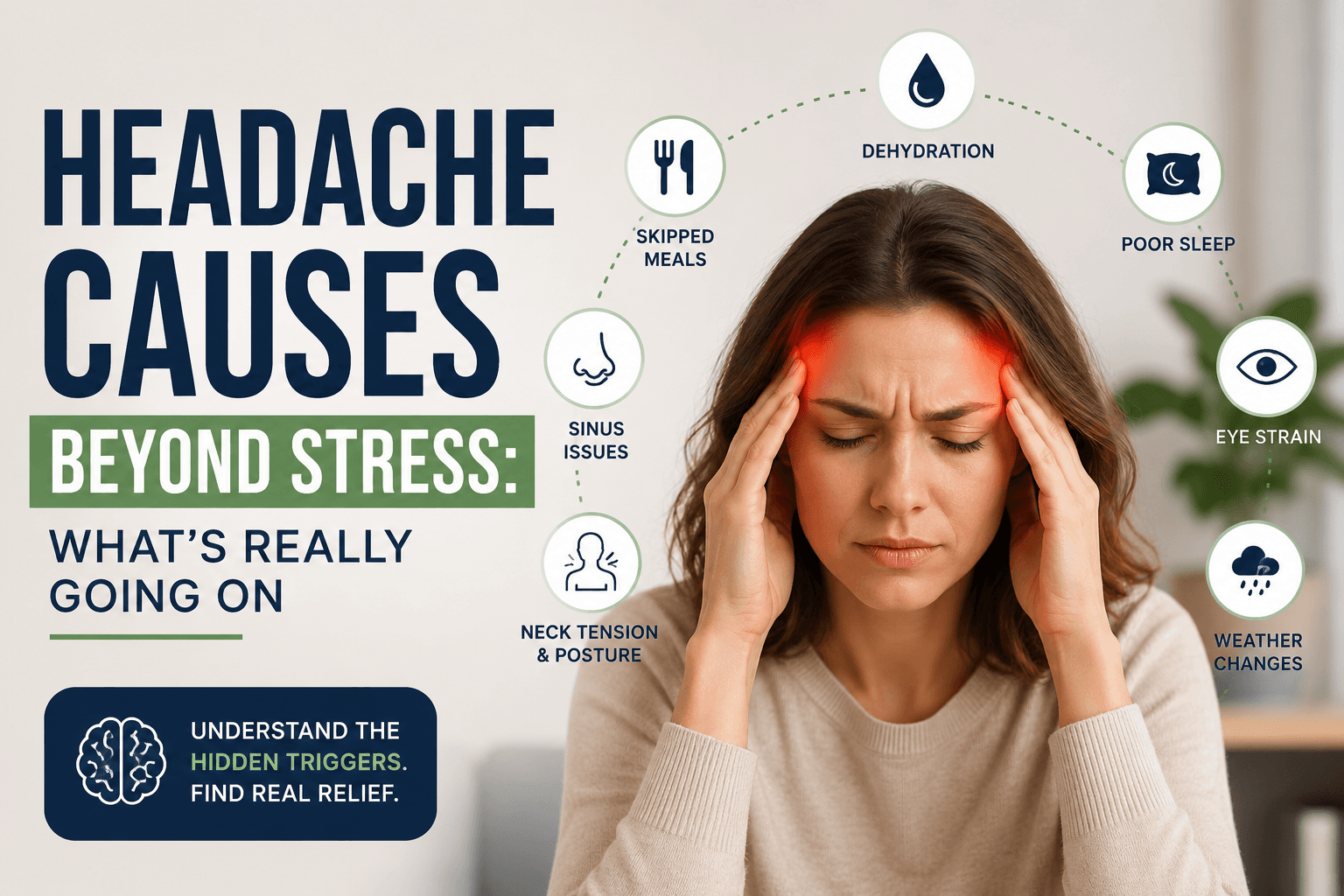
Headache causes beyond stress include hypertension, dengue fever, medication overuse, obstructive sleep apnoea, intracranial pathology, and environmental triggers such as air pollution — conditions that are frequently missed when patients and clinicians default to a stress explanation. Attributing every headache to stress delays diagnosis of conditions that carry real morbidity and, in a minority of cases, mortality. Headache disorders affect approximately 52% of the global population, making them one of the most prevalent neurological conditions worldwide, according to the World Health Organization.
Key Takeaways
- Secondary headaches — those caused by an underlying medical condition — account for approximately 10% of all headache presentations but carry disproportionately higher morbidity than primary headaches.
- Undiagnosed hypertension affects nearly 1 in 3 Malaysian adults and is a recognised, treatable cause of recurrent headache that most patients never consider.
- Dengue fever must be included in the differential diagnosis for any sudden severe headache in Southeast Asia, particularly during outbreak periods.
- Medication overuse headache (MOH) — caused by taking analgesics more than 10–15 days per month — paradoxically worsens chronic headache and is widely underdiagnosed in primary care.
- The SNOOP4 mnemonic gives patients and clinicians a structured framework for identifying red-flag headache features that require urgent investigation.
- Haze events and PM2.5 air pollution, endemic to Malaysia, Indonesia, and Singapore, are associated with a statistically significant increase in emergency department visits for headache and migraine.
- A thunderclap headache — reaching peak intensity within 60 seconds — is a medical emergency until proven otherwise, associated with subarachnoid haemorrhage in up to 25% of cases.
The Headache You Keep Dismissing May Deserve a Second Look
Picture a 38-year-old accountant in Kuala Lumpur who has had a headache every afternoon for the past three months. She attributes it to screen fatigue and deadline pressure — a reasonable assumption on the surface. She takes paracetamol most days, sometimes twice. The headaches persist. When she finally visits a clinic, her blood pressure reads 158/96 mmHg. She has had no idea. The headache was not stress. It was her cardiovascular system signalling a problem that, left unaddressed, carries a measurable risk of stroke.
This scenario is not rare. It is, in fact, one of the most common diagnostic delays seen in Malaysian primary care. The cultural tendency to normalise headache — to absorb it as a cost of modern life — means that patients frequently self-medicate for months before seeking evaluation. By that point, some have developed medication overuse headache on top of their original condition, compounding the clinical picture.
The medical reality is more nuanced than the stress narrative allows. Headache is a symptom, not a diagnosis. It is the brain's most non-specific alarm signal, triggered by everything from muscle tension to rising intracranial pressure. The vast majority of headaches — roughly 90% — are primary headaches, meaning they are the condition itself rather than a symptom of something else. Tension-type headache and migraine dominate this category. But the remaining 10%, classified as secondary headaches, arise from an identifiable underlying cause, according to published data in emergency headache literature. That 10% includes conditions ranging from hypertension and sinusitis to meningitis and intracranial haemorrhage.
Southeast Asian patients face a specific set of headache triggers that Western health literature consistently underserves: transboundary haze from biomass burning, dengue fever as an endemic differential diagnosis, a high background prevalence of undetected hypertension, and over-the-counter analgesic access that facilitates medication overuse. This article addresses all of these directly, using the clinical framework that neurologists and emergency physicians actually apply. Tools like EazyCare AI's symptom checker can help patients structure their symptoms before a clinic visit — but the goal here is to give readers the knowledge to recognise when a headache warrants more than paracetamol and rest.
Primary vs Secondary Headaches: The Distinction That Changes Everything
The International Headache Society's ICHD-3 classification divides headache disorders into two fundamental categories. Primary headaches — tension-type, migraine, and cluster headache — are diagnoses in themselves. No underlying pathology drives them; the headache mechanism is the disease. Secondary headaches are symptoms of something else: infection, vascular abnormality, metabolic disturbance, medication effect, or structural lesion. The clinical imperative is to rule out secondary causes before settling on a primary headache diagnosis, because the management pathways diverge completely.
Tension-type headache is the most prevalent primary headache globally, characterised by bilateral, pressing or tightening pain of mild-to-moderate intensity, typically without nausea or light sensitivity. Migraine, by contrast, is usually unilateral, pulsating, moderate-to-severe in intensity, and accompanied by nausea, photophobia, or phonophobia in the majority of cases. Migraine is the second leading cause of disability globally and affects approximately 1 in 7 people worldwide, according to WHO data. In Malaysia specifically, a community-based study published in Cephalalgia found migraine prevalence at approximately 9.7% among adults, with women affected nearly three times more than men — a hormonal susceptibility pattern consistent with global data.
Why the Distinction Matters Clinically
A patient with tension-type headache needs reassurance, lifestyle modification, and possibly short-course analgesia. A patient with a secondary headache from uncontrolled hypertension needs antihypertensive therapy — and giving them only paracetamol is not just ineffective, it is a missed opportunity to prevent end-organ damage. A patient with a headache from early bacterial meningitis needs intravenous antibiotics within hours. The diagnostic stakes are asymmetric: getting a primary headache wrong costs the patient comfort; getting a secondary headache wrong can cost them their life.
Knowing the symptoms you should never ignore can help differentiate a benign headache from a medical emergency.
| Feature | Tension-Type Headache | Migraine | Secondary Headache (Red Flag) |
|---|---|---|---|
| Location | Bilateral, band-like | Unilateral (60–70%) | Variable; new or changed pattern |
| Quality | Pressing, tightening | Pulsating, throbbing | Thunderclap, progressive, or positional |
| Severity | Mild to moderate | Moderate to severe | Often severe; "worst of life" |
| Associated symptoms | Minimal | Nausea, photophobia, aura | Fever, neck stiffness, focal neurology, vision changes |
| Onset | Gradual | Gradual to subacute | Sudden (thunderclap) or progressive over days/weeks |
| Response to rest | Usually improves | Improves with rest/dark room | May worsen with lying flat or Valsalva |
Practical takeaway: If a headache is new, different from previous headaches, or accompanied by any systemic symptom, treat it as potentially secondary until proven otherwise.
Southeast Asia-Specific Headache Causes Clinicians Must Consider
Four headache triggers are clinically significant in Southeast Asia yet are systematically absent from Western-authored health content. Patients in Malaysia, Indonesia, and Singapore deserve guidance that reflects their actual environment and disease burden.
1. Haze and Transboundary Air Pollution
Annual haze events driven by peatland and forest fires in Sumatra and Kalimantan expose millions of Malaysians and Singaporeans to PM2.5 concentrations that routinely exceed WHO safe limits by a factor of five or more during peak episodes. A peer-reviewed study published in Environmental Health Perspectives found that air pollution exposure was associated with a statistically significant increase in emergency department visits for headache and migraine, with PM2.5 and ozone identified as the primary culprits. The proposed mechanism involves trigeminal nerve sensitisation triggered by inhaled particulates and oxidative stress-induced neuroinflammation — essentially, the same peripheral sensitisation pathway implicated in migraine pathophysiology, activated by an environmental rather than internal stimulus.
Patients who notice that their headaches cluster during haze season, or worsen on high-API days, are not imagining the connection. Checking the Air Pollutant Index (API) on days of headache onset and correlating it with symptom frequency is a clinically useful exercise. Wearing a properly fitted N95 mask during outdoor activity on haze days, staying indoors with air filtration, and ensuring adequate hydration are practical mitigation strategies with a reasonable evidence base.
2. Dengue Fever as a Differential Diagnosis
Malaysia reported over 97,000 dengue cases in 2023, according to Ministry of Health Malaysia surveillance data. Severe retro-orbital headache — pain felt behind the eyes — is one of the hallmark early symptoms of dengue, alongside high fever, myalgia, and rash. The critical diagnostic error is dismissing this headache as viral flu and sending the patient home with paracetamol, without a full blood count to check platelet trajectory. Dengue-associated thrombocytopenia can progress rapidly, and delayed diagnosis is associated with significantly worse outcomes.
For a detailed comparison of flu vs COVID-19 symptoms in 2025, see our related guide.
For additional guidance on fever management in children, consult our fever in children guide.
Any patient presenting with sudden severe headache, high fever (≥38.5°C), retro-orbital pain, and myalgia during dengue season in Malaysia, Singapore, or Indonesia should have a full blood count performed within 24 hours. Do not assume the headache is stress or a common cold without ruling out dengue, particularly if the patient lives or works in an area with recent dengue activity.
3. Undetected Hypertension
Hypertension affects approximately 30% of Malaysian adults aged 18 and above, and a substantial proportion remain undiagnosed, according to the National Health and Morbidity Survey 2019. Hypertensive headache — typically occipital (back of the head), present on waking, and associated with blood pressure readings above 180/120 mmHg — is a recognised secondary headache cause. Below that threshold, the relationship between blood pressure and headache is less linear, but patients with chronically elevated, uncontrolled hypertension do report higher headache frequency. Any patient with recurrent headache who has not had their blood pressure measured in the past 12 months should have it checked before any other investigation. It takes 60 seconds and costs nothing at a klinik kesihatan.
Understanding chest pain causes and meaning is equally important for patients with cardiovascular risk factors.
Understanding blood pressure numbers is essential for interpreting a reading and knowing when to seek treatment.
4. Obstructive Sleep Apnoea
Morning headaches that resolve within 30 minutes of waking, occurring at least 15 days per month, are a recognised diagnostic criterion for sleep apnoea headache under ICHD-3. Obstructive sleep apnoea (OSA) has a prevalence of up to 37.5% in some Southeast Asian cohorts, driven partly by craniofacial anatomy that predisposes to upper airway collapse at lower body mass indices than in Western populations. The headache mechanism is nocturnal hypoxia and hypercapnia causing cerebral vasodilation. Patients with OSA headache frequently present to primary care for headache management without ever being asked about snoring, witnessed apnoeas, or daytime somnolence — the three screening questions that would redirect the diagnosis entirely.
For patients whose headaches disrupt sleep, exploring evidence-based digital solutions for chronic insomnia may help break the cycle.
For patients whose headaches are linked to sleep disruption, digital therapeutics for chronic insomnia in Southeast Asia offer a non-pharmacological alternative.
Insomnia can also exacerbate headaches, but digital sleep solutions now offer effective AI-driven treatment.
If you also suffer from unexplained fatigue, learn about medical reasons for tiredness.
For those with morning headaches, learning the signs your body needs more sleep may uncover a treatable root cause.
If morning headaches are a primary complaint, three questions can screen for obstructive sleep apnoea: (1) Do you snore loudly? (2) Has anyone witnessed you stop breathing during sleep? (3) Do you feel unrefreshed after a full night's sleep? Two or more "yes" answers warrant formal sleep study referral. Treating the OSA resolves the headache in the majority of cases.
The Paracetamol Trap: When Your Headache Remedy Becomes the Cause
Medication overuse headache (MOH) is one of the most common and most underdiagnosed headache conditions in primary care globally. It affects an estimated 1–2% of the global population and arises when patients take analgesics — paracetamol, NSAIDs, triptans, or combination pain relievers — on more than 10 to 15 days per month, according to WHO headache disorder data. The neurobiological mechanism involves central sensitisation: chronic analgesic exposure downregulates the brain's endogenous pain-modulation pathways, paradoxically lowering the headache threshold and creating a cycle of increasing medication use and increasing headache frequency.
In Malaysia, the accessibility of paracetamol and ibuprofen without prescription at pharmacies and convenience stores creates a structural risk for MOH. A patient who begins taking paracetamol for genuine tension headaches three times a week can, within three to six months, find themselves with daily headaches that respond only temporarily to the next dose. The headache has transformed from episodic to chronic — not because the original cause has worsened, but because the treatment has become the pathology.
"Medication overuse headache is the third most common headache disorder worldwide, yet it is almost entirely preventable. The irony is that the patients most motivated to treat their headaches are the ones most at risk of creating a new, more disabling one."
— World Health Organization, Headache Disorders Fact Sheet
The diagnostic criterion is straightforward: headache occurring on 15 or more days per month in a patient who has been overusing acute headache medication for more than three months, where the headache developed or markedly worsened during the overuse period. The treatment is withdrawal of the overused medication — a process that typically involves two to eight weeks of worsening headache before improvement, which is why it should be managed with clinician support rather than attempted alone. Patients who suspect MOH should discuss a structured withdrawal plan with their doctor rather than abruptly stopping all analgesia, particularly if opioid-containing combination products are involved.
For patients wanting to track their analgesic use frequency before a clinic visit, EazyCare AI's health assistant can help log symptoms and medication patterns to bring to a consultation.
The SNOOP4 Framework: How Neurologists Identify Dangerous Headaches
Neurologists and emergency physicians use a structured mnemonic — SNOOP4 — to identify headache features that mandate urgent investigation. Understanding this framework gives patients a clinically grounded basis for deciding when a headache is beyond self-management. Each letter represents a category of red-flag features associated with secondary headache pathology.
Systemic symptoms or disease: Fever, weight loss, night sweats, or a known immunocompromised state (HIV, cancer, immunosuppressive therapy). Headache in this context raises concern for CNS infection, malignancy, or opportunistic infection.
Neurological symptoms or signs: Confusion, altered consciousness, focal weakness, visual field defects, diplopia, dysarthria, or ataxia accompanying the headache. These suggest structural or vascular intracranial pathology requiring immediate imaging.
Onset sudden or thunderclap: A headache reaching peak intensity within 60 seconds — often described as "the worst headache of my life" — is a medical emergency. Thunderclap headaches are associated with subarachnoid haemorrhage in up to 25% of cases, according to published emergency neurology data. The remaining 75% have other serious causes including cerebral venous thrombosis and reversible cerebral vasoconstriction syndrome.
Older age at onset: New headache disorder beginning after age 50 has a higher prior probability of secondary cause, including giant cell arteritis (temporal arteritis), which can cause permanent vision loss if untreated, and intracranial malignancy.
Pattern change: A previously stable headache pattern that changes in character, frequency, or severity. Patients with longstanding migraine who report that their headaches now feel different warrant re-evaluation — the new pattern may represent a superimposed secondary cause.
Positional headache: Headache that worsens significantly when lying down or standing up suggests altered intracranial pressure dynamics — either raised (space-occupying lesion, idiopathic intracranial hypertension) or low (post-lumbar puncture, spontaneous CSF leak).
Precipitated by Valsalva: Headache triggered or worsened by coughing, sneezing, straining, or sexual activity suggests raised intracranial pressure or a Chiari malformation. Cough headache that is new and severe requires imaging.
Papilloedema: Swelling of the optic disc on fundoscopic examination is a direct sign of raised intracranial pressure. Patients may notice blurred vision, brief visual obscurations, or pulsatile tinnitus. This finding requires same-day neuroimaging.
If any single SNOOP4 feature is present, the headache should be evaluated by a clinician the same day — not managed with over-the-counter analgesia and reassurance. The Ministry of Health Malaysia's Clinical Practice Guideline on Headache Management explicitly endorses red-flag-based triage for headache presentations in primary care.
Chronic Headache Causes That Primary Care Frequently Misses
Beyond the high-profile secondary causes, several conditions generate chronic or recurrent headache and are systematically underdiagnosed in Southeast Asian primary care settings. Recognising them requires asking questions that a standard five-minute consultation rarely reaches.
Idiopathic Intracranial Hypertension (IIH)
IIH — raised intracranial pressure without an identifiable structural cause — predominantly affects women of reproductive age with obesity, a demographic profile that is increasingly prevalent across Southeast Asia as urbanisation and dietary patterns shift. The headache is typically daily, diffuse, and associated with pulsatile tinnitus (a whooshing sound in the ears synchronised with the heartbeat) and transient visual obscurations. Without treatment, IIH carries a risk of permanent visual field loss. It is diagnosed by lumbar puncture demonstrating elevated opening pressure after neuroimaging has excluded a mass lesion. Weight loss of 5–10% of body weight is a first-line treatment with documented efficacy in reducing intracranial pressure.
Cervicogenic Headache
Headache originating from the cervical spine — cervicogenic headache — is frequently misclassified as tension-type headache. The distinguishing features are unilateral pain that begins in the neck and radiates to the occiput and frontal region, reproduction of the headache by specific neck movements or sustained postures, and reduced cervical range of motion. In a population where prolonged laptop and smartphone use has become the occupational norm, cervical musculoskeletal dysfunction is a mechanically plausible and treatable headache source. Physiotherapy targeting cervical mobility and deep neck flexor strengthening has a stronger evidence base for cervicogenic headache than for tension-type headache.
Anaemia and Thyroid Dysfunction
Iron deficiency anaemia — prevalent among women of reproductive age in Malaysia and across Southeast Asia — causes headache through cerebral hypoxia and compensatory cerebral vasodilation. Hypothyroidism produces headache as part of a broader metabolic slowing syndrome, often accompanied by fatigue, cold intolerance, and weight gain. Both conditions are diagnosable with a basic blood panel (FBC and TSH) and are entirely reversible with appropriate treatment. A patient with daily headache, fatigue, and pallor who has not had a full blood count in the past year should have one before any headache-specific investigation.
For any patient presenting with new or changed chronic headache, a reasonable minimum investigation panel in Malaysian primary care includes: blood pressure measurement, full blood count (FBC), fasting blood glucose, thyroid-stimulating hormone (TSH), and renal function. These six tests, available at any klinik kesihatan, will identify the majority of common metabolic and haematological secondary causes before specialist referral is considered. Learn more about navigating the Malaysian healthcare system at EazyCare AI.
Frequently Asked Questions About Headache Causes Beyond Stress
What are the warning signs that a headache is serious?
The most reliable warning signs are captured in the SNOOP4 mnemonic: sudden thunderclap onset reaching peak intensity within 60 seconds; neurological symptoms such as confusion, weakness, or vision changes; fever with neck stiffness; headache in a patient over 50 with no prior headache history; and a pattern that is new or markedly different from previous headaches. A headache described as "the worst of my life" must be treated as a subarachnoid haemorrhage until neuroimaging proves otherwise — this is a non-negotiable clinical rule. Headache accompanied by a rash, particularly a non-blanching petechial rash, raises concern for meningococcal meningitis and is a medical emergency. EazyCare AI's symptom checker can help you assess whether your headache features warrant urgent evaluation.
How do I know if my headache is stress-related or something else?
Stress-related (tension-type) headache has a characteristic profile: bilateral, band-like or pressing quality, mild-to-moderate severity, no nausea or vomiting, and not worsened by routine physical activity. It typically correlates temporally with identifiable stressors and resolves with rest or standard analgesia. A headache that does not fit this profile — that is unilateral and pulsating, associated with nausea or light sensitivity, worsened by physical activity, present on waking, or accompanied by any systemic symptom — is not reliably explained by stress alone. The most practical approach is to keep a headache diary for two weeks, recording onset time, location, quality, severity (0–10), duration, associated symptoms, and any medication taken. This diary is the single most useful clinical tool for distinguishing headache types and identifying triggers. EazyCare AI's symptom checker can help you structure this information before a clinic visit.
What diseases can cause frequent headaches?
Frequent headaches can be caused by a wide range of conditions. Common medical causes include uncontrolled hypertension, iron deficiency anaemia, hypothyroidism, obstructive sleep apnoea, and medication overuse headache. Infectious causes relevant to Southeast Asia include dengue fever, sinusitis, and — less commonly — CNS infections such as meningitis or cerebral abscess. Structural causes include idiopathic intracranial hypertension, space-occupying lesions, and Chiari malformation. Metabolic causes include hypoglycaemia, dehydration, and electrolyte imbalance. Psychiatric comorbidities — particularly depression and anxiety — are strongly associated with chronic daily headache, though the causal direction is bidirectional. A clinician evaluating frequent headache will systematically exclude these categories before confirming a primary headache diagnosis.
When should I go to the doctor for a headache in Malaysia?
Visit a klinik kesihatan or private GP the same day if: the headache is new and severe; it is different from your usual headaches; it has been present daily for more than two weeks; it is associated with fever, neck stiffness, or rash; it worsens progressively over days; or it is not responding to standard over-the-counter analgesia after 48 hours. Go directly to the nearest hospital emergency department if: the headache reached maximum intensity within 60 seconds; it is accompanied by confusion, weakness, speech difficulty, or vision loss; or it follows a head injury. For non-urgent headache that is recurrent and affecting quality of life, a GP referral to a neurologist is appropriate after initial workup. The Malaysian Society of Neurosciences provides patient resources at msn.org.my.
Can high blood pressure cause headaches?
Yes, but with important nuance. Hypertensive headache — classified as a secondary headache under ICHD-3 — is specifically associated with hypertensive crisis, defined as blood pressure above 180/120 mmHg. At this level, the headache is typically occipital, present on waking, and may be accompanied by visual disturbances or chest pain. Below this threshold, the relationship between blood pressure and headache is less consistent and more controversial in the literature. However, hypertension affects approximately 30% of Malaysian adults according to NHMS 2019 data, and many are undiagnosed. Any patient with recurrent headache should have their blood pressure measured as a baseline investigation — not because moderate hypertension reliably causes headache, but because it is a treatable cardiovascular risk factor that should not be missed during a headache evaluation.
What is the difference between a tension headache and a migraine?
Tension-type headache is bilateral, pressing or tightening in quality, mild-to-moderate in severity, and not associated with nausea or significant light and sound sensitivity.