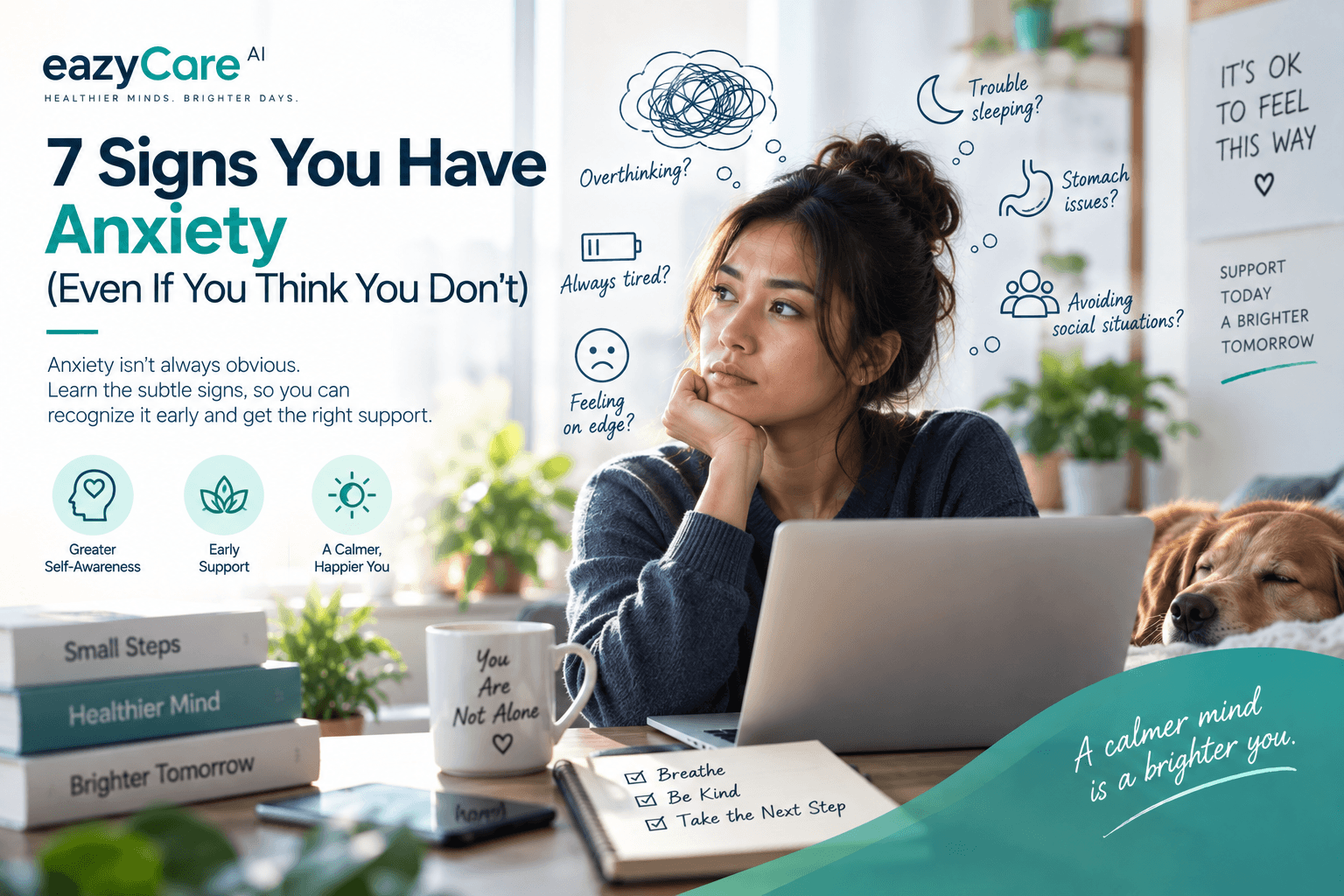
Anxiety is a chronic condition where your brain's threat-detection system fires when there is no actual physical danger, and it affects an estimated 301 million people globally—including roughly 4.4% of Southeast Asia's population. It is not just "feeling stressed" or "overthinking"; it is a systemic disorder that alters your sleep, digestion, heart rate, and behaviour, often without you ever consciously feeling "anxious." This article outlines the 7 signs you have anxiety even when you think you don't, why they are frequently dismissed in Asian cultures, and what to do about it.
Key Takeaways
- Anxiety often manifests as physical symptoms (chest tightness, fatigue, IBS) rather than psychological worry, especially in Southeast Asian patients.
- High-functioning anxiety is a real phenomenon where you appear successful externally but are in a constant state of internal hyperarousal.
- The treatment gap for anxiety in Southeast Asia exceeds 90% in many areas, but effective, low-cost treatments exist—starting with recognising the signs.
- Untreated anxiety increases your risk of cardiovascular disease by 1.5 to 2 times, making early recognition a physical health priority, not just a mental one.
Why You Might Be Missing the Signs You Have Anxiety
You wake up at 3:47 AM with your heart pounding. Your jaw is clenched so tight that your temples ache. You've cancelled another lunch with friends because you feel "too tired," but you can't actually relax on your day off. If you live in Kuala Lumpur, Singapore, or Jakarta, you probably call this "stress" or "just the way I am." But here is the clinical reality: if your body is in a state of alarm more days than not, you are likely experiencing an anxiety disorder—even if your mind never consciously says "I am worried."
In Southeast Asia, this disconnect is amplified by culture. We are taught to endure, to perform, and to prioritise family reputation over personal discomfort. The term masuk angin (literally "wind entering the body") is often used to describe a constellation of symptoms—fatigue, muscle aches, chills, and stomach issues—that are textbook physical manifestations of chronic anxiety. Similarly, the pressure of kiasu culture (the fear of missing out or losing) in Singapore and Malaysia drives a relentless pursuit of achievement that masks underlying hyperarousal. This article is not a lecture on "positive thinking." It is a clinical breakdown of the 7 signs you have anxiety, backed by global data, and tailored to the realities of living in this region. If you are a professional or a parent who feels like you are constantly running on empty, this is for you.
We will also explore practical, low-cost coping strategies that work within our context—from breathing techniques you can do at your desk to knowing exactly when to visit a Klinik Kesihatan or a private specialist. And if you are unsure where to start, EazyCare AI's symptom checker can help you assess your symptoms privately before you decide on next steps.
Because anxiety often masquerades as physical discomfort, understanding common chest pain causes can help you distinguish between a panic response and a cardiac issue.
Physical symptoms like tension headaches can also stem from other underlying issues, so explore headache causes beyond stress to understand the full picture.
Hidden Signs of Anxiety: The Physical Symptoms You Can't Ignore
Anxiety is not a purely psychological phenomenon; it is a full-body experience. When your brain perceives a threat—real or imagined—it activates the sympathetic nervous system, flooding your body with adrenaline and cortisol. According to Harvard Health Publishing, this "stress response" is designed for short-term survival, not chronic activation. When this system stays on, it begins to degrade your body. A 2017 review in PubMed (PMC5573566) highlighted that up to 80% of patients with anxiety present with somatic (physical) complaints rather than psychological ones.
In Southeast Asia, these physical signs are frequently misattributed. A patient might visit a general practitioner complaining of masuk angin—a feeling of bloating, muscle aches, and fatigue—and receive a prescription for wind medication, when the root cause is actually Generalised Anxiety Disorder (GAD). The most common physical signs include:
- Chronic muscle tension: Especially in the jaw, neck, and shoulders. This is your body bracing for impact that never comes.
- Gastrointestinal distress: Diarrhoea, constipation, or Irritable Bowel Syndrome (IBS). The gut has its own nervous system (the enteric nervous system) that is highly sensitive to stress hormones.
- Cardiovascular symptoms: Palpitations, chest tightness, and shortness of breath. This is often the most frightening symptom, leading many to believe they are having a heart attack.
- Fatigue and insomnia: You are exhausted, but your mind will not shut off. This is due to elevated cortisol levels disrupting your sleep architecture.
Practical takeaway: If you have visited a doctor for these symptoms and been told "it's all in your head," seek a second opinion. Ask specifically about an anxiety screening. Your physical health depends on it—untreated anxiety raises your risk of hypertension and heart disease by 1.5 to 2 times.
Your gut produces 90% of your body's serotonin, a neurotransmitter that regulates mood. When anxiety disrupts your gut microbiome, it creates a feedback loop: anxiety causes gut issues, and gut issues worsen anxiety. This is why digestive problems are often the first sign you have anxiety, not the last.
High-Functioning Anxiety Signs: The Cost of "Kiasu" Culture
You are the person who gets the promotion, runs the household, and still finds time to exercise. On paper, you are thriving. Internally, you are running a marathon at a sprint pace. This is the paradox of high-functioning anxiety: it looks like success from the outside, but it is driven by a relentless internal critic and a fear of failure that never switches off.
In Singapore and Malaysia, this is often fuelled by kiasu culture—the fear of losing out. While this cultural trait drives economic success, it also normalises chronic overwork. A 2023 report by the World Health Organization noted that in high-achieving Asian societies, the pressure to perform is a significant contributor to the 4.4% prevalence of anxiety disorders in the region. High-functioning anxiety signs include:
- Over-preparation: You rehearse conversations, create multiple backup plans, and cannot delegate because "no one does it as well as you."
- Procrastination followed by panic: You wait until the last minute to start tasks because the adrenaline rush of a deadline is the only time you feel "on."
- Inability to switch off: Even on holiday, you check work emails. Your mind is a loop of "what ifs" and "should haves."
- People-pleasing: You say "yes" to every request because the fear of disappointing someone feels worse than the exhaustion of overcommitting.
Practical takeaway: If you recognise these patterns, you are not lazy or weak—you are in a state of chronic hyperarousal. The first step is to schedule "worry time" into your day. Set aside 15 minutes to write down all your anxieties, and when they arise outside that window, tell yourself you will address them later. This is a cognitive behavioural technique that helps break the loop.
"High-functioning anxiety is a silent epidemic. It is the executive who has a panic attack in the bathroom before a board meeting, or the mother who lies awake at 3 AM planning her children's futures because she is terrified of failure."
— Dr. Tan Wei Leong, Clinical Psychologist, Singapore
Anxiety vs Stress Symptoms: How to Tell the Difference
The line between stress and anxiety is blurry, but the distinction matters for treatment. Stress is a response to an external trigger—a deadline, a fight with your spouse, a looming exam. It resolves when the trigger resolves. Anxiety, on the other hand, is a persistent state of worry that continues even after the stressor is gone, and it often has no identifiable trigger at all.
Here is a clinical way to differentiate: Stress is about the present; anxiety is about the future. If you are worried about a specific event (e.g., a performance review), that is stress. If you are worried about the possibility of a bad performance review months in advance, and you cannot stop thinking about it, that is anxiety. According to the National Institute of Mental Health (NIMH), anxiety disorders involve "excessive, persistent worry that interferes with daily activities."
In Southeast Asia, this distinction is often lost because of the high baseline of stress. We live in cities with heavy traffic, high living costs, and demanding jobs. But the key question is: Is your baseline returning to normal? If you find that you are constantly waiting for the other shoe to drop—even during peaceful moments—you are likely dealing with anxiety, not just stress.
| Factor | Stress (Normal Response) | Anxiety (Disorder) |
|---|---|---|
| Trigger | Specific, identifiable external event | Often vague or non-existent; persists regardless of circumstances |
| Duration | Short-term; resolves when stressor ends | Long-term; lasts for months and interferes with daily life |
| Physical Symptoms | Muscle tension, headaches, fatigue | Chronic pain, IBS, palpitations, insomnia, panic attacks |
| Behavioural Impact | Mild impairment; still functions normally | Avoidance of situations, significant impairment in work/social life |
Practical takeaway: Track your symptoms for two weeks. Note the trigger, the intensity, and the duration. If your symptoms persist for more than 14 days and occur more days than not, this is a strong indicator that you are dealing with an anxiety disorder, not just stress.
Anxiety Symptoms in Adults: The Avoidance and Safety Behaviours
One of the most common—and most overlooked—signs you have anxiety is avoidance. You might not feel "anxious" because you have structured your entire life to avoid triggering situations. This is called the avoidance cycle, and it is the fuel that keeps anxiety alive.
Examples include declining social invitations because they drain you, taking a longer route to work to avoid a stressful intersection, or delegating phone calls to a partner because speaking to strangers makes your heart race. In the short term, avoidance works—it reduces anxiety immediately. But in the long term, it reinforces the belief that the situation is dangerous, making the anxiety worse.
In the context of Southeast Asian families, this often manifests as "saving face." You might avoid discussing your struggles with family because you fear being a burden or being judged. This isolation is a significant risk factor. A study in the Lancet found that social support is a critical buffer against anxiety, and the lack of it—common in expat-heavy cities like Singapore where families are often far away—can exacerbate symptoms.
Avoidance is the number one predictor of chronic anxiety. Every time you avoid a situation, you teach your brain that the situation is dangerous. This is why anxiety tends to get worse over time if left untreated. If you find yourself saying "I'll do it when I feel better," that is the anxiety talking.
Practical takeaway: Start a "Bravery Log." List one small thing you have been avoiding each day and do it. It doesn't have to be big—calling a friend, asking a question in a meeting, or taking the stairs instead of the lift. The goal is to break the cycle of avoidance and prove to your brain that you can handle discomfort.
Poor sleep also amplifies these symptoms, so recognizing the signs your body needs more sleep is key to breaking the cycle.
The 3 AM Problem: How Anxiety Disrupts Your Sleep Architecture
If you are waking up at 3:00 AM or 4:00 AM with a racing heart and a mind full of worries, you are experiencing a classic sign of anxiety. This is not insomnia in the traditional sense; it is a cortisol spike. Your body releases cortisol in a 24-hour cycle, and for people with anxiety, the peak occurs earlier in the morning, pulling you out of deep sleep into a state of hyperarousal.
This is a vicious cycle. Lack of sleep impairs the prefrontal cortex—the part of the brain that regulates emotion—making you more anxious the next day. This is why anxiety and insomnia are so often comorbid. According to a 2023 study in the Journal of Clinical Sleep Medicine, up to 50% of adults with anxiety also meet the criteria for insomnia.
If this pattern sounds familiar, you may be dealing with sleep anxiety, a specific form that deserves closer attention.
In Southeast Asia, the problem is compounded by the "always-on" culture. You are likely checking your phone in bed, responding to work messages, and scrolling through social media. The blue light from your screen suppresses melatonin, the sleep hormone, making it even harder to fall asleep and stay asleep.
Step 1: Create a "Brain Dump" ritual. 30 minutes before bed, write down every worry, task, and thought on paper. This signals to your brain that the "mental load" is stored safely and you don't need to ruminate.
Step 2: Use the 4-7-8 Breathing Technique. Inhale for 4 seconds, hold for 7 seconds, and exhale slowly for 8 seconds. This activates the parasympathetic nervous system, lowering your heart rate. Apps like Calm or Headspace have guided versions, but you can do this anywhere.
Step 3: Set a "digital curfew." Stop using screens 60 minutes before bed. If you must use your phone, switch to night mode or use a blue-light filter. This is non-negotiable for regulating your circadian rhythm.
Practical takeaway: If you are waking up at 3 AM, do not lie in bed for more than 20 minutes. Get up, go to another room, and do a quiet activity (read a book, listen to a podcast) in dim light until you feel sleepy. This prevents your brain from associating your bed with wakefulness.
Anxiety Signs in Southeast Asia: "Masuk Angin" and the Stigma Barrier
In Southeast Asia, anxiety is often expressed through the body, not the mind. This is known as somatisation. Instead of saying "I feel anxious," a patient might say "I have masuk angin" (wind entering the body) or "I feel lemah" (weak). This is not a linguistic quirk; it is a cultural phenomenon. A 2021 study in the Asian Journal of Psychiatry found that Southeast Asian patients are more likely to report somatic symptoms of anxiety than their Western counterparts, who are more likely to report psychological symptoms.
This has significant implications for treatment. When you visit a doctor with chest pain and fatigue, the doctor might run a battery of physical tests, find nothing wrong, and send you home. But the anxiety is still there, wreaking havoc on your body. The WHO notes that in low- and middle-income countries, only 1 in 4 people with anxiety receive treatment, and in many Southeast Asian countries, the treatment gap exceeds 90%. This is due to a combination of stigma, lack of awareness, and a shortage of mental health professionals.
The stigma is real. In many Asian families, mental health issues are seen as a sign of weakness or a source of shame. This prevents people from seeking help until the symptoms become unbearable. If you are reading this and recognising these signs in yourself, please understand: Anxiety is a medical condition, not a character flaw. It is as biological as diabetes or hypertension.
Somatisation is the process by which psychological distress is converted into physical symptoms. In Southeast Asia, this is the norm rather than the exception. If you have been to multiple doctors for physical complaints and all tests come back normal, it is worth asking for an anxiety screening.
Practical takeaway: When you speak to a doctor, be specific about your symptoms and their duration. Say, "I have had chest tightness and fatigue for the past three months, and it is affecting my sleep." This helps the doctor consider anxiety as a differential diagnosis. If you are in Malaysia, you can visit a Klinik Kesihatan (government clinic) for a subsidised consultation, or use a private GP if you prefer more privacy. For immediate emotional support, Befrienders Malaysia (03-7627 2929) offers free, confidential counselling.
When Anxiety Becomes a Disorder: The 5 Signs You Can't Miss
So, how do you know if your anxiety has crossed the line from a normal human emotion to a clinical disorder? According to the DSM-5 (the diagnostic manual used by psychiatrists), an anxiety disorder is characterised by excessive fear and worry that is difficult to control and causes significant distress or impairment in social, occupational, or other important areas of functioning. Here are the 5 signs you have anxiety that has become a disorder:
- Excessive worry more days than not for at least 6 months. This is the hallmark of Generalised Anxiety Disorder (GAD).
- Physical symptoms that are persistent and unexplained. This includes chronic fatigue, muscle tension, and sleep disturbance.
- Avoidance of situations that cause anxiety. This is a key indicator that anxiety is driving your life.
- Difficulty concentrating or your mind going blank. This is due to the cognitive load of worry.
- Irritability or restlessness. You feel on edge, and small things make you snap.
If you have experienced these symptoms for more than six months, it is time to seek professional help. The good news is that anxiety is highly treatable. According to the WHO, effective treatments include Cognitive Behavioural Therapy (CBT), which has a success rate of 60-80%, and Selective Serotonin Reuptake Inhibitors (SSRIs), which are effective for 50-70% of patients.
Practical takeaway: Do not wait for a crisis. The earlier you seek treatment, the better the outcome. If you are unsure where to start, EazyCare AI's symptom checker can help you assess your symptoms privately and provide a preliminary risk assessment. You can also book a consultation with a mental health professional through our platform.
Frequently Asked Questions
What are the hidden signs of anxiety?
Hidden signs of anxiety are often physical and behavioural rather than psychological. These include chronic fatigue, muscle tension (especially in the jaw and neck), digestive issues like IBS, irritability, difficulty concentrating, and avoidance of social situations. In Southeast Asia, these are often dismissed as masuk angin or "just stress." If you have persistent physical symptoms with no clear medical cause, anxiety could be the underlying issue.
Can you have anxiety without knowing it?
Yes, absolutely. Many people live with anxiety for years without recognising it because they have normalised their symptoms as "just the way I am." You might think everyone feels a knot in their stomach before a meeting or lies awake at night replaying conversations. However, when these symptoms become chronic and interfere with your daily life, they are signs of an anxiety disorder. The fact that you are researching this suggests you might be experiencing it.
What does high-functioning anxiety feel like?
High-functioning anxiety feels like being on a treadmill that never stops. You appear successful and calm on the outside, but internally, you are in a state of constant hyperarousal. You are a perfectionist who is terrified of failure, you struggle to switch off, and you feel a constant sense of impending doom. You might procrastinate until the last minute because the adrenaline rush of a deadline is the only time you feel in control. It is exhausting and unsustainable.
How do I know if I have anxiety or just stress?
Stress is a response to an external trigger and resolves when the trigger is gone. Anxiety is a persistent state of worry that continues even without a clear trigger. If you are worried about a specific event, that is stress. If you are worried about the possibility of something bad happening in the future, and you cannot stop thinking about it, that is anxiety. If your symptoms last for more than two weeks and occur more days than not, it is likely anxiety.
What are the physical symptoms of anxiety?
Physical symptoms of anxiety include chest tightness, palpitations, shortness of breath, chronic fatigue, muscle tension, headaches, dizziness, and gastrointestinal issues like diarrhoea or constipation. These symptoms are caused by the activation of the sympathetic nervous system, which releases adrenaline and cortisol. If you have visited a doctor for these symptoms and been told there is nothing wrong, anxiety is a likely cause. EazyCare AI's symptom checker can help you assess these symptoms.
Can anxiety cause chest pain?
Yes, anxiety can cause chest pain. This is often due to muscle tension in the chest wall or hyperventilation, which can cause the chest to feel tight and painful. However, because chest pain can also be a sign of a heart attack, it is essential to rule out cardiac causes first. If you experience chest pain accompanied by shortness of breath, sweating, or pain radiating down your left arm, call 999 or go to the emergency department immediately.
When should I see a doctor for anxiety?
You should see a doctor if your anxiety is interfering with your daily life—if it is affecting your sleep, your work, or your relationships. You should also seek help if you are experiencing physical symptoms like chest pain, or if you are using alcohol or drugs to cope. In Malaysia, you can visit a Klinik Kesihatan for a subsidised consultation, or a private GP for more privacy. If you are having thoughts of self-harm, call Befrienders Malaysia at 03-7627 2929 immediately.
How can I tell if my anxiety is a disorder?
Anxiety becomes a disorder when it is excessive, persistent, and interferes with your ability to function. This includes having difficulty controlling your worry, avoiding situations that trigger anxiety, and experiencing significant distress in social or occupational settings. If you have had symptoms for more than six months, it is likely an anxiety disorder. The good news is that it is highly treatable with CBT and/or medication.
What are the 5 signs of an anxiety disorder?
The 5 key signs are: 1) Excessive worry more days than not for at least 6 months. 2) Persistent physical symptoms like fatigue, muscle tension, and sleep disturbance. 3) Avoidance of anxiety-provoking situations. 4) Difficulty concentrating or mind going blank. 5) Irritability and restlessness. If you recognise these signs in yourself, it is time to seek professional help. Early intervention leads to better outcomes.
Is anxiety a mental illness?
Yes, anxiety disorders are a group of mental illnesses characterised by excessive fear and worry. They are the most common mental health conditions globally, affecting 4.1% of the population. However, having anxiety is not a sign of weakness, and it is not something you can just "snap out of." It is a medical condition that requires treatment, just like diabetes or hypertension. With the right support, most people recover fully.
When to See a Doctor
While anxiety is treatable, there are certain red flags that require immediate medical attention. Do not ignore these signs:
- Suicidal thoughts or self-harm: If you are having thoughts of harming yourself, this is a medical emergency. Call Befrienders Malaysia at 03-7627 2929 or go to the nearest emergency department.
- Chest pain with shortness of breath: This could be a heart attack. Call 999 immediately.
- Severe panic attacks: If you experience a racing heart, sweating, trembling, and a feeling of impending doom that lasts for more than 10 minutes, seek medical help.
- Inability to eat or sleep for several days: This can lead to severe health complications.
- Substance abuse: If you are using alcohol, drugs, or medication to cope with your anxiety, this is a sign you need professional help.
Call 999 or go to the nearest emergency department if you are experiencing chest pain, difficulty breathing, or thoughts of self-harm. If you are unsure whether your symptoms warrant a visit to the doctor, EazyCare AI can help you decide whether you need urgent care.
Conclusion
Anxiety is a silent epidemic, but it is not a life sentence. Here are the three most important takeaways from this article:
- Anxiety is physical, not just mental. If you have chronic fatigue, chest tightness, or digestive issues with no clear medical cause, anxiety is a likely culprit. Do not dismiss it as masuk angin.
- High-functioning anxiety is real and exhausting. The pressure to succeed in kiasu culture can mask a serious disorder. Recognising the signs is the first step to recovery.
- Treatment works, but you have to seek it. With a treatment gap exceeding 90% in some Southeast Asian countries, you have to be your own advocate. Start with a visit to your local clinic, or use a digital tool to assess your symptoms.
You do not have to live in a state of constant hyperarousal. Whether you are a busy professional in Singapore or a parent in a small town in Malaysia, help is available. Learn more at eazycare.ai or chat with our AI health assistant to get a private, confidential assessment of your symptoms. Your mental health is not a luxury—it is a necessity.
