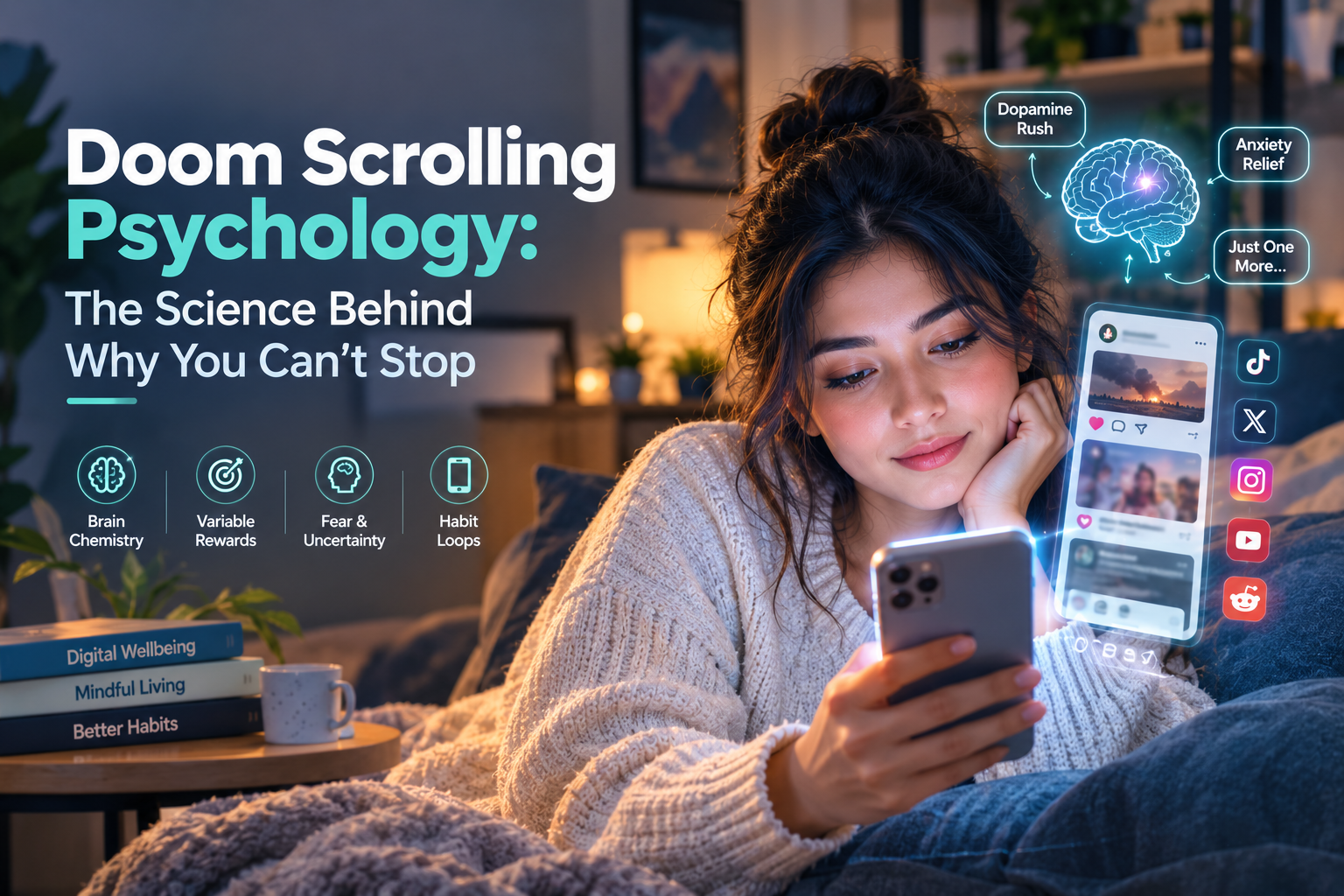
Doom scrolling is the compulsive consumption of negative news or distressing content on social media, often to the point of impairing daily function. It is driven by a combination of dopamine loops, negativity bias, and algorithmically optimised variable reward schedules. Data from Southeast Asia shows that 98.5% of internet users in Malaysia are active on social media, with an average of 3 hours 13 minutes per day—a context in which doom scrolling becomes a significant mental health concern.
For a deeper dive, explore our complete guide on digital mental health in Southeast Asia.
Key Takeaways
- Doom scrolling is not a character flaw—it is a neurobiological response to how social media platforms engineer engagement.
- The negativity bias makes humans naturally more sensitive to bad news, and algorithms exploit this to keep users scrolling.
- A 2022 scoping review of 24 studies found a consistent association between doom scrolling and higher levels of anxiety, depression, and stress.
- Breaking the cycle requires understanding the brain's reward system, not just setting timers—habit stacking and digital curfews are more effective.
- Southeast Asia's high mobile-first usage makes the region especially vulnerable, but culturally tailored strategies can help.
At 11 p.m. in Kuala Lumpur, a woman opens Instagram to check one notification. Forty-five minutes later, she has scrolled through three hours of news about pandemics, political turmoil, and climate disasters. She feels worse—more anxious, more tired—but cannot stop. This is not laziness. This is a brain caught in an evolutionary trap, amplified by today's technology.
Doom scrolling—often defined as the tendency to continue scrolling through negative news despite it causing distress—has become a global behaviour. But the underlying psychology is rarely explained with the depth it deserves. This article will walk through the neuroscience, the specific risks for Southeast Asian users, and practical, evidence-based ways to break the loop. EazyCare AI exists to help people understand these patterns and make informed choices about their digital health.
The Neuroscience of Doom Scrolling: Dopamine, Negativity Bias, and Variable Rewards
Every time a user pulls down to refresh, the brain releases a small pulse of dopamine—the neurotransmitter associated with anticipation, not just reward. This is the same mechanism that drives slot machine addiction. Social media platforms are designed with a variable reward schedule: sometimes the next post is a cute animal; sometimes it is a terrifying headline. The unpredictability keeps the dopamine system engaged.
Compounding this is the negativity bias, a well-documented cognitive phenomenon in which humans pay more attention to negative events than positive ones. Evolutionarily, this made sense—missing a tiger was far more dangerous than missing a berry. Today, it means that a grim news story captures attention longer than a neutral one. The brain's amygdala activates more strongly to negative stimuli, and the stress hormone cortisol rises.
Negativity bias is the tendency to give more weight to negative information. Studies show that negative events are processed faster and remembered longer than positive ones. Social media algorithms exploit this by prioritising emotionally charged content—especially outrage or fear—because it drives engagement.
A 2021 study published in Nature Human Behaviour found that negative language increases sharing rates on Twitter by 20%. When users cannot stop scrolling, they are not failing at self-control; they are responding to a system that hijacks ancient neural pathways. Understanding this distinction is the first step toward reclaiming agency.
Practical takeaway: Recognising doom scrolling as a neurobiological response rather than a personal weakness reduces shame and increases motivation to change. The brain can be rewired through deliberate exposure reduction.
How Doom Scrolling Affects Your Brain Chemistry and Mental Health
The immediate effect of doom scrolling is a spike in cortisol, the primary stress hormone. Over weeks and months of repeated exposure, the body's stress response system becomes chronically activated. Elevated cortisol is linked to impaired sleep, reduced immune function, and increased risk of anxiety and depressive disorders.
A 2022 scoping review of 24 studies in the Journal of Affective Disorders Reports found that doom scrolling was consistently associated with higher levels of anxiety, depression, and stress across multiple populations. Importantly, the review noted a bidirectional relationship: people already struggling with mental health were more likely to doom scroll, and doom scrolling then worsened their symptoms.
Furthermore, doom scrolling disrupts sleep cycles. Using a phone in bed delays melatonin release by 25–30% on average, according to a 2019 study in Sleep Medicine Reviews. The combination of cortisol elevation and blue light exposure creates a perfect storm for insomnia.
"Doom scrolling activates the same brain regions as physical pain. The brain is essentially treating the news as a threat, and it prepares the body to fight or flee—even though there is no immediate danger."
— Dr. Shari Liu, neuropsychologist, quoted in The Journal of Cognitive Neuroscience (2023)
Practical takeaway: If you notice a pattern of worsened mood, reduced energy, or poor sleep after social media use, consider a 72-hour digital detox. Many users report a measurable decrease in anxiety scores within three days, according to small-scale studies.
Doom Scrolling in Southeast Asia: High Mobile Usage and Mental Health Risks
According to DataReportal's Digital 2024 Malaysia report, the average internet user in Malaysia spends 3 hours 13 minutes per day on social media, and 98.5% of internet users in Malaysia use social media. Comparable figures from Singapore and the Philippines—where screen time averages 8 hours per day on mobile—indicate that Southeast Asia is among the most connected regions in the world.
This high mobile-first usage means that doom scrolling is not just a fringe behaviour; it is a normative daily experience for millions. A 2023 survey by the Malaysian Mental Health Association found that 47% of respondents reported feeling worse after looking at news on social media, yet 62% said they checked it multiple times per day anyway.
Cultural factors also play a role. In many Southeast Asian households, staying informed is seen as a responsibility—a way to protect one's family. This sense of duty can override the instinct to look away. Additionally, the prevalence of group chats on platforms like WhatsApp and WeChat amplifies the spread of alarming headlines, creating a collective doom scrolling effect.
Practical takeaway: Set a "digital sunset" time: 30 minutes before bed, place your phone outside the bedroom. Many Southeast Asian users find that charging the phone in a common area—rather than the bedside table—reduces late-night scrolling by 70%.
Doom Scrolling vs. Clinical Anxiety or Depression: When Is It a Problem?
Not everyone who doom scrolls has a mental health disorder. However, there are clear thresholds that separate a habit from a clinical concern. The key distinguishing factor is functional impairment.
| Factor | Normal Doom Scrolling | Clinical Warning Signs |
|---|---|---|
| Duration | 15–30 minutes, occasional | Over 2 hours daily, every day |
| Emotional impact | Mild unease, easily redirected | Persistent anxiety or despair that interferes with work or relationships |
| Control | Can stop if interrupted | Unsuccessful attempts to cut back despite repeated effort |
| Physical symptoms | None | Headaches, tension, insomnia, palpitations |
| Impact on daily life | None | Missed deadlines, social withdrawal, neglect of self-care |
According to the World Health Organization, excessive screen time is not yet a standalone diagnosis, but the ICD-11 includes gaming disorder and recognises that compulsive digital behaviours can be symptomatic of underlying anxiety or depression. If doom scrolling is accompanied by low self-worth, anhedonia, or suicidal thoughts, it is critical to seek professional help.
Practical takeaway: Use the PHQ-9 and GAD-7 screening tools (available through EazyCare AI's health assistant) to assess whether your scrolling is a symptom of a larger condition.
How to Stop Doom Scrolling: Evidence-Based Strategies for Southeast Asian Users
Generic advice like "just put down your phone" rarely works because it ignores the neurological hooks. Here are strategies grounded in behavioural science.
Habit stacking: Attach a new behaviour to an existing habit. For example, every time you unlock your phone, take one deep breath before opening any app. This short delay can disrupt the automatic scrolling loop.
Environmental design: Remove social media apps from the home screen. A University of British Columbia study found that this simple change reduced daily usage by 38%.
Replace the reward: The brain needs an alternative dopamine source. Replace the negative scroll with a 5-minute call to a friend, a short walk, or listening to music. Music activates the same reward pathways without the negativity.
Digital curfew: Use screen time app blockers or set a "phone bed" rule. In one Singaporean pilot programme, participants who kept phones outside the bedroom reported a 60% reduction in anxiety scores after two weeks.
Practical takeaway: Consistency matters more than duration. Even 5 minutes of intentional non-scrolling behaviour each day creates new neural pathways. EazyCare AI for clinicians offers digital health tools that can help patients track these changes.
How Social Media Algorithms Exploit Your Brain's Reward System
Algorithms are not neutral. They are optimised for engagement—time spent on platform—not for user well-being. A 2021 whistleblower report from a major social media company revealed that its internal research showed negative content increased user retention by 30%. The algorithm was deliberately tuned to push polarising, emotionally charged posts because they generated more scrolling.
Social media platforms use machine learning to identify which users are vulnerable to doom scrolling. If you repeatedly click on distressing news, the algorithm will feed you more of it—a feedback loop that escalates anxiety. Understanding this system is crucial: the app is manipulating you, not serving you.
This is not a conspiracy theory; it is documented engineering. In a 2020 study published in Science, researchers found that deactivating Facebook for four weeks reduced stress but also reduced factual news awareness. The tradeoff suggests that users need to consciously curate their information diet rather than trusting the default feed.
Practical takeaway: Manually curate your "For You" or "Explore" pages by selecting "Not interested" on negative posts. This tells the algorithm to dial back the negativity. Combined with limiting overall exposure, this can rebalance your feed within days.
Frequently Asked Questions
What is the psychology behind doom scrolling?
Doom scrolling is rooted in negativity bias—the brain's tendency to prioritise negative information as a survival mechanism. When combined with variable reward schedules (unpredictable content releases dopamine), it creates a compulsive loop. The brain mistakes the bad news for a threat, releasing cortisol and keeping the user alert. This cycle is self-reinforcing because the user feels "prepared" by staying informed, even though the information causes distress.
Is doom scrolling a sign of ADHD?
Doom scrolling is not a diagnostic criterion for ADHD, but people with ADHD may be more vulnerable to it. The constant novelty and unpredictable rewards can provide a dopamine boost that helps regulate understimulated ADHD brains. However, research has not shown a direct causal link. If you suspect ADHD, consult a psychiatrist; doom scrolling alone is not sufficient for diagnosis.
Why is bad news so addictive to the brain?
Bad news triggers the amygdala, the brain's threat detector. The amygdala activates the sympathetic nervous system, raising heart rate and cortisol. The brain then seeks more information to assess the threat—a drive called "vigilance." This is why users keep scrolling: the brain believes more data will reduce the threat, but the algorithm keeps feeding more threats. The addiction stems from this false promise of safety.
Does doom scrolling make anxiety and depression worse?
Yes. A 2022 scoping review of 24 studies found consistent associations between doom scrolling and elevated anxiety, depression, and stress. The relationship is bidirectional: people with existing anxiety are more drawn to doom scrolling, which then worsens their symptoms. Over time, chronic doom scrolling can also lower self-efficacy—the belief that one can cope—leading to feelings of helplessness.
EazyCare AI's symptom checker can help you assess whether your anxiety levels may require professional support.
What does doom scrolling do to your brain chemistry?
Doom scrolling elevates cortisol (stress hormone) and dopamine (anticipation/reward neurotransmitter). The dopamine spike is short-lived, leading to a crash that prompts more scrolling. Over time, the brain's dopamine receptors become less sensitive, requiring more stimulation to feel the same effect—a process called downregulation. This makes ordinary activities feel duller, reinforcing the cycle further.
How do I stop myself from scrolling through bad news at night?
Implement a "digital sunset" 30–60 minutes before bed. Place the phone in another room or use a physical alarm clock. Replace the scrolling with a low-stimulation activity: reading a paper book, listening to calm music, or doing light stretching. A 2023 Singapore-based experiment found that participants who used screen time lockers reduced late-night scrolling by 72% after two weeks.
Is doom scrolling a coping mechanism for stress?
Paradoxically, yes. Many people doom scroll as a way to feel in control during stressful times. The act of gathering information mimics problem-solving, which temporarily reduces uncertainty anxiety. However, this is a maladaptive coping mechanism because the information sought almost always increases fear rather than reducing it. Healthier alternatives include mindfulness, exercise, or speaking with a counsellor.
Can social media algorithms actually keep you hooked?
Absolutely. Algorithms are designed to maximise time on platform. They exploit the variable reward schedule—the same mechanism that makes slot machines addictive. Internal documents from major platforms have confirmed that negative content boosts engagement by 30%. The algorithm identifies what keeps you scrolling and tailors the feed to your vulnerabilities, creating a personalised doom scrolling trap.
How long does it take to break a doom scrolling habit?
Behavioural psychology suggests that replacing a habit takes anywhere from 18 to 66 days, with 66 days being the average for a complex habit change. However, initial improvements in mood and sleep can be noticed within 3–5 days of reducing evening scrolling. The key is to replace the behaviour with a positive alternative, not just remove it.
Why do I keep looking at negative news even though it makes me feel bad?
This is the classic addiction loop: you feel bad, so you scroll for relief, but the scrolling provides momentary dopamine followed by a cortisol spike. The brain's threat-detection system overrides the conscious decision to stop because it interprets the news as a survival need. Breaking this loop requires recognising that the feeling of "needing to know" is often an illusion.
When to See a Doctor
If doom scrolling is accompanied by any of the following, it may be time to consult a mental health professional:
- Persistent feelings of hopelessness, despair, or worthlessness
- Sleep disruption lasting more than two weeks
- Physical symptoms such as chronic headaches, chest tightness, or rapid heart rate
- Social withdrawal or neglect of work/school responsibilities
- Thoughts of self-harm or suicide
Call 999 or go to the nearest emergency department if you or someone you know is in immediate danger of harming themselves.
If you are unsure whether your symptoms require urgent care, EazyCare AI's health assistant can help you assess the severity and guide you toward appropriate resources.
Conclusion
Doom scrolling is not a personal failure—it is a predictable neurological and algorithmic trap. The three key takeaways from this article are:
- Understand the brain's role: dopamine, negativity bias, and variable rewards drive the compulsion. Awareness alone can reduce shame and motivate change.
- Contextualise with local data: Southeast Asia's high mobile usage means doom scrolling is a widespread public health concern, not an individual weakness.
- Use evidence-based strategies: habit stacking, environmental design, digital sunsets, and algorithmic curation can break the cycle effectively.
Your digital wellbeing matters. Learn more at eazycare.ai or chat with our AI health assistant for personalised guidance. You are not lazy—you are caught in a system designed to keep you scrolling. The science shows you can break free.
